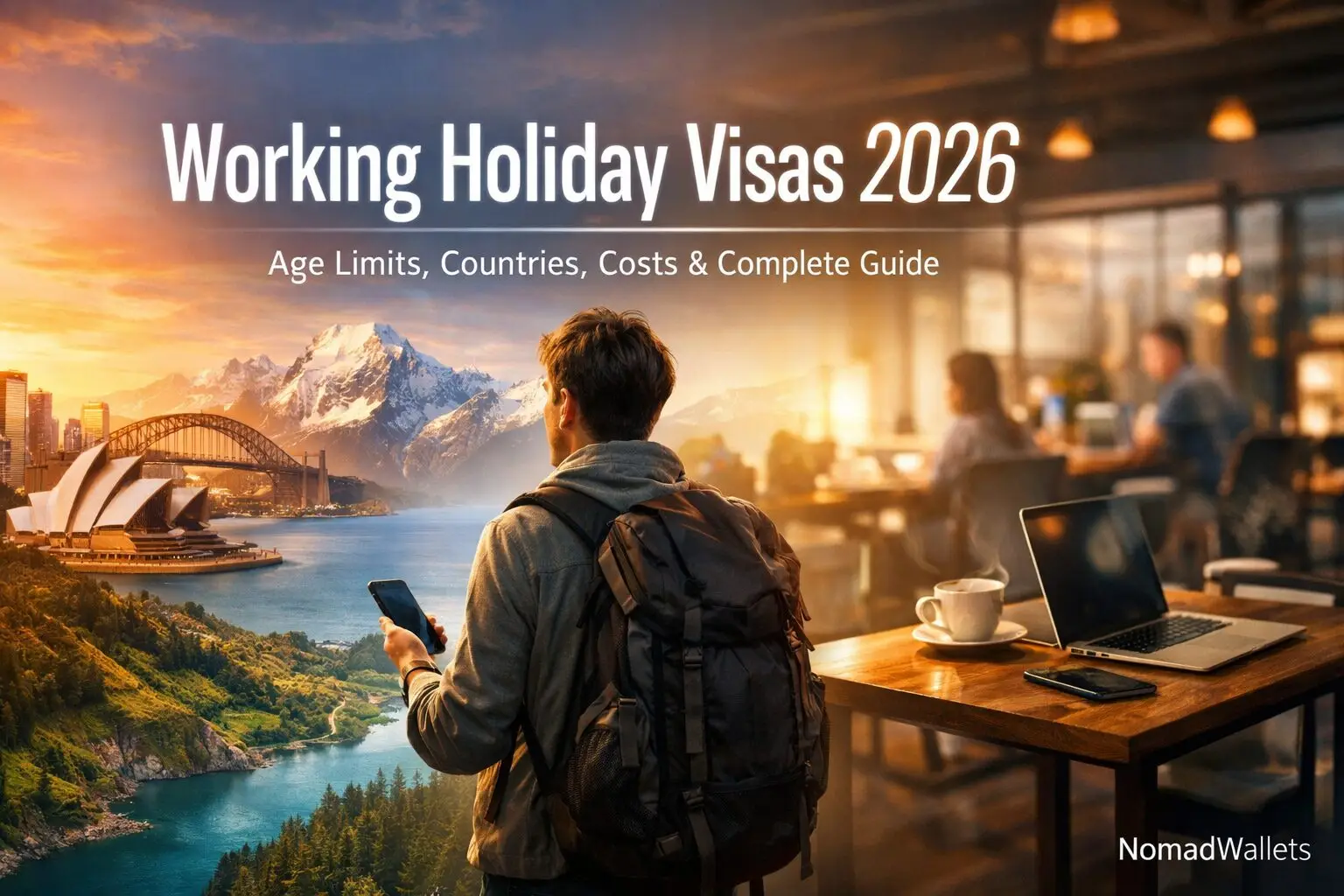
Working Holiday Visas: Ultimate Age Limits Guide for US Nomads (2025)

Working Holiday Visas modern world map, bold routes and traveler icons, for working holiday visas guide.
Table of Contents show

Introduction

Working holiday visas represent one of the most underutilized opportunities for young US digital nomads seeking international work experience. Unlike traditional work permits, working holiday visas allow Americans aged 18-35 to live, travel, and earn income in six different countries while experiencing cultural immersion. These age limited programs offer a unique pathway for recent graduates, freelancers, and location independent professionals to test international markets before committing to long term relocation. gooverseas

​US citizens can access working holiday visas in Australia, Ireland, New Zealand, Singapore, South Korea, and Canada, though each country imposes distinct age restrictions, financial requirements, and employment limitations according to official government immigration programs. Understanding these variations is critical for maximizing your international earning potential while staying compliant with immigration regulations. imigration

​This comprehensive guide covers everything from eligibility requirements and application processes to job hunting strategies, tax obligations, budgeting tips, and pathways to permanent residency equipping you with the complete roadmap for a successful working holiday experience. All information is sourced from official government immigration websites and verified as of November 2025.

What Are Working Holiday Visas?

Working holiday visas are temporary residence permits designed to facilitate cultural exchange while allowing young travelers to offset travel costs through temporary employment. The primary purpose is tourism with supplemental work rights, distinguishing these visas from traditional employment based permits that require employer sponsorship, according to the US State Department’s exchange visitor program documentation. gooverseas

Collage of global passports, age limits, and travel stamps representing working holiday eligibility.

Key Characteristics:

  • Age restrictions: Most working holiday visas require applicants to be between 18-30 years old at the time of application, with Canada extending eligibility to 35 according to official program guidelines
  • Duration: Typically valid for 12 months, with some countries offering extension options up to 3 years per Australian Department of Home Affairs
  • Work limitations: Employment with a single employer is usually capped at 6 months to encourage diverse experiences
  • Study allowances: Many working holiday visas permit short-term study (4-6 months) during your stay according to Immigration New Zealand and Australian immigration policy
  • Multiple entries: Most programs allow unlimited entries and exits during the validity period
  • Flexibility: Unlike J-1 exchange visas, working holiday visas don’t require program sponsors or specific educational components per US State Department comparisons

Countries Offering Working Holiday Visas to US Citizens

Australia (Subclass 462 Work & Holiday)

Australia’s working holiday visas are among the most popular options for Americans, offering robust earning potential and extension opportunities up to three years total according to the Australian Department of Home Affairs. US citizens apply under the Subclass 462 Work and Holiday visa program.

Official Eligibility Requirements (source: Australian Department of Home Affairs):

  • Age 18-30 years old (inclusive) at time of application you can apply until the day before your 31st birthday
  • Hold a valid US passport for at least 6 months beyond intended stay
  • Minimum AUD $5,000 (~USD $3,250) in savings to cover initial expenses
  • High school diploma or equivalent educational qualification
  • No dependent children accompanying you
  • Meet health and character requirements (may include chest x ray and police certificates)
  • No previous subclass 417 or 462 visa

Work & Study Rights (per Australian immigration law):

  • Work up to 6 months with any single employer
  • Study for up to 4 months
  • Unlimited employer changes and job types
  • No restrictions on casual versus professional employment

Extension Options (Australian Department of Home Affairs official policy):

Americans can extend working holiday visas for a second and third year by completing specified regional work during each visa period:

  • Second year: Complete 88 days (approximately 3 months) of specified work in regional Australia during your first visa
  • Third year: Complete 6 months of specified work in regional Australia during your second visa

Eligible industries include agriculture (fruit picking, farm work), construction in rural areas, fishing, mining, bushfire recovery, and hospitality in designated regional postcodes per Department of Home Affairs specifications.

Application Process (official requirements):

  • Apply online through ImmiAccount on the Department of Home Affairs website at immi.homeaffairs.gov.au
  • Application fee: AUD $635 (~USD $431) as of November 2024
  • Processing time: 14-79 days, with 75% processed within 17 days and 90% within 42 days according to official statistics
  • You have 12 months from grant date to enter Australia and activate your visa

Real-World Experience from US Applicant:

Sarah M., a 27-year-old from California who completed her working holiday visa in 2024, shared: “The application itself costs AU$485 [now $635] and you’ll want to have your documents in order so you can quickly get through the process. I submitted my application on November 6th, received a letter stating I needed to get a chest x ray on November 21st, and received my confirmation of approved visa on November 27th total time of 21 days”.

Ireland (Working Holiday Authorization)

Ireland’s program uniquely targets current college students and recent graduates rather than imposing strict age limits according to the Irish Department of Foreign Affairs. This makes working holiday visas accessible to older Americans who returned to education later in life or completed advanced degrees.

Official Eligibility Requirements (source: Irish Embassy & Consulates in the USA):

  • Currently enrolled in a post-secondary institution OR graduated within the past 12 months
  • Valid for associate’s, bachelor’s, master’s, or doctoral degree programs
  • No upper age limit any age eligible if meeting education criteria
  • Valid US passport
  • Minimum USD $1,500 in accessible funds
  • Medical/travel insurance coverage
  • CV and two professional references

Work & Study Rights (per Irish immigration policy):

  • Valid for up to 12 months
  • Work should be supplemental to travel (tourism focused)
  • Popular sectors: hospitality, tourism, agriculture, tech, childcare
  • No specific employer time restrictions

Application Process (official requirements):

  • Apply through nearest Irish consulate in the US (in person submission required)
  • Application fee: USD $270
  • Processing time: 4-8 weeks according to consulate processing standards

Unique Advantage: Ireland is the only working holiday visas program with no age ceiling, making it ideal for career changers, graduate students, and professionals returning to education.

New Zealand (Working Holiday Scheme)

New Zealand’s working holiday visas offer straightforward online applications with rapid processing times according to Immigration New Zealand (immigration.govt.nz).

Official Eligibility Requirements (source: Immigration New Zealand):

  • US citizen aged 18-30 years
  • Minimum NZD $4,200 (~USD $2,519) in accessible funds
  • Valid passport and comprehensive travel insurance
  • Return ticket or sufficient funds to purchase one
  • No previous New Zealand working holiday visa
  • Health and background checks

Work & Study Rights (per Immigration New Zealand policy):

  • Holiday for up to 12 months
  • Work in temporary jobs throughout the 12-month period
  • Study or train for up to 6 months total
  • Cannot accept permanent employment
  • Popular jobs: hospitality, outdoor recreation, adventure tourism, agriculture

Application Process (official requirements):

  • Apply online through Immigration New Zealand website at immigration.govt.nz
  • Application fee: NZD $670 (~USD $401) as of 2024
  • Processing time: 80% of applications processed within 2 weeks according to Immigration New Zealand statistics

Geographic Opportunities: Popular cities for working holiday visas include Auckland (one third of population), Christchurch, Wellington, and Hamilton.

Canada (International Experience Canada)

Canada accepts working holiday visas from US citizens aged 18-35 through the International Experience Canada (IEC) program, making it one of the few programs accommodating applicants over 30 according to official Government of Canada immigration policy.

Official Eligibility Requirements (source: Government of Canada – canada.ca/iec):

  • Age 18-35 years old
  • US citizenship and valid passport
  • Proof of CAD $2,500 (~USD $1,805) in funds
  • Sponsorship letter from Recognized Organization
  • Health insurance coverage
  • Biometrics and background checks

Work & Study Rights:

  • Valid for up to 12 months
  • Popular jobs: adventure sports, hospitality, farm work, retail
  • Opportunity to experience diverse provinces from Vancouver to Montreal

Application Process (official requirements):

  • Unique requirement: Cannot apply independently must go through government-authorized program providers like Interexchange, Global Work & Travel, or BUNAC
  • Total cost: USD $1,395-$1,695 depending on provider
  • Processing time varies by provider

Singapore (Work Holiday Programme)

Singapore offers a shorter 6 month working holiday visas primarily aimed at university students and young graduates seeking international internship experience according to Singapore’s Ministry of Manpower (mom.gov.sg).

Official Eligibility Requirements (source: Singapore Ministry of Manpower):

  • Age 18-25 years old
  • Current undergraduate student OR recent graduate
  • Valid US passport

Work & Study Rights:

  • Duration: 6 months (shortest among all working holiday visas programs)
  • Ideal for internships in tech, business, finance, and healthcare

Application Process (official requirements):

  • Apply online through Singapore’s Ministry of Manpower website at mom.gov.sg
  • Application fee: USD $175
  • Processing time: 3-4 weeks

South Korea (Working Holiday Program)

South Korea’s working holiday visas allow up to 18 months of living and working according to the Korean Embassy in the USA.

Official Eligibility Requirements (source: Korean Embassy & Consulates):

  • Age 18-30 years old
  • Valid US passport
  • Roundtrip flight ticket
  • Proof of funds: varies by consulate but can be upwards of USD $6,000
  • Copies of highest degree obtained or proof of student status
  • Activity plan and application

Work & Study Rights:

  • Duration: up to 18 months (longest among all working holiday visas programs)
  • Popular jobs: English copywriting, marketing, hostel work, hospitality
  • Teaching English NOT permitted on this visa
  • Internships often conducted in English

Application Process (official requirements):

  • Applications must be submitted in person at nearest Korean consulate in the US
  • Application fee: USD $45
  • Processing time: approximately 2 weeks after submission

Comparison of Working Holiday Visas by Country

Data sourced from official government immigration websites as of November 2025

Abstract infographic table with icons showing age, cost, and duration for working holiday visas.

*Must be enrolled student or graduated within 12 months per Irish Department of Foreign Affairs

Data verification: All fees, age limits, and processing times verified against official government immigration websites including immi.homeaffairs.gov.au, immigration.govt.nz, canada.ca/iec, mom.gov.sg, and respective embassy websites as of November 2025.

Benefits of Working Holiday Visas for Digital Nomads

Financial Flexibility

Working holiday visas eliminate the need for substantial savings by allowing you to earn income while exploring new destinations. Unlike tourist visas that prohibit employment, these programs legally permit temporary work to fund your travels.

Case Study – Financial Impact:

Marcus J., a 24 year old software developer from Texas, shared his Australia working holiday experience: “I arrived in Melbourne with AUD $6,000 in savings. Within two weeks, I found casual hospitality work paying AUD $28/hour. After three months, I transitioned to freelance web development earning AUD $50/hour. By the end of my 12 months, I had saved AUD $15,000 while traveling the east coast and working in Sydney. The visa literally paid for itself and funded my next year of travel”.

Market Testing

Digital nomads can use working holiday visas to test international markets before establishing foreign business entities or committing to permanent residency pathways. This is particularly valuable for freelancers and remote entrepreneurs exploring client bases in Australia, New Zealand, or Ireland.

​Benjamin Costes, who documented his working holiday experience, noted: “Of course it is up to you to insist on the ‘Working’ part of the visa during your experience. There is fierce competition and it is not always easy to find a job, so you have to be prepared”.

Professional Development

Working holiday visas provide opportunities to develop soft skills, adaptability, and cultural competency that employers value. Participants gain “professional experience, but, above all, learn about yourself and develop soft skills that you may need to find your dream job” according to documented participant experiences.

Tax Planning Opportunities

Working holiday visas typically create tax residency in the host country after certain thresholds (usually 183 days), which can influence your US tax obligations under foreign earned income exclusion rules according to IRS Publication 54 (Tax Guide for U.S. Citizens and Resident Aliens Abroad). Understanding the intersection of working holiday visas and US tax compliance is essential for nomads earning significant income abroad.

Cultural Immersion

Unlike short term tourist visits, working holiday visas facilitate deeper cultural integration through employment, local friendships, and extended community participation. One experienced traveler documented valuable lessons including “traveling before committing to work, learning from an early mishap that led to a more fulfilling experience” and “keeping an open mind about short term or different jobs outside one’s usual career path”.

Pathway to Permanent Residency

Skilled professionals can use working holiday visas as stepping stones to employer sponsorship and permanent residency according to Australian and New Zealand immigration pathways.

Success Story – Permanent Residency Pathway:

A Reddit user documented their progression: “Arrived in Aus on WHV > got skilled job > after 6 months they sponsored me for a temp visa (4 years) > after 3 years [applied for permanent residency]. The working holiday visa was literally the gateway that changed my life. I’m now an Australian citizen working in Melbourne”.

Application Process for Working Holiday Visas

Timeline graphic showing steps to apply for a working holiday visa.

Step 1: Verify Eligibility

Confirm you meet age requirements, citizenship criteria, and financial thresholds before beginning applications according to official government requirements. Age limits for working holiday visas are strictly enforced you must be within the eligible age range when submitting your application, not when receiving approval.

Critical timing note from Australian Department of Home Affairs: “You can apply up until the day before your 31st birthday. Once granted, you have 12 months to enter Australia and activate your visa”.

Step 2: Gather Required Documents

Standard documentation for working holiday visas as specified by immigration authorities includes:

  • Valid passport (minimum 6 months validity)
  • Proof of funds (bank statements showing required minimum balance)
  • Educational credentials (high school diploma, university transcripts, or degree certificates)
  • Health insurance coverage for entire stay
  • Police clearance certificates (if required)
  • Passport sized photographs meeting host country specifications
  • Birth certificate with parent names (for some countries)
  • Recent medical examinations or chest x rays (if requested)

Pro tip from immigration specialists: “Double check all documents before submitting. Incomplete or incorrect applications can lead to delays or refusals”. One applicant documented receiving a request for chest x ray documentation two weeks after initial submission, delaying final approval.

Step 3: Complete Online Application

Most working holiday visas use online application systems according to official government portals. Create an account on the official immigration website (ImmiAccount for Australia at immi.homeaffairs.gov.au, Immigration New Zealand portal at immigration.govt.nz, etc.) and complete all sections accurately.

Exception: Ireland and South Korea require in person applications through consulates per their official policies.

Step 4: Pay Application Fees

Working holiday visas require non-refundable application fees ranging from USD $45 (South Korea) to AUD $635 (Australia) according to official fee schedules. Some countries also charge biometric processing fees separately.

Step 5: Undergo Health Examinations

Certain destinations require medical examinations by approved panel physicians before working holiday visas are granted per health policy requirements. Health requirements vary based on your country of residence and travel history.

Step 6: Wait for Approval

Processing times for working holiday visas range from 2 weeks (New Zealand) to 79 days (Australia), depending on the complexity of your application and current processing volumes according to official immigration statistics.

Real timeline example from US applicant: “I submitted my application on November 6th, received a letter stating I needed to get a chest x ray on November 21st, and received my confirmation of approved visa on November 27th total time of 21 days”.

Step 7: Activate Your Visa

Once approved, you typically have 12 months to enter the country and activate your working holiday visas according to visa grant conditions. Plan your entry date strategically to maximize your visa validity period.

Various job roles for US nomads using working holiday visas.

Finding Jobs on Working Holiday Visas

Popular Job Categories

Australia & New Zealand (based on employment data and participant experiences):

  • Hospitality: barista, restaurant staff, hotel workers
  • Agriculture: fruit picking, farm work, harvest labor
  • Tourism: tour guides, adventure sports operators, hostel staff
  • Retail: sales associates, customer service
  • Construction: trades work in regional areas
  • Professional: marketing, IT, finance, nursing (if qualified)

Ireland:

  • Tourism and hospitality
  • Technology sector roles
  • Childcare
  • Seasonal agricultural work

Canada:

  • Adventure sports and outdoor recreation
  • Hospitality and tourism
  • Farm and agricultural work
  • Retail

Singapore:

  • Internships in tech, business, finance, healthcare
  • Professional roles in international business hub

South Korea:

  • English copywriting and content creation
  • Marketing roles
  • Hostel and hospitality work
  • Internships (often conducted in English)

Job Hunting Strategies

Before Arrival:

  • Research employer needs in your destination city
  • Prepare “Aussie fied” (or country-appropriate) resume/CV
  • Connect with working holiday visas Facebook groups and forums
  • Identify seasonal hiring periods for your industry

Upon Arrival:

  • Apply for tax file number (TFN in Australia) or equivalent immediately
  • Register with job databases and recruitment agencies
  • Attend employment sessions (available through program providers)
  • Network in hostels, coworking spaces, and community events
  • Consider starting with casual hospitality or farm work to build local references

Resources:

  • LinkedIn and country specific job sites
  • Working holiday program provider job databases (if enrolled)
  • Weekly jobs emails from program providers
  • Nationwide job databases with hundreds of openings

Employment flexibility per Australian immigration law: “Your visa allows you to do jobs related to your training, trade or profession. You can apply for roles as an Aussie would via LinkedIn, job sites and recruiters but just be aware that you can’t work for one employer for more than six months without them sponsoring you”.

US tax documents and foreign coins for nomads abroad.

Tax Obligations on Working Holiday Visas

Disclaimer: This section provides general educational information about tax obligations. NomadWallets does not provide tax advice. Always consult licensed tax professionals (CPAs, Enrolled Agents) for personalized guidance regarding your specific tax situation.

Australia Tax Requirements

Australian Obligations (source: Australian Taxation Office – ato.gov.au and BrightTax tax specialists):

  • Apply for Tax File Number (TFN) immediately upon arrival required to work legally per ATO regulations
  • Special working holiday maker tax rate: 15% on first AUD $45,000 earned (as of 2024 tax year)
  • Higher marginal rates apply above AUD $45,000 threshold according to ATO tax tables
  • Generally classified as non-resident for tax purposes per ATO residency tests
  • Must file Australian tax return at end of financial year (July 1 – June 30)
  • Employer superannuation contributions: Can claim refund when leaving Australia through DASP program

US Tax Obligations (source: IRS Publication 54 and US tax law):

  • Report worldwide income on US tax return, including Australian earnings per US tax code
  • Foreign Tax Credit available under IRC Section 901 to offset Australian taxes paid and avoid double taxation
  • FBAR (FinCEN Form 114) reporting required if foreign bank accounts exceed USD $10,000 at any point per Bank Secrecy Act
  • Filing required if total worldwide income exceeds US filing threshold

Example scenario from tax specialist: “If you earn AUD $20,000 in Australia, you’ll pay 15% tax there (AUD $3,000). When you file your US return, you’ll report this income and can claim a credit for the Australian tax paid” according to BrightTax international tax guidance.

Pro tip from tax professionals: “Keep detailed records of your income, taxes paid, and any superannuation contributions. This will make tax time much less stressful”.

Other Countries

While specific tax rates vary by country, the general principle remains consistent according to international tax law:

  • Obtain local tax identification numbers immediately
  • Understand host country tax rates and obligations
  • Track all income and taxes withheld
  • Report worldwide income to IRS on US tax return per US tax law
  • Claim Foreign Tax Credit to minimize double taxation
  • File FBAR if foreign accounts exceed threshold

Important: Tax obligations can be complex. Consult with international tax specialists like BrightTax, Greenback Expat Tax Services, or H&R Block Expat Tax Services who specialize in US citizen abroad taxation.

Financial Requirements Comparison

Data sourced from official government immigration websites as of November 2025

Verification: All amounts verified against official immigration websites and current exchange rates as of November 2025.

Budgeting on Working Holiday Visas

Multi-currency wallet and budget tools for digital nomads abroad.

Initial Costs (First Month)

Australia example (based on 2024-2025 cost of living data):

  • Visa application: AUD $635
  • Flights: USD $800-1,500
  • Accommodation (hostel/shared): AUD $150-300/week
  • Food: AUD $80-150/week
  • Transportation: AUD $50-100/week
  • Phone/SIM card: AUD $30-50/month
  • Initial setup (bedding, toiletries): AUD $150-300
  • Total first month: approximately AUD $2,500-4,000 (USD $1,625-2,600)

Monthly Living Costs

Budget travelers: AUD $1,200-1,800/month (shared accommodation, cooking at home, public transport)
Moderate lifestyle: AUD $2,000-3,000/month (private room, eating out occasionally, travel on weekends)
Comfortable: AUD $3,500+/month (private apartment, regular dining out, frequent travel)

Income Potential

Casual hospitality/farm work: AUD $20-28/hour per Fair Work Australia minimum wage standards
Professional roles: AUD $30-50+/hour
Full-time equivalent (38 hours/week): AUD $3,040-4,256/month (before tax)

After 15% working holiday maker tax: AUD $2,584-3,618/month take-home according to ATO tax calculations

Extending Your Working Holiday Visa

Pathway to visa extensions for nomads in Australia.

Australia’s Multi-Year Options

Australia permits second and third working holiday visas for applicants who complete specified regional work during their initial stay according to Australian Department of Home Affairs policy. To qualify for extensions:

  • Second year: Complete 88 days (minimum 3 months) of specified work in regional Australia during your first visa
  • Third year: Complete 6 months of specified work in regional Australia during your second visa

Eligible work sectors (per Department of Home Affairs official list):

  • ​Agriculture (fruit picking, harvesting, farm labor)
  • Construction in rural areas
  • Fishing and pearling
  • Mining
  • Bushfire recovery
  • Hospitality in designated regional postcodes

Regional work benefits: “Hospitality and harvest work often include subsidized staff accommodation making them a great choice to save money, meet people and live in wild locations, with the added bonus of those jobs in regional Australia contributing towards your second visa” according to program provider guidance.

Strategic planning tip: Many working holiday visas holders complete regional work during their first 3-6 months to secure extension eligibility, then transition to professional roles in major cities for the remainder of their stay.

Common Restrictions & Limitations

Age Barriers

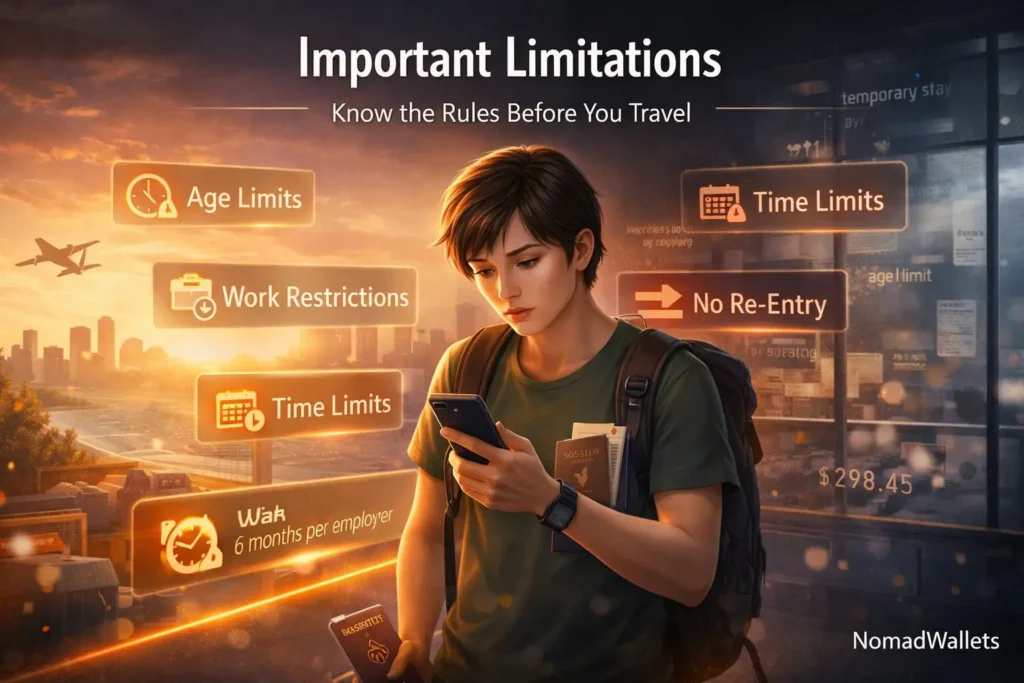
The most significant limitation of working holiday visas is strict age caps per official government policy. Most programs require applicants to be under 31 years old at application submission, making these visas inaccessible to older digital nomads.

Exceptions:

  • Ireland: No age limit for students/recent graduates per Irish Department of Foreign Affairs
  • Canada: Accepts applicants up to age 35 per Government of Canada IEC program

“If you’re approaching the age limit, apply as soon as possible. Once granted, you have 12 months to enter [the country] and activate your visa” according to Australian Department of Home Affairs guidance.

One-Time Use

Most countries prohibit repeat applications for working holiday visas per immigration policy. If you’ve previously held a New Zealand working holiday visa, you cannot apply for another one, even if you only used a portion of the validity period according to Immigration New Zealand rules. Australia allows multiple visas only through regional work extensions.

Employment Restrictions

The 6-month employment limit per employer prevents working holiday visas from functioning as traditional work permits according to visa conditions. Digital nomads with remote US based employment should clarify whether self employment or foreign remote work counts toward these restrictions.

Sponsorship pathway: “You can’t work for one employer for more than six months without them sponsoring you”, but this creates opportunities for employer sponsored visa transitions.

Study Limitations

Working holiday visas typically cap study duration at 4-6 months per official visa conditions, making them unsuitable for full time degree programs but perfect for short courses, language training, or professional certifications.

Working Holiday Visas vs. J-1 Exchange Visitor Program

The US doesn’t issue outbound working holiday visas, but the inbound J-1 Exchange Visitor Program offers similar cultural exchange opportunities for foreigners visiting America according to US State Department programs. Key differences include:

Source: US State Department Exchange Visitor Program documentation and official government immigration websites.

Health insurance and first aid kit for travelers abroad.

Insurance Requirements for Working Holiday Visas

Mandatory Coverage

Most working holiday visas programs require comprehensive health insurance for the visa’s entire duration per official immigration requirements:

  • Medical treatment: Emergency and routine healthcare
  • Hospitalization: Inpatient care coverage
  • Repatriation: Emergency evacuation to home country
  • Minimum coverage: Varies by country but typically USD $50,000-100,000

Recommended Additional Coverage

  • Personal liability: Protection against accidental damage or injury to third parties
  • Travel delays: Compensation for flight cancellations or delays
  • Lost/stolen belongings: Coverage for laptops, phones, and travel gear
  • Adventure sports: Additional coverage if planning activities like skydiving, scuba diving

Provider Options

  • International travel insurance (World Nomads, SafetyWing, IMG Global)
  • Country specific expat insurance
  • US based travel medical insurance with international coverage

Cost estimate: USD $400-800 for 12 months comprehensive coverage

Important: Verify that your insurance meets the specific requirements of your destination country’s immigration department.

Practical Tips from Working Holiday Visas Veterans

Note: The following insights are based on documented experiences from actual working holiday visa participants.

Pre-Departure

Australian immigration success story documented: “Be clear and accurate in your level of experience, and carefully scan in and organise all your documents; it makes the application process so much easier”

  • ​Apply 2-3 months before intended departure to allow processing time
  • Join working holiday visas Facebook groups for your destination country
  • Research seasonal work availability (summer tourism rush, harvest seasons)

Packing Strategies

One experienced working holiday visas participant challenges common norms: “Suitcases over backpacks for ease of mobility and less physical strain”. Consider your specific travel plans when choosing luggage.

Accommodation Choices

From documented participant experience: “Avoid staying in shared dorms the peace of a private room far outweighs the minor cost savings”. While dorms help meet people initially, private accommodation improves sleep quality and work life balance.

Travel Timing

Documented advice from participant: “Travel before committing to work” rather than immediately securing employment. Explore your destination first to identify which cities and regions align with your preferences.

​”Avoid travel during the busy summer months, and instead settle into work during peak tourist seasons” when jobs are abundant and wages competitive.

Job Flexibility

From participant experience: “Keep an open mind about short term or different jobs outside one’s usual career path”. These experiences enrich travel and expand professional networks beyond typical career trajectories.

Skills Development

Benjamin Costes documented: “You have to be really flexible and organized at the same time when you are abroad. I had to be able to adapt easily when I was looking for a job, ready to move to another city if there was an opportunity”.

Tourist Activities

From participant advice: “Embrace tourist activities” rather than avoiding them. Working holiday visas provide time to experience destinations fully, beyond surface level tourism.

Pathways from Working Holiday Visas to Permanent Residency

Australia Skilled Migration

Working holiday visas can serve as stepping stones to skilled migration visas according to Australian immigration pathways:

  • Secure skilled employment within your first 6 months
  • Employer sponsorship for Temporary Skill Shortage (TSS) visa (subclass 482) valid 2-4 years per Department of Home Affairs
  • Permanent residency application after 2-3 years on employer sponsored visa

Documented success story from Reddit: “Arrived in Aus on WHV > got skilled job > after 6 months they sponsored me for a temp visa (4 years) > after 3 years [transitioned to permanent residency]. The working holiday visa was literally the gateway that changed my life. I’m now an Australian citizen working in Melbourne”.

Professional Networking

Working holiday visas provide time to build professional networks that can lead to:

  • Job offers with visa sponsorship
  • Business partnership opportunities
  • Evidence of ties to the country for future visa applications
  • References from local employers

Skill Development

Use working holiday visas time to:

  • Obtain local certifications or licenses
  • Gain Australian/New Zealand work experience (valued by employers)
  • Develop language skills (particularly relevant for South Korea)
  • Build portfolio of local projects

Important: Immigration pathways to permanent residency are complex and subject to eligibility requirements. Consult registered migration agents (for Australia) or licensed immigration attorneys for personalized guidance.

FAQ: Working Holiday Visas for US Digital Nomads

Q1. Can I apply for working holiday visas after age 30?

A. Only Canada (up to 35) and Ireland (no age limit for students/recent graduates) accept working holiday visas from Americans over 30 according to official program guidelines. All other countries strictly enforce the 18-30 age range. For Australia specifically, “you must be between 18 and 30 years old (inclusive) at the time of application. You can apply up until the day before your 31st birthday” per Australian Department of Home Affairs policy.

Q2. ​Do working holiday visas allow remote work for US clients?

A. This varies by country interpretation and tax law. Working holiday visas typically permit “work” in the host country, but remote employment for foreign clients may fall into gray areas. Some countries tax all income earned while physically present, regardless of client location. Consult licensed immigration attorneys and international tax professionals for specific guidance tailored to your situation.

Q3. Can digital nomads extend working holiday visas beyond 12 months?

A. Only Australia offers formal extension pathways, allowing up to 3 years total through regional work requirements per Department of Home Affairs policy. South Korea’s initial visa allows 18 months. Other working holiday visas have fixed 12 month (or 6 month for Singapore) validity with no extensions according to official immigration rules.

Q4. ​Are working holiday visas available for US citizens with dual citizenship?

A. Yes, but you may only use one citizenship per working holiday visas program. Choose strategically based on which passport offers better benefits (some countries have age limits up to 35 for certain nationalities, different financial requirements, or faster processing times). Note: Always check both countries’ immigration policies regarding dual citizenship and visa eligibility.

Q5. What happens if I overstay my working holiday visas?

A. Overstaying can result in deportation, future visa denials, immigration bans (sometimes permanent), and difficulty obtaining visas to other countries according to immigration enforcement policies. Always depart before expiry or apply for alternative visas if you wish to extend your stay legally. This is serious: Immigration violations can have long-term consequences on your ability to travel internationally.

Q6. Can I claim back superannuation from Australia?

A. Yes, according to Australian Taxation Office policy: “Your employer will contribute to a retirement fund (superannuation). You can claim this back when you leave Australia” through the Departing Australia Superannuation Payment (DASP) program. Apply after leaving the country via the ATO website.

Q7. ​Will I owe US taxes on income earned while on a working holiday visa?

A. Yes, according to IRS regulations: “As a U.S. citizen, you must report your worldwide income including earnings in Australia on your U.S. tax return. However, you can usually claim a foreign tax credit for taxes paid in Australia”, helping to minimize or eliminate double taxation. File Form 1116 for Foreign Tax Credit and Form 1040 for your US tax return. Consult licensed tax professionals (CPAs or Enrolled Agents) for personalized guidance.

Q8. ​How do I prove I have sufficient funds for my working holiday visas application?

A. According to official immigration requirements: “You can provide recent bank statements, a letter from your bank, or evidence of available credit to meet the proof of funds requirement”. Most countries want to see funds in your name, readily accessible (not locked in investment accounts), typically within the last 30-60 days.

Q9. ​Can I apply for a second working holiday visa in Australia if I’m American?

A. Yes, according to Australian Department of Home Affairs policy: “U.S. citizens can apply for a second or even third Working Holiday (subclass 462) visa if they complete specified regional work during their first or second visa. Each additional visa requires meeting specific work requirements in designated industries and locations in Australia”. You need 88 days of specified work for your second year and 6 months for your third year.

Q10. ​Should I join a working holiday program or apply independently?

A. Programs offer valuable support according to program provider documentation, including job databases, employment sessions, CV optimization, accommodation assistance, and community events. Benefits include “an in depth employment session with one-on-one support, CV support to ‘Aussie-fy’ your CV, a weekly jobs email with the latest openings, and membership to a nationwide job database”. Canada requires program enrollment, while other countries allow independent applications. Consider your needs: If you want built-in support systems and networking, programs are valuable. If you’re experienced and independent, direct applications work fine.

Digital nomads networking and sharing working holiday experiences.

Conclusion

Working holiday visas provide exceptional opportunities for US citizens aged 18-35 to combine travel, cultural immersion, and income generation across six countries according to verified government immigration programs. While age restrictions limit long-term applicability for older digital nomads, these programs offer invaluable international work experience, market testing opportunities, professional skill development, and potential pathways to permanent residency for young location-independent professionals.

​Understanding the specific requirements, benefits, limitations, tax implications, job markets, and strategic extensions of working holiday visas in Australia, Ireland, New Zealand, Canada, Singapore, and South Korea allows you to strategically plan international experiences that align with your digital nomad career trajectory. With proper preparation including sufficient funds, appropriate insurance, realistic job expectations, and tax compliance knowledge working holiday visas can launch transformative year long (or longer) adventures that shape your professional and personal development.

The most successful working holiday visas participants approach the experience with flexibility, adaptability, and openness to opportunities outside their comfort zones according to documented experiences. Whether you’re picking fruit in regional Australia to qualify for visa extensions, building tech skills through a Singapore internship, networking in Ireland’s hospitality scene, or exploring Canada’s adventure sports industry, working holiday visas offer unparalleled freedom to design your international experience on your terms.

Always verify current requirements with official government immigration websites before applying, as policies and fees change regularly. All information in this guide was accurate as of November 2025 based on official sources.

Important Disclaimers:

  • Immigration Advice: NomadWallets does not provide immigration legal advice or visa application services. This article is for educational purposes only. Always verify current requirements with official government immigration websites (immi.homeaffairs.gov.au, immigration.govt.nz, canada.ca/iec, etc.) and consult licensed immigration attorneys or registered migration agents for personalized guidance.
  • Tax Advice: NomadWallets does not provide tax advice. Tax situations vary based on individual circumstances. Always consult licensed tax professionals (CPAs, Enrolled Agents, or international tax specialists) for personalized guidance regarding your specific tax obligations.
  • Currency Conversions: All currency conversions are approximate and based on November 2025 exchange rates. Actual rates fluctuate daily.
  • Information Currency: While we strive to maintain accurate information, immigration policies, fees, and processing times change frequently. Always verify current requirements with official government sources before applying.

About NomadWallets

NomadWallets is a trusted resource platform for US digital nomads, providing comprehensive guides on international finance, visas, taxes, and location-independent lifestyle since 2019. Founded by Tushar, a US digital nomad with extensive research across 50+ countries, NomadWallets helps Americans navigate the complexities of international living through well-researched, source-verified content.

Our Mission: To provide accurate, practical, and helpful information for US citizens pursuing location independent lifestyles, always citing authoritative sources and maintaining transparency about our content purpose and limitations.

Content Purpose Statement:
This is an educational guide designed to help US citizens understand working holiday visa options, requirements, and application processes. NomadWallets does not provide immigration legal advice or visa application services. Always verify current requirements with official government immigration websites and consult licensed immigration attorneys for personalized guidance.

Ready to explore more visa options? Download our Complete Digital Nomad Visa Guide covering 50+ countries, residency pathways, and tax implications for US nomads.

Related Resources on NomadWallets:

Official Government Immigration Resources (always verify current requirements):

e95a95691e8fd6064ae708608500dfe1a4b0f006b2562c19dcbb1322083147f0?s=150&d=mp&r=g
Founder & Editor at  * nomadswallets@gmail.com * Web *  posts

Hi, I’m Tushar a digital nomad and the founder of NomadWallets.com. After years of working remotely and traveling across Asia and Europe, I started NomadWallets to help U.S. nomads confidently manage money, travel, banking, crypto, and taxes. My mission is to make complex financial topics simple, so you can focus on exploring the world and building true location freedom.

Leave a Comment

Your email address will not be published. Required fields are marked *

Scroll to Top