

Finding the best Portuguese banks for non-residents is one of the first real tasks on your list when you decide to move to Portugal. It is not just admin either. You genuinely cannot get your D7 or D8 visa approved without showing a local Portuguese bank account and IBAN. Consulates want to see your money sitting in a PT50 account before they stamp anything.
For Americans moving to Portugal, the process of opening a Portuguese bank account as a non-resident is more complicated than it sounds. Most banks want you physically present with a residency card. Two banks have figured out how to actually serve expats properly: Millennium BCP and ActivoBank. This guide covers both in detail, including the 2026 income thresholds, what each bank is like day-to-day, and how to get set up from the US before you land.
If you are still early in your planning, our Ultimate Guide for Digital Nomads in Portugal covers NIFs, neighborhoods, and everything else you need to know before you arrive.
The 2026 Numbers That Affect Your Bank Account Choice
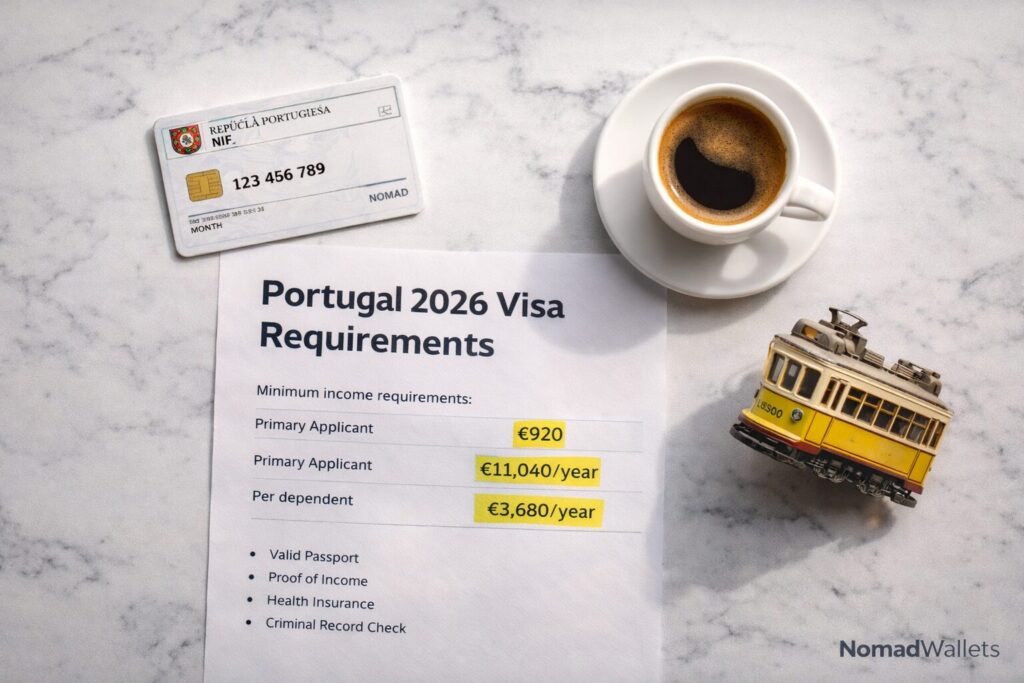
Portugal’s national minimum wage rose to €920 per month on January 1, 2026. (Official Portuguese Government announcement) This directly affects which of the best Portuguese banks for non-residents you need to prioritise, because both the D7 and D8 visa income thresholds are calculated against this figure.
- D7 Visa (Passive Income): You need to show at least €920 per month in passive income and a minimum of €11,040 in savings deposited in your Portuguese bank account. That is 12 months of the minimum wage sitting in a PT50 account before your appointment. (Source: Portugalist D7 Guide 2026)
- D8 Visa (Digital Nomad): The Portugal D7 visa bank requirements and D8 requirements follow the same minimum wage logic. For D8, you need €3,680 per month in remote income (four times the minimum wage), averaged over three months, plus €11,040 in savings. (Source: Global Citizen Solutions D8 Guide) (Source: Lamáres & Capela Law)
One important detail: AIMA (Portugal’s immigration authority) calculates your thresholds against the minimum wage in force at the time of your appointment, not when you started your application. If the wage rises before your interview date, the required savings figure moves with it. (Source: MSP Lawyers)
Why CGD and Banco CTT Are Not on This List
When researching the best Portuguese banks for non-residents, you will come across Caixa Geral de Depósitos (CGD) and Banco CTT. Both are legitimate regulated banks. So why are they not here?
- Caixa Geral de Depósitos (CGD): Portugal’s state bank works fine once you have a residency card and are living in the country. Remote account opening for non-residents is a different story. Their Power of Attorney process is inflexible and slow, with very little experience handling applications from the US. For visa purposes they are a poor starting point.
- Banco CTT: A decent zero-fee bank for local daily spending, but the international infrastructure is thin. SWIFT transfers are clunky, English support is limited, and if you are receiving income from outside Portugal regularly, you will run into friction fast.
Neither is a bad bank. They were just not designed with the non-resident visa applicant in mind. When you are specifically looking for the best Portuguese banks for non-residents who need to prove funds before arriving, they simply do not fit the brief. Once you are fully settled and your banking is simple, they are worth a second look.
1. Why Non-Residents Need a Dedicated Portuguese Bank Account
The best Portuguese banks for non-residents are not just a convenience upgrade over Revolut or Wise. They are a visa requirement. Some consulates will accept a Wise statement for the D7, and plenty of expats use Revolut for daily spending. But “some consulates” covers a lot of variation. Requirements shift from office to office with no warning. If your VFS appointment is in three weeks, betting on a Revolut statement being accepted is a genuine risk you do not need to take.
Beyond the visa, there is another reason to get a Portuguese bank account set up quickly: MB Way. This is the payment system that runs daily life in Portugal. Rent, bills, splitting dinner, smaller shops. You need a debit card from a licensed Portuguese bank to use it. Revolut does not qualify. Wise does not qualify. (MB Way official site)

2. Millennium BCP: The Best Portuguese Bank for Non-Residents Before You Arrive
Among the best Portuguese banks for non-residents still living abroad, Millennium BCP has no real competition. It is Portugal’s largest private bank and the only major institution with a reliable process for Americans trying to figure out how to open a bank account in Portugal as an American before their visa interview.
Opening from the US
Millennium accepts a Power of Attorney arrangement, so a representative in Portugal can open the account on your behalf. Services like Bordr and E-residence handle this as a bundle alongside your NIF application. It takes one to two weeks and costs more than opening in person, but you land in Lisbon with a fully active account and a real bank statement already in hand. Millennium is also the only major bank that consistently issues the Termo de Responsabilidade (a formal declaration of responsibility) that VFS officers in the US and UK specifically look for at the visa interview. That document makes a real difference.
The Prestige Tier
If you keep a healthy balance, Millennium will eventually invite you into their Prestige tier. You get a dedicated relationship manager who almost always speaks fluent English. This is one reason Millennium is consistently rated among the best Portuguese banks for non-residents who are bringing significant savings or pension income into the country.
The Fees
Millennium charges €5 to €7.50 per month in maintenance fees plus stamp duty, and around €20 to €30 per year for a physical debit card. By expat banking Portugal standards that is expensive. Most people accept it in the short term because the institutional reliability and the POA process are worth it for visa purposes.
3. ActivoBank: The Best Portuguese Bank for Non-Residents Once You Are on the Ground
ActivoBank is owned by Millennium BCP and carries the same deposit protection and regulatory backing. The difference is that it was built for digital-first users. When comparing ActivoBank vs Millennium BCP for everyday banking, ActivoBank wins almost every time once you are actually living in Portugal. It consistently appears near the top of any list of best Portuguese banks for non-residents who have already arrived and want to cut costs.
What Makes It Worth Using
- Zero fees: No monthly maintenance charge, no annual card fee. The optional AB Plus plan at €3.99 per month adds travel insurance and other extras, but the standard account costs nothing.
- The app: One of the best banking apps in the country. Fast, clean, and reliable for day-to-day expat banking in Portugal.
- Branch hours: Ponto Activo branches stay open until 8pm and are open Saturdays. Most Portuguese banks close at 3pm and are shut all weekend, so this genuinely matters.
The Limitation for Non-Residents
ActivoBank requires a Portuguese address and residency card for digital onboarding. If you are in Chicago or London without either, you cannot open an account remotely. This is not the bank for the pre-arrival phase. It is the Portugal bank non-resident option you come back to after you have your NIF sorted and a place to stay.

4. Two Scenarios That Show How This Works in Practice
Scenario One: The Visa Deadline
Jake is a product designer in Austin planning a move to Lisbon on a D8 visa. His VFS appointment is in four weeks. He needs a bank statement from one of the best Portuguese banks for non-residents showing sufficient funds. He signs up with Bordr, gets his NIF and Millennium BCP account opened remotely via Power of Attorney, and two weeks later has a stamped Termo de Responsabilidade ready for his interview. The monthly fees cost him a bit more than he wanted, but he got the visa.
Scenario Two: The Switch
Marta arrived in Lisbon six months ago on a D7. She has been paying Millennium’s monthly fee since before she left the US and it adds up to roughly €84 a year. Now that she has her residency card, she walks into an ActivoBank branch on a Saturday morning with her passport and NIF. Thirty minutes later she has a new account, a debit card, and MB Way set up. She keeps Millennium open for a mortgage she is considering but moves all daily spending to ActivoBank. Her experience is typical of how most people use the best Portuguese banks for non-residents in practice.

5. How to Open a Portuguese Bank Account Remotely as a Non-Resident
The best Portuguese banks for non-residents who are still abroad all route through Millennium BCP, and two services make that process reliable.
- Bordr: Bundles your NIF application and Millennium BCP account opening into one process. Well-known in the expat community with responsive customer support.
- E-residence: Slightly cheaper than Bordr and equally reliable. Good if you are watching costs during your move.
Both require a signed Power of Attorney document, a passport copy, and proof of address. The full process takes one to two weeks from when they receive your documents. For a deeper breakdown, see our guide to open Portuguese bank account remotely before arriving.
6. Banking in Portugal: What You Need to Know
Multibanco
Portugal’s ATM network is one of the most advanced in Europe. You can pay electricity bills, top up a phone, buy train tickets, and renew a driving licence from any cash machine. Every major bank connects to it.
Your PT50 IBAN
Your account number starts with PT50. Landlords, employers, and anyone sending money inside the EU will ask for this. Even the best Portuguese banks for non-residents recommend linking a Wise account to your PT50 IBAN for currency exchange, as it makes dollar-to-euro transfers significantly cheaper.

MB Way
Understanding Portugal D7 visa bank requirements gets you through the application. MB Way is what makes daily life actually work once you arrive. You register your phone number with your debit card, and from that point you can pay rent, split bills, and send money to anyone in Portugal instantly. Worth knowing: MB Way does work with non-Portuguese phone numbers linked to a Portuguese bank card, so you do not need to rush out and buy a local SIM on day one. (MB Way international numbers FAQ)
7. Documents You Need to Open an Account
Whether you are opening in person or remotely, every one of the best Portuguese banks for non-residents will ask for these four things. Having them ready before you contact a service like Bordr saves you at least a few days.
- Valid Passport: A driving licence is not accepted. Passport only.
- NIF (Portuguese Tax ID): Without a NIF you cannot open any Portuguese bank account. Get this sorted first.
- Proof of Address: A recent US utility bill or bank statement is fine for the pre-arrival process.
- Proof of Income: A pay stub, employment contract, or tax return. For Americans, consulates increasingly expect an IRS Tax Return Transcript rather than just an employer letter, and at least three months of consistent income records. The stronger your paper trail, the smoother the process.
8. Best Portuguese Banks for Non-Residents: Side-by-Side Comparison
| Feature | Millennium BCP | ActivoBank |
| Monthly Fees | €5 – €7.50 + Stamp Duty | €0 (basic) / €3.99 (AB Plus) |
| Annual Debit Card Fee | ~€20 – €30 | €0 |
| Remote Opening Before Arrival | ✅ Yes (via POA service) | ❌ Not possible |
| D7 / D8 Visa Suitability | ⭐⭐⭐⭐⭐ Excellent | ⭐⭐ Post-arrival only |
| Issues Termo de Responsabilidade | ✅ Yes | ❌ No |
| Mobile App | Good | Best in Portugal |
| MB Way | ✅ Full support | ✅ Full support |
| English Customer Service | Strong (dedicated international team) | Good in Lisbon and Porto |
| Branch Network | Nationwide | Major cities only |
| Non-Resident Mortgages | ✅ Yes (market leader) | ❌ Not offered |
| SWIFT Transfers | Full support | Full support |
| Deposit Protection | ✅ Up to €100,000 (EU) | ✅ Up to €100,000 (EU) |
| Best For | Visa applicants, pre-arrival setup | Daily spending once resident |

The Strategy That Works for Most Expats
Most Americans moving to Portugal end up using both of these best Portuguese banks for non-residents, at least for the first year. Millennium gets you through the visa process. ActivoBank handles everyday spending once you are on the ground. Trying to skip straight to ActivoBank leaves you without the remote opening option you need before your VFS appointment.
Open Millennium first through Bordr or E-residence, as early in your planning as possible. Once you arrive and have your residency card, walk into an ActivoBank branch and open the second account. This is the exact workflow the best Portuguese banks for non-residents are set up to support. Then decide whether to keep Millennium for mortgages or other financial products, or close it and consolidate everything with ActivoBank.
That two-step approach is how the majority of long-term expats handle expat banking in Portugal. Starting with a clear plan avoids the scramble that comes from figuring it out after you land.
1. Financial Disclaimer This is the most important one given you are discussing bank accounts, fees, and deposit protection.
“The information in this article is for general informational purposes only and does not constitute financial advice. We are not financial advisors. Always consult a qualified financial professional before making any banking or investment decisions.”
2. Visa and Immigration Disclaimer Critical for a D7/D8 article because requirements change without notice.
“Visa requirements, income thresholds, and consulate policies change frequently and vary by location. The figures in this article reflect requirements as of January 2026. Always verify current requirements directly with your nearest Portuguese consulate or a licensed immigration lawyer before submitting any application.”
3. Accuracy Disclaimer (optional but recommended) “While we make every effort to keep this information accurate and up to date, banking products, fees, and promotional offers can change at any time. Please verify all details directly with the relevant bank before opening an account.”
Common Questions About the Best Portuguese Banks for Non-Residents
Q1: Is my money safe in a Portuguese bank?
A: Yes. Portugal is an EU member, meaning deposits are protected up to €100,000 per person per bank under the European Deposit Guarantee Scheme. Both Millennium and ActivoBank are fully covered.
Q2: Can I use Wise or Revolut for my visa application?
A: Some consulates accept them, many do not. There is no consistent rule and it changes without notice. Having a PT50 IBAN from a locally licensed bank removes that uncertainty entirely.
Q3: What are the exact 2026 income requirements for the D7 and D8?
A: D7: €920 per month in passive income and €11,040 in savings in your Portuguese account. D8: €3,680 per month in remote income averaged over three months, plus €11,040 in savings. Both figures are tied to the national minimum wage and will rise if it rises. (Portugalist 2026 guide)
Q4: Can I get a mortgage in Portugal as a non-resident?
A: Yes. Millennium BCP is one of the most active non-resident mortgage lenders in the country. Expect a deposit of 30 to 40 percent depending on the property and your financial profile.
Q5: Which bank has better English customer service?
A: Millennium has a dedicated international team and English support is consistent across most branches. ActivoBank is fine in Lisbon and Porto but can be hit or miss in smaller cities.
Q6: What happens to my account if I leave Portugal?
A: You can usually keep it open, but the bank may reclassify you as a non-resident, which can change your fees or account type. Check with your bank before you leave.
Q7: How long does it take to open a Portuguese bank account remotely?
A: In person: 30 to 60 minutes. Through a remote service like Bordr: one to two weeks from when they receive your signed Power of Attorney documents.
Q8: Do I need a Portuguese SIM card to use MB Way?
A: No. MB Way works with international phone numbers as long as you have a Portuguese bank debit card. Most expats pick up a local SIM shortly after arriving, but it is not required to get started. (MB Way international numbers FAQ)

Tushar Sharma is the founder and editor of NomadWallets, where he writes about international banking, travel cards, cross-border payments, taxes, and financial tools for digital nomads and globally mobile professionals. He created NomadWallets to make global money decisions simpler through practical, research-backed guides built from official sources and real-world financial data.