
It’s 2026, and the digital nomad economy has never been more complex or more rewarding. With over 40 million digital nomads worldwide, the infrastructure supporting this lifestyle has matured dramatically. But so have the financial pitfalls. Inflation has reshaped traditional nomad hubs like Lisbon and Bali, crypto is now a standard payment rail for freelancers, and multi-currency headaches have become the single biggest silent killer of nomad financial health. If you’ve ever watched your bank balance shrink faster than expected while bouncing between Thai baht, Mexican pesos, and euros, you already know the problem.
⚡ Quick Answer: Best Budget Tracking Apps for Digital Nomads (2026)
If you want the short version first:
- Best overall: TravelSpend
- Best minimal tracker: Trail Wallet
- Best automation: Spendee
- Best wealth-building system: YNAB
- Best for freelancers: Expensify
Best Budget Tracking Apps for Digital Nomads (2026)
| App | Best For | Price | Platform |
| TravelSpend | Group travel & splitting | Free + Premium | iOS & Android |
| Trail Wallet | Manual minimalist tracking | $4.99 one-time | iOS only |
| Spendee | Automated bank sync | Free / $1.99-$4.99/mo | iOS, Android, Web |
| YNAB | Wealth building & zero-based budgeting | $14.99/mo or $109/yr | iOS, Android, Web |
| PocketGuard | Impulse spending control | Free + Premium | iOS & Android |
| Wallet by BudgetBakers | Global bank coverage | Free + Premium | iOS, Android, Web |
| Expensify | Freelancers & business owners | Free / $5-$9/mo | iOS, Android, Web |
Below, each app gets a full breakdown showing exactly how it fits into a complete digital nomad financial system, because the app you pick is only one piece of a much bigger puzzle.
Here’s the uncomfortable truth: roughly 90% of new digital nomads blow their budget within the first three months of going location-independent. They underestimate foreign exchange losses. They ignore the compounding effect of micro-fees. They treat budgeting as something they’ll “figure out later.”
And when reality hits, whether that’s an unexpected visa fee in Colombia, a currency crash in Argentina, or a forgotten subscription still billing in British pounds, they’re caught with no system in place to absorb the shock.
This guide is not another listicle of pretty apps. What you’re about to read is a complete financial operating system for location independence. It covers banking infrastructure, software selection, burn-rate strategy, tax compliance, and the emerging frontier of AI-driven finance.
Whether you’re a freelance developer earning in USD, a content creator invoicing in euros, or a startup founder juggling stablecoins and fiat, this is your roadmap.
Why Standard Budgeting Fails the Global Citizen
Traditional budgeting advice was designed for people with one currency, one country of residence, and one predictable cost of living. Digital nomads have none of these luxuries, and that fundamental mismatch is where the trouble begins.
The Multi-Currency Trap
Consider what a typical nomad week looks like financially. You invoice a client in US dollars on Monday. On Tuesday, you transfer funds to your Wise account, where it’s held in a multi-currency wallet. By Wednesday, you’re converting a portion to Thai baht because you’ve just landed in Chiang Mai.
On Thursday, you pay for coworking in baht, grab dinner using your Revolut card (which auto-converts from your euro balance), and send rent to your landlord via a local bank transfer. By Friday, you’ve touched four currencies without leaving your apartment.
Seasoned nomads call this “Currency Chaos,” and it’s the primary reason digital nomad budget tracking is so much harder than domestic budgeting. Every transaction carries an implicit foreign exchange (FX) decision.
Every conversion has a spread, which is the difference between the mid-market rate you see on Google and the rate your bank or app actually gives you. Over hundreds of transactions per month, these micro-spreads compound into serious money.
🚨 The 3 Biggest Money Leaks for Digital Nomads
Most nomads lose money in three places:
- Currency conversion spreads: the gap between the rate you see and the rate you get.
- ATM withdrawal fees: $3 to $7 per withdrawal adds up fast across dozens of monthly transactions.
- Forgotten subscriptions in foreign currencies: that gym membership in Lisbon is still billing you in euros.
Even a 2 to 3% FX markup can quietly drain over $1,000 per year from your travel budget.
The Invisible 3% Tax
Most traditional banks charge around 1% to 3% in foreign transaction fees, often buried in the exchange rate markup rather than listed as a visible fee. For a nomad spending $3,000 per month abroad, that’s up to $90 per month, or $1,080 per year, evaporating silently.
This “invisible tax” is the single most destructive force working against your digital nomad budget tracking efforts, and most people never notice it because it doesn’t appear as a line item on their statement.
💰 Example: The Real Cost of FX Fees
If you spend $3,000 per month abroad:
| Fee | Monthly Cost | Yearly Cost |
| 1% FX spread | $30 | $360 |
| 2% FX spread | $60 | $720 |
| 3% FX spread | $90 | $1,080 |
Most traditional banks fall between 2 and 3%. That means many nomads unknowingly lose $700 to $1,000 every year, before they even start overspending.
Dynamic Lifestyles Break Fixed Budgets
The envelope method, the 50/30/20 rule, zero-based budgeting. These frameworks assume your cost of living stays relatively stable month to month. But when you move from Lisbon (where a modest apartment runs €1,200/month in 2026) to Canggu, Bali (where a comparable villa is closer to $600/month), your entire expense structure shifts overnight.
Fixed categories become meaningless. Your “housing” line item swings by 50% based on geography alone, and your food budget can triple or halve depending on whether you’re in Copenhagen or Medellín. Effective digital nomad budget tracking must account for this dynamism, which means the tools and strategies you use need to be radically more flexible than what a standard personal finance app provides.
User Story: Sarah’s £1,500 Lesson
Meet Sarah, a 31-year-old UX designer from Manchester. In 2024, she left her agency job to freelance remotely and spent her first year as a nomad in Lisbon, Tbilisi, and Chiang Mai. She earned in GBP, kept her Barclays account as her primary, and used her standard debit card for most purchases abroad.
She tracked her spending in a Google Sheet, dutifully logging every coffee and coworking day, but she made one critical mistake: she never established a base currency system.
Because she was logging expenses in local currencies and only loosely converting them to pounds at the end of each month, she consistently underestimated her actual spend. The Thai baht fluctuated against the pound during her four months in Chiang Mai, and the conversion fees on her Barclays card added up silently.
When she finally reconciled everything at tax time, she discovered she had spent £1,500 more than her spreadsheet suggested. The culprit wasn’t reckless spending. It was sloppy currency tracking and invisible FX fees. Sarah’s story is a textbook example of why digital nomad budget tracking requires purpose-built infrastructure, not just good intentions.
💡 Key Takeaway: The problem isn’t that nomads spend too much. It’s that they don’t see what they’re spending until it’s too late. Your tracking system is only as good as the financial infrastructure underneath it.
Most people jump straight to downloading a budget app. That’s like installing a dashboard on a car with no engine. Let’s build the engine first.
Building Your 2026 “Financial Stack”
Here’s something most budget guides get wrong: they start with tracking apps. But tracking is the final layer of a well-designed financial system. Before you can meaningfully track where your money goes, you need to control how it moves.
Think of your finances like a technology stack. The base layer is your banking infrastructure, meaning how money enters and exits your world. The middle layer is your currency management strategy, meaning how you minimize friction and fees. The tracking layer sits on top, giving you visibility into the whole system.
Without the base layer, your tracking data will be polluted with hidden fees, phantom conversions, and reconciliation nightmares. Let’s build from the ground up.
The Base Layer: Banking Infrastructure
Your banking setup is the foundation of every financial decision you’ll make as a nomad, and in 2026, the two dominant players for location-independent workers remain Wise and Revolut. Both offer multi-currency accounts, competitive FX rates, and global debit cards, but they serve subtly different needs.
Wise has positioned itself as the transparency champion. Its fees are displayed upfront before every conversion, and it consistently offers rates within 0.3 to 0.5% of the mid-market (interbank) rate. In 2026, Wise has expanded its “Assets” feature, allowing users to hold funds in interest-bearing accounts across multiple currencies.
For nomads who earn in one currency and spend in several, Wise’s auto-conversion feature converts money at the best available rate during a set window and has become a core tool for digital nomad budget tracking. Wise also now supports direct debits in several countries, making it viable as a primary account for freelancers billing European and US clients.
Revolut, on the other hand, has leaned into becoming a full financial ecosystem. Its 2026 offering includes crypto trading, stock investments, travel insurance, and lounge access, essentially a fintech super-app. For pure FX conversion during market hours, Revolut’s paid plans (Ultra and Metal) offer unlimited fee-free exchanges at interbank rates.
However, weekend and off-hours conversions still carry a markup of 0.5 to 1%, which can catch infrequent users off guard. Revolut’s strength for digital nomad budget tracking lies in its built-in analytics dashboard, which categorizes spending automatically and provides monthly reports by category and currency.
Bottom line: Many seasoned nomads use both. Wise as the “pipes” for moving money, and Revolut as the daily spending card.
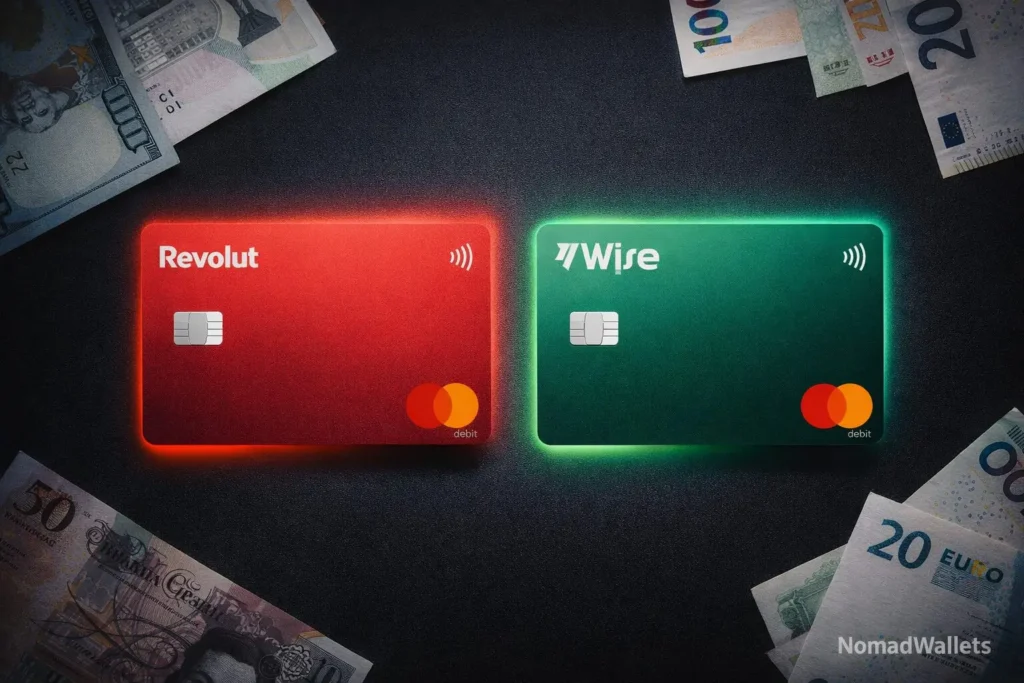
🏦 Wise vs. Revolut: The Quick Verdict (2026)
| Feature | Wise | Revolut |
| FX transparency | ✅ Industry-leading | ⚠️ Markup on weekends |
| Multi-currency holding | ✅ 40+ currencies | ✅ 30+ currencies |
| Built-in spending analytics | ❌ Basic | ✅ Detailed dashboard |
| All-in-one lifestyle app | ❌ Focused on transfers | ✅ Crypto, insurance, lounges |
| Best for | Moving money cheaply | Daily spending + tracking |
The Anchor Bank: Why You Still Need a Home-Country Account
Despite the rise of borderless banking, maintaining a traditional bank account in your home country remains essential. Tax authorities, pension systems, and many visa applications still require proof of a domestic banking relationship.
In the US, Charles Schwab’s Investor Checking Account continues to be the gold standard for nomads, offering unlimited ATM fee rebates worldwide and no foreign transaction fees. In the UK, Monzo provides a strong mobile-first experience with instant spending notifications that aid real-time digital nomad budget tracking.
For European nomads, N26 offers a streamlined interface with sub-accounts (Spaces) that function as virtual envelopes for budgeting. Your anchor bank is your safety net, the account that remains stable and accessible regardless of where your nomad journey takes you.
The Tracking Layer: Software Categories
With your banking stack in place, it’s time to add the visibility layer. Digital nomad budget tracking software generally falls into two categories.
Manual tracking apps require you to log each expense by hand, giving you granular control and forcing mindful spending habits.
Automated tracking apps sync with your bank accounts and credit cards, categorizing transactions automatically.
Each approach has trade-offs. Manual tracking is more accurate in cash-heavy economies like Vietnam, Morocco, or rural Mexico, but requires daily discipline. Automated tracking saves time but can miss cash transactions and sometimes miscategorizes expenses, especially across currencies.
The best digital nomad budget tracking systems often combine both approaches: automated syncing for card-based spending, with a manual overlay for cash and informal transactions.
The tools you choose can easily save or cost you thousands per year in hidden fees and missed spending patterns.
Top 7 Apps for Digital Nomad Budget Tracking (2026 Rankings)
The app landscape for nomad finance has matured significantly. Here are the seven best tools for digital nomad budget tracking in 2026, ranked by their suitability for the location-independent lifestyle.
| App Name | Best For | Tracking Style | 2026 Key Feature |
| TravelSpend | Group Travel/Social | Manual/Semi-Auto | Split-Bill AI |
| Trail Wallet | Minimalists | Manual | Instant “Logging” UI |
| Spendee | Automation Lovers | Bank-Sync | Multi-Wallet AI |
| YNAB | Wealth Builders | Zero-Based | Currency Conversion Plugins |
| PocketGuard | Over-Spenders | Automated | “In My Pocket” calculation |
| Wallet by BudgetBakers | Global Coverage | Mixed | 4,000+ Bank Integrations |
| Expensify | Business Owners | Tax/Compliance | One-Tap Receipt Scanning |
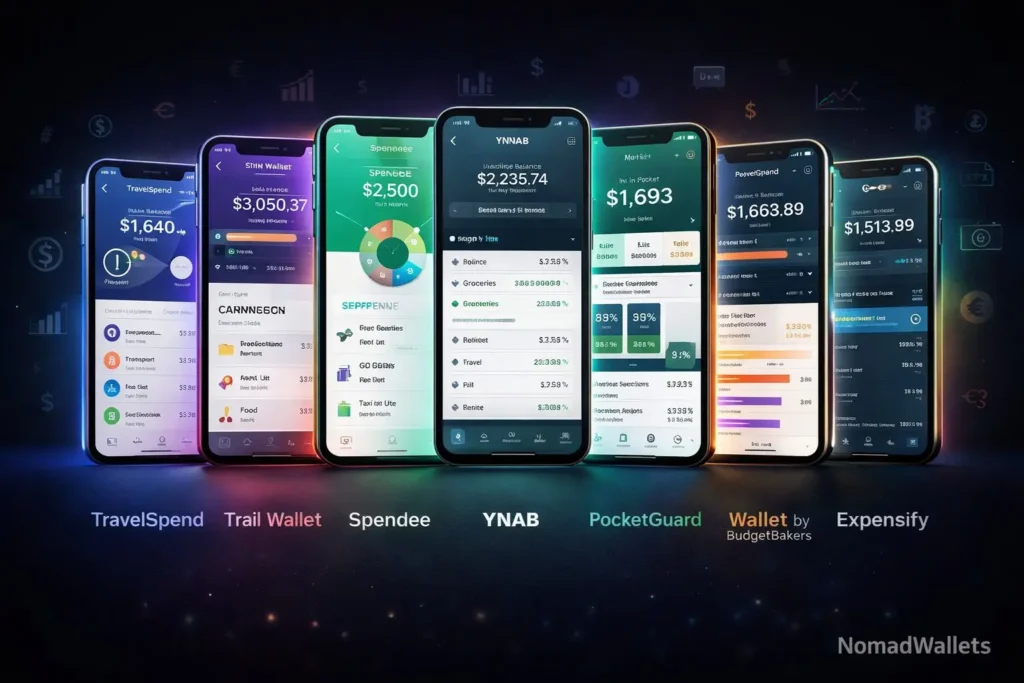
1. TravelSpend: Best for Group Travel and Social Budgeting
TravelSpend has carved out a unique niche among nomads who frequently travel with partners, friends, or small groups. Its 2026 standout feature is Split-Bill AI, which automatically divides shared expenses like Airbnbs, group dinners, and rental cars, and tracks who owes what across multiple currencies.
The interface is deliberately simple: you tap a button, enter the amount in local currency, and it instantly converts to your base currency using near-real-time FX rates. For digital nomad budget tracking in cash-heavy economies, TravelSpend shines because it’s designed for manual entry with minimal friction.
The app works fully offline, which is a crucial feature when you’re logging a street food purchase in a Vietnamese alley with no cell signal.
Where TravelSpend falls short is in long-term financial planning. It’s built for trip-based tracking, not annual budget management.
2. Trail Wallet: Best for Minimalists
Trail Wallet appeals to nomads who believe the best budget system is the one you’ll actually use. Its design philosophy is radical simplicity: open the app, enter the expense, pick a category, done. There are no bank syncs, no AI features, no social integrations.
The 2026 version has refined its instant logging UI to the point where entering an expense takes under five seconds. It supports over 200 currencies and provides a clean daily/weekly/monthly spending summary with color-coded visuals. For nomads who are disciplined about logging every purchase, Trail Wallet delivers surprisingly powerful digital nomad budget tracking despite, or perhaps because of, its minimalism.
The limitation is obvious: everything is manual, and if you skip a few days of logging, the data gap is hard to recover.
⏱️ Speed Test: Trail Wallet averages 4.8 seconds per entry. Over 30 daily transactions in a month, that’s just 24 minutes of total logging time. Compare that to the hours you’d spend reconciling messy spreadsheets at the end of the month.
3. Spendee: Best for Automation Lovers
Spendee has evolved into one of the most sophisticated automated digital nomad budget tracking platforms available in 2026. Its Multi-Wallet AI feature connects to bank accounts across dozens of countries and automatically categorizes transactions using machine learning trained on nomad spending patterns.
It recognizes that a charge from “Grab” is transportation in Southeast Asia, that “Rappi” is food delivery in Latin America, and that a wire from “Toptal” is freelance income.
Spendee’s multi-currency support is native, so you can view your total financial picture converted to any base currency in real time. The 2026 update introduced predictive budgeting, which analyzes your spending velocity and warns you mid-month if you’re on track to exceed your targets.
The trade-off is that Spendee’s bank-sync feature doesn’t cover every institution in every country. In cash-heavy economies, you’ll still need to supplement with manual entries.
4. YNAB (You Need A Budget): Best for Wealth Builders
YNAB has long been the gold standard for intentional budgeting, and its philosophy, “give every dollar a job,” resonates deeply with nomads who are trying to build wealth, not just survive.
The zero-based budgeting approach forces you to allocate every unit of income to a specific purpose before spending it, which is transformative for digital nomad budget tracking. In 2026, YNAB’s community has developed robust currency conversion plugins that automatically adjust allocations when you move between countries.
The learning curve is steeper than simpler apps, but nomads who commit to YNAB’s methodology consistently report higher savings rates.
YNAB is ideal for the nomad who has moved past the “backpacker” phase and is focused on building an investment portfolio, saving for property, or planning for retirement while living internationally.
📊 YNAB users report saving an average of $600 in their first month and over $6,000 in the first year. For nomads practicing geo-arbitrage, those savings compound even further in lower-cost destinations.
5. PocketGuard: Best for Over-Spenders
If your biggest financial challenge is impulse spending, PocketGuard’s “In My Pocket” feature is designed specifically for you. This calculation takes your income, subtracts your bills and savings goals, and tells you exactly how much you have left to spend freely, updated in real time.
For digital nomad budget tracking, this provides a constant, at-a-glance reality check. The 2026 version supports multi-currency income streams and automatically adjusts your “In My Pocket” figure when exchange rates shift.
PocketGuard syncs with banks and cards for automated tracking and includes a bill negotiation feature that identifies subscriptions you may have forgotten.
Its weakness for nomads is that bank connectivity outside North America and Western Europe can be spotty.
6. Wallet by BudgetBakers: Best for Global Coverage
With over 4,000 bank integrations spanning 50+ countries, Wallet by BudgetBakers has the widest automated reach of any digital nomad budget tracking app in 2026. This matters enormously for nomads who open local bank accounts in the countries they visit, which is a common strategy for avoiding ATM fees and accessing local payment systems.
Wallet’s mixed tracking approach lets you sync some accounts automatically while logging others manually, creating a unified view of your finances regardless of how fragmented your banking setup is. The app also supports shared wallets for couples and family budgeting, planned payments tracking, and export to CSV for tax preparation. The user interface is more complex than some competitors, but the depth of functionality rewards the learning investment.
7. Expensify: Best for Business Owners and Freelancers
Expensify occupies a different space than the other apps on this list, focusing on the intersection of personal spending and business accounting. Its one-tap receipt scanning uses OCR technology to extract merchant names, amounts, currencies, and dates from photos of receipts, automatically categorizing them as business or personal expenses.
For nomads who need to maintain a clean separation between business and personal spending, which is essential for tax compliance and digital nomad budget tracking at a professional level, Expensify is unmatched.
The 2026 version integrates directly with accounting software like QuickBooks and Xero, and its SmartScan feature now handles receipts in over 160 currencies. Expensify is overkill for the nomad who just wants to track daily spending, but for anyone running a business while traveling, it’s indispensable.
Most digital nomads track expenses. Very few understand their true financial survival number.
The “Burn Rate” Strategy: Managing Global Costs
Effective digital nomad budget tracking goes beyond logging expenses. It requires understanding your burn rate: the total monthly cost of sustaining your lifestyle.
Your Global Minimum Burn Rate is the lowest amount you can spend per month while maintaining a quality of life you consider acceptable. Calculating this number gives you a critical safety metric: if income drops, how long can your savings sustain you?
To calculate your burn rate, total your fixed costs (accommodation, insurance, subscriptions, loan payments) and add your average variable costs (food, transport, entertainment, coworking) over a three-month period. Divide by three for a monthly average, then add a 15% buffer for unexpected expenses. This is your burn rate.
Knowing this number transforms your digital nomad budget tracking from passive observation to active strategy.
🔢 Quick Formula: Your Global Minimum Burn Rate
(Average Fixed Costs + Average Variable Costs) x 1.15 = Monthly Burn Rate
Example: ($800 rent + $200 insurance + $150 subscriptions + $400 food + $150 transport + $200 entertainment) x 1.15 = $2,185/month
If you have $20,000 in savings, that’s a 9.1-month runway, your financial safety net before income reaches zero.
Geo-Arbitrage 101
Once you know your burn rate, you can use it to identify geo-arbitrage opportunities, meaning locations where your money stretches further without sacrificing quality of life. The core principle is simple: earn in a strong currency, spend in a weak one.
But in 2026, the calculation has become more nuanced because traditional “cheap” destinations have experienced significant inflation driven by nomad demand itself.
Here’s a snapshot of 2026 monthly costs for a comfortable nomad lifestyle (private apartment, coworking, eating out regularly, social activities) across major hubs, adjusted for 2026 inflation. Cost estimates combine data from Numbeo cost-of-living indexes and nomad community reports.
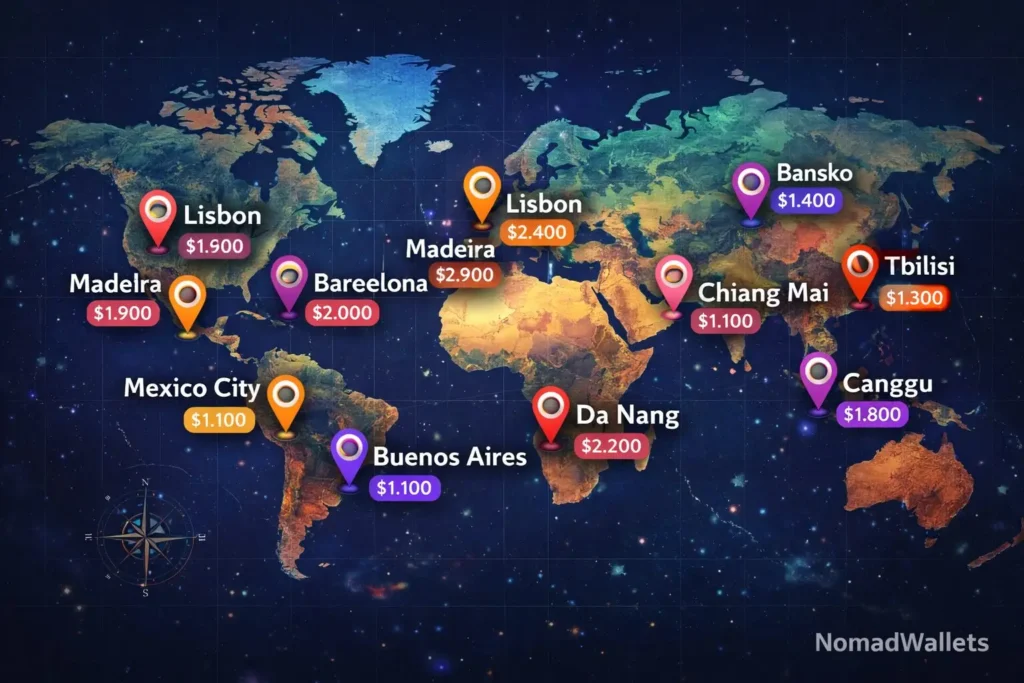
| Region | City | Monthly Cost (USD) | Best For |
| SE Asia | Chiang Mai, Thailand | $1,100 to $1,400 | Long-term base, community |
| SE Asia | Canggu, Bali | $1,300 to $1,700 | Lifestyle, surf culture |
| SE Asia | Da Nang, Vietnam | $900 to $1,200 | Maximum value |
| LATAM | Medellín, Colombia | $1,200 to $1,600 | Weather, social scene |
| LATAM | Mexico City, Mexico | $1,500 to $2,000 | Culture, food, co-working |
| LATAM | Buenos Aires, Argentina | $800 to $1,200 | Extreme value (volatile FX) |
| Balkans | Bansko, Bulgaria | $900 to $1,200 | Tight community, affordable EU |
| Balkans | Tbilisi, Georgia | $1,000 to $1,400 | Visa-free, unique culture |
| W. Europe | Lisbon, Portugal | $2,200 to $2,800 | Nomad visa, infrastructure |
| W. Europe | Madeira, Portugal | $1,800 to $2,400 | Nature, slower pace |
| W. Europe | Barcelona, Spain | $2,000 to $2,600 | City life, nomad visa |
By tracking your spending meticulously across locations, you build a personal cost-of-living database that’s far more accurate than any generic index. This is one of the most powerful long-term benefits of consistent digital nomad budget tracking: it gives you the data to make strategic relocation decisions based on your actual lifestyle, not someone else’s estimates.
🌍 Geo-Arbitrage in Action: A nomad earning $5,000/month in USD could save $800/month by choosing Da Nang over Mexico City. That’s $9,600 per year in additional savings, with no reduction in quality of life. Use the NomadWallets Cost of Living Tool to run these numbers against your own burn rate.
Advanced Digital Nomad Budget Tracking for Taxes
For many nomads, the most consequential reason to maintain rigorous digital nomad budget tracking is tax compliance. As governments worldwide tighten regulations around remote work and digital income, your expense records become a primary line of defense during audits and a prerequisite for many visa applications.
The Business/Personal Split
If you’re a freelancer or business owner, cleanly separating business and personal expenses isn’t optional. It’s a legal requirement in virtually every tax jurisdiction. Your digital nomad budget tracking system should categorize every expense as one or the other at the point of entry, not retroactively at tax time.
Use separate bank accounts or cards for business and personal spending where possible, and choose a tracking app like Expensify or YNAB with custom categories that enforces this separation in the data structure. For a deeper look at structuring your nomad business correctly, see the NomadWallets LLC setup guide for US-based nomads.
Digital Nomad Visas and Proof of Funds
The proliferation of digital nomad visas has created a new use case for detailed financial tracking. Countries like Spain, Portugal, Croatia, and Greece now offer digital nomad visa programs that require proof of sufficient income and financial stability during the application process.
Portugal’s IFICI regime (which replaced the former NHR program) requires applicants to demonstrate qualifying income and may request detailed financial records during the application. Spain’s digital nomad visa, fully operational in 2026, requires proof of income at least 200% of the Spanish minimum wage.
Having twelve months of meticulously tracked income and expenses, exported from your digital nomad budget tracking app, provides exactly the documentation these consulates want to see.
📋 Visa-Ready Financial Records: What Consulates Want
Most digital nomad visa applications require three things your tracking app can provide:
- Proof of consistent income: 6 to 12 months of income records showing regular freelance or remote earnings.
- Proof of sufficient funds: bank statements or savings balances above the country’s threshold.
- Expense history: evidence that you can sustain yourself financially in the host country.
An organized export from YNAB or Expensify can replace months of scrambling for documents.
Tax Residency Tracking
Your tracking data also helps establish or disprove tax residency. Many countries use a 183-day rule. If you spend more than 183 days in a jurisdiction, you may be considered tax resident there. Your digital nomad budget tracking data, showing the dates and locations of your spending, creates a de facto travel log that can support your tax position.
This is increasingly important as tax authorities develop more sophisticated methods for tracking the movements of remote workers.
For a complete breakdown of how this applies to US citizens specifically, the NomadWallets US digital nomad tax guide is a good starting point.
The best tracking systems don’t just record what happened. They tell a story. These two stories show what happens when that story goes wrong, and when it goes right.
User Stories: Real-World Tracking Failures and Successes

The “Cash-Only” Nightmare
James, a 28-year-old Australian web developer, spent six months in Vietnam in 2025, working primarily from Hanoi and Hoi An. Vietnam remains one of the most cash-dependent economies in Southeast Asia for everyday transactions. Street food, local markets, motorbike rentals, and many smaller accommodations operate exclusively in Vietnamese dong, with no card reader in sight.
James had set up Spendee for automated tracking through his Wise card, but he quickly discovered that his card accounted for less than 30% of his actual spending. The other 70% was cash, withdrawn from ATMs and spent in small, untraceable increments.
For the first two months, he tried to log cash expenses manually each evening, but the discipline slipped. By month three, he was estimating rather than recording. By month six, his digital nomad budget tracking data was essentially fiction.
His Spendee dashboard showed he was under budget, while his actual bank balance told a different story. He had overspent by approximately $2,400 AUD over the period.
🔑 James’s Fix: He switched to Trail Wallet for its five-second manual entry speed, committed to logging every transaction at the point of purchase (not at the end of the day), and used ATM withdrawal amounts from his bank statement as a cross-reference to catch any gaps. When he moved to Thailand afterward, his tracking accuracy improved to within 3% of his actual bank balance.
The “Automated” Success
Maria, a 34-year-old freelance copywriter from Portland, Oregon, set a goal in early 2025: save $40,000 for a down payment on a property while living abroad. She chose Tbilisi, Georgia as her base, a city where her $5,500/month freelance income would stretch significantly further than in the US.
Maria’s digital nomad budget tracking system was built on three layers. She used Wise as her primary banking platform, with auto-conversions from USD to Georgian lari. She connected Wise and her US credit card to YNAB, where she practiced zero-based budgeting with a custom category structure designed around her savings goal. And she conducted a weekly 15-minute financial review every Sunday morning, reconciling her accounts and adjusting her budget for the coming week.
Over eighteen months, Maria’s system worked remarkably well. YNAB’s currency conversion plugins handled the USD/GEL exchange rate fluctuations, and her disciplined weekly reviews caught small category overages before they compounded. She reached her $40,000 savings target two months ahead of schedule, partly because her tracking data revealed that her grocery spending in Tbilisi was 60% lower than Portland, freeing up more money for savings than she had projected.
Her experience demonstrates that digital nomad budget tracking, when layered onto solid banking infrastructure and practiced with consistency, can be a genuine wealth-building tool.
Step-by-Step: Setting Up Your Tracking System in 15 Minutes
You don’t need a weekend to build a functional digital nomad budget tracking system. Here’s how to get operational fast.
Step 1: Choose a Base Currency (2 minutes)
This is the currency you think in, earn primarily in, and will use to evaluate your financial health. For most nomads, this is USD, EUR, or GBP. Every expense you track should ultimately convert to this base currency, regardless of what local currency you spend in. Set this in your tracking app immediately. It’s the single most important configuration decision you’ll make.
Step 2: Select Your Tracking Trigger (3 minutes)
Decide based on your lifestyle. If you spend primarily by card in countries with strong banking infrastructure, choose an automated app like Spendee or Wallet by BudgetBakers and connect your accounts. If you spend significant amounts in cash, choose a fast manual app like Trail Wallet or TravelSpend. If your spending is mixed, use an automated app supplemented by manual cash entries.
Step 3: Set “Local Buffer” Categories (5 minutes)
Beyond your standard categories (housing, food, transport, entertainment), create a “Local Buffer” category for each country you visit. This catches location-specific expenses that don’t fit neatly elsewhere: visa fees in Thailand, SIM card purchases in Portugal, motorbike deposits in Bali. These irregular costs are where digital nomad budget tracking most commonly breaks down, and having a dedicated category prevents them from distorting your other data.
Step 4: Establish a Weekly Review Routine (5 minutes to schedule)
Choose a fixed time each week. Sunday morning with coffee works for many nomads. Spend 10 to 15 minutes reviewing your data: check that automated transactions are categorized correctly, enter any missing cash expenses, compare your spending velocity against your monthly budget, and adjust your plan for the coming week. This single habit is the difference between nomads who succeed at digital nomad budget tracking and those who abandon it within a month.
✅ Your 15-Minute Setup Checklist
- ☐ Base currency selected and configured in app
- ☐ Primary tracking app downloaded (manual, auto, or both)
- ☐ Bank accounts connected (if using automated tracking)
- ☐ “Local Buffer” category created for current country
- ☐ Weekly review time blocked on your calendar
Done. You now have a functional digital nomad budget tracking system. Refine it over the coming weeks, but start tracking today.

The Future of Money: AI and Crypto in Your Budget
Agentic Commerce and AI-Driven Tracking
The most exciting frontier in digital nomad budget tracking is the emergence of agentic AI, meaning AI assistants capable of not just recording your finances but actively managing them. In 2026, early versions of these systems can monitor your spending patterns, alert you to unusual charges, negotiate better rates on recurring subscriptions, and even suggest optimal times to convert currencies based on FX trend analysis.
Within the next two to three years, expect AI agents that can fully automate your digital nomad budget tracking by ingesting data from every financial account, reconciling cash spending through receipt photos, and generating real-time budget reports with natural language summaries.
Stablecoins in Your Financial Stack
For a growing number of nomads, stablecoins like USDC and USDT have become a practical part of daily finance, used for receiving client payments, storing value outside traditional banking, and making cross-border transfers with minimal fees.
If you use stablecoins, your digital nomad budget tracking system needs to account for them alongside fiat currencies. Some tracking apps have begun adding crypto wallet integration, but in most cases you’ll need to log stablecoin transactions manually or use a crypto-specific tracker like CoinTracker alongside your primary budget app.
The key is ensuring that your financial picture is complete. If 20% of your income flows through stablecoins and you’re only tracking fiat, your budget data is fundamentally incomplete.
🔮 What’s Coming: AI Budget Tracking by 2027 to 2028
- Auto-categorization of every transaction across cards, cash (via receipt photos), and crypto wallets
- Predictive alerts that warn you before you overspend, not after
- FX optimization with AI agents that convert currencies at statistically optimal times
- Tax-ready reports generated automatically at year-end
The nomads who build solid tracking habits now will be best positioned to leverage these tools when they arrive.
Frequently Asked Questions
Q1: What is the best budget app for digital nomads just starting out?
A: Trail Wallet or TravelSpend work best for beginners because they’re simple, affordable, and teach budget awareness through manual tracking. Start with manual tracking for two to three months to understand your spending patterns, then consider automated options like Spendee if manual entry becomes burdensome.
Q2: How do I handle ATM fees in my budget?
A: Create a dedicated “Banking Fees” category and log every ATM fee, currency conversion charge, and service fee you encounter. Over time, this data reveals which banks and cards are costing you the most. Many nomads find that switching to accounts with ATM fee reimbursement, like Charles Schwab Investor Checking, eliminates this category almost entirely.
Q3: Can I use multiple budget apps simultaneously?
A: Yes, and many experienced nomads do exactly this. A common setup is using Wise or Revolut for banking and currency exchange while using Trail Wallet or TravelSpend for detailed expense tracking. The apps serve different purposes and complement each other well.
Q4: How do I handle fluctuating exchange rates in my budget?
A: Track expenses using the actual exchange rate you received for each transaction, not theoretical mid-market rates. Most budget apps update exchange rates automatically, but if you’re manually tracking, record the rate shown on your bank statement or currency exchange receipt for accuracy. YNAB’s guide on multiple currencies is a solid reference for this approach.
Q5: Should I set my budget in USD or the local currency?
A: Set your overall budget in your home/tax currency (USD for Americans), but create location-specific sub-budgets in local currencies for daily spending awareness. This dual approach maintains consistent long-term financial planning while giving you practical spending limits in the currency you’re actually using.
Q6: How much should I budget monthly as a digital nomad?
A: It varies dramatically by location and lifestyle. Low-cost destinations like Southeast Asia, parts of Latin America, and Eastern Europe support comfortable nomad lifestyles for $1,500 to $2,000 monthly. Mid-range locations like Portugal, Spain, and Mexico City typically require $2,000 to $3,000 monthly. High-cost cities in Western Europe, Singapore, and Tokyo often demand $3,000 to $5,000+ monthly. For more targeted estimates, the NomadWallets Cost of Living Calculator lets you compare cities against your actual budget.
Q7: Is manual tracking better than bank syncing?
A: Neither is universally superior. Manual tracking offers more control and works in cash-heavy economies, while bank syncing saves time and reduces the risk of forgotten transactions. The most effective digital nomad budget tracking systems combine both, using automated syncing for card transactions and manual entry for cash.
Q8: Do I need to track expenses for tax purposes?
A: Yes, if you’re running a business as a digital nomad. The IRS allows deductions for legitimate business expenses including coworking, business travel, professional development, equipment, and internet service. Detailed expense tracking throughout the year makes tax filing significantly easier and often reduces tax liability by thousands of dollars. The NomadWallets US digital nomad tax guide covers deductible categories in detail.
Choosing Your Budget Tracking System
Most digital nomads don’t use just one tool. The most common approach combines a digital banking solution like Wise or Revolut for currency exchange and international spending with a dedicated digital nomad budget tracking app like Trail Wallet, TravelSpend, or Spendee for detailed expense tracking and budget management.
Choose Trail Wallet if you want simple manual tracking without subscriptions, prefer one-time purchases over ongoing fees, and primarily travel solo for shorter periods of one to six months.
Choose TravelSpend if you need group expense splitting functionality, want detailed location-based analytics, and plan long-term travel of six months or more across multiple countries.
Choose Spendee if you want automated bank syncing to eliminate manual entry, use credit/debit cards for 90%+ of purchases, and have consistent internet access.
Choose YNAB if you want comprehensive financial management including debt payoff, retirement savings, and investment tracking alongside travel expense monitoring.
Choose Wise or Revolut if you want banking and budget tracking combined in one platform with minimal app switching and no third-party synchronization.
The best recommendation? Test different combinations during your first two to three months as a digital nomad. Your tracking system should feel natural and sustainable, not like homework you’re constantly avoiding. If you’re not checking your budget app at least weekly and adjusting spending based on what you see, something about your setup isn’t working for your personal style.
Budget tracking isn’t about restriction. It’s about awareness and optimization. The goal is understanding where your money goes so you can make informed decisions about spending more on experiences you value and less on things that don’t matter. Good systems enable the freedom to travel sustainably for years, not just months before running out of money.
🚀 Your Next Move
Head over to the NomadWallets Cost of Living Tool to compare your current burn rate against dozens of global nomad hubs, and start making geo-arbitrage decisions backed by real data, not guesswork. You can also explore the NomadWallets tax estimator to see how location changes affect your tax position alongside your living costs.
Further Reading and Reference Links
- Best Budgeting and Expense Tracking Apps for Digital Nomads — Freaking Nomads
- Best Expense Tracker/Budget App with Multi-Currency — r/solotravel Discussion
- How to Handle Multiple Currencies in YNAB — You Need A Budget
- Using Multiple Currencies in YNAB: A Guide — YNAB Support
- TravelSpend Review: The Best Budget App for Long-Term Travelers — The Traveler
- TravelSpend Review: How We Track Every Dollar — Adam and Linds
- Spendee Pricing — Official Subscription Plans
- Digital Nomad Essentials 2025: The Best Apps, Tools and Resources — Citizen Remote
- Best Budgeting Apps of 2025 — Forbes Advisor
- Numbeo Cost of Living Database — Global Cost Comparisons
- Global Remote Work Statistics 2026 — DemandSage
- Wise Official Fee Schedule — Wise
- Revolut Plans and Pricing — Revolut
All pricing, features, and app capabilities were verified as of early 2026. Budget ranges reflect 2026 cost-of-living data from multiple nomad communities and financial platforms.

Hi, I'm Tushar, founder of NomadWallets.com. I created this site after realizing how complicated managing money becomes once you start living and working across multiple countries. Most financial advice online is written for people who never leave their home country, which leaves digital nomads navigating international banking, transfers, taxes, and visas with very little reliable guidance.
NomadWallets exists to provide clear, practical, research-backed financial information for location-independent professionals worldwide. Every article published on this site is researched using official sources, live platform data, and global benchmarks such as World Bank remittance reports. Our research covers international banking, cross-border payments, and financial infrastructure for digital nomads.