

Primary References: Ministério dos Negócios Estrangeiros (MFA Portugal), AIMA.gov.pt, Diário da República
If you are reading guides written in 2024, stop. You are looking at a country that no longer exists legally.
The “Gold Rush” era of moving to Portugal, characterized by cheap city rents, easy tax holidays, and loose visa rules is over. In 2026, we have entered the Settlement Era. The government has professionalized the migration system, significantly raised the financial bars, and closed the most popular loopholes.
But this isn’t bad news. For serious remote workers, Digital Nomad Portugal remains the best base in Europe. The infrastructure is better, the internet is faster (now averaging 1Gbps in cities), and the community is now permanent rather than transient.
This guide is your Central Hub for navigating the new reality of Digital Nomad Portugal in 2026. We will cover the specific income math for the D8 visa, the truth about the “New NHR” (IFICI), and the realistic cost of living in the top three nomad hubs.
The Visa Landscape (Active vs. Passive)
The most common mistake Digital Nomad Portugal applicants make in 2026 is applying for the wrong visa. Portuguese consulates are now strictly enforcing the difference between “Passive Income” and “Active Work.” If you apply for the wrong stream, you will not just be delayed; you will be rejected.
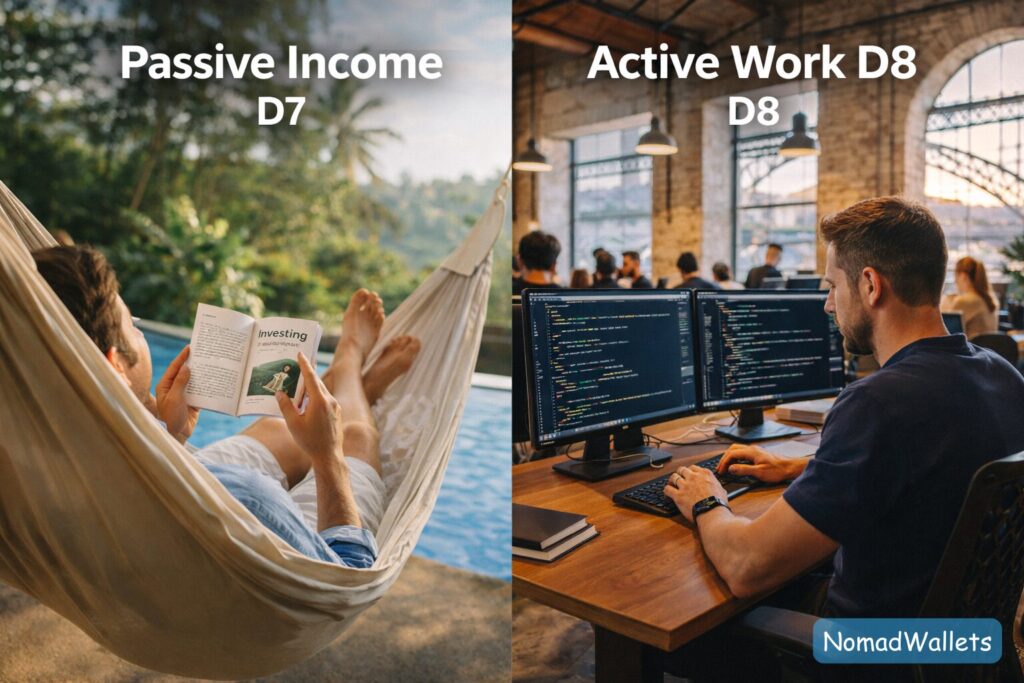
1. The D8 Visa (Digital Nomad Visa)
Best for: Remote Employees, Freelancers, & Founders
Introduced to solve the legal grey area of remote work, the D8 is now the standard route for the Digital Nomad Portugal community earning a salary. However, the income requirement has jumped significantly due to the 2026 minimum wage increase.
The 2026 Income Math
The law states you must earn 4x the Portuguese Minimum Wage. According to the official Government Decree for 2026, the minimum wage is now €920.
- 2026 Minimum Wage: €920 per month.
- Your Required Income: €3,680 per month (Net vs. Gross depends on consulate interpretation. Always document gross income to avoid discretionary rejection).
- Compliance Tip: Always use your Gross Income for the application, but be prepared to show that your Net Income still covers at least €3,680 after your home-country taxes are paid.
Required Documents Checklist
To apply, you must gather these documents before booking your appointment at VFS Global or the Consulate:
- Proof of Work: An employment contract or service agreement allowing remote work. (Must be dated within the last 3 months).
- Proof of Income: Pay slips or bank statements for the last 3 months showing the €3,680+ deposits.
- NIF (Tax Number): You must obtain a NIF before applying. This can be done remotely via services like Bordr or Anchorless.
- Bank Account: You must open a Portuguese bank account (funded with approximately 12 months of minimum wage savings (~€11,040), depending on consulate).
- Accommodation: You need a 12-month lease. Warning: Airbnb bookings are no longer accepted by most consulates.
- Criminal Record: Issued by the FBI (for Americans) or your home country’s police, with an Apostille.
Portugal Digital Nomad Visa (D8) 2026: Avoid Rejection & Get Approved (In this article: We break down the exact documents you need, the NIF process, and why “Temporary Stay” might be better than “Residency” for some).
2. The D7 Visa (Passive Income)
Best for: Retirees, Crypto Investors, Landlords & FIRE Adherents
Often called the “Retirement Visa,” the D7 remains a premier route for younger nomads exclusively living off passive sources like dividends, rental income, or royalties. It is legally processed under the general provisions of Article 58 of Law 23/2007 and specifically defined by Regulatory Decree 84/2007
The 2026 Income Math
The requirement is strictly tied to the 2026 Minimum Wage (€920). To pass an audit or consulate check, you must prove you receive this amount monthly from passive sources.
| Applicant | 2026 Monthly Income | 12-Month Savings (Min) |
| Main Applicant | €920 | €11,040 |
| Spouse/Partner | +€460 (50%) | +€5,520 |
| Dependent Child | +€276 (30%) | +€3,312 |
The “Active Income” Trap
Do not try to use a remote salary for the D7. If you submit a payslip from a US company as your “proof of income,” the consulate will reject you and tell you to apply for the D8. The D7 is strictly for income that arrives while you sleep (Passive).
⚠️ 2026 Compliance Warning: Do not attempt to use a remote salary for the D7 visa. Portuguese consulates and AIMA (formerly SEF) have officially ended the “grey area” where remote workers could use the lower D7 income threshold. Active remote work, including full-time employment, freelance contracts, and managed business income now falls strictly under the D8 (Digital Nomad Visa). If your income requires you to “show up” to work (even virtually), the D7 is no longer an option and will result in an immediate rejection.
Deep Dive: Is the D7 Right for You? If you have passive income (rentals, dividends, or a pension) and want a lower-cost path to residency than the D8, the D7 remains the “gold standard.” For a complete step-by-step on 2026 income thresholds, the NIF process, and how to prove your passive earnings to the consulate, see our dedicated Portugal D7 Visa Approval Guide.
Comparison Table: D7 vs. D8 Visa
| Feature | 🧘 D7 Visa (Passive Income) | 💻 D8 Visa (Digital Nomad) |
| Primary Target | Retirees, Landlords, Investors | Remote Workers, Freelancers |
| Income Source | Pensions, Dividends, Real Estate, Royalties | Salary, Invoices, Service Contracts |
| Min. Monthly Income (2026) | €920 (Main Applicant) | €3,680 (Main Applicant) |
| Dependent Add-on (Income) | +€460 (Spouse) / +€276 (Child) | +€1,840 (Spouse) / +€1,104 (Child) |
| Savings Required (12 Mo) | €11,040+ (Single) | €11,040+ (Single) |
| Savings for Couple | €16,560+ | €16,560+ |
| Tax Status | Standard Progressive (unless IFICI) | Standard Progressive (unless IFICI) |
| Can you work locally? | Yes | Yes |
| Residency Path | 5 Years to Citizenship | 5 Years to Citizenship |
The Tax Reality (NHR is Dead, Long Live IFICI)
For over a decade, the Non-Habitual Resident (NHR) program was the crown jewel of the Digital Nomad Portugal strategy.
As of late 2024, the old NHR is closed to new applicants.
Anyone planning a move as a Digital Nomad Portugal resident in 2026 faces a new tax reality. Depending on your professional profile, you will navigate between the Standard Progressive Tax or the new IFICI regime.
Option A: The IFICI Regime (NHR 2.0)
The Tax Incentive for Scientific Research and Innovation (IFICI) is the replacement. It is far stricter than the old NHR. According to Ordinance 352/2024/1, eligibility is now tied to specific “value-added” careers.
Who Qualifies in 2026?
You must fall into specific categories verified by the Foundation for Science and Technology (FCT) or the Tax Authority:
- Certified Startups: Employees or board members of startups certified by Startup Portugal.
- Research & Development: Scientists and researchers working in recognized centers.
- Higher Education: University professors and teaching staff.
- Highly Qualified Roles: Specialists in IT (Code 25), Engineering (Code 21), and Executive Management (Code 112) working for entities in eligible sectors.
[!IMPORTANT] ⚠️ The January 15 Deadline: To benefit from IFICI, you must submit your application by January 15 of the year following the year you become a tax resident. If you move in 2026, your deadline is January 15, 2027.
Who DOESN’T Qualify?
- The generic freelance copywriter.
- The marketing consultant working for a US agency.
- The crypto trader.
- Important: You cannot qualify if you work remotely for a foreign company with no Portuguese entity.
Read the Full Guide: Portugal’s NHR 2.0 (IFICI): Can US Digital Nomads Still Pay 20% Tax? (In this article: We analyze the specific job codes and how to “structure” yourself to potentially qualify).
Option B: Standard Progressive Tax
If you don’t qualify for IFICI, you pay standard Portuguese tax on your worldwide income. For 2026, the tax brackets have been updated by 3.5% to account for inflation.
2026 Official Tax Brackets (IRS):
| Taxable Income (€) | Rate |
| Up to €8,342 | 13.00% |
| €8,342 – €12,587 | 15.70% |
| €12,587 – €17,838 | 21.20% |
| €17,838 – €23,089 | 24.10% |
| €23,089 – €29,397 | 31.10% |
| Over €86,634 | 48.00% |
🇺🇸 Special Note for Americans: Even if you qualify for Portuguese tax breaks, the IRS still wants its share. You need to leverage the Totalization Agreement to avoid paying Social Security in both countries. For more strategies on managing US taxes, banking, and compliance while living abroad, check out our US Digital Nomad Hub and also Read the Full Guide: US Expats in Portugal: Avoiding Double Taxation & Social Security
Lifestyle & Where to Live (The Top 3 Hubs)
The Digital Nomad Portugal map has shifted. Lisbon is now a premium European capital with prices to match. In 2026, the community has decentralized into three distinct “hubs,” each offering a completely different lifestyle.
1. Lisbon: The Global Capital
- Vibe: Fast-paced, international, tech-focused.
- Best For: Networking, nightlife, and access to investors.
- The Reality: It is crowded. You will hear more English and French on the streets than Portuguese. Lisbon remains the most popular entry point for the Digital Nomad Portugal scene.
- Coworking: Second Home, Croissant, Heden.
- Rent (2026): Expect to pay €1,600+ for a decent T1 in the city center.
2. Porto: The Northern Soul
- Vibe: Moody, creative, architectural, authentic.
- Best For: Designers, writers, and those who find Lisbon too “plastic.”
- The Reality: The weather is grey and rainy in winter (November–March). You must be okay with rain.
- Coworking: Porto i/o, Synergy.
- Rent (2026): Slightly cheaper than Lisbon, but rising fast. €1,100 – €1,300 for a T1.

3. Madeira: The Nomad Island
- Vibe: Nature, hiking, wellness, “Island Time.”
- Best For: Community seekers. The “Ponta do Sol” Digital Nomad Village created a tight-knit bubble.
- The Reality: It is an island. Amazon deliveries take longer, and you can get “island fever” after 6 months.
- Coworking: StartUp Madeira, Cowork Funchal.
- Rent (2026): The best value. €800 – €1,000 for a T1.

Table: Digital Nomad Portugal Cost of Living (2026)
| Expense | Lisbon | Porto | Madeira (Funchal) |
| Rent (T1 Center) | €1,600 | €1,200 | €950 |
| Coworking (Monthly) | €250 | €180 | €150 |
| Coffee (Espresso) | €1.50 | €1.00 | €1.00 |
| Meal (Mid-range) | €25 | €18 | €15 |
| Uber (Avg Trip) | €7 – €10 | €5 – €8 | €5 – €7 |
| Total Budget (Single) | €2,800+ | €2,200+ | €1,800+ |
A Note on Transport: While Uber is cheap (as seen in the table above), buying a car is expensive due to the ISV tax. Most nomads make the mistake of trying to import their foreign vehicle. Don’t do it.
Logistics & The “Boring” Stuff
You can’t live on “vibes” alone. To succeed in your Digital Nomad Portugal move, you need to handle the basics: internet, health insurance, and banking.
1. The Housing Crisis & Guarantors
Finding an apartment is the hardest part of the Digital Nomad Portugal transition. Portuguese landlords almost always demand a Fiador (Guarantor). Since you don’t have a Portuguese family member to sign for you, you need a strategy.
- Strategy A: Use Flatio or Uniplaces. These platforms are designed for mid-term stays (1-6 months) and do not require guarantors.
- Strategy B: Offer 6 months rent upfront. This is the standard “foreigner tax” to bypass the guarantor requirement on sites like Idealista.
For a complete step-by-step breakdown of both strategies, visa-compatible contracts, neighbourhood pricing, and how to avoid rental scams, read our full guide: How to Rent in Lisbon Without a Guarantor: Proven Strategies for Lisbon & Porto (2026)
2. Healthcare: SNS vs. Private
Your visa application requires private travel insurance (like Allianz or MGEN) with coverage of at least €30,000. However, once you are a legal resident (have your residency card) and are registered with Finanças and your local health center, you get access to the SNS (Serviço Nacional de Saúde).
- SNS Cost: Nearly free (small co-pays for appointments).
- Wait Times: Long for non-emergencies. Most nomads keep private insurance (€40/month) to skip the queues at private hospitals like CUF.
3. Banking & Money
You cannot rent an apartment or get internet without a Portuguese IBAN.
Millennium BCP is the one to open before you arrive. They accept Power of Attorney setups through services like Bordr, which means you can land in Lisbon with a fully active account and a real bank statement already in hand, exactly what your visa application needs. ActivoBank, owned by the same group, is the zero-fee option most expats switch to once they have their residency card. The app is the best in Portugal and the branches stay open on Saturdays.
One thing many guides skip: you need a Portuguese bank account specifically to use MB Way, the payment system that runs daily life here. Rent, bills, splitting dinner. Revolut does not qualify.
🏦 Read the Full Guide: Best Portuguese Banks for Non-Residents – Millennium BCP vs. ActivoBank We cover the 2026 fee structures, how to open remotely before you arrive, and the exact two-step strategy most long-term expats use.
4. Internet & SIM Cards
You cannot rely on average Airbnb Wi-Fi for Zoom calls. You need to know which fiber providers have the best upload speeds and which SIM cards offer unlimited data for backup.
5. The “Holy Trinity”: NIF, NISS & Finanças
Getting the visa is only half the battle. Once you land in Portugal, you have a strict 30-day window to register with the Tax Authority (Finanças) and Social Security. If you miss this, you cannot legally issue invoices to your clients or access public healthcare. You must secure three specific numbers immediately:
- NIF: (Tax ID – you likely have this already).
- NISS: (Social Security Number – required for your residency card).
- NNU: (National Health Number – required for the hospital).

6. The “Pain Point”: AIMA (Formerly SEF)
Getting the visa is step one. Getting your residency card is the real battle. The agency SEF was abolished and replaced by AIMA (Agência para a Integração, Migrações e Asilo). The backlog for appointments in 2026 remains a major hurdle.
- The Reality: You might enter on your D8 visa and wait 8-10 months for your biometric appointment.
- The Rule: You are legal to stay in Portugal while waiting, even if your visa “expires,” as long as you have an appointment pending.
Final Verdict: Is Portugal Still Worth It in 2026?
Moving to Portugal is no longer a “hack.” It is a lifestyle investment.

If you are looking for the cheapest place in the world to live, this isn’t it anymore (try SE Asia or South America). But if you are looking for a safe, stable, European base with a high quality of life, excellent healthcare, and a time zone that aligns with both the US East Coast and Europe, Digital Nomad Portugal is still the gold standard.
Stay tuned. We are currently finalizing our deep dive guides on the D8 Visa and NHR 2.0 to ensure they have the latest 2026 updates. Bookmark this page and check back soon.
Disclaimer: This article is provided for general informational and educational purposes only and does not constitute legal, tax, or financial advice.
Note: Immigration rules, visa requirements, and tax regimes in Portugal (including D7/D8 visas and the NHR/IFICI framework) change frequently and may be applied differently by individual consulates and authorities. While this guide is updated for 2026, you should always consult a qualified Portuguese immigration lawyer or tax professional before making relocation or financial decisions based on your personal circumstances.
Frequently Asked Questions (FAQ)
Q1: Can I work on a tourist visa in Portugal?
A: Legally, no. The “tech visa” loophole is gone. You should apply for the D8 or D7 visa from your country of residence. Entering as a tourist and trying to “regularize” via the “Manifestation of Interest” (Article 88.2) was abolished in June 2024. Do not attempt this route in 2026.
Q2: Is the “Golden Visa” still available?
A: Yes, but not for Real Estate. You can no longer buy a €500k apartment to get a visa. You must invest in Funds (Private Equity/VC) or Cultural Heritage projects.
Q3: What happens if I don’t meet the D8 income requirement?
A: You will be rejected. There is no “close enough.” If you earn €3,000 instead of €3,680, consider moving to Spain (Non-Lucrative Visa) or Italy (Digital Nomad Visa), which have different thresholds.
Q4: Do I need to speak Portuguese?
A: To survive? No. English is widely spoken in Lisbon, Porto, and Algarve. To integrate? Yes. The locals appreciate it, and it is required (A2 level) if you want to apply for Citizenship after 5 years.

Hi, I'm Tushar, founder of NomadWallets.com. I created this site after realizing how complicated managing money becomes once you start living and working across multiple countries. Most financial advice online is written for people who never leave their home country, which leaves digital nomads navigating international banking, transfers, taxes, and visas with very little reliable guidance.
NomadWallets exists to provide clear, practical, research-backed financial information for location-independent professionals worldwide. Every article published on this site is researched using official sources, live platform data, and global benchmarks such as World Bank remittance reports. Our research covers international banking, cross-border payments, and financial infrastructure for digital nomads.