

If you are relying on Temporary Protection right now, there is something you need to know before the deadlines arrive.
The rules changed in March 2026, quietly, without warning, and thousands of digital nomads and remote workers across Eastern Europe are only finding out when they try to access a bank, renew a benefit, or book a flight. These Eastern Europe visa changes 2026 are not just administrative updates.
What sounds like a bureaucratic change is actually a structural shift in how the EU treats displaced workers, and the ripple effects touch banking, tax residency, and your ability to legally work from anywhere in the region. This is where things start to break for people.
If you are building a remote career in Europe, you need to understand this shift now, not when your account gets frozen.
Eastern Europe Visa Changes 2026: What You Need to Know Fast
Here is what changed and why it matters:
- Temporary Protection is entering its final phase, with a hard deadline of March 2027
- Leaving Poland for more than 30 consecutive days automatically cancels your legal status
- Banks are tightening access for anyone with uncertain or transitional residency status
- A Digital Nomad Visa is now the most reliable path to stable legal footing in Europe
- The August 31, 2026 identity verification deadline in Poland affects a large group of current holders
If any of those apply to you, keep reading.
Eastern Europe Visa Changes 2026: Why the Old System No Longer Works
Eastern Europe has long been one of the most affordable and accessible bases for location-independent workers. But the legal foundation that made much of this possible, the EU Temporary Protection Directive, is now running out.
Poland updated its rules in March 2026. Romania raised its digital nomad income requirements. Spain moved to strict physical presence verification for renewals. The era of lightly enforced temporary frameworks is over. What replaces it requires real compliance.
For digital nomads, this creates three specific risks. Your legal status now directly affects your banking access. How long you stay in a country determines your tax exposure. And many remote workers have been operating on tourist logic inside frameworks that were never designed for them.
The 2026 changes are forcing a decision that has been deferred for years: get a proper legal structure, or accept the consequences of staying in the grey zone.
This is not a policy update. It is a system reset.
Pro Tip: Always treat temporary visas as short-term solutions. The moment you receive one, start planning your transition to something stable. The people in crisis right now are the ones who did not.
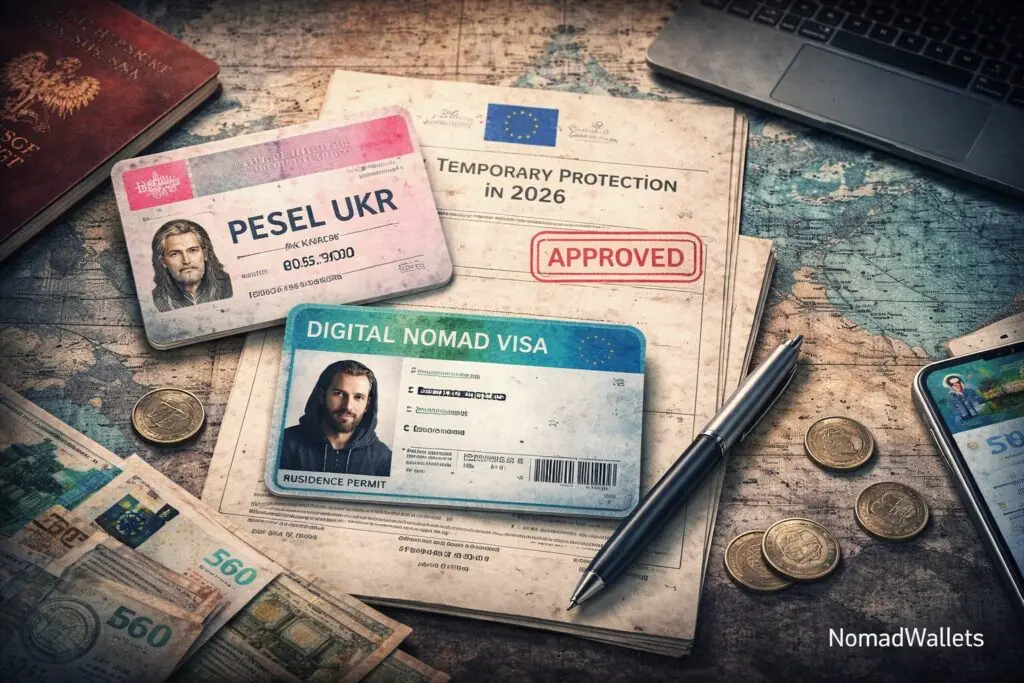
Key Terms Explained: Eastern Europe Visa Changes 2026
Temporary Protection Status (TPS)
An EU emergency mechanism activated in March 2022, giving displaced Ukrainians the right to reside and work in EU countries without going through individual asylum applications.
PESEL UKR
Poland’s national ID number with a UKR designation, issued to Ukrainians under Temporary Protection. It is the document that unlocks banking, healthcare, employment, and social services in Poland.
Digital Nomad Visa (DNV)
A formal residence permit for remote workers, offering stable legal status, defined rights, and a residency that banks can actually verify.
Poland 2026: What Actually Changed
Poland is home to approximately 1.5 million Temporary Protection holders, the largest single group in the EU. On 5 March 2026, the country replaced its emergency “Ukrainian Special Act” with a new framework aligned to the general EU Temporary Protection system. According to DLA Piper, this brought formal eligibility rules, clearer rules on when status is lost, and mandatory identity checks.
Here is what changed in practice:
- PESEL UKR is now valid until 4 March 2027, aligned with the EU-level extension
- New arrivals must register for PESEL UKR within 30 days of entering Poland
- Leaving Poland for more than 30 consecutive days automatically cancels Temporary Protection status, regardless of reason
- Temporary Protection holders can now set up a sole proprietorship (JDG) on the same terms as Polish citizens
- A new CUKR residence card is available for three years with full Schengen travel rights
The 30-Day Rule
Under the new regulations, leaving Poland for more than 30 consecutive days triggers automatic loss of Temporary Protection status. That means banking access, healthcare, and work authorization all go with it. Status can be re-applied for, but the process is not guaranteed and comes with gaps in legal coverage.
The August 31 Deadline
Anyone whose PESEL UKR was issued on the basis of a declaration, without presenting a valid travel document, must appear in person at a municipal office with a valid travel document by 31 August 2026. According to UNHCR Poland, failure to do this changes status to NUE (unregulated stay) from 1 September 2026, meaning loss of all legal residence rights. If this applies to you, act now.
Important: Never travel outside Poland without checking how the trip length affects your status. Even a well-intentioned visit to family can trigger cancellation under the current rules.

The Banking Risk Nobody Talks About
Legal status and financial access are now directly linked across the EU, and banks move faster than immigration offices.
What triggers account restrictions:
- Holding temporary or transitional status with no stable residency proof
- Frequent IP or device location changes (common for nomads)
- Crypto-heavy or multi-source irregular income
- A status change flagged by an automated compliance system
In many cases, accounts get frozen within days of a status change, not because they did anything wrong, but because the bank’s system detected the status change and flagged it.
How to protect yourself:
Keep at least one verified employment contract or client agreement showing stable, recurring foreign income. Maintain accounts in at least two separate institutions. Fintech providers like Wise or Revolut are useful buffers, but they are not a substitute for a primary account tied to a verified residential address.
For specific account types and providers that hold up when your status is in flux, the best mobile banks for travelers guide is worth reading before you travel.
Digital Nomad Visas: Your Stable Exit
The EU Council’s own exit strategy, adopted in September 2025, makes the direction clear: the replacement for Temporary Protection is national residence permits. For remote workers, a Digital Nomad Visa is now the cleanest path forward.
Hungary – White Card
A residence permit for non-EU nationals working remotely for companies outside Hungary. One of the most accessible DNV options in Europe.
- Income: EUR 3,000/month net, from outside Hungary
- Savings: EUR 10,000 minimum
- Valid 1 year, renewable once (2 years max)
- No pathway to permanent residency
- No family reunification through this permit
- Processing time: 3 to 4 months
Best for remote employees who want an affordable EU base without a long-term commitment.
Romania – Digital Nomad Visa
Introduced under Law 22/2022, with a strong tax structure for short stays.
- Income: approximately EUR 3,600 to 3,800/month (3x Romanian average salary)
- Valid 6 months, extendable up to 3 years total
- Application fee: EUR 120, health insurance EUR 30,000 minimum
- Tax exempt on foreign income under 183 days; 10% flat tax if you become tax resident
Best for freelancers who want an affordable base and a clean tax window.
Spain – Digital Nomad Visa
Introduced under Law 28/2022, the most established and pathway-rich option in Europe.
- Income: EUR 2,849/month gross (updated January 2026)
- 1-year visa converts to 3-year residence permit, renewable for 2 more years
- Eligible for permanent residency after 5 years
- Beckham Law: 24% flat tax on Spanish income up to EUR 600,000/year
- Authorities now strictly verify 183-day physical presence for renewals
- Family members can be included
Best for remote workers ready to commit to long-term EU settlement.
Eastern Europe Visa Changes 2026: Digital Nomad Visa Comparison
| Country | Income Minimum | Max Stay | Pathway to PR |
| Hungary | EUR 3,000/month | 2 years | No |
| Romania | ~EUR 3,700/month | 3 years | Possible via other permits |
| Spain | EUR 2,849/month | 5+ years | Yes, after 5 years |
If you want to understand what typically goes wrong before approval, the nomad visa rejection guide is worth checking before you apply.
Note: Start your DNV application before your current status expires. Hungary alone takes 3 to 4 months. Do not let a deadline force the decision.
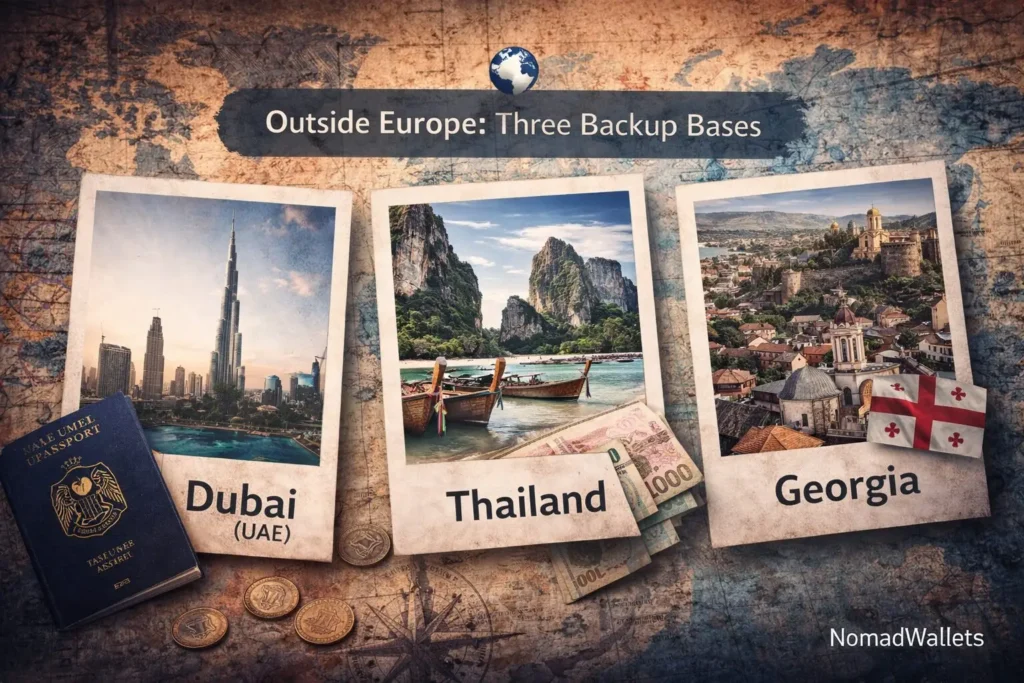
Outside Europe: Three Backup Bases
For nomads who do not yet meet EU income thresholds, or who need flexibility while paperwork is in progress, three non-EU options are seeing heavy nomad traffic in 2026.
Dubai (UAE): The Virtual Working Programme is a 1-year renewable permit requiring $3,500/month income, zero personal income tax, and as of April 2026, six months of bank statements for the application. Fast to process, high earning power, strong infrastructure.
Thailand (DTV): Launched in mid-2024, the Destination Thailand Visa is a 5-year multiple-entry visa with 180-day stays. No monthly income requirement, just 500,000 THB (~$14,500 USD) in savings. Remote work for foreign employers is permitted. Low cost of living, high flexibility.
Georgia: No formal nomad visa, but most nationalities enter visa-free for up to 365 days per year. Low cost of living, flat 20% tax rate generally not applied to foreign-sourced income for short stays, and a growing Tbilisi nomad community. A solid bridge while pursuing EU status.
These are pressure valves, not permanent solutions.
Tax Residency: The 183-Day Line
Spend more than 183 days in any EU country in a calendar year and most jurisdictions will treat you as a tax resident. That means your worldwide income, not just what you earn locally, becomes subject to local tax.
Poland and Romania use the 183-day presence test. Spain adds a “center of economic interests” clause, meaning clients or business activity based in Spain can trigger residency even with fewer than 183 days in country.
Track your days in a spreadsheet, in real time, not from memory after a tax notice arrives. If you are approaching the threshold, decide deliberately whether to trigger residency and use available tax regimes, or exit and reset the clock.
For US-based nomads managing FEIE, foreign tax credits, and EU obligations together, the tax hacks for digital nomads guide covers the key scenarios in plain language.
Worst-Case Scenario
You have been in Poland for eight months on PESEL UKR. You book a trip, a wedding in the UK and a short visit to family in Ukraine. You are gone for 45 days.
You return. Your status was automatically cancelled on day 31. You do not know this yet.
Three days later your bank account is restricted. Your health insurance through NFZ is suspended. Your apartment lease requires proof of valid residency. Your employer is waiting on a payment confirmation.
You call the immigration office. They confirm the loss of status and explain re-application. The timeline is unclear. The documents you need include a valid travel document you should have used to confirm your PESEL UKR identity before August 31.
Six to eight weeks to resolve.
This is not hypothetical. It is the direct result of not checking the 30-day rule before booking.
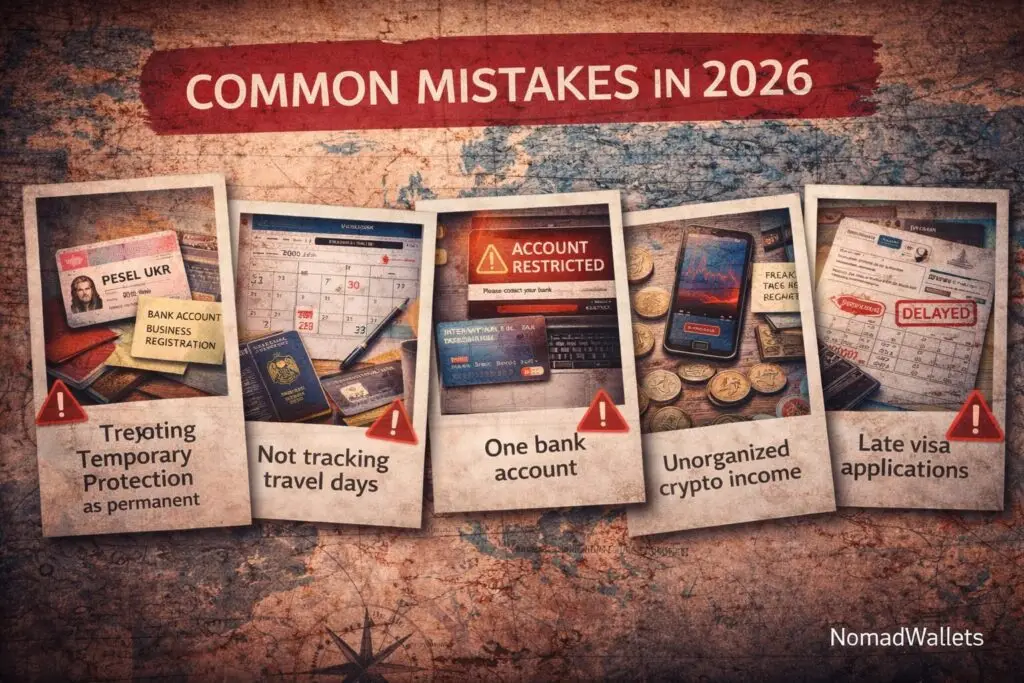
Common Mistakes in 2026
Treating Temporary Protection as permanent. It was an emergency measure. Planning banking, taxes, and business registration around it long-term was always a gamble that is now coming due.
Not tracking travel days. The 30-day Poland rule and the 183-day tax threshold are only problems if you are not watching the calendar. Most people are not.
One bank account. If it is tied to PESEL UKR and your status changes, your financial access disappears. Two accounts minimum, in separate institutions.
Unorganized crypto income. EU banks flag crypto by default. If it is a significant part of your income, your documentation needs to be cleaner than average, not less.
Late visa applications. Hungary takes 3 to 4 months. Spain is rarely quick. Waiting until the last moment guarantees a gap in legal status during processing.
Assuming foreign income means no EU tax exposure. Physical presence in an EU country past 183 days triggers local tax obligations regardless of where the income comes from.
Who Needs to Act Immediately
Not everyone reading this is in the same position. Some have time. These people do not.
You are in Poland on PESEL UKR issued by declaration. The August 31 identity verification deadline is your most urgent priority. Missing it means losing status on September 1.
You have a trip planned that will take you outside Poland for more than 30 days. You either restructure the trip or transition your legal status before you leave.
You have been in any EU country for more than 150 days this year. You are approaching the 183-day tax residency threshold and need to make a deliberate decision about what happens next.
You have no formal legal status in the EU and are working remotely on a tourist visa. The compliance environment is actively tightening. A DNV is not a future consideration anymore.
Checklist: Before You Leave Your EU Base
Run through this before booking any trip:
- Confirm your status is valid and will remain valid beyond your return date
- Check the exact travel day limit for your current status (30 consecutive days for PESEL UKR in Poland)
- Download the last three months of bank statements before you leave
- Save a PDF copy of your residence document on your phone
- Message your bank about the trip if the destination might trigger a fraud flag
- Confirm your health insurance covers you outside the country
- Build a 5-day buffer before the travel limit kicks in
Fifteen minutes now. Six weeks of resolution later if you skip it.
FAQs About Eastern Europe Visa Changes 2026
Q1: Does Temporary Protection Status still exist in 2026?
A: Yes. EU member states extended it until 4 March 2027. But enforcement is now active, compliance is mandatory, and the exit strategy is already in motion.
Q2: Can I travel freely under PESEL UKR in Poland?
A: No. Leaving for more than 30 consecutive days cancels your status automatically, regardless of the reason.
Q3: What is the safest visa option for digital nomads right now?
A: A Digital Nomad Visa. Hungary is the most accessible entry point. Romania offers the best tax structure for short stays. Spain is the only option with a clear permanent residency pathway. See the full Digital Nomad Visa 2026 guide for details.
Q4: What happens if I lose Temporary Protection status?
A: Banking, work authorization, and healthcare access can stop immediately. Get legal advice as soon as possible and do not wait to see how it resolves.
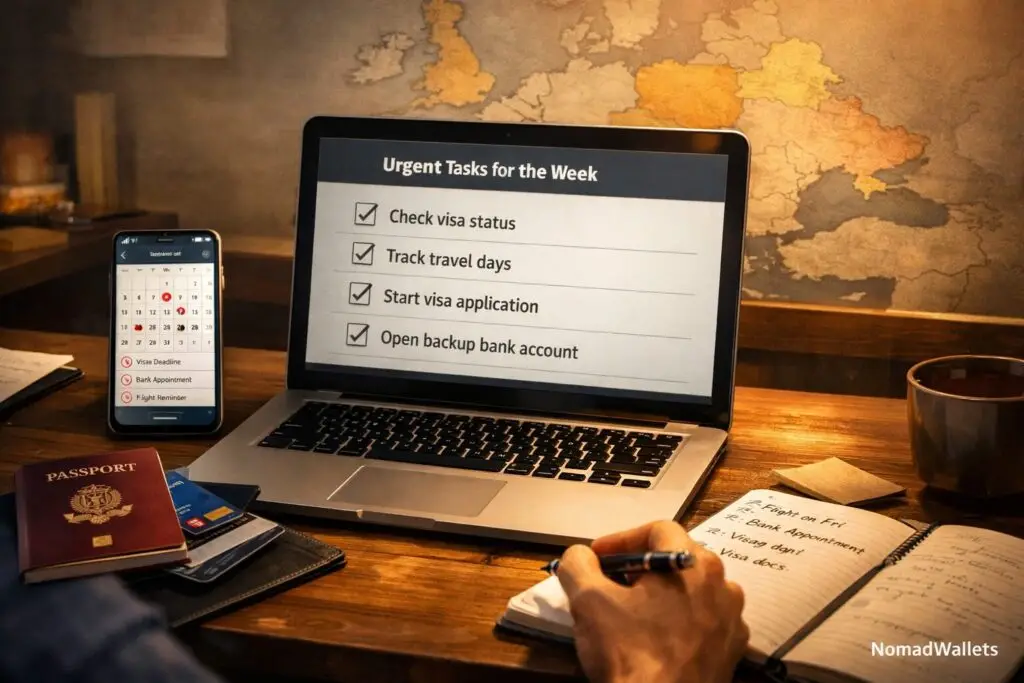
What You Should Do This Week
Not eventually. This week.
Check your status. If your PESEL UKR was issued by declaration, the August 31 deadline is non-negotiable. Confirm your status at your local municipal office.
Start tracking your days. Open a spreadsheet today. Log every entry and exit date for every country. If you do not know your current count, work it out from boarding passes or calendar records.
Start the DNV process. If your income qualifies for Hungary, Romania, or Spain, the best time to start the application was three months ago. The second best time is now.
Fix your banking setup. If you are running everything through one account tied to a transitional status, open a second account this week. For guidance on which providers hold up under nomadic conditions, the best mobile banks for travelers guide is the right starting point.
Eastern Europe Visa Changes 2026: Who Is Most at Risk
- Nomads relying only on Temporary Protection
- Remote workers without a registered legal residency
- People close to the 183-day tax threshold
- Anyone using a single bank account tied to local status
Why Eastern Europe Visa Changes 2026 Matter for Digital Nomads
What is happening in Eastern Europe in 2026 is not an isolated policy shift. Emergency legal frameworks across the EU are being replaced by standard immigration rules, and standard rules do not come with grace periods.
They are also less forgiving of people who are not paying attention.
The nomads who navigate this cleanly are the ones who treat legal residency as infrastructure, not an afterthought. A DNV that matches your income, travel patterns, and goals is not bureaucratic overhead. It is the foundation that makes everything else, banking, taxes, contracts, healthcare, function reliably.
Ignoring it is what turns a manageable situation into a crisis. Predictable problems have solutions.
Most problems in this space are predictable. The only question is whether you act early or react late.
For those still working through the foundational questions about building a location-independent career, the complete guide to going digital nomad covers the baseline decisions before the compliance layer becomes relevant.
Disclaimer: This article is for informational purposes only. Immigration, tax, and financial regulations change frequently. The information above reflects publicly available sources as of April 2026. Always verify current requirements through official sources, including the European Commission’s migration portal and UNHCR Poland’s guidance pages, before making decisions. Consult a qualified immigration lawyer or tax professional for advice specific to your situation.

Hi, I'm Tushar, founder of NomadWallets.com. I created this site after realizing how complicated managing money becomes once you start living and working across multiple countries. Most financial advice online is written for people who never leave their home country, which leaves digital nomads navigating international banking, transfers, taxes, and visas with very little reliable guidance.
NomadWallets exists to provide clear, practical, research-backed financial information for location-independent professionals worldwide. Every article published on this site is researched using official sources, live platform data, and global benchmarks such as World Bank remittance reports. Our research covers international banking, cross-border payments, and financial infrastructure for digital nomads.