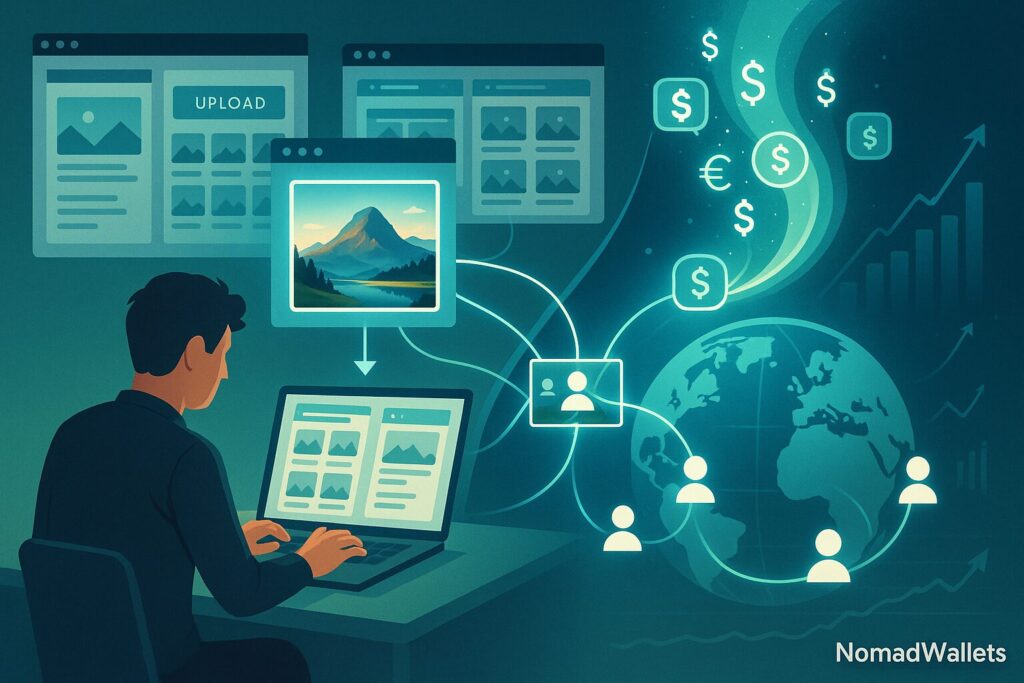
The remote work revolution created something powerful for creative professionals the ability to earn income that travels with you. But here’s what most digital nomads overlook the difference between trading hours for dollars and building assets that pay you repeatedly.
Intellectual property licensing for creative nomads represents that second category, where your past work generates ongoing revenue while you focus on new projects, explore new cities, or simply take a break without your income stopping.
Unlike client work that demands your constant presence, intellectual property licensing for creative nomads allows photographers, writers, designers, musicians, and other creatives to monetize their work multiple times across different markets and platforms.
A single photograph can license to dozens of companies. One course can sell thousands of copies. A design template can generate royalties for years. The work happens once, but the income continues and it travels wherever you do.
This guide breaks down exactly how intellectual property licensing for creative nomads works in 2026, including the legal frameworks you need to understand, the platforms that pay the best royalties, the tax implications across borders, and the realistic expectations around passive versus semi passive income.
As of 2025, over 70 countries now offer some form of digital nomad or remote work visa, making location independent creative work more legally accessible than ever. Whether you’re a photographer in Bali, a writer in Lisbon, or a designer bouncing between coworking spaces worldwide, licensing your creative work can transform your nomadic income from unpredictable to sustainable.
What Is Intellectual Property Licensing?
Intellectual property licensing is the process of granting permission to others to use your creative work in exchange for payment, while you retain ownership of the original asset. Think of it as renting out your creations rather than selling them outright.
The photographer keeps their copyright but licenses the image to magazines, websites, and advertisers. The course creator maintains ownership of their content but allows students to access it for a fee.
Four Main Types of IP for Creative Nomads
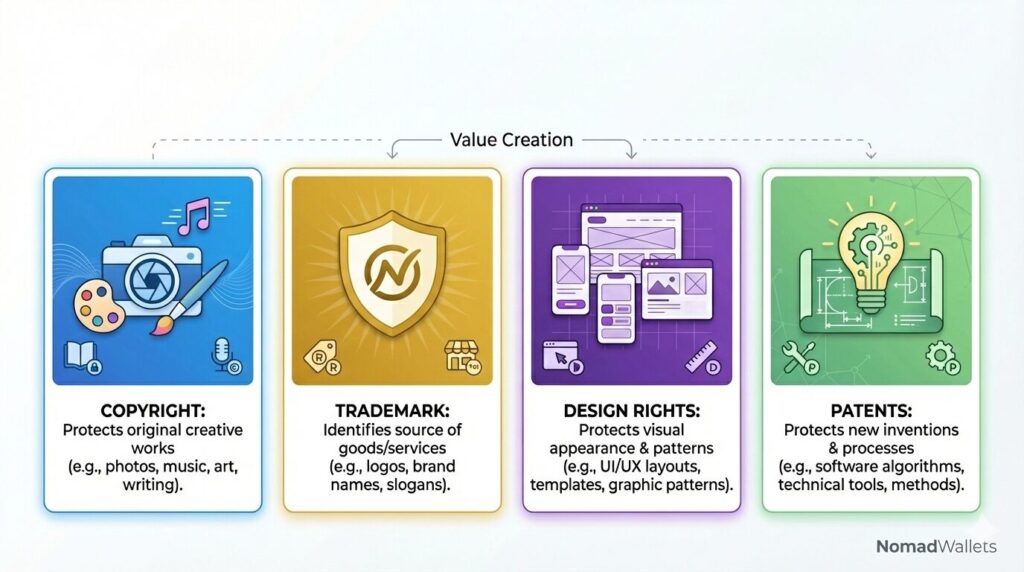
- Copyright: Protects original creative works like writing, photography, music, videos, and digital courses
- Trademarks: Protects brand names, logos, and distinctive marks that identify your business or personal brand
- Patents: Protects inventions and unique product designs (less common for most creative nomads)
- Design Rights: Protects the visual appearance of products, templates, and digital assets
The critical distinction here is between owning intellectual property and licensing it. When you own IP, you control all rights to use, reproduce, distribute, and profit from that work. When you license IP, you temporarily grant specific usage rights to someone else while maintaining ownership.
A stock photographer who licenses an image to a company for their website doesn’t lose copyright they’re simply allowing that company to use the image under defined terms (duration, geography, exclusivity) for an agreed payment.
This structure makes intellectual property licensing for creative nomads uniquely valuable because it’s completely location independent. The licensing agreement doesn’t care whether you’re signing it from Chiang Mai or Medellín.
Royalty payments flow to your bank account regardless of time zones. Your creative assets work globally while you sleep, and unlike freelance client work, licensing income doesn’t require you to be available for calls, revisions, or project management.
Why Intellectual Property Licensing Is Ideal for Creative Nomads
Intellectual property licensing for creative nomads solves several problems that plague traditional freelance income:
Key Advantages:
No client calls required: A designer who licenses UI kits on marketplaces doesn’t coordinate with buyers the platform handles transactions, and customers download instantly. Contrast this with freelance design work, which involves discovery calls, revision rounds, feedback loops, and often conflicting time zones that force nomads to work odd hours.
Zero time zone dependency: Royalty income from stock photography, online courses, or template sales happens 24/7 across global markets. Your content licenses to a business in Tokyo at 3 AM while you’re asleep in Buenos Aires, and you wake up to royalty payments in your account.
This asynchronous income model is rare in the freelance world, where real time availability often determines your earning potential.
Scales without more time: A photographer who uploads 500 images to Adobe Stock can earn from those same 500 images indefinitely ten sales this month, fifty next month, and the work investment remains static. According to real creator earnings data from 2025, established photographers earn $2,000-4,000 monthly from portfolios built over years.
Compare this to freelance photography, where each new client project demands new shooting time, editing hours, and delivery coordination. Licensing decouples your time from your income, which is the foundation of genuine scalability.
Works while traveling: Royalty income continues flowing during personal downtime vacations, family emergencies, creative breaks, or even burnout recovery periods where active work isn’t possible. For nomads who value freedom and flexibility, this resilience is invaluable.
The Passive vs Semi Passive Reality
Let’s address this honestly. True “set it and forget it” passive income is rare in intellectual property licensing for creative nomads. Most licensing models require ongoing work uploading new content to stay competitive on platforms, updating courses to reflect current information, refreshing templates to match design trends, and occasionally marketing your licensable assets.
The initial creation is substantial work, and maintenance while lighter isn’t zero. But compared to trading hours for dollars in traditional freelancing, licensing offers far greater leverage and location independence.
Types of Intellectual Property Creative Nomads Can License
Copyright Licensing
Copyright licensing is the most accessible entry point for intellectual property licensing for creative nomads, covering a wide range of digital and creative outputs.
Writing, Blogs, and Ebooks
Writers can license their content in multiple ways:
- License articles to publications, content platforms, and businesses
- License ebooks to educational platforms or corporations for internal training
- License content to foreign publishers for translated editions
- Earn through flat fees per piece or ongoing royalties based on usage
According to recent copyright licensing practices for content creators, copyright protection is automatic upon creation, but registration provides stronger legal enforcement rights.
Photography and Videography
Photography dominates the copyright licensing landscape for nomad creatives. Here’s how the major platforms compare:
| Platform | Royalty Rate | Best For | Portfolio Size Needed |
| Adobe Stock | 33% (photos), 35% (videos) | High quality content, Creative Cloud integration | 3,000+ images for consistent income |
| Shutterstock | 15-40% (based on annual sales) | Volume sellers, global reach | 5,000+ images recommended |
| Getty Images/iStock | Higher per license rates | Premium editorial, corporate clients | Selective acceptance, quality over quantity |
| Canva Contributors | Varies by content type | Templates, graphics, integrated designs | Active user base |
Real earnings example: One photographer earning $3,421 monthly in November 2025 reported Adobe Stock contributed $809, Shutterstock $699, and Getty/iStock $621 from a portfolio of 9,580 images across multiple platforms demonstrating that diversification and volume drive sustainable income for intellectual property licensing for creative nomads.
Music and Audio Licensing
Musicians and audio producers license tracks to:
- Video creators and filmmakers
- Podcasters and content producers
- Advertisers and commercial projects
- Background music libraries
Royalty free music libraries pay creators each time their track is licensed, and some agreements include performance royalties when music is broadcast or streamed publicly.
Courses and Digital Content
Online course creators on platforms like Teachable, Podia, and Gumroad effectively license access to their educational content. Here’s how the platforms compare:
| Platform | Pricing Model | Transaction Fees | Best For |
| Gumroad | $0/month | 10% flat fee | Testing products, simple setup, minimal management |
| Podia | $39/month or $89/month | 5% (cheaper plan) or 0% (premium plan) | Scaling creators, email marketing integration |
| Teachable | $39-119/month | Varies by plan | Full course platforms, quizzes, certificates |
| Udemy | Free to list | 50% revenue share (Udemy sales), 3% (creator sales) | Platform driven traffic, no marketing needed |
One Udemy instructor earning $17,000 monthly created over 40 courses, letting the platform handle all marketing while splitting profits 50/50 demonstrating that intellectual property licensing for creative nomads can scale significantly through platform leverage.
Trademark Licensing
Trademark licensing allows creative nomads with established personal brands or business names to monetize their reputation.
Brand names and logos: A successful nomad blogger with a recognized brand might license their name to a travel gear company for co branded products, earning royalties on each sale. Trademark licensing typically generates revenue through:
- Upfront licensing fees
- Ongoing royalty fees (commonly 5-15% of sales using the licensed trademark)
- Territorial exclusivity premiums
Personal brands: A creator with significant reach might license their name, image, and likeness to sponsors, product lines, or regional partners, earning passive income from brand association without active promotion work. However, maintaining brand quality control is essential the licensing agreement should specify usage guidelines to prevent brand dilution.
Design & Asset Licensing
Design licensing represents one of the fastest growing areas for intellectual property licensing for creative nomads.
Popular Licensable Digital Assets
- UI kits and design systems: Comprehensive interface elements (buttons, forms, navigation) that license repeatedly
- Website and app templates: Pre built designs that developers purchase and customize
- Icons and illustrations: Packs of visual elements for commercial use
- Fonts and typography: Custom typefaces licensed to individuals and businesses
- Stock graphics and vectors: Illustrations for marketing, websites, and products
These assets typically sell for $20-100 per license on marketplaces like Envato, Creative Market, and independent platforms. Popular kits can generate thousands in cumulative revenue from a single creation effort.
Patent & Product Licensing (Advanced)
Patent licensing is less common but highly lucrative for nomad inventors and product developers.
Product ideas and manufacturing licensing: Inventors license their patented designs to manufacturers who handle production, distribution, and sales. Key characteristics:
- Royalties typically 3-10% of wholesale prices
- Higher percentages for exclusive arrangements
- No manufacturing operations required
- Truly passive income after patent and licensing agreement are secured
Real Examples of IP Licensing Income for Nomads
Understanding intellectual property licensing for creative nomads becomes clearer when you see how real creators structure their licensing revenue streams.
Photographer Licensing Images Globally
A stock photographer with 9,580 images across multiple platforms earning approximately $4,200 per month demonstrates the power of diversification. According to real earnings data from November 2025, this translates to roughly $2.28 per image per year across the portfolio.
Key insights from real photographers:
- A single best selling image earned over $1,200 on Shutterstock alone through 1,670 downloads over 18 months
- Best sellers can earn 1,000 times more than average content because they match exactly what buyers need
- Monthly breakdown: Adobe Stock $809, Shutterstock $699, Getty/iStock $621, plus additional platforms
- Portfolio size matters: 5,000-10,000 images needed for consistent $3,000-4,000 monthly income
This demonstrates that intellectual property licensing for creative nomads rewards both volume and quality, with strategic content creation producing exponentially better results than generic stock photography.
Course Creator Licensing Educational Content
One Udemy instructor earns $17,000 per month in passive income from online courses by splitting profits 50/50 with the platform. The instructor created over 40 courses, allowing Udemy to handle all marketing and promotion while retaining half the royalties from each sale.

The semi passive licensing model:
- Upfront work is substantial (course creation, scripting, recording)
- Once published, content licenses to thousands of students globally
- No additional effort per transaction after creation
- Platform handles marketing, payments, delivery, customer support
This exemplifies intellectual property licensing for creative nomads who prefer not to manage their own marketing, trading higher royalty percentages for completely automated distribution.
Designer Licensing Templates on Marketplaces
UI designers and template creators on Envato, Creative Market, and Gumroad typically price digital assets between $20-100 per license. Envato Market pays creators 70% commission (with creators receiving the majority after Envato’s 30% affiliate structure), while Envato Elements operates on a subscription model with per download payouts.
Popular UI kits that solve specific design problems earn through:
- Landing page templates for specific industries
- Mobile app interface collections
- Complete design systems with documentation
- Niche specific templates (SaaS dashboards, Ecommerce themes)
Popular kits can generate thousands in cumulative revenue from a single creation effort, with the platform handling all transactions and delivery.
Creator Licensing Brand Name to Regional Partners
Trademark licensing allows established creators to monetize their personal brand across different markets. A travel blogger with significant audience reach might license their brand name and logo to a regional tour operator or travel gear company.
Typical trademark licensing terms:
- 5-15% royalties on products sold using the licensed trademark
- Upfront licensing fees for exclusive territory rights
- Quality control clauses to prevent brand dilution
- Quarterly or semi annual royalty payments based on sales
This licensing structure provides passive income without requiring the creator to manufacture products or manage retail operations the licensee handles production and sales while the creator receives quarterly royalty payments based on revenue.
Videographer Licensing Stock Footage
A videographer earning $500 per month from video licensing across Shutterstock, Adobe Stock, and Pond5 achieves approximately $3.38 per clip per year with consistent passive sales. Video content generally commands higher royalty rates than photography Adobe Stock pays 35% on videos compared to 33% on photos reflecting the greater production effort required.
Video licensing advantages for nomads:
- Higher per license earnings than photography
- Less competition than photography (fewer contributors)
- Travel footage has commercial value (tourism, advertising)
- One shoot can produce dozens of licensable clips
For nomad videographers who already create travel content, licensing footage to commercial buyers transforms personal documentation into recurring income for intellectual property licensing for creative nomads.
How Intellectual Property Licensing Generates Passive Revenue
The financial mechanics of intellectual property licensing for creative nomads center on royalties recurring payments made to IP owners when their licensed work is used.
Understanding Royalty Structures
Royalty payment models:
- Percentage based: 3-50% of sale price depending on platform and IP type
- Flat rate per license: $0.33-$5 per download on stock platforms
- Revenue share: 50/50 splits common on education platforms
- Tiered systems: Rates increase with performance (Shutterstock’s 15-40% based on annual earnings)
According to structured royalty payment best practices, most agreements specify quarterly or semi annual payment schedules, meaning licensors receive payments 2-4 times per year depending on the contract.
One Time vs Recurring Licensing
| License Type | Payment Structure | Duration | Best For |
| One time perpetual | Single payment, indefinite usage rights | Forever (within scope) | Stock photography, templates, graphics |
| Term limited | Single payment, expires after period | 1-5 years typically | Exclusive arrangements, brand licensing |
| Subscription based | Recurring monthly/annual fees | Active subscription only | Course access, software, membership content |
| Usage based | Pay per download/stream/use | Varies by contract | Music licensing, API access |
One time licenses grant perpetual usage rights in exchange for a single payment a buyer pays once and can use the image indefinitely within the license scope. Recurring licenses involve ongoing fees for continued access, generating predictable monthly income for creators.
Exclusive vs Non Exclusive Licenses
This distinction dramatically affects both pricing and revenue potential for intellectual property licensing for creative nomads. Here’s how they compare:
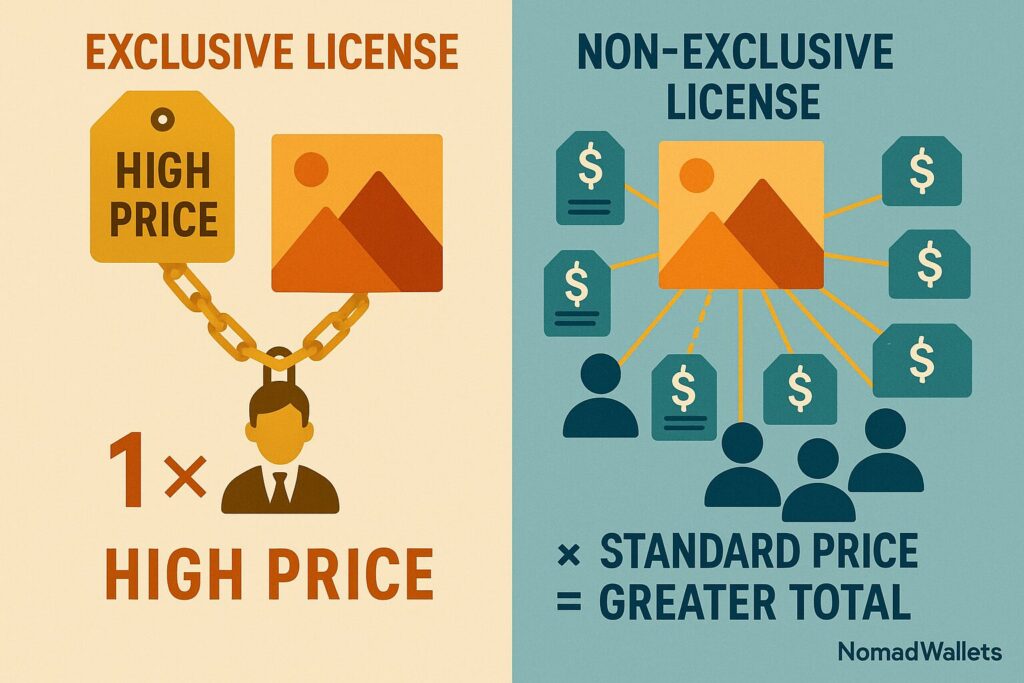
| Factor | Exclusive License | Non Exclusive License |
| Usage Rights | Sole rights to one licensee only | Same asset licenses to unlimited buyers |
| Pricing | 2-5x higher fees | Standard market rates |
| Revenue Model | Concentrated, high value | Distributed, volume based |
| Control | Licensee has full control in scope | Creator maintains broader control |
| Risk | High (depends on one partner) | Low (spread across many buyers) |
| Best For | Custom brand licensing, patents | Stock content, templates, courses |
According to licensing structure comparisons, exclusive licenses concentrate value and control in one partner, while non exclusive licenses provide broader reach and diversified income streams.
Non exclusive licensing allows creators to sell the same asset to unlimited buyers one photograph licenses to dozens of companies simultaneously, multiplying revenue from a single creation. This is why most stock photography and template marketplaces use non exclusive models to maximize creator earnings through volume.
Exclusive licenses grant sole usage rights to one buyer within a defined scope (territory, industry, duration), eliminating competition but commanding 2-5 times higher fees to compensate for lost multi buyer revenue potential. Custom brand licensing or high value product patents typically demand exclusivity.
Territory Based Licensing
Geographic restrictions allow creators to license the same IP to different buyers in different regions, maximizing global revenue:
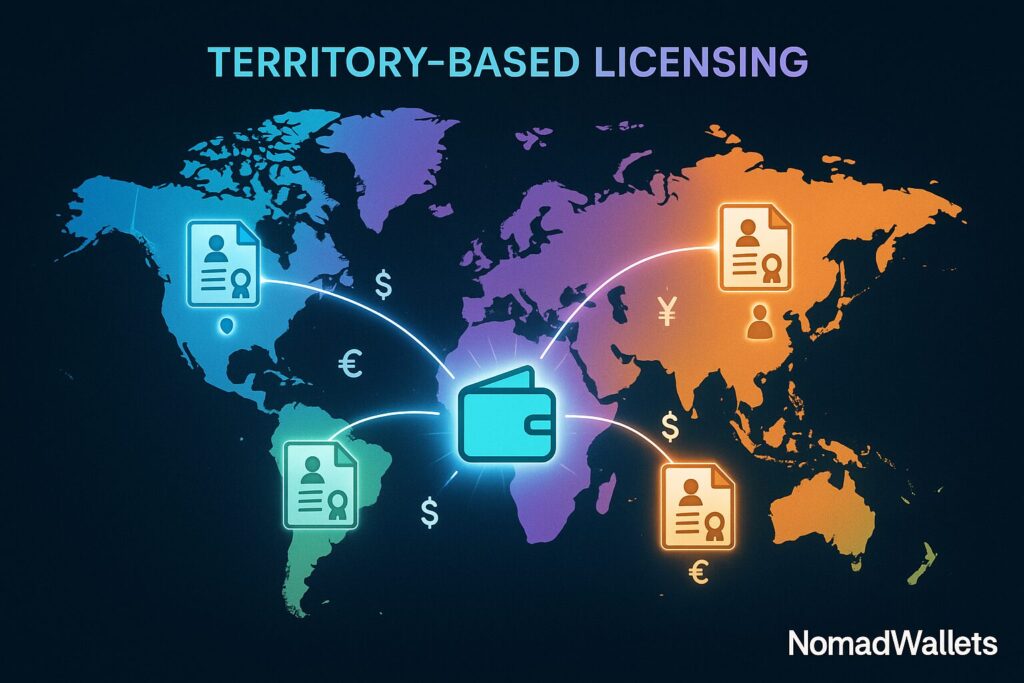
- Regional exclusivity: License image exclusively to European travel agency while simultaneously licensing non exclusively in Asia and North America
- Language based territories: License translation rights separately (English, Spanish, French versions earn separate royalties)
- Market based territories: License to retail buyers in one territory, wholesale in another
Territory based licensing is particularly valuable for intellectual property licensing for creative nomads because it leverages global mobility creators living in Asia can negotiate regional partnerships unavailable to US based creators, then relocate to Europe and repeat the strategy.
Platforms & Marketplaces for IP Licensing
Content & Media Licensing Platforms
| Platform | Content Type | Royalty Rate | Best For | Portfolio Size for Income |
| Shutterstock | Photos, vectors, videos | 15-40% (tiered by annual earnings) | Volume sellers, global reach | 5,000+ images for $3,000+ monthly |
| Adobe Stock | Photos, vectors, videos, templates | 33% (images), 35% (videos) | Creative Cloud integration, quality focus | 3,000+ images for consistent income |
| Getty Images | Premium photos, editorial content | Higher per license rates | Corporate clients, editorial work | Selective acceptance, quality priority |
| Envato Market | Themes, plugins, graphics, audio | ~70% to creators | Digital assets, WordPress themes | Template quality > quantity |
| Pond5 | Video footage, music, sound effects | 50% (non exclusive), 60% (exclusive) | Video creators, audio producers | Specialized content performs well |
Key platform characteristics:
Shutterstock operates one of the largest stock content marketplaces globally, with royalty rates ranging from 15% to 40% based on annual earnings top performing contributors reaching higher percentage tiers. Photographers earning $4,000+ monthly often maintain portfolios of 5,000-10,000 images.
Adobe Stock integrates directly with Adobe Creative Cloud applications, giving contributors access to designers and creatives already working within the Adobe ecosystem. Contributors report that Adobe Stock often becomes the second highest earner after Shutterstock for established photographers.
Getty Images positions itself as a premium licensing platform, typically requiring higher quality standards and editorial documentation but offering higher per license payments due to Getty’s premium brand positioning and corporate clientele.
Envato operates multiple marketplaces including ThemeForest (website themes), CodeCanyon (scripts), GraphicRiver (graphics), and AudioJungle (music). For intellectual property licensing for creative nomads, Envato’s ecosystem allows diversification across multiple asset types within a single platform.
Course & Digital Asset Licensing
| Platform | Monthly Cost | Transaction Fees | Best For | Break Even Point |
| Gumroad | $0 | 10% flat fee | Testing products, minimal management | Immediate (no fixed costs) |
| Podia | $39 or $89 | 5% (cheaper plan) or 0% (premium) | Scaling creators, email marketing | $1,800/month sales (where $89 fee = 5% savings) |
| Teachable | $39-$119 | Varies by plan | Full course features, certificates, quizzes | Depends on plan and sales volume |
| Udemy | $0 to list | 50% (Udemy sales), 3% (your traffic) | Platform traffic, no marketing needed | Best for volume + no marketing effort |
Gumroad charges a flat 10% transaction fee with no monthly subscription costs, making it accessible for new creators testing digital product licensing. The platform handles payment processing, file delivery, and basic email marketing.
Podia offers tiered pricing starting at $39/month with 5% transaction fees, or $89/month with zero transaction fees. For creators scaling beyond initial launches, Podia’s zero fee tier becomes cost effective once monthly sales exceed $1,800.
Teachable focuses exclusively on online courses with white label capability creators can use custom domains and branding, making courses appear independently hosted rather than platform dependent.
Direct Licensing to Businesses
Beyond platforms, many creative nomads negotiate direct licensing contracts with businesses for custom arrangements. A photographer might license images directly to a tourism board for exclusive regional use. A designer could license a template set to a software company for inclusion in their product.
Direct licensing advantages:
- Eliminates platform fees (15-50% depending on marketplace)
- Custom pricing based on specific usage needs
- Negotiable terms for exclusivity, territory, duration
- Direct relationship with licensee
Direct licensing requirements:
- Contract negotiation skills
- Legal agreement templates
- Invoicing and payment tracking systems
- License compliance monitoring
Similar to how having clear remote work contracts provides proof of legitimate employment when applying for digital nomad visas, standardized licensing agreements establish professional credibility when negotiating with businesses and provide clear legal recourse if terms are violated.
Legal Basics Creative Nomads Must Understand
Intellectual property licensing for creative nomads requires understanding several legal fundamentals to protect your work and avoid costly mistakes.
Copyright Ownership Essentials
Automatic protection: Copyright establishes automatically when you create original work no registration required in most countries due to international Berne Convention protections.
Registration benefits:
- Stronger legal standing in infringement disputes
- Enables statutory damages (up to $150,000 per work in the US)
- Public proof of ownership with specific dates
- Required before filing infringement lawsuits in some jurisdictions
Registration costs: Typically $35-$100 depending on jurisdiction (US Copyright Office, UK IPO, etc.)
Licensing Agreement Must Haves
The agreement must clearly define what rights are granted and what rights are retained:
Critical contract elements:
- Usage scope: Commercial or personal use only
- Media types: Print, digital, broadcast, social media, etc.
- Geographic territory: Worldwide, specific continents, or individual countries
- Exclusivity status: Exclusive or non exclusive
- Duration: Perpetual, or term limited (1 year, 5 years)
- Sublicensing: Permitted or prohibited
- Payment terms: Amount, schedule, currency, late fees
Ambiguous contracts lead to disputes a photographer who grants “website usage rights” without specifying duration might discover their image used indefinitely when they intended a one year license.
Duration, Territory, and Usage Scope
These three critical constraints directly affect pricing:
| Constraint | Definition | Impact on Pricing |
| Duration | How long license remains valid | Longer duration = higher fees |
| Territory | Geographic boundaries where license applies | Broader territory = higher fees |
| Usage Scope | How licensed work can be used | Broader usage = higher fees |
Example pricing tiers:
- Limited scope (social media only, 1 year, single country): $200
- Medium scope (digital marketing, 3 years, North America): $800
- Broad scope (all commercial uses, perpetual, worldwide): $3,000+
Broader scope, longer duration, and larger territories justify higher licensing fees for intellectual property licensing for creative nomads.
Moral Rights
Moral rights protect creators’ reputation even after licensing their work:
- Attribution right: Right to be credited as creator
- Integrity right: Right to prevent modifications that harm reputation
- Geographic variation: Strong in European nations, weaker in United States
For intellectual property licensing for creative nomads operating internationally, understanding moral rights in different territories prevents situations where your licensed work is altered or used in ways that damage your professional reputation.
Common Legal Mistakes to Avoid
Top 5 licensing mistakes:
- No written contracts: Relying on verbal agreements or informal emails that lack legal enforceability
- Imprecise language: Using vague terms like “unlimited usage” when you meant “social media usage”
- Underpricing: Failing to research industry standard rates leaves significant revenue on the table
- No usage tracking: Making it impossible to identify unauthorized usage or enforce contract terms
- Unclear payment terms: Not specifying currency, payment schedule, and late fees leads to disputes
Tax & Residency Considerations for IP Licensing Income
Tax treatment of intellectual property licensing for creative nomads involves complex international considerations, particularly regarding where royalty income is taxed and at what rates.
Where Royalties Are Taxed
Two competing tax systems:
- Source rules: Tax royalties in the country where IP is used or where licensee is located
- Residency rules: Tax royalties based on where creator is a tax resident
This creates potential double taxation the same royalty income taxed in both the source country and the creator’s residence country. For example, a photographer who is a tax resident of Portugal but licenses images to a US company might face taxation in both jurisdictions on the same income.
Source of Income Rules
The US taxes royalty payments made by US companies to foreign recipients through withholding taxes, typically 30% unless reduced by treaty. YouTube, for example, withholds up to 30% on earnings from US viewers for non US creators without proper tax documentation.
Source taxation varies by country:
- US: 30% withholding on royalties to foreign recipients (reduced by treaty)
- EU: Often eliminates withholding between member states
- Some countries: No source taxation (taxable only in recipient’s residence country)
Understanding source rules matters for intellectual property licensing for creative nomads because it determines whether platforms like Shutterstock, Adobe Stock, or Gumroad will withhold taxes before paying you.
Withholding Tax on Royalty Payments
When a US based platform pays royalties to a foreign creator, the platform typically withholds 30% by default and remits it to the IRS. However, tax treaties between countries often reduce this rate to 0-15% if the creator properly completes tax documentation (W-8BEN form for non US creators).
Example impact:
- Without proper documentation: $10,000 Adobe Stock royalties → $3,000 withheld → $7,000 received
- With treaty documentation: $10,000 royalties → $1,000 withheld (10% treaty rate) → $9,000 received
- Best treaty rates: $10,000 royalties → $0 withheld → $10,000 received
Failing to submit proper documentation results in maximum withholding, significantly reducing net income for intellectual property licensing for creative nomads.
Double Taxation Treaties
Most developed nations have bilateral tax treaties that allocate taxing rights between source and residence countries. According to international tax treaty structures, treaties typically:
- Allow source country to impose limited withholding (0-15%)
- Give primary taxing authority to residence country
- Provide credits for taxes paid abroad to prevent true double taxation
Treaty benefits for creators:
- Being tax resident of a country with extensive favorable treaty coverage significantly improves net royalty income
- Some treaties eliminate withholding entirely on copyright royalties
- Credits in residence country offset taxes paid in source country
US Creators vs Non US Creators
US citizens and residents:
- Pay US income tax on worldwide income regardless of where they live
- Foreign Earned Income Exclusion (FEIE) doesn’t apply to royalties (passive income, not earned income)
- Must report all global licensing income on US tax returns
For U.S. citizens in particular, understanding how U.S. digital nomad taxes interact with royalty income and foreign residency rules is essential when structuring licensing arrangements across multiple countries, as passive royalty income receives different treatment than active freelance income.
Non US creators:
- Generally not taxed by home country on foreign source royalties unless tax resident there
- Face varying withholding rates on US source royalties (0-30% depending on treaty)
- May receive credit for US taxes paid when filing in residence country
Tax Residency for Nomads Without Fixed Base
For nomads without clear tax residency (not meeting 183+ day thresholds anywhere), royalty income taxation becomes ambiguous technically all countries where you spend significant time might claim taxing authority, though enforcement is difficult.
Many digital nomad visas explicitly address this by clarifying that visa holders aren’t tax residents unless they exceed specific duration thresholds. However, creators earning substantial licensing income should consult international tax specialists to structure their residency and business entities optimally.
Risk consideration: While working remotely on tourist visas creates visa compliance issues, visa rejections and entry bans for digital nomads are becoming more common as enforcement tightens worldwide proper documentation of income sources and appropriate visa status protects both legal standing and future travel opportunities.
How to Start Intellectual Property Licensing as a Nomad
Starting intellectual property licensing for creative nomads follows a systematic process that transforms existing creative work into revenue generating assets.
Step by Step Launch Process
Step 1: Identify Licensable Assets
Audit your existing creative work to find content with licensing potential:
For photographers:
- Review travel archives for destination specific content
- Identify lifestyle shots businesses might need
- Compile event coverage with commercial appeal
- Select images with clear subjects and commercial viability
For writers:
- Evaluate blog posts that could license to publications
- Identify articles suitable for ebook compilation
- Review guides adaptable to different industries
- Compile specialized knowledge into licensable courses
For designers:
- Compile templates from past projects for marketplace sale
- Extract UI elements usable across multiple projects
- Identify graphics with broad commercial appeal
- Review fonts or icon sets with licensing potential
For musicians:
- Identify tracks suitable for background music licensing
- Compile instrumental pieces for podcast/video use
- Review commercial quality recordings for library placement
According to international copyright licensing practices, contributors who analyze their existing portfolios before uploading report 40% higher initial earnings compared to those who upload randomly, because strategic selection matches market demand better than volume alone.
Step 2: Register or Protect IP
While copyright protection is automatic in most countries under the Berne Convention, formal registration strengthens your legal position if disputes arise.
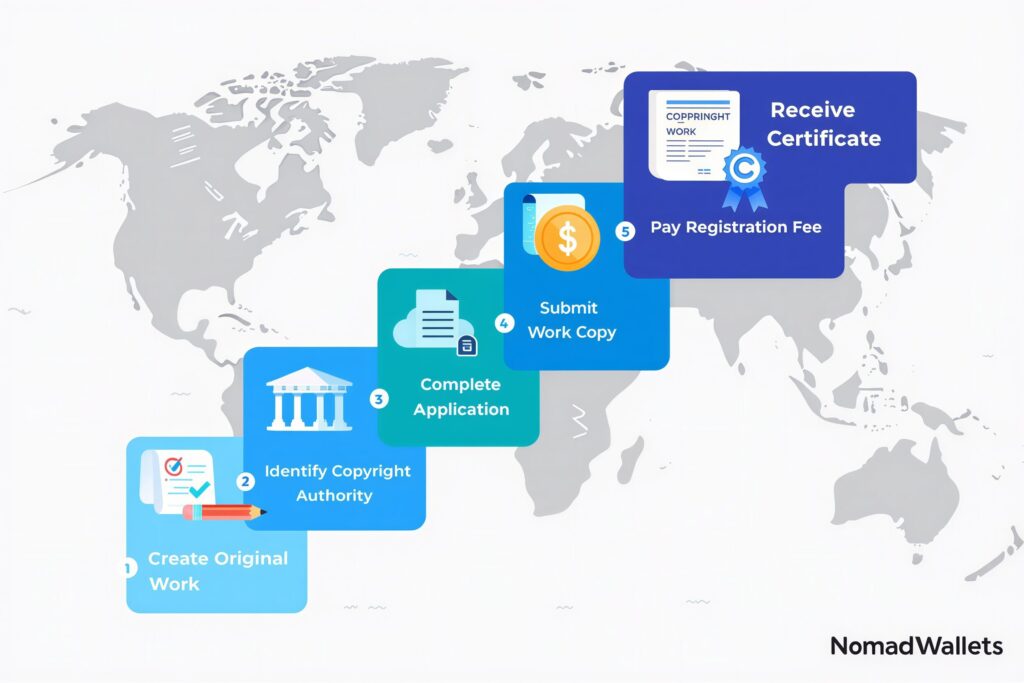
Registration process overview:
| Jurisdiction | Authority | Cost | Processing Time | Benefits |
| United States | US Copyright Office | $35-$100 per work | 2-7 months | Statutory damages up to $150k, required for lawsuits |
| European Union | National offices (varies by country) | €50-200 | 1-6 months | EU wide recognition through harmonization |
| India | Copyright Office (Government of India) | ₹500-2,000 | 3-6 months | Legal proof of ownership, enforcement rights |
| International | WIPO (recognition only) | Varies | N/A | No single global registration, use treaties |
According to the international copyright registration process, here’s how to register:
Registration steps:
- Determine need: Registration provides official proof of ownership for enforcement
- Identify authority: File with copyright office in countries where you want protection
- Select correct form: Different forms for literary works, music, visual arts, software
- Complete application: Provide title, author name, creation date, publication details
- Submit copy of work: Physical or digital copy for verification
- Pay fee: Non refundable processing fee (varies by country)
- Await approval: Review process takes weeks to months depending on jurisdiction
For intellectual property licensing for creative nomads, digital documentation becomes critical maintain timestamped records of creation, original files with metadata intact, and correspondence establishing ownership. Cloud storage with version history serves as informal proof of creation dates when formal registration isn’t feasible.
Trademark registration: Requires formal application before licensing apply through national trademark offices (USPTO in the US, EUIPO for EU wide protection) with costs ranging from $250-$1,000 depending on jurisdiction and trademark classes.
Step 3: Choose Licensing Model
Decide whether your intellectual property licensing for creative nomads strategy will focus on:
Platform based licensing:
- ✅ Automated distribution and payment processing
- ✅ Zero administrative work or customer management
- ✅ Established buyer audiences
- ❌ 10-50% commission fees reduce net income
- Best for: Passive income seekers, minimal business management
Direct licensing:
- ✅ No platform fees (100% of negotiated rate)
- ✅ Custom pricing and contract terms
- ✅ Direct relationships with licensees
- ❌ Requires negotiation, contracts, invoicing
- ❌ Ongoing relationship management
- Best for: Nomads with business development skills, high value exclusive arrangements
Hybrid approach:
- License generic content through platforms for volume based passive income
- Negotiate direct deals for exclusive, high value arrangements
- Maximize total revenue through diversification
Step 4: Select Platforms
Research platform royalty rates, audience size, and category strength before uploading.
Platform selection criteria:
| Factor | What to Evaluate | Why It Matters |
| Royalty rate | 15-70% depending on platform | Directly impacts net income |
| Audience size | Millions (Shutterstock) vs thousands (niche platforms) | Determines sales volume potential |
| Category strength | Platform specialization | Your content type must match platform strength |
| Payment threshold | $25-$100 minimum payout | Affects cash flow for new creators |
| Marketing support | Platform driven vs self driven traffic | Determines workload for visibility |
Strategic platform approach for intellectual property licensing for creative nomads:
- Start with 1-2 major platforms in your category
- Build portfolio to 1,000+ assets before expanding
- Add secondary platforms once primary ones generate consistent income
- Diversify to protect against algorithm changes or policy shifts
Step 5: Create Licensing Terms
Draft standardized licensing agreements that clearly specify usage rights, exclusivity status, territory, duration, and pricing. You can generate licensing agreements using AI tools or customize templates from legal marketplaces.
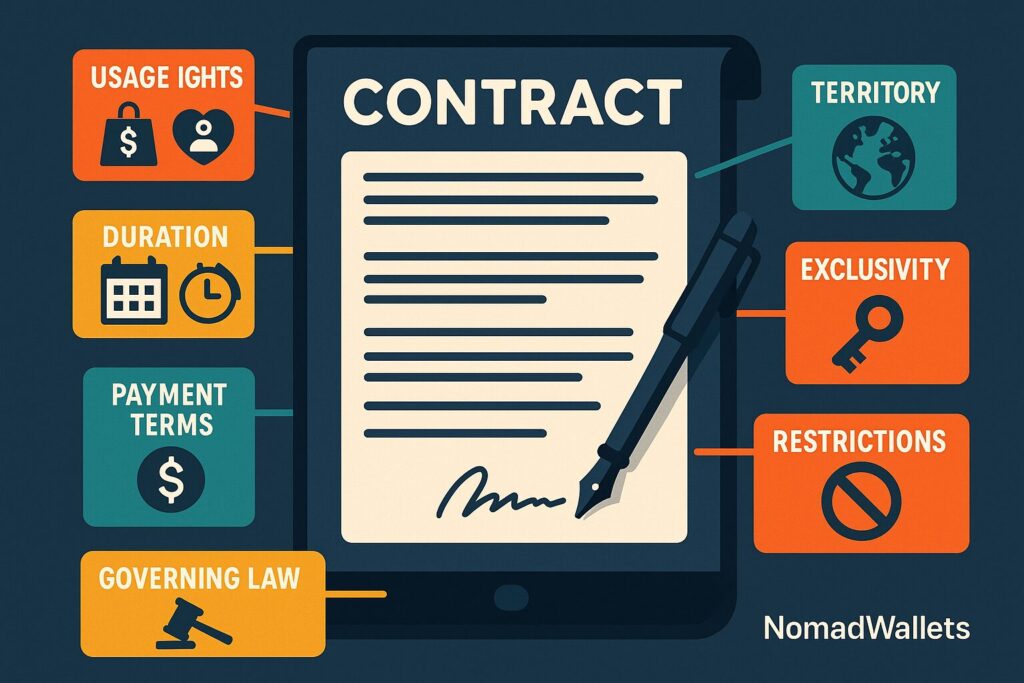
Essential licensing agreement elements:
Standard Non Exclusive License Agreement Template
1. PARTIES
Licensor: [Your Name/Business]
Licensee: [Client Name/Business]
2. LICENSED WORK
Description: [Specific asset being licensed]
Copyright Registration: [If applicable]
3. GRANT OF RIGHTS
– Usage: [Commercial/Editorial/Personal]
– Media: [Digital/Print/Broadcast/All Media]
– Territory: [Worldwide/Specific Countries/Regions]
– Duration: [Perpetual/Term Limited to X years]
– Exclusivity: [Exclusive/Non Exclusive]
4. RESTRICTIONS
– No sublicensing without written permission
– No resale or redistribution of original files
– No registration of derivative trademarks
5. PAYMENT TERMS
– Fee: $[Amount] USD
– Payment Due: [Upon signing/Net 30/Quarterly]
– Late Payment: [2% monthly penalty]
6. ATTRIBUTION (if required)
Credit as: [Your Name/Business Name]
7. TERMINATION
Conditions under which license terminates
8. GOVERNING LAW
Jurisdiction: [Your preferred legal jurisdiction]
Similar to how having proper remote work contracts proves income legitimacy when applying for visas, standardized licensing agreements establish professional credibility when negotiating with businesses and provide clear legal recourse if terms are violated.
For nomads without permanent residence: Specify arbitration rather than litigation to avoid jurisdictional complications if disputes arise while traveling.
Step 6: Track Royalties
Implement systems to monitor where your IP is licensed, payment schedules, and usage compliance.
Tracking methods by licensing type:
| License Type | Tracking Method | Tools | Frequency |
| Platform sales | Automatic dashboards | Shutterstock Analytics, Adobe Stock Portal | Weekly review |
| Direct licenses | Manual spreadsheet | Excel, Google Sheets, Airtable | Monthly reconciliation |
| Unauthorized usage | Reverse image search | Google Images, TinEye, Pixsy | Quarterly audits |
| Payment reconciliation | Accounting software | Wave, QuickBooks, Xero | Monthly |
Reverse image search for photographers: Use tools to identify unauthorized usage. According to reverse image search best practices, photographers should:
- Upload original images to find instances of use online
- Prioritize high traffic websites where plagiarism may occur
- Document unauthorized usage with screenshots and timestamps
- Send cease and desist notices or negotiate retroactive licensing
For intellectual property licensing for creative nomads earning across multiple platforms and currencies, consolidated income tracking simplifies tax reporting across jurisdictions. Set quarterly reviews to identify top performing assets, underperforming content to retire, and licensing trends to guide future content creation.
Common Mistakes Creative Nomads Make
Understanding intellectual property licensing for creative nomads means recognizing the pitfalls that reduce income and create legal vulnerabilities.
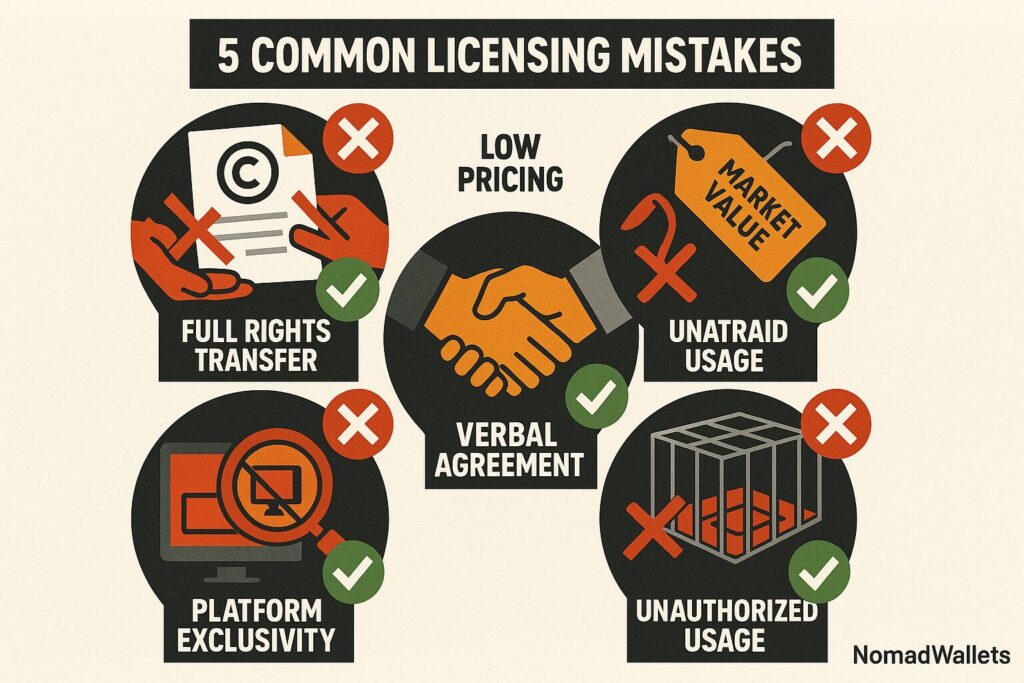
Top Licensing Mistakes
1. Giving Away Rights Unnecessarily
The most expensive mistake is granting full copyright transfer when a license would suffice.
The problem:
- Some platforms or clients request “work for hire” or “complete rights transfer”
- This means you permanently lose all future licensing opportunities
- A photographer who sells full rights to an image for $500 cannot license that same image to other buyers ever again
- Forfeits potentially thousands in cumulative licensing revenue
The solution:
- Always negotiate to retain copyright ownership
- Grant only specific usage rights the buyer needs
- If client insists on exclusive rights, charge 3-5 times standard licensing fee
- Use non exclusive platforms like Shutterstock/Adobe Stock to preserve multi buyer licensing ability
2. Underpricing Licenses
Without researching industry standard rates, many creators charge far below market value.
Pricing benchmarks for intellectual property licensing for creative nomads:
| Asset Type | Standard License | Extended License | Exclusive License |
| Stock Photo | $30-50 | $300-500 | $1,000-5,000+ |
| Custom Photography | N/A | $500-2,000 | $2,000-10,000+ |
| UI Kit/Template | $20-100 | N/A | $500-2,000 |
| Online Course | $10-200 per student | N/A | $5,000-50,000 (corporate) |
| Brand/Trademark | N/A | N/A | 5-15% of licensee sales |
Research before pricing:
- Study what similar creators charge for comparable licensing
- Stock platforms establish baseline pricing (extended licenses = 10-20x standard)
- Specialized professional content can command $200-500+ pricing
- Custom work for businesses should start at hundreds or thousands
3. No Written Contracts
Verbal agreements or informal email exchanges lack legal enforceability when disputes arise.
Why contracts matter:
- A designer who emails “you can use this logo” without specifying terms might discover indefinite usage when they intended one year
- Written contracts don’t require legal jargon plain language is legally binding
- Digital signature platforms (DocuSign, HelloSign) work remotely while traveling
- Protects both parties by establishing clear expectations
- Provides documentation for tax purposes and visa applications
Minimum contract requirements:
- What rights are granted vs retained
- Payment terms (amount, schedule, currency)
- Duration and territory
- Usage restrictions
- Termination conditions
4. Platform Exclusivity Traps
Some platforms offer higher royalty rates in exchange for exclusive distribution rights, preventing you from licensing the same content elsewhere.
Exclusivity calculation:
Example scenario:
- Platform A: 50% royalties (exclusive)
- Platforms B, C, D: 33% royalties each (non exclusive)
Financial analysis:
- If Platform A generates $1,000 monthly → You earn $500
- If Platforms B+C+D generate $400+$300+$200 = $900 total → You earn $297 from each = $891 total
- Result: Non exclusive multi platform earns more despite lower per platform rates
When exclusivity makes sense for intellectual property licensing for creative nomads:
- Platform’s exclusive royalty exceeds potential multi platform total
- Platform provides massive traffic you couldn’t generate independently
- Exclusive term is limited (1 year) allowing renegotiation
- Upfront payment compensates for lost opportunity
5. Not Tracking Usage
Without monitoring how and where licensed IP is used, creators miss unauthorized usage and cannot verify royalty payments.
Tracking strategies:
- Photographers: Reverse image search top sellers quarterly
- Course creators: Audit for content on piracy sites, issue DMCA takedowns
- Musicians: Register with performance rights organizations (ASCAP, BMI) for public play royalties
- All creators: Verify exclusive licensees aren’t allowing third party usage
Tracking becomes particularly important for exclusive licenses if you’ve granted exclusive rights in a specific territory, you need to verify that no other parties are using your IP in that region, because allowing it undermines the exclusivity you sold.
Is Intellectual Property Licensing Truly Passive?
The honest answer about intellectual property licensing for creative nomads is that it exists on a spectrum from semi passive to genuinely passive, depending on your specific licensing model and ongoing maintenance approach.
Setup Work vs Long Term Rewards
Initial investment reality:
| Creator Type | Setup Time | Initial Income | 12 Month Income | 24 Month Income |
| Stock Photographer | 6-12 months (building 5,000+ images) | $50-200/month | $1,000-3,000/month | $2,000-5,000/month |
| Course Creator | 100-300 hours per course | $0-500/month | $500-2,000/month | $1,000-4,000/month |
| Template Designer | 3-6 months (building collection) | $100-500/month | $500-1,500/month | $1,000-3,000/month |
| Music Producer | 6-12 months (building track library) | $50-300/month | $300-1,000/month | $800-2,500/month |
During setup phase, intellectual property licensing for creative nomads generates minimal or zero income it’s pure investment with delayed returns. However, portfolios reaching critical mass (3,000+ images, 10+ courses, 50+ templates) begin generating consistent income with minimal ongoing maintenance.
Maintenance Requirements
Ongoing work needed:
- Content additions: 20-50 new items monthly to maintain platform visibility
- Updates: Course content refreshes annually, template redesigns every 1-2 years
- Keyword optimization: Updating titles/descriptions quarterly for search performance
- Customer support: Minimal on platforms, moderate for direct licenses
Revenue impact of maintenance:
- Portfolios without new uploads for 6+ months: 20-30% revenue decline
- Active contributors: Algorithm prioritization increases visibility
- Updated content: Maintains relevance and competitive positioning
However, maintenance work is dramatically less than initial creation effort adding 50 new images monthly requires far less time than building the initial 5,000 image foundation.
True Passive Elements
Once licensing infrastructure is established, several aspects genuinely become passive:
✅ Platform sales are fully automated (no buyer interaction, payment handling, delivery)
✅ Old content continues earning (2024 upload generates 2026 sales without additional work)
✅ Sales happen 24/7 globally (while you sleep, travel, or work on other projects)
✅ Royalty payments arrive on schedule (without fulfillment work per transaction)
✅ Income continues during downtime (vacations, illness, burnout, personal time)
This resilience distinguishes licensing income from freelance client work, where income stops immediately when you stop working making intellectual property licensing for creative nomads particularly valuable for sustainable nomadic lifestyles.
Realistic Income Timeline
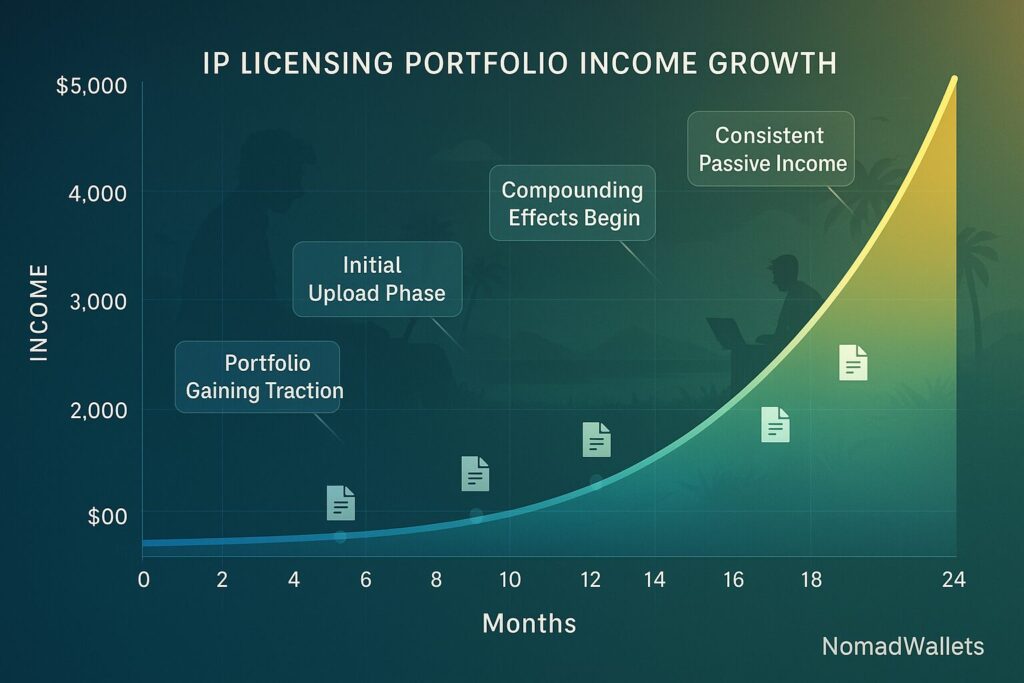
Month by month progression:
- Months 1-3: Under $100 (initial uploads, portfolio establishment)
- Months 4-6: $200-500 (growing portfolio gains traction)
- Months 7-12: $500-1,500 (compounding effects, seasonal demand cycles)
- Year 2: $2,000-4,000 monthly (consistent content creation pays off)
- Years 3-5: $5,000-10,000+ monthly (top performers with 3-5 years investment)
The income curve is exponential, not linear patience and consistency during low earning initial phase determines whether creators reach the highly passive income stage or quit before compounding effects materialize.
FAQs About Intellectual Property Licensing for Nomads
Q1. Do I need to register copyright?
A. Copyright protection exists automatically when you create original work in most countries due to Berne Convention international agreements. Registration isn’t required for copyright to exist, but according to how to secure intellectual property rights, registering with national copyright offices provides:
1. Stronger legal standing in infringement disputes
2. Statutory damages (up to $150,000 per work in US) rather than just actual damages
3. Public proof of ownership with specific dates
4. Required for filing infringement lawsuits in some jurisdictions
For intellectual property licensing for creative nomads earning significant income from licensing, registration costs of $35-100 per work are worthwhile insurance, especially for highest earning assets.
Q2. Can I license IP while traveling?
A. Yes, intellectual property licensing for creative nomads is entirely location independent. You can:
1. Negotiate contracts from anywhere with internet
2. Sign agreements digitally using DocuSign or HelloSign
3. Upload content to platforms while traveling
4. Receive royalty payments to international bank accounts
5. Manage entire licensing business remotely
The IP itself exists digitally or as registered legal rights that travel with you. However, tax implications vary based on where you’re a tax resident and where your licensees are located.
Q3. Is licensing legal on tourist visas?
A. Technically, most countries prohibit all income generating activities on tourist visas regardless of whether the income source is domestic or foreign. However, passive licensing income through platforms like Adobe Stock or Gumroad is virtually undetectable by immigration authorities.
The practical reality:
1. Many creators earn royalties while traveling on tourist visas without issues
2. Enforcement is extremely rare for digital passive income
3. It’s technically prohibited in most jurisdictions
Risk consideration: While enforcement is rare, visa rejections and entry bans for digital nomads are becoming more common as countries tighten enforcement worldwide. For nomads concerned about visa compliance or needing documented income for future applications, obtaining proper remote work or digital nomad visas provides:
1. Legal clarity for income activities
2. Documented income history for future visa applications
3. Protection against immigration questioning
4. Ability to openly discuss your work without legal concerns1
Q4. How do I handle currency and international payments?
A. Most major licensing platforms handle currency conversion automatically:
Platform payment options:
1. Adobe Stock, Shutterstock, Gumroad: Multi currency payouts to bank accounts or PayPal
2. Minimum thresholds: $25-$100 before payout
3. Payment schedule: Monthly or when threshold reached
For direct licensing deals:
1. Specify payment currency in contracts (USD widely accepted)
2. Use business PayPal, Wise, or Payoneer for international payments
3. Lower fees than traditional bank wires
4. Maintain consistent payment methods for simplified accounting
For intellectual property licensing for creative nomads frequently changing countries, consistent currency preferences reduce transaction costs and simplify tax reporting.
Q5. How long do licenses last?
A. License duration varies based on contract terms. Most stock photography licenses are perpetual once a buyer licenses your image, they can use it indefinitely within the scope purchased. Platform based licenses for templates, graphics, and digital downloads typically grant perpetual usage rights as well.
1. Term limited licenses usually last 1-5 years and are common for brand licensing and exclusive arrangements, where the license expires after the agreed period and requires renewal. Subscription based licenses grant access only during active subscription periods common for online courses, software, and membership content. Usage based licenses apply per transaction, such as music licensing where each use requires a separate license or payment.
2. Longer duration licenses command higher fees to compensate for extended usage rights. For intellectual property licensing for creative nomads, perpetual licenses generate one time income per sale, while term limited licenses create opportunities for renewal fees and re licensing to the same buyer at updated rates.
Q6. What if someone uses my IP without licensing it?
A. Unauthorized usage happens frequently, especially for photographers and designers whose work appears publicly.
Detection and enforcement process:
1. Find unauthorized usage: Use reverse image search (Google Images, TinEye, Pixsy)
2. Document evidence: Screenshots, URLs, timestamps, usage context
3. Send cease and desist: Request immediate removal or retroactive payment
4. Negotiate settlement: Many infringers will pay rather than face litigation
5. Legal action if needed: Consult IP attorneys (many work on contingency)
Why registration matters: Registering copyrights before infringement occurs enables statutory damages of up to $150,000 per work in the US, making legal action economically viable even for small creators.
For intellectual property licensing for creative nomads, automated monitoring services scan the web for your content and alert you to unauthorized usage, making tracking easier while traveling.
Final Thoughts: Building Borderless Income with IP Licensing
Intellectual property licensing for creative nomads represents one of the most genuine forms of location independent income available to modern creators. Unlike freelance client work that demands constant availability and timezone coordination, licensing transforms past creative work into ongoing revenue streams that function regardless of where you are or what you’re doing.

The Realistic Path Forward
The path isn’t quick or easy building licensing income to $2,000-5,000 monthly typically requires 12-24 months of consistent content creation, strategic platform selection, and learning which assets perform best in your niche. But the compounding effects are real:
- A photographer’s image uploaded in 2024 generates royalties throughout 2025, 2026, and beyond
- A course created in 2025 sells to thousands of students over five years
- A UI kit designed once licenses to hundreds of developers worldwide
- Music tracks earn performance royalties for decades after creation
Why IP Licensing Works for Nomadic Life
For creative nomads seeking sustainable income that truly travels, intellectual property licensing for creative nomads offers several unique advantages:
Income resilience:
- Continues during personal downtime, travel disruptions, periods when you choose not to work
- Grows through accumulation rather than requiring more hours
- Ceiling isn’t limited by available working hours like freelance services
Business scalability:
- Digital licensing operates across borders seamlessly
- No geographical restrictions or work authorization concerns
- Platform infrastructure handles global distribution automatically
Financial sustainability:
- Multiple revenue streams reduce dependency on single clients
- Passive income foundations support active income pursuits
- Portfolio value compounds over years of consistent contribution
Getting Started Today
Start by auditing creative work you’ve already produced. Identify photos, writings, designs, or other assets with licensing potential. Choose one primary platform matching your content type:
- Shutterstock for photography
- Gumroad for digital products
- Teachable for courses
- Envato for design assets
Commit to building a substantial portfolio over 6-12 months before evaluating results. Research how similar creators price licenses and structure agreements to avoid underpricing your work. Document everything with proper contracts, even for small deals, establishing professional standards that protect your rights.
Resources for Nomadic Creators
Compare your current location costs using tools like Cost of Living Calculator to find destinations where your emerging licensing income sustains comfortable living while you build toward higher revenue tiers.
Access comprehensive nomad resources, tax guidance, and visa information through the NomadWallets US Digital Nomad Hub and free templates and checklists at NomadWallets Free Resources to structure your intellectual property licensing for creative nomads business properly from the start.
The Inflection Point
The most successful licensing creators share one trait: they started before they felt ready, uploaded consistently despite minimal early income, and trusted the compounding process long enough to reach the passive income inflection point where past work generates more than new creation efforts.
That inflection point is real, and it’s worth pursuing. Your creative work already has value. Licensing simply multiplies how many times and how many places that value generates income. For nomads building borderless lives, few income models offer better alignment between location independence and financial sustainability than intellectual property licensing for creative nomads.
Start creating today. Upload tomorrow. Let compounding do the rest.

Hi, I'm Tushar, founder of NomadWallets.com. I created this site after realizing how complicated managing money becomes once you start living and working across multiple countries. Most financial advice online is written for people who never leave their home country, which leaves digital nomads navigating international banking, transfers, taxes, and visas with very little reliable guidance.
NomadWallets exists to provide clear, practical, research-backed financial information for location-independent professionals worldwide. Every article published on this site is researched using official sources, live platform data, and global benchmarks such as World Bank remittance reports. Our research covers international banking, cross-border payments, and financial infrastructure for digital nomads.