
For over a decade, Portugal was the undisputed tax haven of Europe. The “Old NHR” (Non-Habitual Resident) regime was legendary: 0% tax on crypto, 10% on pensions, and a flat 20% for almost any “high-value” freelancer.
That party ended on January 1, 2024.
If you are moving to Portugal in 2026, you are entering a new era. The old regime has been replaced by the Tax Incentive for Scientific Research and Innovation (IFICI), often nicknamed “Portugal NHR 2.0”.
The bad news? It is much stricter. The good news? If you are a software engineer, a startup founder, or an R&D specialist, you might still hit the jackpot.
This guide clarifies the confusion between the old rules and the new Portugal NHR 2.0 regime, explains exactly who qualifies, and answers the burning question for Americans: “Do I still save money, or will I get hit with a 48% tax bill?”
1. Old NHR vs. Portugal NHR 2.0: What Changed?
The biggest mistake new expats make is reading blog posts from 2023. Those rules are dead. The government has shifted its focus from attracting passive wealth (retirees) to attracting active brainpower (innovators).
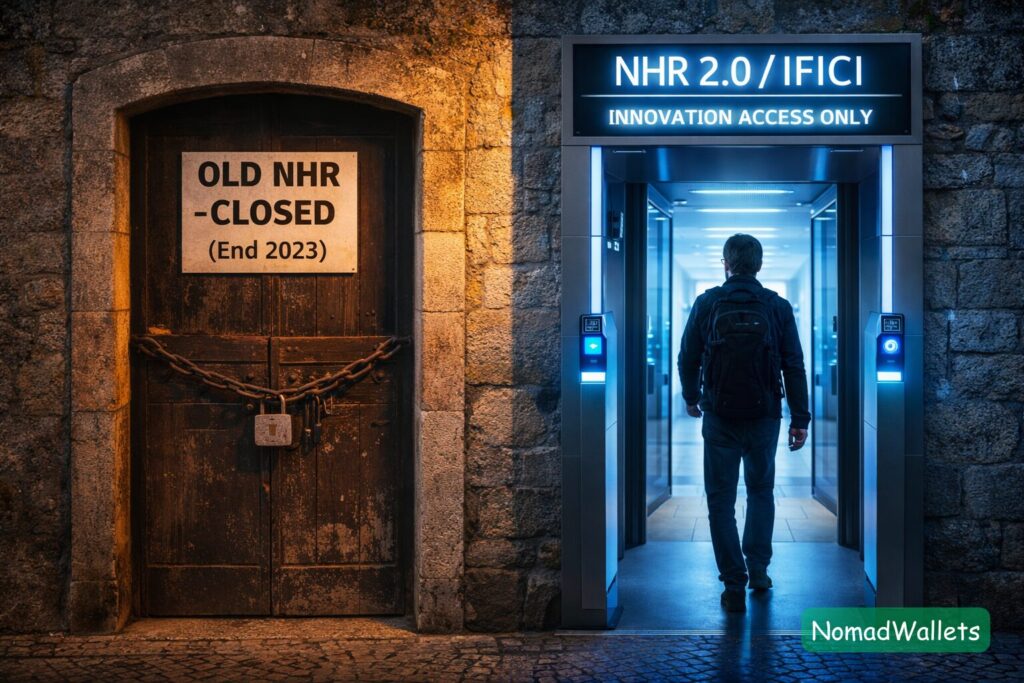
Table 1: The Major Shift (Old vs. New)
Use this table to quickly see if you are looking at outdated information.
| Feature | Old NHR (Ended Dec 2023) | Portugal NHR 2.0 (Active 2026) |
| Who Qualified? | Retirees, Marketers, Designers, Consultants. | Strictly Scientific Research, R&D, Certified Startups. |
| Pension Tax | Flat 10%. | Standard Progressive Rates (14%–48%). |
| Freelance Tax | Flat 20% (Broad “High Value” list). | Flat 20% (Only for Innovation/R&D roles). |
| Foreign Dividends | Generally exempt under treaty rules. | Generally exempt under treaty and sourcing rules (not automatic). |
| Duration | 10 Years. | 10 Years. |
Key Takeaway: If you moved here to retire on a pension, the Portugal NHR 2.0 door is likely closed for you. You will be taxed at standard rates unless you qualify for specific grandfathering clauses.
2. Do You Qualify? The “Scientific” Restriction
The new law (Article 58-A of the Tax Benefits Statute) restricts the flat 20% tax rate to specific categories. This is the heart of the Portugal NHR 2.0 challenge.

The “Green Light” List (Likely to Qualify)
If you hold one of these roles, you have a strong case for applying for Portugal NHR 2.0:
- Software Engineers & CTOs: But there is a catch. You usually need to work for a “Certified Startup” or a company recognized by AICEP or IAPMEI as adding “innovation value.”
- Scientific Researchers: University professors, R&D lab workers, and doctoral candidates.
- Startup Founders: If you launch a company in a certified Portuguese incubator. You can find the official list of qualified entities via the RNi – Portugal Incubators network.
- Highly Qualified Personnel: Professionals working in certified “Investment Tax Code” projects. The full list of eligible “highly qualified” codes is defined in Ordinance no. 352/2024/1.
The “Red Light” List (Unlikely to Qualify)
- Generic Freelancers: SEO consultants, graphic designers, copywriters, or life coaches generally do not qualify for Portugal NHR 2.0 unless they can prove their work is “innovative R&D” (which is very hard to do).
- Retirees: There is no special tax bracket for you anymore.
- Crypto Traders: Trading profits are taxed at 28% (unless held for 365+ days, which is exempt under general law, not NHR).
3. The US Digital Nomad Scenario (W-2 vs. 1099)
This is where it gets messy for Americans. As a US citizen, you are taxed on your worldwide income forever. So, does Portugal NHR 2.0 actually help you?
Scenario A: The Remote Employee (W-2)
If you work remotely for Google (USA) while living in Portugal:
- Portugal View: You are working in Portugal. They want to tax your salary. Without Portugal NHR 2.0, you pay progressive rates (up to 48%). With it, you pay a flat 20%.
- US View: You get a “Foreign Tax Credit” for taxes paid in Portugal.
- The Verdict: IFICI is huge here. Paying 20% in Portugal is often lower than your US tax bill, meaning you owe the IRS very little (or nothing) due to the credit offset.

Scenario B: The Independent Contractor (1099)
If you freelance, you might not even need Portugal NHR 2.0.
- The Hack: You might benefit more from the “Simplified Regime” (Regime Simplificado).
- How it works: Portugal applies a presumed-expense deduction (commonly 35% or up to 75%, depending on activity classification). For many digital nomads earning under €200k, this effectively lowers your tax rate to around 15-20%, effectively beating the Portugal NHR 2.0 rate anyway.
⚠️ Why this works: This tax coordination is governed by the US-Portugal Income Tax Convention. Under this treaty, the “Saving Clause” allows the US to tax its citizens, but it also provides the mechanism for the Foreign Tax Credit, which prevents you from paying the same dollar to both governments.
Warning: You cannot just “guess” this. As noted in the Official IRS Technical Explanation of the Treaty, one wrong form and you could be double-taxed.
4. The “Foreign Income” Loophole (Dividends & Interest)
Here is the secret weapon of Portugal NHR 2.0 that no one talks about. Even if your job doesn’t qualify for the 20% rate on salary, you might still qualify for the Foreign Income Exemption if you are accepted into the regime.
If you become a tax resident under IFICI, passive income sourced outside Portugal is generally exempt (0%).
Note: This treatment results from treaty allocation and income-sourcing rules, not from a special exemption created by IFICI itself.

Table 2: Passive Income Taxation under IFICI
| Income Source | US Tax Treatment | Portugal NHR 2.0 Tax Treatment |
| US Dividends | Taxed by IRS | Generally exempt in Portugal if taxed in the source country or taxable under a tax treaty |
| US Interest | Taxed by IRS | Generally exempt in Portugal if sourced abroad and not arising from a Portuguese payer |
| US Rental Income | Taxed by IRS | Generally exempt in Portugal if the property is located outside Portugal |
| Capital Gains (Stock) | Taxed by IRS | Often exempt in Portugal if sourced abroad and treaty conditions are met |
Note: You still pay US tax on these, but you won’t pay Portuguese tax on top of it.
5. Action Plan: How to Apply in 2026
While it is technically possible to apply alone, in practice most applications require professional support due to the evidentiary burden. The “Innovation” proof requires submitting specific forms to AICEP (for business/startup roles) or the FCT (Foundation for Science and Technology) for scientific research and academic positions.
Step 1: Secure your D7 or D8 Visa and move to Portugal.
Step 2: Change your NIF address to your Portuguese address (This triggers tax residency).
Step 3: Register as a Tax Resident on the Portal das Finanças.
Step 4 (The Hard Part): Submit your application for Portugal NHR 2.0 status.
- Deadline: You must apply by January 15 of the year following your arrival (e.g., if you move in 2025, you must apply by January 15, 2026).
- The Proof: You must attach a declaration from your employer or a certified incubator proving your job adds “high added value” to the Portuguese economy as defined by Ordinance no. 352/2024/1.
Do You Need a Lawyer?
Yes. With the old NHR, you could just tick a box online. With Portugal NHR 2.0, you have to argue your case.
- If you are a coder, your lawyer needs to frame your job description to match “Computer Consulting” codes and link it to an innovative sector.
- If you mess this up, your application is rejected, and you default to the standard 48% tax bracket.
Final Verdict
Is Portugal still a tax haven?
- For Retirees: No. It is just a beautiful place with normal taxes.
- For “Standard” Nomads: It is good, but requires the “Simplified Regime” or careful Portugal NHR 2.0 structuring.
- For High-Value Tech Talent: Yes. Portugal NHR 2.0 remains one of the best deals in Europe for 10 years of tax stability.
Don’t Risk the 48% Tax Rate. Tax laws change faster than blogs can update. We highly recommend booking a consultation with a certified Portuguese Tax Attorney to review your specific US-Portugal exposure.
✅ Done with Taxes? Now Plan the Move.
Understanding the 20% flat tax is only one piece of the puzzle. To successfully relocate, you still need to choose the right visa (D8 vs. D7), secure a NIF, and find a home in a city that fits your budget.
Read Next: Digital Nomad Portugal 2026: The Ultimate Master Guide – our complete roadmap for moving, living, and thriving in Portugal.
Disclaimer: This article is for educational purposes only. Tax laws in Portugal (Decree-Law n.º 249/2009 and subsequent IFICI updates) are complex and subject to change. Never make financial decisions without professional advice.
FAQ: NHR 2.0 for Nomads
Q1: I moved in 2023 but didn’t register. Can I get the Old NHR?
A: Maybe. There is a “grandfathering” clause if you can prove you had a lease or visa process started in 2023. You need a lawyer immediately to fight for the old status vs the new Portugal NHR 2.0.
Q2: Is crypto tax-free in Portugal in 2026?
A: Generally, yes-if you hold for more than 365 days. This is a general law, not part of Portugal NHR 2.0. However, short-term trading is taxed at 28%.
Q3: Does the D7 Visa automatically qualify me for NHR 2.0?
A: No. The visa gets you in the door. The tax status is a separate application. Most D7 holders (retirees) will not qualify for the 20% rate on pension income under the new Portugal NHR 2.0 rules.

Hi, I'm Tushar, founder of NomadWallets.com. I created this site after realizing how complicated managing money becomes once you start living and working across multiple countries. Most financial advice online is written for people who never leave their home country, which leaves digital nomads navigating international banking, transfers, taxes, and visas with very little reliable guidance.
NomadWallets exists to provide clear, practical, research-backed financial information for location-independent professionals worldwide. Every article published on this site is researched using official sources, live platform data, and global benchmarks such as World Bank remittance reports. Our research covers international banking, cross-border payments, and financial infrastructure for digital nomads.