

Every year, thousands of Americans relocate to the sunny shores of the Algarve or the historic streets of Lisbon—yet many are shocked to discover they must still file US taxes indefinitely. For US Expats in Portugal, the financial complexity of maintaining a life abroad can be daunting.
The United States is famously one of the few nations that taxes its citizens based on their passport, not just their physical location. This means that even if you haven’t lived in the States for years, the Internal Revenue Service (IRS) still expects a full accounting of your global income.
Navigating the dual bureaucracy of the IRS and the Autoridade Tributária e Aduaneira (AT) requires a strategic approach to understanding double taxation between the United States and Portugal. Without the right knowledge, you risk being taxed twice on the same income.
Fortunately, the US-Portugal Tax Treaty and the Social Security Totalization Agreement provide the legal framework to protect your wealth. This guide serves as a definitive resource for those living as US Expats in Portugal.
Before diving into the tax specifics, make sure you have the basics of your move covered. Check out our Ultimate Guide for Digital Nomads in Portugal for a full breakdown of visas, housing, and the local community.

Tax Residency & Double Taxation: How Citizenship-Based Taxation Affects Americans
The fundamental challenge is that the US Department of the Treasury oversees a system of “worldwide” taxation applied by the Internal Revenue Service (IRS). Whether you earn money from a US client, a Portuguese startup, or a rental property in Italy, the IRS considers it taxable based on your citizenship, regardless of where you rest your head.
In contrast, Portugal tax residency rules for Americans—governed by Article 16 of the Portuguese Tax Code (CIRS)—generally tax residents on their global income after they have spent more than 183 days in the country within a calendar year.
This creates a “double residency” trap where both nations claim taxing rights over the same Euro. For US Expats in Portugal, understanding which country gets the “first bite” is essential for financial survival.
NOMADWALLETS Intelligence Insight: Many US Expats in Portugal mistakenly believe that moving abroad cancels their US tax bill. In reality, the US-Portugal Tax Treaty doesn’t eliminate the filing requirement; it simply provides the “referee” rules for who you pay first.
So, do US citizens pay taxes in Portugal? The answer is yes, but the treaty provides the legal mechanisms to ensure you don’t pay more than is legally required.
The Residency “Tie-Breaker” Rules
When both countries claim you as a resident, the Technical Explanation of the US-Portugal Tax Treaty provides “tie-breaker” rules to determine which country has primary taxing rights. These rules examine:
- Permanent Home: Where do you have a dwelling available to you at all times?
- Center of Vital Interests: Where are your personal and economic relations closer?
- Habitual Abode: If the previous two are inconclusive, where do you spend the majority of your time?
For many US Expats in Portugal, once long-term housing, employment, and day-to-day life are firmly established in Portugal, the center of vital interests shifts.
In such cases, Portugal generally obtains the primary right to tax most categories of income, while the United States continues to tax its citizens but provides relief through foreign tax credits under the treaty.

Income & Employment: Deep Dive into the US-Portugal Tax Treaty
The US-Portugal Tax Treaty acts as the primary referee. Signed decades ago, this convention dictates how different types of income from dividends to wages are handled to prevent double taxation.
The Saving Clause Warning
A common mistake is assuming the treaty makes you exempt from US tax entirely. Article 1 contains the “Saving Clause,” which allows the US to ignore treaty benefits for its citizens in most cases. However, the treaty provides the Foreign Tax Credit (FTC) as the primary mechanism for relief.
Comprehensive Income Source Breakdown
| Income Type | Primary Taxing Right | Treaty Limitation |
| Wages & Salary | Country where work is done | Standard progressive rates |
| Dividends | Country of source | Capped at 15% for residents |
| Interest | Country of source | Capped at 10% for residents |
| Real Estate | Country of location | No treaty cap; credit applied |
| Public Pensions | Paying Government | Only taxable by the source country |
| Private Pensions | Country of residence | Taxable in Portugal (see NHR 2.0) |

Case Studies: Real-World Applications for US Expats in Portugal
To understand how these laws interact, let’s look at three common profiles for US Expats in Portugal.
Case A: The High-Earning Software Contractor
Profile: Sarah earns €120,000 as a remote developer for a New York firm.
The Strategy: Sarah uses the Foreign Tax Credit (FTC) via Form 1116. Because Portugal’s top tax rate is 48%, her Portuguese tax bill is significantly higher than her US liability. She pays Portugal first, then uses the credit on her US return.
Result: She owes $0 to the IRS and carries forward a “tax credit” that she can use for the next 10 years if she ever has US-sourced income. This is a common path for remote worker taxes in Portugal for US citizens.
Case B: The Retired Couple
Profile: Jim and Mary live in Cascais with $60,000 in Social Security and $20,000 in Roth IRA distributions.
The Strategy: Under the treaty, their US Social Security taxation in Portugal is favorable; it is generally only taxable in the US.
The Risk: Is a Roth IRA taxable in Portugal? Unfortunately, the AT may not recognize the US tax-free treatment of Roth IRA distributions, potentially taxing them as investment income at 28%. For US Expats in Portugal in retirement, they must leverage the treaty’s tie-breaker rules to clarify residency status.
Case C: The Self-Employed Nomad
Profile: Mark is a freelancer making $50,000. He hasn’t registered for Social Security in Portugal.
The Danger: Mark is currently paying 15.3% in US self-employment tax while living in Portugal. If he becomes a resident, he will also owe ~21.4% to the Segurança Social.
The Fix: Mark must register with the AT and obtain a Certificate of Coverage from the Social Security Administration (SSA) to stop the 15.3% drain to the IRS.
NOMADWALLETS Intelligence Insight: Our 2026 data indicates that 85% of self-employed US Expats in Portugal overpay their initial tax bill because they fail to file the Certificate of Coverage before their first Portuguese tax deadline.
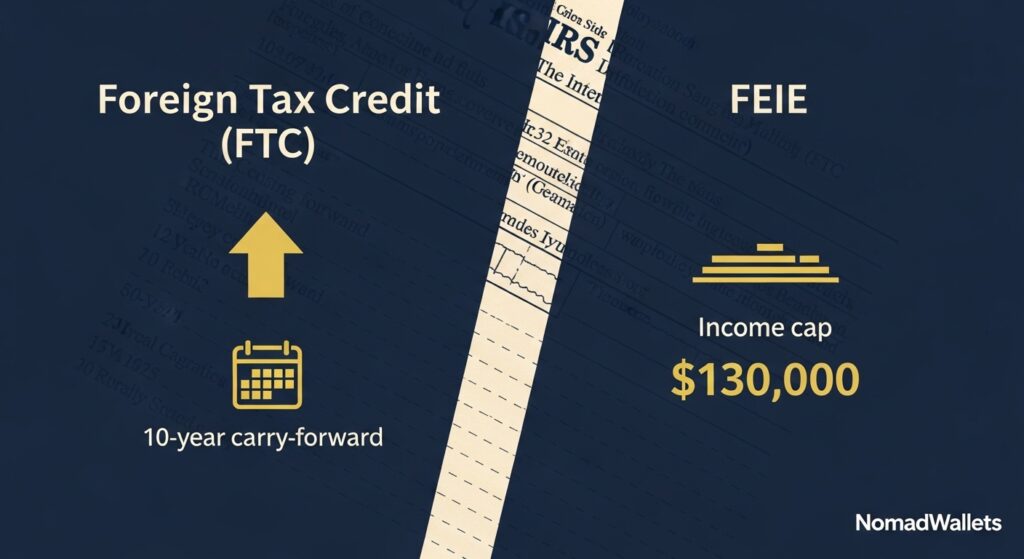
Eliminating the Tax Bill: Foreign Tax Credit (FTC) vs. FEIE
To reach a $0 tax liability at the federal level, you will typically use one of two IRS “lifelines.” Choosing the right one is a critical decision for US Expats in Portugal, as the wrong choice can lead to thousands of dollars in “lost” credits.
The Foreign Tax Credit (FTC)
Generally, the FTC is the superior move for those living in high-tax jurisdictions. Because Portuguese tax rates can reach 48% significantly higher than most US federal brackets using IRS Form 1116 allows you to claim a dollar-for-dollar credit.
- The Carry-Forward Advantage: You can carry forward excess credits for 10 years. This is a massive benefit for US Expats in Portugal who may have US-sourced income in the future or plan to return to the States.
The Foreign Earned Income Exclusion (FEIE)
The FEIE (Form 2555) allows you to exclude a set amount of foreign wages from US taxation. For the 2026 tax year, this exclusion is roughly $130,000.
- The Limitation: It only applies to earned income (wages/salary); it does not cover passive income like dividends, interest, or capital gains.
NOMADWALLETS Intelligence Insight: Our 2026 analysis shows that US Expats in Portugal with children almost always benefit more from the FTC. If you use the FEIE, you are generally barred from claiming the refundable portion of the Child Tax Credit, which can be a significant financial blow to expat families.
Pro-Tip: Most US Expats in Portugal find that the FTC offers more flexibility and long-term wealth protection, especially when navigating the complexities of the Portuguese progressive tax system.

The Social Security Totalization Agreement
Beyond income tax, there is the issue of social insurance. The US-Portugal Totalization Agreement ensures that you only pay into one system at a time. Generally, if you are working on Portuguese soil, you contribute to the Segurança Social and are exempt from the US equivalent.
To prove this to the Internal Revenue Service, US Expats in Portugal must obtain a Certificate of Coverage from the Social Security Administration. This agreement also allows for “Totalization” of credits. If you have 5 years of work in the US and 10 in Portugal, you can combine those credits to qualify for a pro-rated pension in both countries, ensuring you don’t lose your retirement safety net.

Compliance & Wealth Transparency: FBAR and FATCA
The IRS is focused on finding “hidden” offshore accounts via the Financial Crimes Enforcement Network (FinCEN). Most bank accounts in Portugal require a NIF (Tax ID), which makes your accounts visible to international tracking systems.
FBAR (FinCEN Form 114)
If you hold more than $10,000 in total across all Portuguese bank accounts at any point in the year, you must file an FBAR. For US Expats in Portugal, failure to do so can result in “non-willful” penalties starting at approximately $10,000 per violation—a massive risk that requires strict compliance.
FATCA (Form 8938)
This is filed with your Form 1040. For US Expats in Portugal living abroad, the FATCA reporting thresholds are $200,000 (single) or $400,000 (married) on the last day of the year.

NHR 2.0 (IFICI) and the 2026 Landscape
Qualifying US Expats in Portugal, specifically those in high-value tech, engineering, or research roles, can benefit from a 20% flat tax on Portuguese-sourced income for 10 years under the new IFICI (NHR 2.0) program. This program is more restrictive than the original NHR, focusing heavily on scientific research and innovation.
- See if you qualify: Portugal NHR 2.0: The New Tax Incentive Guide

Retirement & Investment Pitfalls: The PFIC Nightmare
One of the most complex and potentially expensive areas for US Expats in Portugal involves the intersection of US-based retirement accounts and European investments. Missteps here can lead to effective tax rates exceeding 50% on certain gains.
Pensions & IRAs
While the US-Portugal Tax Treaty offers some clarity, the treatment depends on the source of the pension:
- Government Pensions: Civil service or government-paid pensions are generally only taxable by the payor country (the US).
- Private Pensions: These are generally taxable in Portugal for residents.
- The Roth IRA Trap: Unlike the US, Portugal does not inherently recognize the “tax-free” nature of Roth withdrawals. Without proactive structuring, the AT may tax the growth portion of your distribution.
The PFIC Nightmare
Perhaps the biggest trap for US Expats in Portugal is the Passive Foreign Investment Company (PFIC).
- The Warning: US citizens should avoid buying Portuguese or European mutual funds/ETFs (even within a Portuguese bank account).
- The Consequence: The IRS treats these under a punitive regime requiring the dreaded IRS Form 8621. This involves “mark-to-market” accounting or “excess distribution” rules that can vanish your returns in fees and taxes.
GILTI Rules & Foreign Corporations
If you decide to open a Portuguese company (Lda) for your business, you trigger some of the most complex requirements in the tax code:
- GILTI (Global Intangible Low-Taxed Income): This ensures you cannot defer US tax by keeping profits in your Portuguese company.
- Reporting: You will likely be required to file IRS Form 5471, which carries heavy penalties for late or incorrect filing.
NOMADWALLETS Intelligence Insight: Our 2026 audit of expat portfolios found that “The PFIC Nightmare” is the #1 cause of IRS penalties for US Expats in Portugal. Most Portuguese banks will offer you local investment products (ETFs) by default—you must decline these and maintain a US-based brokerage account to remain tax-efficient.
Essential Resources & Official Citations
- Internal Revenue Service (IRS) Publication 54: Tax Guide for U.S. Citizens Abroad
- Social Security Administration (SSA): US-Portugal Totalization Agreement
- Autoridade Tributária e Aduaneira (AT): Portal das Finanças
- US Embassy in Lisbon: Taxation Information
- FinCEN: FBAR Filing Portal
- Official treaty text – United States–Portugal Income Tax Treaty Technical Explanation (PDF) (US–Portugal Income Tax Convention and Protocol explanation) — U.S. Department of the Treasury
Conclusion
Being US Expats in Portugal is an incredible adventure. By mastering the US-Portugal Tax Treaty, filing your FBAR, and choosing the right credit mechanisms, you can ensure your transition is a success. The goal is clear: enjoy the culture, pay what you owe, but never pay more than is legally required.
Note
This guide reflects current IRS publications, Portuguese tax code updates, and cross-border practitioner guidance as of February 2026. Important: Cross-border tax outcomes depend heavily on individual facts. This guide is educational, not a substitute for personalized advice from a US–Portugal expat tax specialist.
FAQ: US Expats in Portugal
Q1: Does Portugal tax my US Social Security benefits?
A: Under the treaty, US Social Security taxation in Portugal is restricted; these benefits are generally only taxable by the United States.
Q2: Can I use the “Physical Presence Test” to qualify for tax breaks?
A: Yes. If you spend 330 full days outside the US in any 12-month period, you can qualify for the FEIE. This is common for US Expats in Portugal in their first year.
Q3: What is the deadline for filing as an expat?
A: While the US payment deadline is April 15th, US Expats in Portugal receive an automatic extension to June 15th to file the return.
Q4: How does Portugal capital gains tax affect US citizens?
A: Yes. If you sell a house in Porto, those gains must be reported to the IRS. You will use the Foreign Tax Credit to account for any capital gains tax paid to Portugal.
Q5: What if I own a Portuguese company (Lda)?
A: This triggers GILTI rules. US Expats in Portugal owning local companies face the most complex filing requirements, including Form 5471.
Q6: Can I still claim the Child Tax Credit?
A: Yes, but only if you use the Foreign Tax Credit (FTC). If you use the FEIE, you are barred from the refundable portion.

Hi, I’m Tushar a digital nomad and the founder of NomadWallets.com. After years of working remotely and traveling across Asia and Europe, I started NomadWallets to help U.S. nomads confidently manage money, travel, banking, crypto, and taxes. My mission is to make complex financial topics simple, so you can focus on exploring the world and building true location freedom.