
Sarah’s Reality Check at the Airport
Sarah lands in Barcelona late at night. Before she reaches baggage claim, she opens her banking app. Her money is already converted at a good rate, her card works instantly, and the app shows nearby ATMs with no extra fees. No calls. No surprises. No “card blocked” message. She walks out of the terminal and starts her trip exactly the way travel should feel.
This isn’t a fantasy scenario. In 2026, the best mobile banks for travelers make this kind of seamless experience routine. Your phone isn’t just convenient anymore, it’s your primary travel banking tool. The leading mobile banks for travelers now outperform traditional banks on every metric that matters: fees, reliability abroad, security, and speed. Legacy institutions still charge foreign transaction markups, still freeze cards at the first sign of an overseas purchase, and still force you to call a domestic phone number to fix problems that a tap on a screen should solve.
Planning a move like Sarah? Use our Cost of Living Calculator to compare 150+ cities and see how much cash you’ll actually need to withdraw.
This guide is written from real travel use across the US, UK, and Europe, not from marketing claims. It’s focused on what actually matters when your money crosses borders, built for frequent travelers, remote workers, and digital nomads who need the best banks for frequent travelers rather than whichever brand spends the most on advertising.
What Actually Matters in a Travel Bank (2026 Criteria)
The phrase “travel-friendly” gets thrown around loosely. In 2026, it means something specific and measurable. Here’s what separates a genuinely useful travel bank from one that simply waives a single fee and calls itself international.
- Foreign exchange fees. The most important number. Traditional banks typically mark up the exchange rate by 1–3% on every foreign purchase. The best mobile banks for travelers either charge nothing or convert at the real mid-market rate with a small, transparent fee. Over a two-week trip, this difference alone can save $50–$150.
- Real exchange rate vs. marked-up FX. Some banks advertise “no foreign transaction fees” but quietly inflate the exchange rate itself. The only honest benchmark is the mid-market rate: the real rate banks use between themselves. Any gap between that rate and what you’re charged is a hidden fee, regardless of what the marketing says.
- ATM withdrawal fees. There are two layers here: what your bank charges you, and what the local ATM operator charges. The best banks with free ATM use outside the country reimburse both. Others waive only their own fee, leaving you to absorb operator surcharges of $3–$7 per withdrawal.
- Card reliability abroad. A card that gets frozen every time it’s used in a new country is worse than useless. False fraud blocks remain one of the most common complaints among international travelers. The best mobile banks for travelers use smarter fraud detection that recognizes travel patterns rather than simply flagging every foreign transaction.
- App-based security. The ability to freeze and unfreeze your card instantly, receive real-time push notifications on every transaction, and generate virtual or disposable card numbers for risky online purchases. These aren’t premium extras, they’re baseline requirements for cross-border banking in 2026.
- Multi-currency support. Holding balances in multiple currencies and choosing when to convert rather than being forced into a conversion at the point of sale gives you control over foreign exchange fees and timing.
Best Mobile Banks for US Travelers
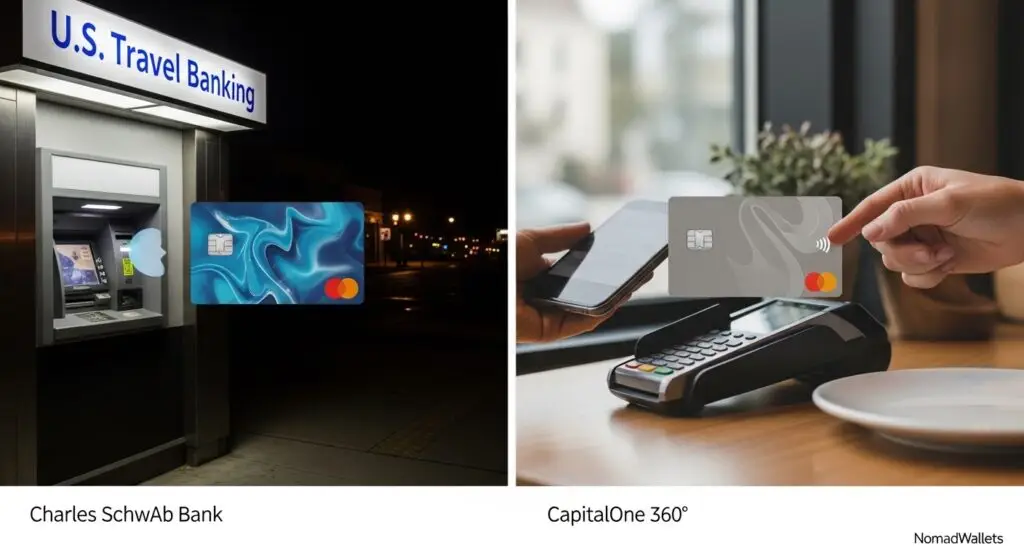
Charles Schwab — High-Yield Investor Checking With Unlimited Global ATM Fee Reimbursements
Charles Schwab Investor Checking remains the gold standard for American travelers, and the reason is simple: no other US bank matches its ATM policy. It is the strongest choice among the best mobile banks for travelers holding US residency.
Best for: Cash-heavy travelers, long international trips, and frequent ATM usage.
- Unlimited global ATM fee reimbursements – both Schwab’s fees and the local operator’s surcharge, with no monthly cap
- No foreign transaction fees on any purchase
- FDIC-protected checking account with no minimum balance
Pros: Schwab’s international ATM reimbursement is genuinely unlimited. During testing in Thailand, every operator fee (typically 220 THB, roughly $6) was reimbursed in full at statement’s end. There are no monthly maintenance fees, no minimum balance requirements, and the card works reliably across every country I’ve tested it in. For travelers who rely on cash and in much of Southeast Asia, Latin America, and parts of Eastern Europe, you still will – Schwab remains the best checking account for travelers in the US market.
Cons: No multi-currency wallet. The app is functional but basic compared to European neobanks. A linked Schwab brokerage account is required to open checking (it can sit empty at zero cost). Available to US residents only.
Capital One — Fee-Free Online Checking for International Card Spend
Capital One 360 Checking is the safest mainstream option, less specialized than Schwab but dependable and easy. It earns its place among the best mobile banks for travelers who prefer simplicity.
Best for: Card-first travelers, short to medium trips, and anyone who values simplicity over features.
- No FX fees on purchases abroad
- Strong global Visa acceptance
- Stable, well-designed mobile app
Pros: No monthly fees, easy setup, and excellent card reliability abroad. Capital One’s global Visa network means acceptance is rarely an issue. For travelers who pay by card almost exclusively and want a best bank with no monthly fees, it delivers without complication.
Cons: No ATM fee reimbursements for international withdrawals. Fewer travel-specific tools than Schwab. Not the right pick for cash-reliant travelers.
Best Mobile Banks for UK Travelers
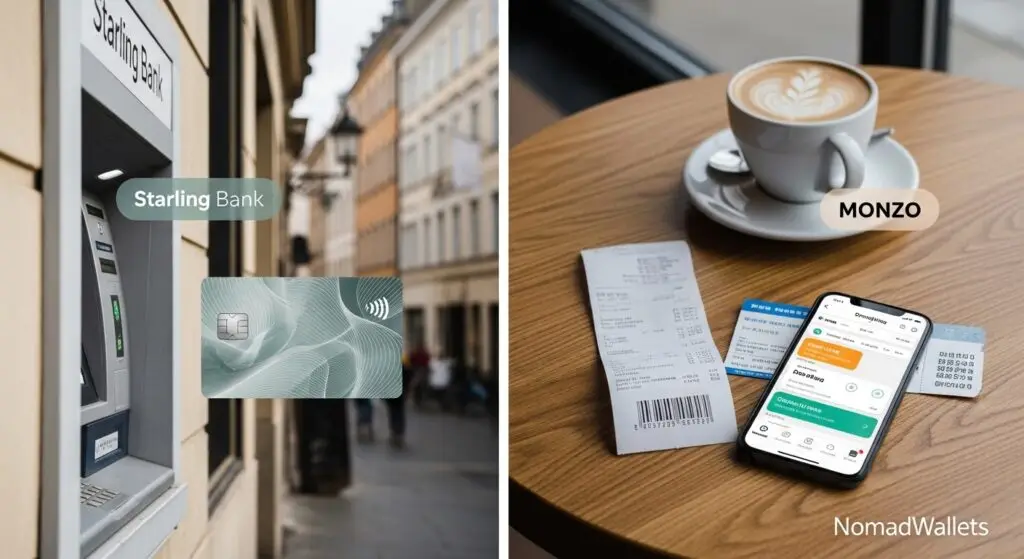
Starling Bank — App-First UK Bank With No Foreign Card Fees
Starling Bank has built one of the most complete travel banking packages in the UK, and it’s the reason frequent travelers trust it as their primary card abroad. It consistently ranks among the best mobile banks for travelers based in the United Kingdom.
Best for: Long-term travel, Europe-heavy trips, and fee-sensitive users.
- No FX fees on any international card payment
- Fee-free ATM usage abroad with generous limits
- Full FSCS protection up to £85,000
Pros: Transparent pricing with no hidden markups. Strong regulatory trust signals. Excellent card reliability. I used Starling across Portugal, Germany, and Greece without a single declined transaction or fraud alert. For UK travelers who want a single, zero-fee card that simply works, Starling is difficult to beat. It’s one of the best banks for frequent travelers who don’t want to manage multiple accounts.
Cons: Available to UK residents only. Limited advanced budgeting tools compared to Monzo.
Monzo — Smart Budgeting and Real-Time Spending Alerts for Travelers
Monzo takes a different approach, building its travel proposition around spending clarity and budgeting intelligence. Among digital banks for frequent withdrawals and expense tracking, Monzo leads the UK market.
Best for: Expense tracking, frequent EU travel, and travelers who want granular spending visibility.
- Real-time spending insights categorized automatically
- Travel spending reports broken down by country
- Instant transaction alerts
Pros: The best budgeting visuals of any bank I’ve tested. After a week in Lisbon, I could see exactly how much I’d spent on food, transport, and accommodation. All converted to GBP in real time. Easy card controls and excellent usability across EU countries. It’s one of the best mobile banks for travelers who want to understand where their money goes, not just spend it.
Cons: ATM withdrawal limits on the free tier (£200/month abroad). UK-only availability. Premium plans unlock higher limits but add monthly costs.
Best Mobile Banks for EU Travelers
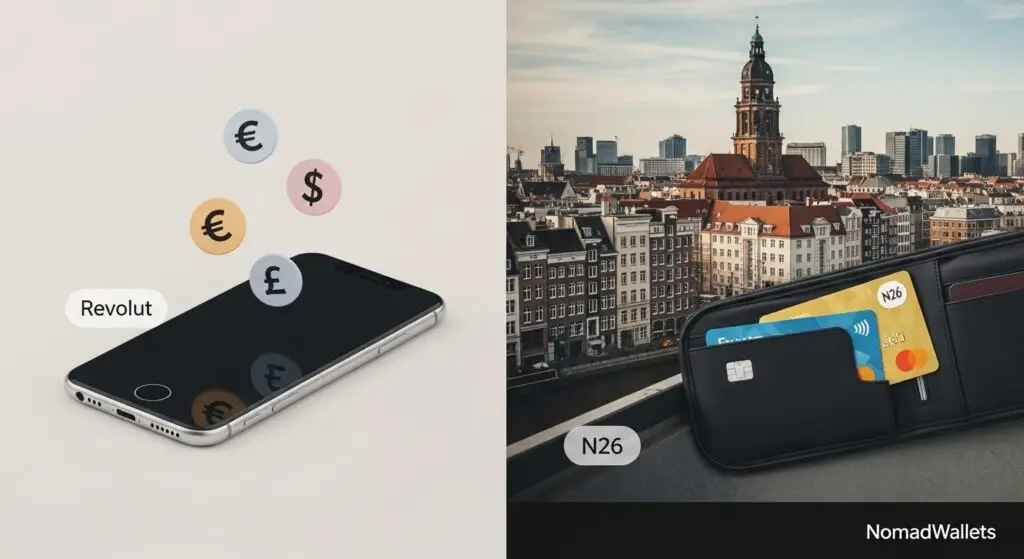
N26 — Pan-European Mobile Bank Built for Cross-Border Living
N26 is available only to EU/EEA residents and is not offered in the US or UK. Within its service area, it delivers a clean, stable banking experience built on strong regulatory foundations. It belongs among the best mobile banks for travelers based in Europe.
Best for: Euro-zone travel, minimalist banking, and stability-focused users.
- Full European banking license (German BaFin-regulated)
- Strong SEPA integration for Euro-zone transfers
- Clean, intuitive mobile experience
Pros: High regulatory trust. Reliable and consistent across EU countries. Simple fee structure that’s easy to understand. For European residents who travel primarily within the Euro zone, N26 offers exactly what’s needed without unnecessary complexity.
Cons: Limited multi-currency holding compared to Revolut. Available to EU/EEA residents only. Fewer advanced features on the free tier.
Revolut — Feature-Rich Digital Bank for Travelers and Digital Nomads
Revolut has become the most flexible mobile banking platform available to European travellers, and increasingly, to users globally. Among the best mobile banks for travelers who want maximum functionality in a single app, Revolut stands apart.
Best for: Multi-currency travel, virtual card users, and power users who want everything in one app.
- Multi-currency accounts supporting 30+ currencies
- Disposable virtual cards for online security
- Tiered plans ranging from free to premium
Pros: Extremely flexible. Strong global feature set including budgeting, crypto, and integrated insurance on premium tiers. Excellent app controls and real-time notifications. For travelers managing money across multiple currencies, Revolut’s ecosystem is unmatched. The contrast between neobanks vs traditional banks is sharpest here: no legacy institution offers anything close to this breadth.
Cons: Weekend FX markups apply on free-tier currency conversions. Feature limits on the free plan can feel restrictive for heavy users. Premium tiers add meaningful cost.
The Global Travel Essential: Wise
Wise is not a replacement bank. It’s a travel companion. It belongs in a separate category because it serves travelers everywhere, regardless of residency. Among the best mobile banks for travelers who operate across borders, Wise is the one account that fits every toolkit.
Managing cross-border finances also means staying on top of the IRS. Check out our guide on 2026 US Tax Deadlines for Expats to avoid penalties while you travel.
Best for: International transfers, multi-currency holding, freelancers, and remote workers.
- 40+ currencies held in a single account
- Local bank details in multiple countries (US routing number, UK sort code, European IBAN)
- Conversions at the real mid-market exchange rate with transparent fees
Wise earns its place through use-cases that no single regional bank covers:
- Receiving income in foreign currencies without losing money on conversion
- Moving money between countries at the real exchange rate
- Pairing with a main travel bank (Schwab, Starling, or Revolut) as a digital nomad bank account for handling the financial complexity of location-independent life
The Wise debit card supports fee-free ATM withdrawals up to a modest monthly limit. It won’t replace a Schwab card for heavy cash users, but as the hub of a best banks for money transfers strategy, nothing else competes on transparency or breadth.
US vs. UK vs. EU: Quick Comparison
| Region | Best Choice | Runner-Up | Key Advantage |
| US | Charles Schwab | Capital One 360 | Unlimited ATM rebates |
| UK | Starling Bank | Monzo | Zero FX & ATM fees |
| EU | Revolut | N26 | Multi-currency ecosystem |
| Global | Wise | – | Real FX rates, 40+ currencies |
The best mobile banks for travelers aren’t universally “best”, they’re best for specific situations. Your residency, cash habits, and travel frequency determine the right fit. The table above reflects real-world testing, not theoretical rankings.
Travel Banking Safety Tips (From Experience)
These practices are tested across dozens of countries and consistently prevent the most common financial problems travelers face. Even the best mobile banks for travelers work better when paired with smart habits.
- The two-card rule. Carry cards from two different banks on two different networks (one Visa, one Mastercard). Keep them in separate physical locations. During a regional Visa processing outage in Southeast Asia, travelers with only Visa cards were locked out for nearly a full day. A Mastercard backup made the difference between inconvenience and crisis.
- Avoid Dynamic Currency Conversion (DCC). When an ATM or terminal offers to charge you in your home currency instead of the local one, always decline. DCC inflates the exchange rate by 3–8%. Choose the local currency every time and let your bank handle the conversion at its far better rate.
- Choose ATMs carefully. Use ATMs attached to actual banks rather than standalone machines in tourist areas. Independent ATMs in airports and shopping districts frequently charge higher operator fees and are more likely to push DCC. The difference in ATM withdrawal fees abroad between a bank-attached machine and a tourist-area kiosk can be $5–$10 per transaction.
- Freeze cards instantly if anything feels wrong. Every bank in this guide lets you lock your card from the app in under five seconds. If you notice a suspicious charge, lose sight of your card, or simply feel uneasy; freeze first, investigate later. You can unfreeze just as quickly.
Choosing the Right Travel Bank
The best mobile bank for travelers depends on three things: where you hold residency, how much you rely on cash versus card payments, and how often you travel internationally. There is no single perfect answer: only the right combination for your specific situation.
US travelers who use cash abroad should start with Schwab. UK travelers who want zero-fee simplicity should look at Starling. EU residents benefit most from Revolut’s flexibility or N26’s stability. And every traveler, regardless of home base, gains something from keeping a Wise account as their multi-currency backbone.
The best mobile banks for travelers in 2026 have eliminated the old “travel tax” that legacy banks quietly imposed for decades. The tools are available, most are free to set up, and the cost of not using them (in fees, in frozen cards, in unnecessary stress) is entirely avoidable. Choose the combination that fits your life, test it before you leave, and travel knowing your money works as hard as you do.
Disclaimer:
This article is based on independent research and real-world travel use across the US, UK, and Europe. Banking features, fees, and availability may change over time and can vary by residency and account type. This content is for informational purposes only and does not constitute financial advice. Always verify current terms directly with the bank before opening an account.
You may also like :
- The Rise of the Digital Nomad Movement: Size, Growth, and Global Impact in 2025
- Best AI Powered Investing Tools for US Nomads – 2025 Expert Guide
- Ultimate Nomad Productivity Hacks for US Freelancers 2025
FAQs: The Best Mobile Banks for Travelers
Q1: Is mobile banking safe while traveling?
A: Yes, in most practical respects, safer than traditional banking. Instant transaction alerts mean you know the moment your card is used. Biometric login (fingerprint, face recognition) adds security that a physical card alone can’t match. In-app card freezing replaces the old process of calling a domestic phone number and waiting on hold. The US banks reviewed here carry FDIC insurance; UK banks carry FSCS protection. Your deposits are protected to the same standard as any high-street bank. The best mobile banks for travelers have made security a core feature rather than an afterthought.
Q2: Can I open these accounts while abroad?
A: Some, yes: Wise and Revolut both support remote account opening from most countries with a valid passport or national ID. US-based banks like Schwab and Capital One generally require a US address and domestic identity verification. The consistent recommendation: open your accounts two to four weeks before departure. This gives you time to receive physical cards, test transactions, and confirm everything works before you’re relying on it in an unfamiliar country.
Q3: What if my card is blocked overseas?
A: This is where modern mobile banks demonstrate their advantage. With Schwab, Starling, Revolut, and Wise, you can typically resolve a block directly in the app, verifying your identity through biometrics and confirming the flagged transaction is legitimate. Resolution takes minutes, not days. With legacy banks, the same situation often requires an international phone call during home-country business hours. The best mobile banks for travelers treat overseas usage as normal, not suspicious.

Tushar Sharma is the founder and editor of NomadWallets, where he writes about international banking, travel cards, cross-border payments, taxes, and financial tools for digital nomads and globally mobile professionals. He created NomadWallets to make global money decisions simpler through practical, research-backed guides built from official sources and real-world financial data.