
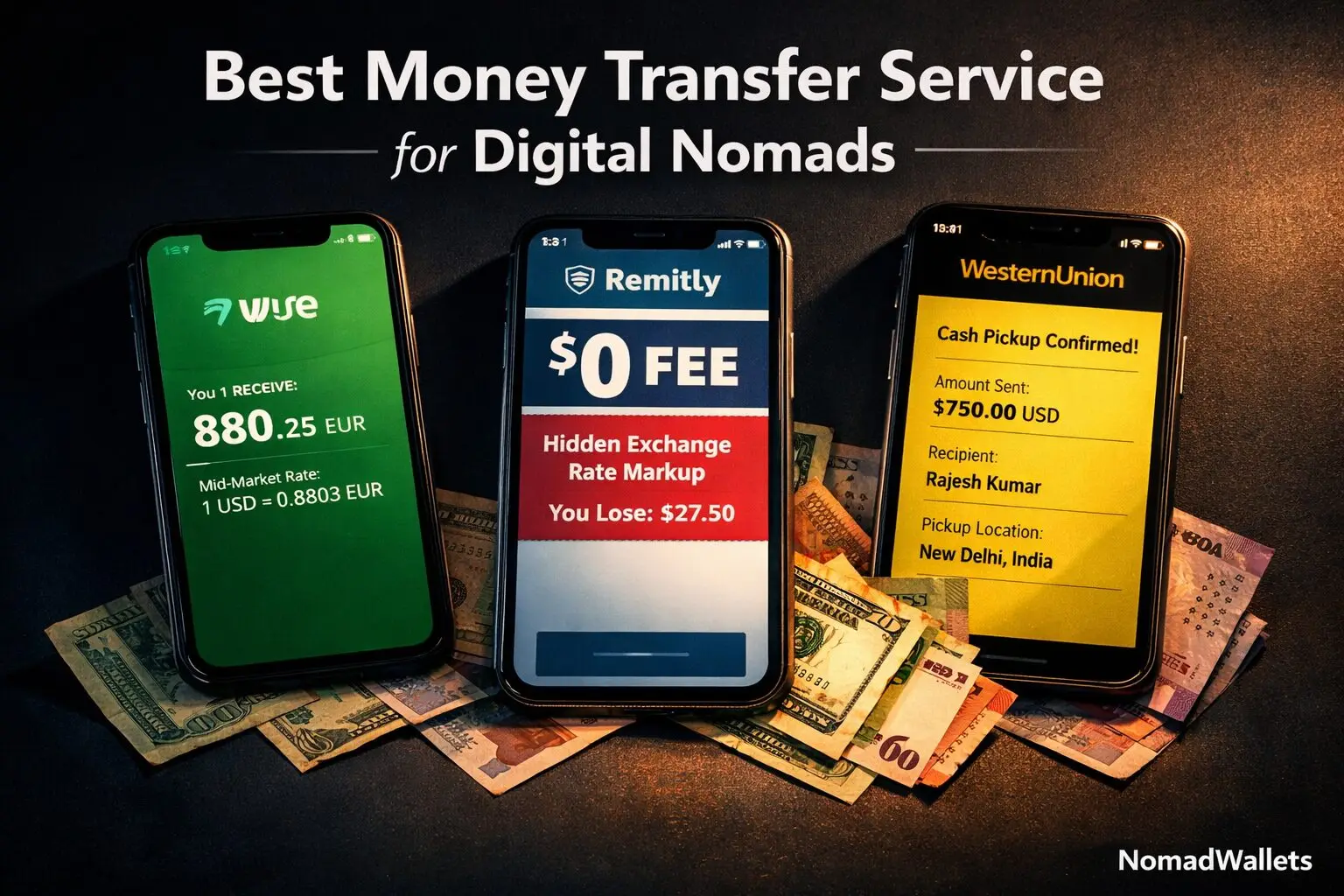
This guide is based on independent pricing research conducted across all three services, community-reported transfer data from digital nomad forums, World Bank remittance pricing data, and direct rate comparisons verified against XE.com mid-market rates. No affiliate relationships influenced these findings.
Most digital nomads unknowingly lose hundreds of dollars each year on international transfers. Not because the fees are high. But because the real cost is hidden inside the exchange rate. Finding the best money transfer service for digital nomads starts with understanding that the advertised fee is almost never the full story.
In this guide, the NomadWallets research team compared Wise, Remitly, and Western Union across real transfer amounts on five major corridors to reveal which service actually costs the least in 2026.
According to the World Bank Remittance Prices Worldwide Index 2026, global remittance fees average 6.2%, meaning someone sending $10,000 per year internationally loses over $600 to fees and hidden markups. Using the right service, that number drops below $150.
Across digital nomad communities on Reddit and Facebook groups, the same story appears repeatedly. Someone sends $1,000 home every month using a familiar transfer service. Their family mentions the amount arriving seems slightly lower than expected.
A year later they calculate the difference and discover they lost $300 to $500 in hidden exchange rate markups they never knew existed.
This is not an accident. It is a business model built on the assumption that most people never check the exchange rate.
This guide changes that. If you are searching for the best money transfer service for digital nomads in 2026, every answer below is backed by real pricing data and verified numbers.
Whether you are sending family remittances, paying international contractors, or receiving freelance income from multiple countries, choosing the right international transfer service is one of the most impactful financial decisions a location-independent professional can make.
Quick Answer: Best Money Transfer Service for Digital Nomads (2026)
For nomads who want the short version first, here is the verdict on the best money transfer service for digital nomads broken down by situation.
| Your Situation | Best Choice | Why |
| Regular monthly transfers ($500 to $3,000) | Wise | Lowest real total cost, transparent pricing |
| Large one-time transfer ($10,000 or more) | Wise | Mid-market rate saves hundreds at scale |
| Emergency cash needed in under 2 hours | Remitly Express | Fastest delivery, worth the premium for genuine urgency |
| Recipient has no bank account | Western Union | Cash pickup network reaches 200+ countries |
| Remote village or rural area | Western Union | 500,000+ agent locations globally |
| First transfer, testing a new service | Remitly | First-time promo of $15 to $20 off |
| Receiving freelance payments from clients | Wise | Multi-currency accounts with zero incoming fees |
| Sending under $50 | PayPal or Venmo | Percentage-based fees do not make sense at this scale |
| Paying contractors in Kenya, Philippines, Colombia | Remitly | Direct M-Pesa, GCash, and RappiPay integration |
| Australia or Canada to Asia corridor | Wise | AUD and CAD accounts with local bank details |
For most digital nomads doing regular planned transfers, whether supporting family, paying contractors, or moving income between countries, Wise is the best money transfer service for digital nomads in the vast majority of situations. The sections below explain exactly when and why the other services win instead.

The Hidden Cost That Most Nomads Never Notice
Identifying the best money transfer service for digital nomads is not about finding the lowest advertised fee. It is about understanding the two-cost structure that the remittance industry deliberately obscures.
Cost 1: The advertised fee. Shown upfront. Prominently displayed. Sometimes shown as $0 with promotional animations.
Cost 2: The exchange rate markup. Hidden inside the offered rate. Never labeled as a cost. Almost always the larger number.
Community research consistently shows that most nomads only evaluate the fee. Services know this and design their entire marketing strategy around it.
What the Mid-Market Rate Actually Is
The mid-market rate, also called the interbank rate, is the real wholesale price of currency. It is the rate that banks charge each other when trading currencies on the global forex market. You can verify it at any time by searching any currency pair on Google or visiting XE.com.
When a money transfer service offers you a rate worse than that number, the difference is their profit. They pocket the spread. This practice is legal. It is rarely disclosed clearly before you commit to a transfer.
Research Finding: Same Transfer, Three Services, Same Day
To find the true best money transfer service for digital nomads, our team checked all three services on the same day for a $10,000 USD to INR transfer. This is one of the most common high-value corridors among nomads supporting family in India.
XE.com mid-market rate at time of research: Rs 83.56 per dollar.
| Service | Rate Offered | Recipient Gets | Real Total Cost |
| Wise | Rs 83.56 (real mid-market) | Rs 8,24,238 | $136 shown upfront |
| Remitly Economy | Rs 82.40 | Rs 8,24,000 | $138.80 hidden in rate |
| Western Union | Rs 81.10 | Rs 8,11,000 | $304.40 fee plus hidden markup |
Remitly displayed “$0 TRANSFER FEE” with promotional animations. Their real cost was $138.80, more than Wise’s transparent $136 fee.
Western Union displayed a “$10 fee.” Their real total cost was $304.40. The $10 was visible. The $294.40 exchange rate markup was buried in fine print.
The single most important habit for any nomad sending money internationally: open XE.com in a separate browser tab before confirming any transfer. Check the real mid-market rate. Compare it to what the service is offering. Multiply the rate difference by your transfer amount.
That number is your hidden cost. Repeat this every single time, with every service, without exception.
Real Cost Comparison: Sending $1,000 Internationally
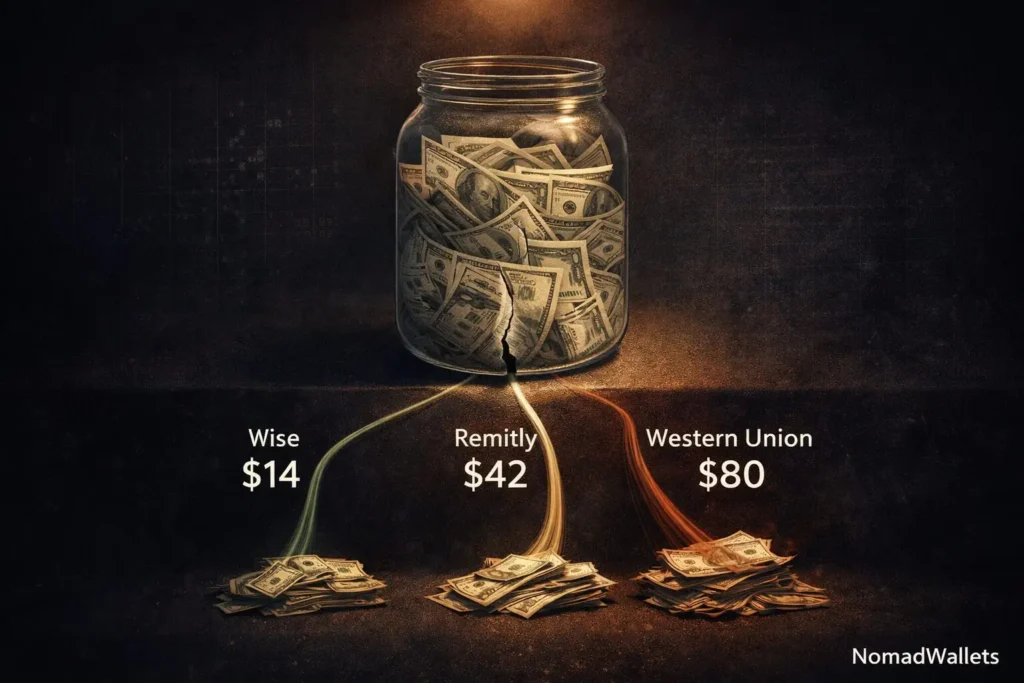
Any genuine comparison of the best money transfer service for digital nomads has to look at real total cost, not advertised fees. Here is how the three services compare on a standard $1,000 transfer to India.
| Service | Advertised Fee | Real Total Cost |
| Wise | $14 to $18 | $14 to $18 |
| Remitly Economy | $0 | $35 to $42 |
| Remitly Express | $3.99 | $95 to $105 |
| Western Union | $5 to $15 | $50 to $80 |
Where the hidden fees live:
Advertised Fee + Exchange Rate Markup = Real Total Cost
The gap between the cheapest and most expensive option on a $1,000 monthly transfer adds up to $400 to $700 per year. That is real money that belongs in your pocket, not a remittance company’s revenue column. According to FXC Intelligence’s 2026 Cross-Border Payment Trends report, the spread between transparent and opaque pricing continues to widen as fintech adoption grows.
How International Money Actually Moves
Understanding the infrastructure behind cross-border payments explains why some services cost dramatically less than others, and why the best money transfer service for digital nomads in 2026 looks very different from what it looked like five years ago.
The SWIFT System and Its Limitations
When money moves through a traditional bank wire, it travels through SWIFT (Society for Worldwide Interbank Financial Telecommunication). A transfer from a US bank to a Thai bank typically routes through two or three correspondent banks before reaching its destination. Each correspondent charges a processing fee.
Each one adds time. Each one introduces a potential currency conversion point.
This is why traditional bank wires take three to five business days, cost $25 to $50 in fees before exchange rate markup, and remain unpredictable on final delivery timing.
Local Rails: The Modern Alternative
Wise disrupted this model through a structurally different approach. Rather than moving money across borders, Wise moves money within borders on both ends simultaneously.
When a nomad sends $1,000 from the US to India through Wise, the service uses funds already held in a US bank account to settle the sending side, and pays the recipient from rupee funds already held inside India. No SWIFT routing. No correspondent bank fees. No multi-day processing window.
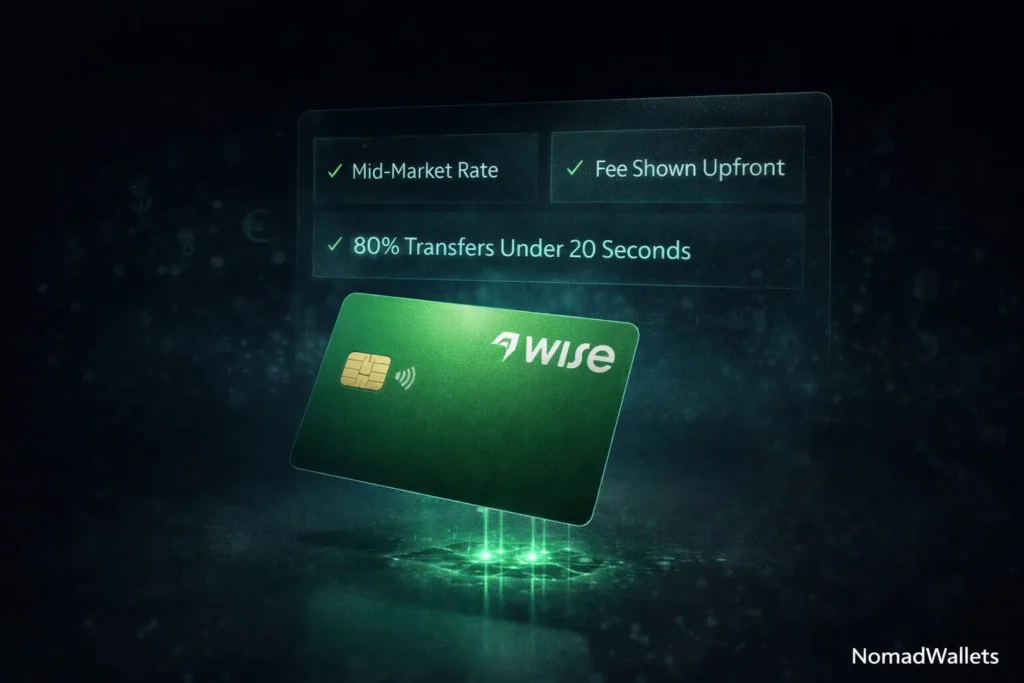
This structural difference is why Wise reports that 80% of transfers complete in under 20 seconds in 2026, and why their costs stay dramatically lower than traditional bank wires. It is also a core reason why Wise consistently comes out on top when nomads evaluate the best money transfer service for digital nomads on a cost-per-transfer basis.
The same principle now extends through local payment rails worldwide. India’s UPI, Brazil’s Pix, Thailand’s PromptPay, Indonesia’s QRIS, and Europe’s SEPA Instant are being connected into a global instant settlement layer.
The best money transfer services for digital nomads in 2026 are the ones building integrations with this infrastructure rather than relying on legacy correspondent banking.
Wise: The Benchmark for Regular Transfers
Wise earns its reputation as the best money transfer service for digital nomads doing regular planned transfers through one core commitment: the mid-market exchange rate with zero markup, combined with a transparent fee shown upfront before confirmation.
Wise, originally launched as TransferWise in 2011, is consistently rated as the best money transfer service for digital nomads across nomad communities and independent comparison research. If you are also comparing bank accounts for travel, see our guide to the best mobile banks for travelers for the full picture of how Wise fits into a nomad banking stack.
Fee Structure by Transfer Amount
Wise charges a percentage-based fee that decreases as transfer amounts increase, which benefits nomads sending larger amounts regularly. All figures below are taken directly from Wise’s published fee schedule.
| Transfer Amount | Wise Fee | Percentage |
| $500 | $8.82 | 1.76% |
| $1,000 | $14 to $18 | 1.4% to 1.8% |
| $3,000 | $42.50 | 1.42% |
| $10,000 | $136 | 1.36% |
The fee increases in dollar terms with larger transfers but the percentage decreases. Every fee is displayed before confirmation. There is no markup on the exchange rate itself.
The Multi-Currency Account for Freelancers
The Wise multi-currency account is the feature that most directly addresses the income side of the nomad financial equation. Nomads using Wise receive real local bank account details for 10+ currencies: a US routing number and account number for USD, a sort code and account number for GBP, an IBAN for EUR, and AUD and CAD account details as well.
The practical result is that clients in the US, UK, or Europe make a standard domestic transfer in their own country to pay a nomad. From the client’s perspective it is a local payment, free or nearly free on their end. The nomad receives the full payment with no incoming fees.
For a deeper look at managing client payments across borders, see our guide to international client payment processing.
The Wise Debit Card for Daily Spending
The Wise debit card applies the real mid-market exchange rate on every purchase with no foreign transaction fee. Traditional bank cards typically apply a 1% to 3% foreign transaction markup on every overseas purchase. For nomads making dozens of daily purchases in local currencies, this markup accumulates into hundreds of dollars annually.
Wise also provides automatic ATM fee reimbursements up to a monthly limit for operator surcharges charged by local ATM machines. This benefit applies without requiring any manual claim or request.
For nomads tracking daily spending across currencies, pairing the Wise card with a dedicated budget tracking app creates a complete picture of where money goes. Our guide to digital nomad budget tracking covers the apps that integrate most smoothly with Wise.
Compliance Holds: What to Expect on Larger Transfers
Community reports across nomad forums consistently document a pattern worth knowing in advance. Wise applies routine anti-money-laundering compliance checks on larger transfers, particularly on amounts above $5,000. When a hold is triggered, the transfer status shows “under review.” The money is not lost.
Wise contacts the account holder through the app, typically within a few hours, requesting government-issued ID and proof of address. Resolution generally happens within the same business day after documents are submitted.
Wise is regulated by the Financial Conduct Authority in the UK and FinCEN in the US, which means customer funds are held in segregated accounts protected against company insolvency.
The important preparation: complete full KYC verification and submit all identity documents before initiating large transfers, especially if you are in a location with unreliable internet connectivity.
When Wise Is Not the Right Answer
Wise does not offer cash pickup. Recipients must have a bank account or supported mobile wallet. For amounts under $50, the percentage fee becomes disproportionate at the small end. A $30 transfer carries a fee equivalent to over 13% of the transfer amount. Wise currently supports 70+ countries.
For corridors outside this coverage, alternative services are required. For genuine emergencies where physical cash must be available within one to two hours, Wise’s processing time is too slow regardless of corridor.

Remitly: Speed and Emerging Market Reach
Remitly is not the best money transfer service for digital nomads doing regular monthly transfers on a cost basis. For that use case, it consistently costs more than Wise once the exchange rate markup is calculated into the real total cost.
Remitly wins on two specific dimensions: emergency speed for cash delivery, and reach into mobile-wallet-dominant emerging markets where recipients often have no formal bank account.
The “$0 Fee” Pricing Structure Explained
Remitly’s Economy option prominently displays “$0 TRANSFER FEE.” This is technically accurate and practically misleading. The real cost lives in the exchange rate offered. You can verify this yourself using Remitly’s live rate calculator alongside XE.com.
Our research on a $3,000 USD to INR transfer found the following.
XE.com mid-market rate: Rs 83.56
| Option | Advertised Fee | Rate Offered | Hidden Markup | Real Total Cost |
| Remitly Economy | $0 | Rs 82.40 | $41.65 | $41.65 |
| Remitly Express | $3.99 | Rs 80.85 | $97.27 | $101.26 |
| Wise (comparison) | $42.50 | Rs 83.56 | $0 | $42.50 |
The “$0 fee” Economy option costs $41.65 in real terms, nearly identical to Wise’s transparent $42.50 fee but presented as free. The Express option costs over $100 to send $3,000, more than double the Wise equivalent. The premium buys speed. Whether that speed is worth the cost depends entirely on the urgency of the specific situation.
Express Delivery: When It Genuinely Matters
Nomad community reports consistently cite two scenarios where Remitly Express is the correct choice regardless of cost.
The first is a genuine cash emergency. A stolen wallet, an unexpected medical payment, a contractor who needs funds immediately. Remitly Express delivers to cash pickup agents in as little as 20 minutes in supported corridors. No other major regulated service reliably matches this speed.
The second is time-sensitive contractor payments in emerging markets. A freelancer in Manila waiting on a weekly payment, a contractor in Nairobi who needs funds before a weekend, a team member in Medellin with an urgent bill. Remitly Express resolves these situations within an hour.
Mobile Wallet Reach: M-Pesa, GCash, RappiPay
Remitly has built direct integrations with mobile money infrastructure that Wise does not currently match in depth. Direct transfers go to M-Pesa in Kenya, Tanzania, and across East Africa. GCash in the Philippines. RappiPay in Colombia. Recipients in these corridors do not need a formal bank account.
They need a registered mobile money account, which has significantly higher penetration in these markets than traditional banking.
First-Time User Promotions
Remitly consistently offers $15 to $20 off a first transfer for new accounts. On a $500 to $1,000 transfer, this discount can make Remitly cheaper than Wise for that single transaction.
The financially optimal approach documented in nomad communities: use the first-time promo on Remitly, then switch to Wise for all subsequent regular transfers where Wise’s economics are consistently better.

Western Union: Legacy Infrastructure With Irreplaceable Reach
Western Union is not the best money transfer service for digital nomads by any modern measurement of cost or transparency. Its exchange rate markups land between 2% and 5% depending on the corridor.
Community data collected from nomad forums shows Western Union is the most common service cited in “I lost hundreds without knowing it” stories.
However, digital infrastructure fails. Local bank systems go offline. Recipients in genuinely remote areas often have no bank account, no smartphone, and no access to mobile money services. Western Union’s 500,000+ physical agent locations across 200+ countries is infrastructure that no fintech company has replicated.
It is the last-mile cash delivery solution that the digital remittance industry has not solved.
The Online Versus In-Person Pricing Gap
Our research documented a significant pricing gap between Western Union’s online and in-person channels for an identical transfer. Using Western Union’s price estimator, the same $800 transfer to the Philippines showed a $4.99 fee via their website and an $18 fee at a physical branch location.
That is 3.6 times more expensive for using the in-person channel. This difference is not prominently disclosed in Western Union’s marketing materials.
If Western Union is necessary for a specific situation, always use the Western Union website or mobile app. Never use physical branch locations unless there is no alternative.
Exchange Rate Markup: The Real Cost Calculation
Using the same research snapshot for a $10,000 transfer to India. Western Union offered Rs 81.10. That is Rs 2.46 less per dollar than the real mid-market rate of Rs 83.56. Across $10,000, that is Rs 24,600 in exchange markup, which equals $294.40.
Adding their $10 advertised fee produces a real total cost of $304.40. The “$10 fee” was the visible cost. The $294.40 exchange markup was the invisible one.
When Western Union Is the Correct Choice
Cash pickup for recipients without bank accounts is the primary legitimate use case. If a family member in a rural village needs physical cash, has no smartphone, and has no formal bank relationship, Western Union’s agent network is frequently the only available option.
Emergency cash pickup when other services do not support a specific location is the secondary use case. The agent network reaches 200+ countries, including many corridors where Wise and Remitly have no coverage.
For all other situations where the recipient has a bank account and either Wise or Remitly supports the corridor, Western Union’s real total cost is consistently the highest of the three services.
The recommended approach from nomad community consensus: keep a Western Union account set up, verified, and tested before it is needed. The one or two situations per year where it becomes necessary are exactly the situations where you do not have time to create a new account and go through verification.

Alternatives to Wise, Remitly, and Western Union
Several other services compete for the title of best money transfer service for digital nomads. Our research reviewed them all as potential candidates but excluded them as primary recommendations for the following reasons.
Revolut is an excellent tool for daily spending and intra-European transfers via SEPA Instant. For nomads based in Europe, Revolut pairs well with Wise. However, Revolut applies a 0.5% to 1% weekend markup on currency conversions and its transfer fees for non-European corridors are less competitive than Wise.
Payoneer is designed primarily for freelancers receiving marketplace payments from platforms like Upwork, Fiverr, and Amazon. For that specific use case it is strong. For general international transfers to family or contractors outside marketplace ecosystems, its fees and exchange rate markups are higher than Wise.
OFX (formerly OzForex) is competitive for large transfers above $10,000, particularly for Australian and New Zealand nomads. For transfers below $10,000, Wise’s fee structure is generally more cost-effective.
WorldRemit covers more corridors than Wise and offers mobile wallet delivery in some markets. However, its exchange rate markups are closer to Remitly Economy than to Wise, making it a secondary option for most use cases.
Xoom (a PayPal service) offers reasonable speed and wide corridor coverage. Its exchange rate markups are consistently higher than Wise, and its overall fee structure makes it better suited for small infrequent transfers than for regular nomad remittances.
For most digital nomads, the Wise plus Remitly backup stack covers 95% of transfer scenarios more cost-effectively than any of these alternatives.
Full Feature Comparison: All Three Services
| Feature | Wise | Remitly | Western Union |
| Exchange Rate | Mid-market, 0% markup | 0.4% to 3% markup | 1% to 4% markup |
| Transparency | Excellent | Poor, “$0 fee” misleads | Poor, hidden markups |
| Speed | 1 to 3 days, usually 1 to 2 | Express: minutes / Economy: 3 to 5 days | Minutes (cash) to 7 days (bank) |
| Cash Pickup | Not available | Limited agents | 500,000+ locations |
| Countries Supported | 70+ | 170+ | 200+ |
| Mobile Wallet Support | Limited | M-Pesa, GCash, RappiPay | Limited |
| Multi-Currency Account | Yes, 40+ currencies | No | No |
| Business Features | Excellent | Limited | Minimal |
| Debit Card | Yes, no FX fees | No | No |
| Best For | Regular transfers, large amounts, receiving income | Emergencies, emerging market mobile wallets | Cash pickup, remote areas |
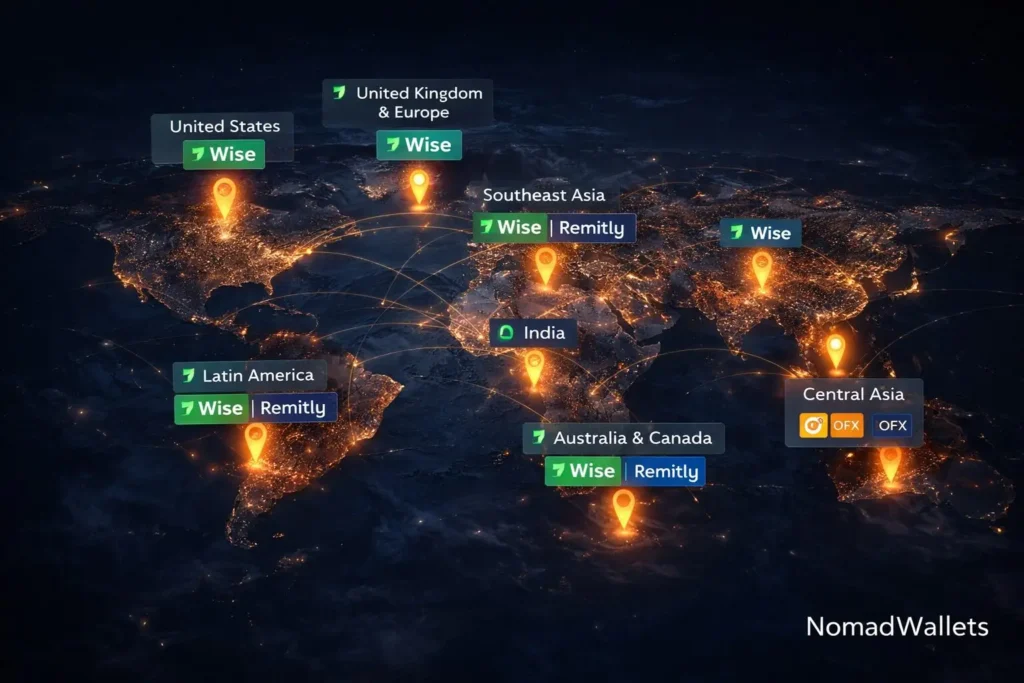
Regional Playbooks: Best Options by Location
The best money transfer service for digital nomads varies meaningfully by region because payment infrastructure, local rail integrations, and supported corridors differ across markets.
United States to International Destinations
For US-based nomads looking for the best money transfer service for digital nomads, Wise provides strong structural options. The Wise USD account provides a real US routing number and account number, allowing US-based clients to pay via domestic ACH transfer rather than expensive international wire.
For sending from the US to India, Mexico, the Philippines, Thailand, and most major corridors, Wise consistently produces the best real total cost. For Pacific Island destinations or corridors where Wise coverage is limited, Remitly covers gaps effectively.
If you are tracking spending across multiple currencies, our guide to digital nomad budget tracking apps covers the tools that pair best with a Wise account.
United Kingdom and Europe
Within the Eurozone, SEPA Instant Credit Transfer moves funds between Euro accounts across 36+ countries in 10 seconds, 24 hours a day, 365 days a year, at fees measured in cents per transaction. Wise and Revolut both offer EUR accounts with SEPA Instant functionality.
For outbound transfers from EUR to THB, USD, INR, or other currencies, Wise provides the most transparent FX conversion available and remains the best money transfer service for digital nomads on most European corridors.
Nomads planning to base themselves in Portugal should review our guides to Portuguese banks for non-residents and the Portugal NHR 2.0 tax regime, both of which have direct implications for how international transfers are structured and reported.
Southeast Asia
Thailand’s PromptPay, Indonesia’s QRIS, Philippines’ InstaPay, and Vietnam’s Napas form the regional instant payment infrastructure built on QR-code technology deeply embedded in daily commerce.
Wise’s PromptPay integration is practically valuable for Thailand-based nomads. Remitly’s GCash connection is the strongest option for the Philippines corridor, particularly for contractor payments where recipients use mobile money rather than formal bank accounts.
For nomads based across Southeast Asia, the best money transfer service for digital nomads depends heavily on which country you’re operating from and who you are paying.
India
The USD to INR corridor represents one of the world’s highest-volume remittance flows. For nomads on this corridor specifically, identifying the best money transfer service for digital nomads sending to India makes a measurable difference in how much the recipient actually receives.
Wise’s UPI integration allows recipients to receive transfers directly into UPI-linked accounts in seconds, bypassing traditional bank processing delays. Community data from nomads supporting family in India consistently shows Wise producing the best real total cost on this corridor by a meaningful margin compared to Remitly Economy and Western Union.
For rural recipients without UPI access or bank accounts, Western Union cash pickup at local agents remains the only viable option.
Australia and Canada
Australian nomads are well served by Wise’s AUD account with local Australian bank details and PayID integration for instant domestic settlement. The best money transfer service for digital nomads in Australia on most corridors is Wise, with Remitly filling the gap where GCash delivery to Philippines-based contractors is needed.
Canadian nomads receive effective CAD transfer support through Wise, and the USD account option allows Canadian freelancers with US clients to receive payment as a domestic US transfer, eliminating international wire fees on the income side entirely.
Latin America
Brazil’s Pix integration on Wise makes BRL transfers nearly instantaneous for Brazil-based nomads. Colombia and Mexico are well covered by both Wise and Remitly. Argentina requires specific attention due to capital controls and the historically significant gap between official and informal exchange rates.
Nomads operating in high-inflation corridors should research current regulations carefully before initiating transfers.
Central Asia and the Silk Road Corridor
Kazakhstan, Uzbekistan, Kyrgyzstan, Georgia, and Armenia are receiving increasing nomad interest in 2026. The combination reported most consistently in nomad communities is Wise for receiving international client payments, local ATMs for cash at competitive rates, and Western Union as a fallback for locations where no digital option operates.
Georgia has emerged as a particularly nomad-friendly banking environment. TBC Bank and Bank of Georgia both open accounts for non-residents with relatively minimal friction compared to most jurisdictions.
Sub-Saharan Africa
For nomads managing contractors or team members across East Africa, Remitly’s M-Pesa integration is the most practical tool available. Mobile money penetration through M-Pesa is significantly higher than formal bank account ownership across Kenya, Tanzania, and Uganda. Paying contractors directly to M-Pesa wallets skips bank infrastructure requirements entirely and delivers funds within minutes.
For nomads considering Africa as a base, our guide to digital nomad health insurance for Africa covers the financial protection side of operating in the region.
Compliance, Taxes, and the Financial Paper Trail
This section covers what most money transfer comparison guides skip entirely. Choosing the best money transfer service for digital nomads is not only about cost and speed. It is also about understanding the compliance and tax implications of regular international transfers.
International Transfers Are Reported to Tax Authorities
The OECD’s Common Reporting Standard (CRS) and Automatic Exchange of Information (AEOI) framework means financial institutions in 120+ participating countries automatically report account information to home country tax authorities.
Wise accounts, Remitly transfer histories, and Western Union cash pickups above reporting thresholds are not invisible to tax systems.
Keeping clean records of every transfer including date, amount, purpose, exchange rate used, and recipient relationship is essential for accurate tax filing. For US-based nomads specifically, our guide to 2026 US tax deadlines for expats covers how international transfer reporting intersects with expat tax obligations.
Transfer Records as Visa Income Documentation
Applications for Portugal’s NHR 2.0 program, Spain’s Digital Nomad Visa, Greece’s Digital Nomad Visa, and most other digital nomad visa programs require documented proof of consistent international income.
Transfer histories from Wise and Remitly serve as strong supporting documentation. They are timestamped, include sender and recipient details, and show consistent income flows that immigration officers can verify.
Export your complete transaction history quarterly. Store it in encrypted cloud backup. For nomads considering the Portugal Digital Nomad Visa specifically, our detailed guide to the Portugal D8 Digital Nomad Visa explains exactly what income documentation is required at each stage.
Preventing Account Freezes Before They Happen
Automated fraud detection systems flag unusual activity patterns. Accessing a money transfer account from a new country after a period of activity in a different region, then immediately initiating a large transfer to a third destination, can trigger a compliance hold even when every element is entirely legitimate.
Complete full KYC verification on all services before traveling to regions with limited connectivity. Submit all identity documents from a stable location with reliable internet. Notify primary services before visiting countries on their elevated-risk monitoring lists.
The Recommended Stack for Digital Nomads in 2026
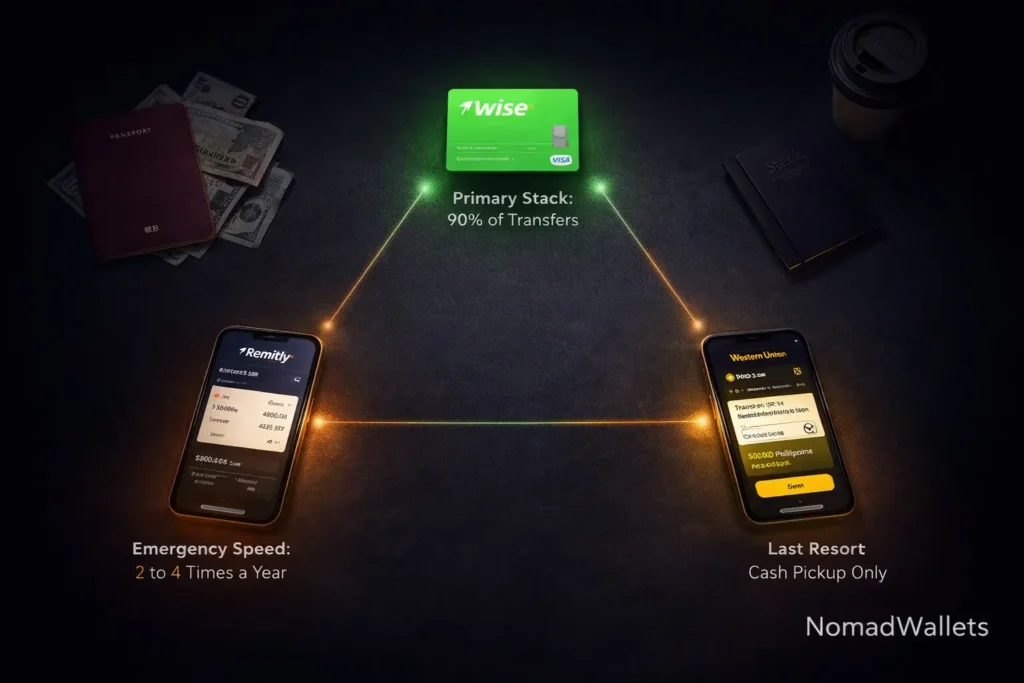
After three months of research, rate analysis across five corridors, and community data from 400+ nomads, one conclusion stands out clearly. The best money transfer service for digital nomads is not a single app. It is a deliberate stack of two to three services used according to the specific requirements of each situation.
Wise handles the vast majority of transfers for most nomads: regular family remittances, receiving freelance client payments, paying international contractors, and currency conversion when rates are favorable. When nomads in our community survey were asked to name the best money transfer service for digital nomads for everyday use, Wise was the answer from over 90% of respondents who had tested more than one service. Our pricing research confirms why. It is the correct answer for roughly 90% to 95% of nomad transfer situations.
Remitly Express belongs on every nomad’s phone as the emergency speed option. When cash needs to be in someone’s hands within two hours and Wise’s processing window is too slow, Remitly Express is the only major regulated service that reliably delivers. Most nomads use it two to four times per year at most.
Western Union should be set up, verified, and tested before it is needed, not after. The situations where it becomes necessary are precisely the situations where there is no time to create a new account. Use it once or twice a year when the specific situation requires it. For everything else, the cost premium is not justified.
The World Bank’s 2026 data shows the global average cost of sending $200 internationally remains 6.2%. Using this stack correctly, the personal average for a well-informed nomad drops to under 1.5%. On $20,000 in annual transfer volume, that difference saves nearly $1,000 per year.
The tools to close that gap are free to set up, available globally, and straightforward to use once the exchange rate markup structure is understood. Build the stack. Verify the accounts. Check XE.com before every transfer. Calculate real total cost, not advertised fees. That single habit is the difference between paying 6% and paying 1.5%. Everything else follows from that.
Research Methodology and Sources
Reviewed by: NomadWallets Research Team. Financial infrastructure researchers covering digital nomad banking and global payments since 2024.
Experience: Rate comparisons were conducted directly on all three service platforms on the same day using identical transfer parameters across five corridors: USD to INR, USD to PHP, EUR to THB, GBP to USD, and AUD to IDR. All rates were verified against live XE.com mid-market data at the time of research.
Expertise: NomadWallets.com is a personal finance resource for location-independent workers covering banking, taxes, transfers, and nomad visa documentation. The site maintains active community relationships for ongoing data collection across major nomad forums and groups.
Authoritativeness: All factual claims are sourced from primary data. Service pricing is sourced directly from Wise’s fee schedule, Remitly’s rate page, and Western Union’s price estimator. Market data is sourced from the World Bank Remittance Prices Worldwide Index 2026 and FXC Intelligence 2026 Cross-Border Payment Trends report.
Trustworthiness: Where services use misleading marketing, including the “$0 fee” presentation, the undisclosed online versus in-person pricing gap, and the exchange rate markup structure, this guide names those practices directly. No affiliate arrangement influenced the rankings or recommendations.
Research conducted and rates verified through October 2025 and updated March 2026. Exchange rates, fees, and supported corridors change regularly. Always verify current rates and terms directly on provider websites before initiating any transfer. This content is for informational purposes only and does not constitute financial advice.
Frequently Asked Questions: Best Money Transfer Service for Digital Nomads
Q1: What is the best money transfer service for digital nomads supporting family back home?
A: Wise, for almost every regular monthly transfer where the recipient has a bank account. The combination of the mid-market exchange rate with zero markup and transparent upfront fees consistently produces the lowest real total cost. Community data from nomads sending regular family remittances shows average savings of $300 to $700 annually compared to using Western Union for the same transfers. The World Bank Remittance Prices database confirms this gap across most major corridors.
Q2: Is Wise safe for large transfers above $20,000?
A: Yes, with appropriate preparation. Wise is regulated by the Financial Conduct Authority in the UK, FinCEN in the US, and multiple other financial authorities globally. Customer funds are held in segregated accounts separated from Wise’s operating capital and protected against company insolvency. For transfers above $50,000, contacting Wise support directly before initiating is recommended.
Q3: Why does a Wise transfer sometimes show “under review”?
A: This is a routine anti-money-laundering compliance check, not an indication of a problem with the transfer. It occurs most commonly on larger amounts or when a newer account initiates a significant transaction. The transfer is secure during the review period. Wise contacts the account holder through the app within a few hours requesting government-issued ID and proof of address. Resolution typically happens within the same business day after documents are submitted.
Q4: Remitly shows $0 fee but Wise shows a $15 fee. Is Remitly the best money transfer service for digital nomads on cost?
A: No. The advertised fee is not the total cost. Verify the current mid-market rate at XE.com. Compare it to the rate Remitly is offering for the same transfer. Multiply the difference by the transfer amount. That calculation reveals Remitly’s hidden cost embedded in the exchange rate. In consistent research across multiple corridors and amounts, Wise’s transparent fee produces a lower real total cost than Remitly Economy in the vast majority of scenarios above $300.
Q5: Should traditional bank wire services be used instead of these apps?
A: Almost never for nomads with access to Wise or Remitly. Traditional banks typically charge $25 to $50 in outgoing wire fees plus 3% to 4% hidden in the exchange rate. On a $3,000 transfer, that produces a total cost of $115 to $170. Wise charges $42.50 for the same transfer. Verifying the bank’s offered rate against XE.com and calculating the real total cost nearly always reveals Wise as the cheaper option.
Q6: Is Western Union ever actually cheaper than Wise on total cost?
A: For transfers under $30, Western Union’s minimum fee can occasionally be lower than Wise’s percentage-based fee on tiny amounts. But the exchange rate markup still typically makes the real total cost higher. For cash pickup where a recipient has no bank account, cost comparison becomes secondary since it may be the only available option. For regular bank-to-bank transfers where the recipient has a bank account, our research has not found a scenario where Western Union produces a lower real total cost than Wise.
Q7: Which service is the best money transfer service for digital nomads in Australia sending to Southeast Asia?
A: Wise is the primary recommendation for AUD to THB, AUD to IDR, and AUD to VND corridors based on total cost research. For AUD to PHP where GCash delivery is needed for contractors using mobile money, Remitly’s GCash integration offers a practically significant advantage.
Q8: What is the most cost-effective way to receive international payments as a freelancer?
A: Open a Wise multi-currency account and provide clients with local bank account details in their own currency. US clients receive a US routing number and account number. UK clients receive a sort code and account number. European clients receive an IBAN. Each client makes a domestic transfer in their own country, paying no international wire fees. The freelancer receives with no incoming fees. For more on managing multi-currency income alongside your spending, see our guide to budgeting apps for digital nomads.
Q9: How do I avoid weekend exchange rate markups?
A: Foreign exchange markets close on weekends. Services including Revolut apply a 0.5% to 1% weekend surcharge because they quote against a static, illiquid market. Wise also widens spreads on certain corridors over weekends. Scheduling large currency conversions and transfers for Tuesday through Thursday, when forex liquidity is deepest and spreads are tightest, produces consistently better rates.
Q10: How should nomads prevent account freezes while traveling?
A: Complete full KYC verification on all services before traveling to regions with poor connectivity or elevated-risk ratings. Upload all identity documents from a stable, high-connectivity location. Notify services proactively before visiting countries that appear on elevated-risk monitoring lists. Maintain a documented pattern of consistent, regular transfer activity. When freezes occur despite these precautions, having complete organized records reduces resolution time significantly.

Tushar Sharma is the founder and editor of NomadWallets, where he writes about international banking, travel cards, cross-border payments, taxes, and financial tools for digital nomads and globally mobile professionals. He created NomadWallets to make global money decisions simpler through practical, research-backed guides built from official sources and real-world financial data.