

Digital nomads are professionals who work remotely while traveling the world, and by 2025, over 35 million people have embraced this lifestyle according to recent industry research. If you’re searching for answers about becoming a digital nomad, handling taxes, finding visas, or managing finances across borders, this guide answers every question people ask online.
Most digital nomad guides focus on one narrow topic or recycle the same surface level advice. This comprehensive resource is different. We’ve analyzed thousands of real questions people search on Google and Answer the Public, consulted official government visa sources, reviewed the 2025 Global Digital Nomad Report analyzing 64 countries’ digital nomad programs, and compiled expert insights from US tax regulations to create the most complete digital nomad guide available in 2025.
Whether you need specific visa requirements for Spain or Thailand, want to understand FEIE tax exclusions, compare living costs across 15+ cities, or learn from real case studies of nomads earning $3,000-$9,000 monthly, every answer is here with authoritative sources cited.
Whether you’re a US freelancer planning your first international move, a remote employee exploring visa options, or curious about the realities of location independent work, you’ll find expert answers covering jobs, visas, taxes, destinations, and practical systems.
Digital Nomads Basics (Most Asked Questions)

What is a digital nomad?
A digital nomad is a professional who works remotely using technology while living in different countries.
Unlike traditional remote workers anchored to one location, digital nomads intentionally move between cities or regions. They combine income generation with travel and cultural experiences through the laptop lifestyle.
The category includes freelancers, remote employees, online business owners, and consultants across industries from software development to marketing to design. What defines them is location independence, not job title.
Digital nomads meaning -What does the term really mean?
Etymology and evolution:
The term “digital nomad” combines:
- Digital: Working through technology and internet
- Nomad: Moving between locations without permanent home
Modern definition:
A digital nomad is someone who:
- Earns income remotely using technology
- Lacks permanent geographic ties
- Intentionally moves between countries/cities
- Maintains location-independent lifestyle
What digital nomads are NOT:
- Permanent tourists (they work, not vacation)
- Illegal workers (many use proper visas)
- Always traveling (most stay 1-3 months per location)
- Necessarily wealthy (many earn $2,000-4,000 monthly)
Lifestyle spectrum:
Slow travelers: 3-6 months per destination, deep local integration
Regular nomads: 1-3 months per city, balanced work and exploration through the slow travel movement
Fast movers: 2-4 weeks per location, prioritize variety over depth
The meaning has evolved from 1990s remote workers to today’s diverse community of freelancers, remote employees, and online business owners spanning all age groups and income levels.
What does a digital nomad actually do?
Digital nomads perform the same work as office based professionals: writing code, managing client campaigns, designing graphics, teaching languages, consulting, or running online businesses.
The difference is where they execute that work, not the work itself.
Daily routines typically involve:
- Working from coworking spaces or rentals during regular hours
- Managing client communications across time zones through distributed teams
- Maintaining productivity while navigating new environments
- Balancing work deliverables with local exploration
The work remains professional and structured despite changing locations. According to the 2025 Global Digital Nomad Report, technology related professions dominate, with software and web developers representing over 25% of the nomad workforce, alongside marketing, creative industries, SaaS, and consulting.
What exactly does a digital nomad do?
Digital nomads engage in borderless work performing regular professional tasks (coding, design, writing, marketing, consulting) remotely while traveling.
The work itself is standard. The location changes.
Most maintain disciplined schedules matching client time zones rather than treating every day as vacation. This work abroad approach enables sustainable careers while experiencing global mobility.
What skills do digital nomads need?
Success requires three skill categories:
Technical skills
- Proficiency in your professional domain (development, design, marketing, writing)
- Familiarity with remote tools (Slack, Zoom, Asana, project management platforms)
- Basic tech troubleshooting without IT support
Soft skills
- Self-discipline to work without supervision
- Time management across zones
- Clear communication with distributed teams
- Adaptability to varying internet quality and work environments
These often matter more than technical abilities. They separate sustainable nomads from those who struggle with the telecommuting lifestyle.
Business fundamentals
- Financial management (budgeting, invoicing, tax planning)
- Client acquisition for freelancers through international freelancing platforms
- Understanding cross border banking and US digital nomad tax obligations
- Multi currency money management
According to the IRS guidelines on foreign earned income, Americans working abroad must understand FEIE requirements for proper tax compliance.
Is becoming a digital nomad hard?
Difficulty depends on your starting position.
Remote employees with stable jobs face logistical challenges (visas, banking, housing) but maintain income security.
Aspiring freelancers must build client bases while managing international logistics simultaneously, creating a steeper curve for those pursuing location independence.
Common misconceptions include:
- Thinking minimal income suffices (sustainable life requires $1,500-3,000+ monthly)
- Believing constant travel is necessary (successful nomads typically stay 1-3 months per location)
- Assuming it eliminates stress (new challenges replace office politics: visa compliance, isolation, healthcare access)
Reality check: Most successful transitions involve:
- 3-6 months building remote income
- Saving 3-6 months emergency reserves
- Researching visa strategies
- Testing short trips before committing fully
Learn the complete roadmap in how to become a digital nomad in 2025.
How much money do you need to be a digital nomad?
Starting capital: $3,000-10,000
This covers:
- Flights to initial destination
- Accommodation deposits
- Travel insurance
- Equipment upgrades
- Emergency reserves
Monthly costs vary by destination:
| Budget Level | Destinations | Monthly Cost |
| Budget | Thailand, Vietnam, Indonesia | $1,000-1,500 |
| Mid range | Lisbon, Mexico City, Medellín | $1,800-2,500 |
| Expensive | London, Singapore, Tokyo | $3,500-5,000+ |
Track expenses across destinations using digital nomad budget tracking systems and best budgeting apps for US digital nomads to master geo arbitrage strategies.
Emergency reserves should cover:
- 3-6 months living expenses
- Unexpected medical costs
- Emergency flights
- Visa complications
Experienced nomads maintain $5,000-15,000 liquid funds depending on risk tolerance.
Is 30 too old to be a digital nomad?
No. Age stereotypes contradict demographic data.
The facts:
- Average digital nomad age: 32 years old
- 40% are over age 35
- Many successful nomads start in their 40s and 50s
Why older professionals often succeed more:
- Established skills commanding higher rates
- Greater financial reserves
- Proven client networks
- Clearer work life boundaries
- Specialized expertise valuable to clients
The challenge isn’t age but career stage. Professionals with developed skills and networks transition smoothly regardless of years into the remote lifestyle.
Digital Nomad Jobs & Income Streams
What jobs do digital nomads do?
Freelancing dominates the remote economy:
- Software development and web design
- Copywriting and content marketing
- Graphic design and video editing
- SEO and digital marketing consulting
- Social media management
- Virtual assistance and admin support
- Translation and language services
Software and web developers represent over 25% of the digital nomad workforce according to recent studies, while startup founders, marketers, and creative professionals make up significant additional shares.
Remote employment with remote first companies offers stability:
- Customer support
- Project management
- Sales and business development
- HR and recruiting
- Accounting and financial analysis
- Data analysis
Online business ownership provides highest earning potential:
- E-commerce stores (dropshipping, Amazon FBA)
- Affiliate marketing websites
- Online courses and coaching
- SaaS products and apps
- Content creation (YouTube, podcasts)
- Stock photography licensing
Which jobs do digital nomads typically do?
High-income specialized skills command premium global rates:
Development roles:
- Full-stack JavaScript/Python/React: $80-150/hour
- Cloud architecture and DevOps: $100-200/hour
- Blockchain development: $150-250/hour
Marketing expertise:
- Paid advertising management (Google/Facebook): $75-150/hour
- Conversion optimization consulting: $100-200/hour
- Enterprise SEO strategy: $150-300/hour
These rates enable comfortable living in any destination while building significant savings through effective geo arbitrage.
What kind of jobs allow you to be a digital nomad?
Entry-level positions typically pay $15-30/hour but provide starting points for overseas remote workers:
- Virtual assistant (email, scheduling, admin)
- Customer service for tech companies
- Content moderation and data entry
- Social media posting and engagement
- English teaching with TEFL certification
These roles fund initial experiences in budget destinations while developing skills for higher-paying work in the international freelancing marketplace.
How can I make $2000 a week working from home?
High income remote work paths include:
Technical roles:
- Software development: $6,000-12,000 monthly
- DevOps engineering: $8,000-15,000 monthly
- Data science: $7,000-13,000 monthly
Business roles:
- Paid advertising management: $5,000-10,000 monthly
- SaaS sales with commission: $6,000-15,000 monthly
- Specialized consulting: $8,000-20,000 monthly
Building to $2,000/week ($8,000+ monthly) requires 2-5 years developing specialized expertise clients pay premium rates for through borderless work opportunities.
What jobs make $3,000 a month without a degree?
Achievable through skill development and portfolio building in international freelancing:
- Freelance writing: $2,000-5,000
- Social media management: $2,500-5,000
- Virtual assistance: $2,000-4,000
- Web development (bootcamp trained): $4,000-8,000
- Graphic design: $2,500-5,000
These work abroad opportunities require dedicated skill building but don’t demand traditional degrees.
How do digital nomads get paid internationally?
Wise (TransferWise) offers best conversion rates:
- 0.4-2% fees versus 3-5% bank rates
- Multi currency accounts holding 50+ currencies
- Details at best money transfer service for digital nomads
PayPal remains standard despite high fees:
- 3-5% conversion costs
- Essential for many client relationships
Deel and Remote.com manage international contractor payroll for distributed teams:
- Handle tax documentation
- Process compliant payments
- Manage benefits
Cryptocurrency enables borderless work payments:
- Bitwage converts crypto to local currency
- Stablecoins (USDC, USDT) eliminate exchange rate volatility
Visas, Immigration & Legal Questions

Do digital nomads need a visa?
Yes. The type depends on duration and legality preferences.
Tourist visas (30-90 days):
- Technically prohibit work
- Enforcement varies by country
- Many nomads use these short-term
Digital nomad visas specifically authorize remote work:
- Over 50 countries now offer these
- Require income proof ($2,000-3,500 monthly)
- Need health insurance
- Application fees: $100-1,500
According to the 2025 Global Digital Nomad Report analyzing 64 countries, digital nomad visa programs have transitioned from niche offerings to significant economic policy tools.
Explore options in digital nomad visas in Europe 2025.
Portugal’s official D7 visa page provides detailed requirements for European residence.
Does the US allow digital nomads?
Yes, but the US doesn’t offer a specific “digital nomad visa” for foreigners wanting to work remotely while living in America.
For foreigners wanting to be digital nomads in the US:
- B-1/B-2 tourist visas prohibit work, even remote work for foreign companies
- No legal pathway exists for pure remote workers
- Must obtain traditional work visas (H-1B, L-1) requiring US employer sponsorship
For US citizens wanting to become digital nomads:
- Completely legal to work remotely for US companies while abroad
- Must continue paying US taxes on worldwide income
- Can use FEIE to exclude up to $126,500 annually
The US lags behind 50+ countries offering digital nomad visas, making it challenging for foreign remote workers to legally base themselves in America long term while pursuing expat life.
Which country is best for digital nomads?
Top destinations share key traits according to 2025 rankings:
- Reliable fast internet (25+ Mbps)
- Affordable living costs
- Active nomad communities
- Accessible visas
- Quality healthcare
Spain ranks #1 in the 2025 Digital Nomad Index, followed by UAE, Netherlands, Uruguay, and Czech Republic for overall suitability. However, “best” depends on personal priorities.
Portugal leads Europe for affordability:
- Lisbon and Porto offer 100+ Mbps internet
- €1,200-1,800 monthly costs
- Welcoming communities
- Straightforward visa processes
Thailand dominates Asia:
- Chiang Mai and Bangkok have massive nomad populations
- $1,000-1,500 monthly budgets
- Ubiquitous coworking spaces
- 30+ Mbps speeds
Mexico attracts Americans:
- Mexico City and Playa del Carmen offer cultural depth
- Compatible time zones with US clients
- 180-day visa free entry
- $1,200-2,000 monthly costs
Where is the best place to go for digital nomads?
For beginners seeking location independence:
- Chiang Mai, Thailand: Largest community, lowest costs
- Mexico City: Same time zones as US, vibrant culture
- Lisbon, Portugal: European base, excellent infrastructure
For high earners:
- Barcelona, Spain: Culture and connectivity
- Singapore: Asian hub with English fluency
- Dubai, UAE: Tax benefits and luxury
For budget travelers:
- Bali, Indonesia: Beach lifestyle
- Medellín, Colombia: Perfect weather
- Da Nang, Vietnam: Coastal affordability
Warsaw, Poland and Siargao, Philippines are emerging as top new destinations for 2025 according to recent nomad community rankings.
What is the easiest country to get a digital nomad visa?
Estonia Digital Nomad Visa:
- Income requirement: €3,504 monthly ($3,800)
- Processing: 15-30 days
- Cost: €80-100
- Validity: 1 year plus Schengen access
Barbados Welcome Stamp:
- Income: $50,000 annual
- Approval: 7-10 days
- Fee: $2,000 individual ($3,000 family)
- Duration: 12 months
Croatia Digital Nomad Visa:
- Income: €2,300 monthly ($2,500)
- Processing: 30 days maximum
- Cost: Minimal fees
- Stay: 1 year coastal living
Dubai Virtual Work Residence:
- Income: $5,000 monthly
- Approval: 48 hours
- Cost: $287 plus $611 Emirates ID
- Renewable: 1 year
Details at Dubai virtual work visa.
What is the cheapest country for digital nomads?
Vietnam (Hanoi, Da Nang): $800-1,200 monthly
| Expense | Cost |
| Accommodation | $300-500 |
| Food | $150-250 |
| Coworking | $50-100 |
| Entertainment | $200-300 |
Colombia (Medellín, Bogotá): $900-1,400 monthly
| Expense | Cost |
| Housing | $400-600 |
| Groceries/dining | $200-300 |
| Internet | $30-50 |
| Social | $200-400 |
Indonesia (Bali): $1,000-1,600 monthly
| Expense | Cost |
| Room | $350-600 |
| Food | $200-350 |
| Coworking | $100-150 |
| Transport | $50-80 |
These combine affordability with essential infrastructure, making them ideal for geo-arbitrage strategies.
According to the 2025 Global Digital Nomad Report, African countries like Mauritius, Cabo Verde, and Namibia offer some of the most affordable entry points, though infrastructure remains a limitation.
Which country has the best tax for digital nomads?
Portugal NHR Program:
- 0% tax on foreign income
- 10 year benefit period
- Requires residency and 183+ days annually
Georgia:
- Territorial taxation
- Foreign income exempt
- Ideal for frequent movers practicing perpetual travel
Panama:
- Only Panama sourced income taxed
- Perfect for US citizens working remotely
UAE:
- Zero personal income tax
- Higher living costs offset savings
- Ranked 2nd globally for digital nomads
Can a US citizen get a digital nomad visa in Spain?
Yes. Spain launched its digital nomad visa in January 2023 and ranks #1 globally in the 2025 Digital Nomad Index.
Requirements:
- Non-Spanish employment or international freelance clients
- €2,160 monthly income minimum ($2,350)
- Comprehensive health insurance
- Clean criminal record
- €80 application fee
Benefits:
- 1 year initial residence (3 years if applying within Spain)
- Renewable for 2 year periods
- Family inclusion allowed
- Healthcare and banking access
Processing: 1-3 months
Tax warning: 183+ annual days trigger Spanish tax residency with rates up to 47% on worldwide income. However, freelancers may qualify for special tax incentives during their first year, and those eligible for Beckham Law pay just 24% flat tax.
Spain’s official residence permit information provides complete details.
Country-Specific Digital Nomad Visa Details
Digital nomads visa Thailand:
Thailand offers multiple options for remote workers seeking longer stays beyond standard 30 day tourist visas.
Thailand Elite Visa:
- 5-20 year residence options
- Costs $15,000-$60,000 depending on duration
- No work permit but allows remote work for foreign companies
- Fast track immigration and airport perks
Smart Visa (for tech workers):
- 4 year validity for skilled professionals
- Requires employment with Thai tech company or startup
- Income threshold: $80,000+ annually
- Work permit included
Thailand’s cost of living ($1,000-1,500 monthly in Chiang Mai) and massive nomad community make it worth the visa investment for long term stays pursuing the remote lifestyle.
Digital nomads visa Portugal:
Portugal’s D7 Passive Income Visa serves as the primary pathway for digital nomads, though it requires demonstrating passive income rather than active remote work.
D7 Visa requirements:
- €760+ monthly passive income (investments, rentals, pensions)
- Can supplement with freelance/remote work income
- Initial 2 year residence renewable indefinitely
- Path to citizenship after 5 years
- Processing: 2-4 months
- Cost: €80-200 in fees
Non-Habitual Resident tax benefit:
- 0% tax on foreign sourced income for 10 years
- Must spend 183+ days annually in Portugal
- Game changing for high earners
Portugal’s official immigration website provides complete D7 application details.
Lisbon and Porto offer 100+ Mbps internet, €1,200-1,800 monthly costs, and thriving English speaking nomad communities making Portugal Europe’s top digital nomad destination for location independence.
Digital nomads visa Japan:
Japan doesn’t offer a formal digital nomad visa, but several pathways exist for remote workers.
Designated Activities Visa:
- Case by case approval for remote workers
- Requires Japanese sponsor or business connection
- 6-12 month validity
- Difficult to obtain without existing Japan ties
Business Manager Visa:
- Requires establishing Japanese business entity
- ¥5 million ($33,000) minimum capital investment
- Allows living and working in Japan indefinitely
- Best for those running online businesses
Working Holiday Visa (age 18-30 only):
- Available for citizens of 26 countries including US, Canada, Australia
- 1 year validity allowing work and travel
- One time opportunity only
- Easiest pathway for young digital nomads
Japan’s high costs ($2,500-4,000 monthly in Tokyo) and complex visa system make it challenging for long-term digital nomad stays compared to Southeast Asian alternatives.
Digital nomads Italy:
Italy launched its digital nomad visa in April 2024 targeting non EU remote workers.
Italy Digital Nomad Visa requirements:
- €28,000+ annual income ($30,500)
- Employment with non Italian company or self employment
- Comprehensive health insurance
- Proof of accommodation in Italy
- Clean criminal record
- Application fee: €116
Visa benefits:
- 1 year initial validity
- Renewable for additional year
- Family members included
- Access to Italian healthcare system
- Schengen area travel privileges
Tax considerations:
- Special flat tax regime: 7% on foreign income for first 5 years (if relocating to Southern Italy)
- Standard progressive rates (23-43%) elsewhere
- Must avoid 183-day tax residency if maintaining low tax strategies
Best Italian cities for digital nomads:
- Rome: Historical richness, €1,500-2,500 monthly
- Milan: Business hub, €2,000-3,000 monthly
- Florence: Cultural center, €1,400-2,200 monthly
- Naples: Affordable south, €1,200-1,800 monthly
Italy’s excellent food, culture, and infrastructure attract nomads willing to navigate bureaucratic visa processes and higher costs than Eastern Europe.
Digital nomads Valencia:
Valencia, Spain has emerged as a top European digital nomad destination beyond Barcelona’s crowds and costs.
Why Valencia attracts digital nomads:
- Mediterranean beach lifestyle
- €1,400-2,200 monthly living costs (30% cheaper than Barcelona)
- Growing coworking scene (Wayco, Vortex, Utopic)
- 300+ sunny days annually
- Excellent public transit
- Large expat community pursuing expat life
Spain’s digital nomad visa applies:
- €2,160 monthly income minimum
- 1 year initial residence
- Remote work for non Spanish companies
- Processing through Spanish consulate
Valencia cost breakdown:
| Expense | Monthly Cost |
| 1 bedroom apartment (city center) | €700-1,000 |
| Food and dining | €300-450 |
| Coworking membership | €100-180 |
| Public transport | €40-50 |
| Entertainment | €200-300 |
| Total | €1,400-2,200 |
Valencia combines Barcelona’s culture with lower costs and better work life balance, making it ideal for digital nomads prioritizing Mediterranean lifestyle without premium pricing.
Taxes & Money Management for Digital Nomads
Do digital nomads pay taxes?
Yes. Tax obligations depend on citizenship and residency.
US citizens face worldwide taxation:
- IRS requires reporting all global income
- Obligations exist regardless of location
Tax residency creates obligations:
- Triggered at 183+ days in most countries
- Can create dual taxation scenarios
Tax treaties prevent double taxation:
- Provide credits or exemptions
- Require careful navigation
Full details at US digital nomad taxes.
The IRS Foreign Earned Income Exclusion page explains exclusion requirements for overseas remote workers.
Do digital nomads pay US taxes?
Yes. All US citizens must file regardless of location.
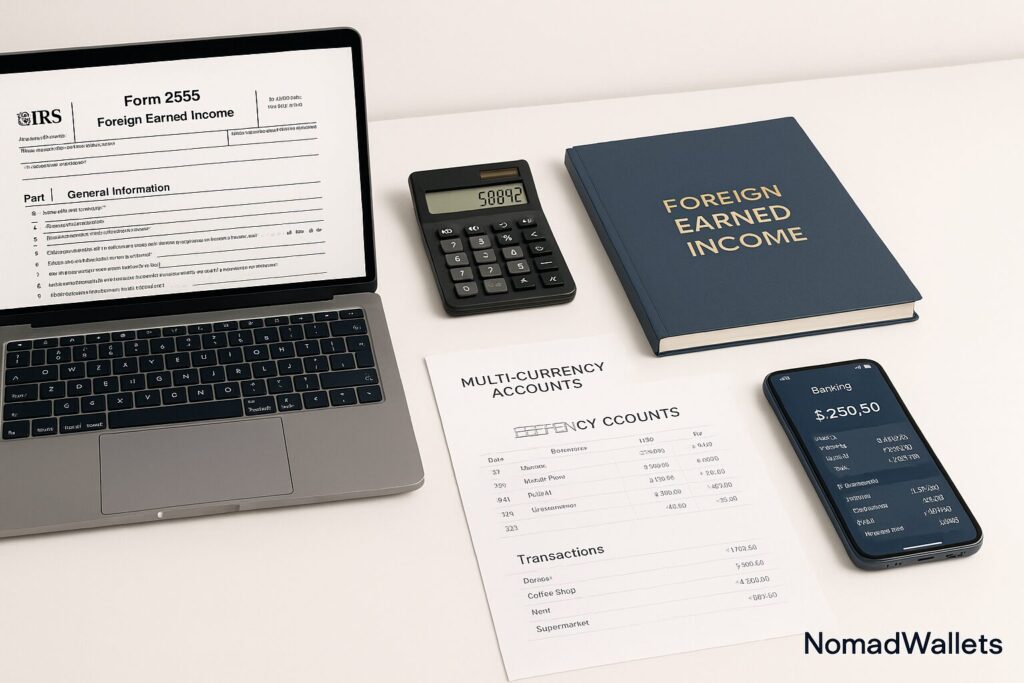
Foreign Earned Income Exclusion (FEIE):
- Excludes up to $126,500 (2025)
- Requires Physical Presence Test or Bona Fide Residence Test
Physical Presence Test (more common):
- 330 days outside US in any 12 month period
- Doesn’t need to align with calendar year
Self employment tax:
- 15.3% still applies to excluded income
- FEIE eliminates income tax, not SE tax
State residency:
- Requires active steps to break
- Establish residency in no tax states (Florida, Texas, Wyoming, South Dakota)
Reporting requirements:
- FBAR for foreign accounts over $10,000
- Form 8938 for accounts over $200,000 individual
What is a digital nomad LLC?
A US LLC provides:
- Liability protection
- Professional credibility
- Pass through taxation for single member structures
Best states:
- Wyoming: Low fees, minimal reporting
- Delaware: Established corporate law
- Florida: No state income tax
Setup guide at digital nomad LLC setup.
Alternatives:
- Sole proprietorship: Simplest but no liability protection
- Foreign corporations: Rarely benefit US citizens due to CFC rules
How do digital nomads manage money?
Multi-currency banking:
- Wise and Revolut hold 50+ currencies
- Eliminate 3-5% conversion fees
- Enable effective geo-arbitrage
Digital banking options:
- Charles Schwab: Global ATM fee reimbursement
- Wise Borderless: Multi currency accounts
- Mercury: Online business focused
Compare at best bank account for digital nomads 2025.
Budget tracking:
- Trail Wallet: Travel specific
- YNAB: Multi currency support
- TravelSpend: Daily expense logging
Methods at digital nomad budget tracking.
Accounting software:
- QuickBooks Self Employed
- FreshBooks
These manage invoicing, expenses, and quarterly tax estimates.
Lifestyle, Safety & Practical Living Questions

How do digital nomads choose where to live?
Internet reliability tops priorities:
- Consistent 25+ Mbps for video calls
- Backup options (coworking, mobile hotspots)
- Community verified infrastructure
The 2025 Global Digital Nomad Report ranks countries heavily on internet speed as a core decision factor, with high-speed connectivity enabling the remote lifestyle.
Cost versus income determines sustainability:
- $3,000 monthly enables comfort in Southeast Asia
- Same income struggles in Western Europe
- Budget 30-40% housing, 20% food, 20% discretionary
Time zone alignment:
- East Coast US clients make Europe challenging (6 hour gap)
- Mexico or Colombia work better (0-2 hours) for distributed teams
Community presence:
- Established hubs (Chiang Mai, Medellín, Lisbon, Bali)
- Instant networks and local knowledge
- Coworking scenes facilitating global mobility
Where do most digital nomads go?
Top destinations by nomad population seeking location independence:
- Chiang Mai and Bangkok (Thailand)
- Bali and Jakarta (Indonesia)
- Lisbon and Porto (Portugal)
- Medellín (Colombia)
- Mexico City and Playa del Carmen (Mexico)
- Barcelona and Valencia (Spain)
Recent data shows emerging destinations including Warsaw (Poland), Tallinn (Estonia), Budapest (Hungary), and Prague (Czech Republic) gaining significant traction in 2025.
What is the digital nomad capital of the world?
Chiang Mai, Thailand historically held this title with the largest sustained nomad population, extensive coworking infrastructure, and ultra low costs supporting perpetual travel lifestyles.
Lisbon, Portugal has emerged as the European equivalent with better infrastructure and EU access.
However, Spain now ranks #1 overall in the 2025 Global Digital Nomad Index for comprehensive nomad suitability.
Digital nomads lifestyle – What’s daily life actually like?
Typical daily routine:
Morning (7-9 AM):
- Wake up naturally (no commute)
- Exercise or yoga
- Coffee at local cafe
- Review emails and priorities
Work hours (9 AM-5 PM):
- Coworking space or home office
- Client calls and project work through distributed teams
- Lunch at local restaurants
- Afternoon focus blocks
Evening (5-10 PM):
- Explore new neighborhood
- Attend coworking events or meetups
- Cook using local ingredients
- Language practice or cultural activities
Reality vs. Instagram:
The Instagram version:
- Beach laptop photos
- Constant adventures
- Perfect work life balance
- Endless freedom
The reality:
- Disciplined work schedules
- Occasional loneliness
- Visa stress and bureaucracy
- WiFi troubleshooting
- Time zone juggling
Work-life integration:
Most successful digital nomads treat it as “work from anywhere” not “vacation with laptop.”
They maintain:
- Consistent work hours matching client zones
- Dedicated workspaces separating work and leisure
- Regular exercise and health routines
- Social connections through coworking and communities
- 1-3 month minimum stays allowing depth in the slow travel movement
The remote lifestyle offers freedom to choose location and schedule but requires discipline, financial stability, and adaptability to thrive long term.
Cost of living in popular cities
| City | Monthly Budget | Housing | Food | Coworking | Key Feature |
| Chiang Mai | $1,200-1,800 | $300-500 | $200-350 | $50-100 | Largest SE Asia hub |
| Lisbon | $2,000-2,800 | $700-1,200 | $300-500 | $100-200 | EU access, tech scene |
| Mexico City | $1,500-2,300 | $500-900 | $250-400 | $100-150 | US time zones |
| Bali | $1,400-2,200 | $400-700 | $250-400 | $100-150 | Beach wellness |
| Medellín | $1,300-2,000 | $400-700 | $200-350 | $80-120 | Perfect weather |
Healthcare for digital nomads
International insurance:
SafetyWing ($45-80/month):
- Covers 185+ countries
- Limited US coverage (15 day trips)
World Nomads ($100-200/month):
- Includes adventure sports
- Comprehensive global coverage
Cigna Global ($200-500/month):
- Premium worldwide care
- Direct billing networks
Compare at best health insurance for US digital nomads.
Review WHO international travel health guidance for destination specific health requirements supporting expat life.
Local healthcare:
- Mexican dental: 50-70% cheaper than US
- Thai medical tourism: Quality procedures at low cost
- European systems: Emergency care regardless of insurance
Telemedicine:
- Doctor on Demand
- Teladoc
Enable US provider consultations for prescriptions while abroad.
See comprehensive coverage at digital nomad healthcare guide 2025.
Digital nomads insurance – What coverage do you need?
Essential insurance types:
Health insurance (key points):
- International coverage 185+ countries
- Emergency evacuation ($100K+ coverage)
- Pre existing condition coverage
- Telemedicine access
See complete comparison at best health insurance for US digital nomads.
Equipment insurance:
- Laptop and electronics coverage
- Theft and damage protection
- Worldwide coverage
- Options: World Nomads tech add on, Lemonade renters insurance with travel coverage
Liability insurance:
- Professional liability (E&O) for freelancers
- General liability for online business owners
- Protects against client lawsuits
- Options: Hiscox, Simply Business
Travel insurance basics:
- Trip cancellation/interruption
- Lost luggage
- Flight delays
- Emergency evacuation
Many digital nomads combine international health insurance (SafetyWing, World Nomads) with separate equipment coverage rather than traditional travel insurance designed for short vacations.
Tools & Systems Digital Nomads Use
Best apps for productivity
Notion: Centralizes notes, projects, and databases for borderless work
Todoist: Task management with natural language input
RescueTime: Tracks time spent revealing productivity patterns
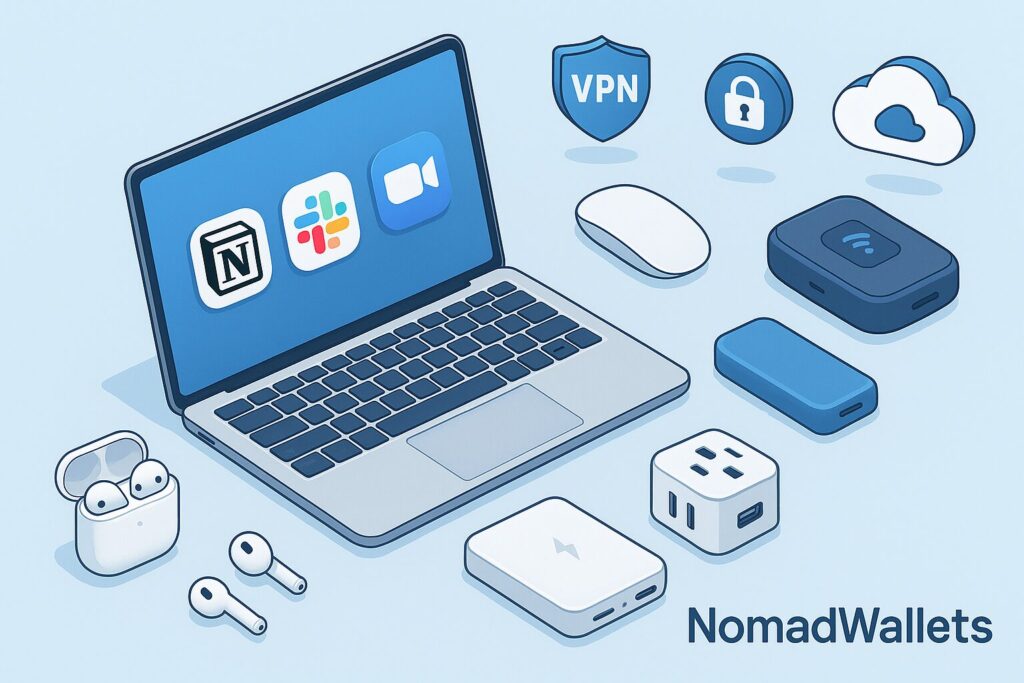
Essential remote work tools
Communication:
- Slack: Asynchronous messaging for distributed teams
- Zoom: Video calls
- Loom: Asynchronous video updates
Project management:
- Asana
- Trello
- Monday.com
Security:
- NordVPN: Strong encryption
- 1Password: Password management
See complete toolkit at 50 best apps for digital nomads (2025).
Budget & banking tools
Expense tracking:
- Trail Wallet: Nomad specific
- YNAB: Comprehensive budgeting
- TravelSpend: Daily expense logging
Banking:
- Wise: Multi currency accounts
- Revolut: Currency exchange
- Charles Schwab: ATM fee reimbursement
Details at best bank account for digital nomads 2025.
Credit cards:
See best credit cards for digital nomads 2025 for no foreign fee cards with travel rewards.
Digital Nomad Challenges & Solutions

Loneliness & burnout
Challenge:
- Constant movement prevents deep relationships
- Work life boundaries blur
- Always on mentality develops
Solutions:
- Stay 2-3 months minimum per location
- Join coworking spaces for daily interaction
- Establish strict work hours
- Schedule regular calls with home connections
Visa overstays & legal issues
Challenge:
- Losing track of expiration dates
- Misunderstanding tourist visa work prohibitions
- Unexpected denials in expensive countries
Solutions:
- Use TripIt tracking visa dates
- Research requirements before booking
- Maintain 30 day buffer before expiry
- Keep $3,000+ emergency relocation funds
Finding stable Wi-Fi
Challenge:
- Accommodations advertise “fast” but deliver 5 Mbps
- Surprise outages during client meetings
- Limited backup options
Solutions:
- Request speed tests before booking
- Arrive with local SIM data plans
- Book near coworking spaces
- Test internet during cancellation windows
Managing time zones
Challenge:
- 3 AM client meetings
- Timezone math deadline errors
- Jet lag compounding
Solutions:
- Use World Time Buddy visualization
- Schedule “core hours” overlapping client zones
- Decline same day meetings in incompatible zones
- Stay minimum 4 weeks allowing adjustment
Real Case Studies

US freelancer earning remotely from Europe
Sarah, 34, Marketing Consultant, Portland → Europe
Income: $6,500/month from US clients (Facebook ads management)
Strategy: 3 month rotations in Lisbon, Barcelona, Athens avoiding tax residency while experiencing European culture deeply. Uses FEIE via Physical Presence Test and maintains Florida residency.
Daily routine: Works 1-9 PM local matching US East Coast mornings. Found coworking spaces with private call booths solving client call needs. Built 6 month emergency fund after unexpected Barcelona housing issue required quick relocation.
Financial setup: Receives payments via Wise ($0 transfer fees from US clients), uses Chase Sapphire Reserve for travel points, tracks expenses through YNAB separating business and personal costs.
Biggest lesson: “Staying 3 months maximum per country keeps me under tax residency thresholds while allowing real local experiences beyond tourist visits. The key is meticulous calendar tracking and understanding each country’s 183 day rules.”
Indian digital nomad living in Southeast Asia
Raj, 29, Software Developer, Bangalore → SE Asia
Income: $2,800/month remote salary plus $1,200 freelance projects
Strategy: Rotating between Chiang Mai, Bali, Da Nang in 2 month cycles. Uses tourist visas with occasional visa runs. Investigating Thailand’s new digital nomad visa for longer stays.
Cost breakdown: Lives comfortably on $1,400/month total (housing $500, food $300, coworking $100, entertainment $300, savings $200), saves $2,600 monthly (65% savings rate).
Work setup: Maintains strict 8 AM-5 PM schedule preventing burnout. Uses separate monitor and mechanical keyboard recreating office ergonomics in each location. Established freelance pipeline through Upwork while keeping full-time employment.
Growth path: Started with $3,200 combined income 18 months ago. Freelance income grew from $400 to $1,200 monthly through client referrals. Plans transitioning to full freelance within 12 months.
Key insight: “Southeast Asia’s affordability lets me save 65% of income while living better than I could in Mumbai. The key is staying disciplined about work hours and not treating every day like vacation.”
Mid-30s remote worker switching careers
Marcus, 36, Sales → Web Development, Chicago → LatAm
Income: Started $3,200/month junior dev, now $7,800 after 18 months
Transition path: Completed coding bootcamp while working part time sales. Built 6 portfolio projects. Landed first remote dev role through AngelList. Spent first year in low cost Colombia and Mexico while building skills.
Financial strategy: Lived on savings for 4 months during intensive skill building. Accepted below market $3,200/month initially to gain experience. Invested 20+ hours weekly learning new frameworks while traveling.
Location choices: Started Medellín ($1,300/month costs) allowing focus on skill development without financial panic. Moved to Mexico City ($1,800/month) after first promotion. Now comfortable in Lisbon ($2,400/month) after doubling income.
Career progression: Junior dev → mid-level in 12 months through aggressive learning and side projects. Negotiated 60% raise after building strong portfolio. Now earns double previous sales income with better work-life balance.
Advice: “Choosing cheap destinations during career transition let me focus on skill development without constant money stress. Now I earn double what I made in sales with complete location freedom.”
Solo female digital nomad
Emma, 31, Content Writer & Social Media Manager, Austin → World
Income: $4,200/month from mix of retainer clients and project work
Safety approach: Joins women-focused Facebook groups (“Girls Gone International,” “Digital Nomad Girls”) before arriving. Books accommodations in well reviewed neighborhoods through female traveler recommendations. Maintains comprehensive travel insurance including emergency evacuation coverage.
Location strategy: Prefers established nomad hubs (Lisbon, Medellín, Chiang Mai) with active female traveler communities over isolated destinations. Stays near coworking spaces allowing safe daytime work. Uses Uber/Bolt instead of public transport at night.
Community building: Attends women only coworking events. Organizes weekly coffee meetups through Facebook groups creating instant friend networks. Maintains regular video calls with family for emotional support.
Career growth: Built client base over 8 months before quitting office job. Established boundaries with clients across time zones (no weekend work). Created tiered pricing increasing rates 40% over two years.
Perspective: “Safety concerns are real but manageable. I research extensively, trust my instincts, and connect with local women’s groups immediately. The nomad community is incredibly supportive, especially other women who share safety tips freely.”
Couple traveling full-time
Jake & Maria, both 33 (Designer & Project Manager), Denver → World
Combined income: $9,200/month ($4,800 + $4,400)
Location strategy: 3-4 month stays in mid-range destinations balancing cost and comfort (Portugal, Croatia, Mexico, Colombia). Research apartments with separate work spaces before booking.
Relationship dynamics: Separate coworking memberships preventing cabin fever and creating independent social circles. Designated “together time” outside work hours (no work talk during dinners). Alternate who chooses next destination preventing resentment.
Work boundaries: Treat work hours as sacred (9 AM-6 PM both). Schedule date nights preventing work life blur. Use separate bedrooms as offices when possible. Invest in noise canceling headphones for overlapping calls.
Financial management: Pool income into joint account for shared expenses (housing, food, travel). Maintain separate accounts for personal spending. Track combined budget staying under $4,500 monthly in mid range cities allowing $4,700 savings.
Long-term vision: Plan returning to US for kids within 3-5 years. Using nomad period to save aggressively (50%+ savings rate) for house down payment while experiencing world through perpetual travel.
Advice: “Traveling as a couple requires even clearer boundaries than solo nomading. We treat work hours as sacred and plan adventures around our combined schedules. Having separate coworking spaces is relationship saving.”
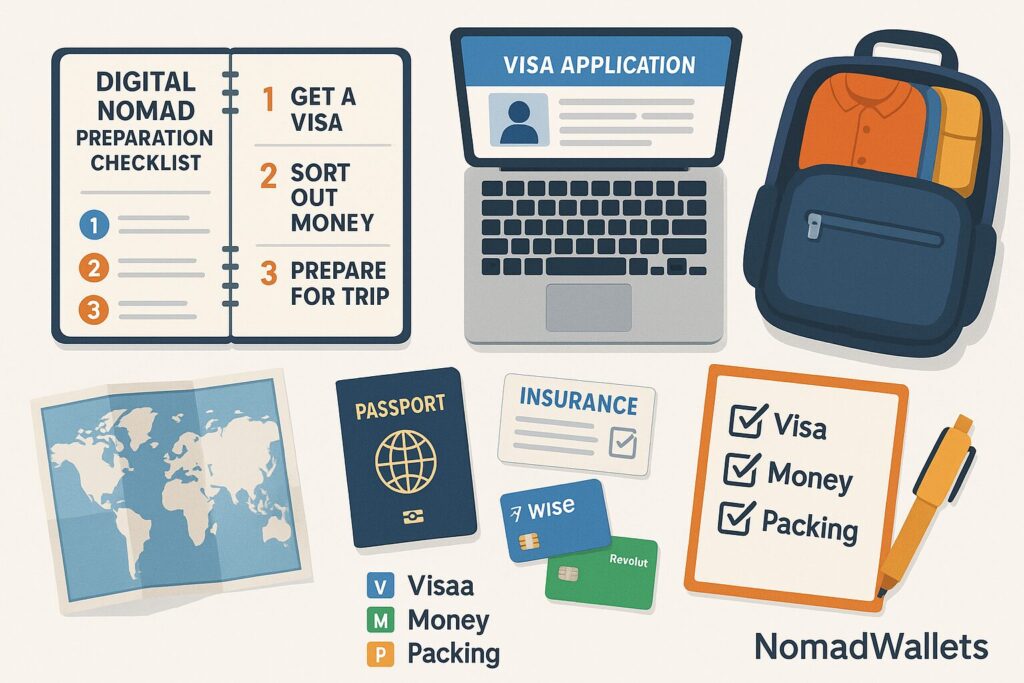
Step By Step: How to Become a Digital Nomad in 2025
Step 1: Choose your income source
Assess current work:
- Can your job become remote?
- Request trial remote periods before quitting
Build freelance skills:
- Spend 3-6 months developing marketable abilities
- Focus on coding, design, writing, or marketing
- Create portfolio projects
Secure first clients:
- Land 2-3 paying clients before moving
- Aim for $3,000+ monthly minimum
Timeline: 3-6 months for career changers, 1-2 months for current remote workers
Step 2: Pick your visa strategy
Research destinations:
- Match visa requirements to your income
- Use digital nomad visas in Europe 2025 and regional guides
Start simple:
- Begin with visa free countries (Mexico for US citizens)
- Try Southeast Asia tourist visas
- Apply for formal visas after testing lifestyle
Gather documents:
- Income proof
- Employment contracts
- Bank statements
- Insurance documentation
Timeline: 1-2 months research, 2-8 weeks visa processing
Step 3: Set up banking & finances
Open multi currency account:
- Wise or Revolut for international payments
- See best money transfer service for digital nomads
Get travel credit cards:
- No foreign transaction fees
- Travel rewards
- Guide at best credit cards for digital nomads 2025
Establish tax residency:
- Change driver’s license to no tax state
- Update voter registration
- Review US digital nomad taxes
Set up accounting:
- QuickBooks or FreshBooks
- Track income, expenses, tax obligations
Timeline: 2-3 weeks for approvals
Step 4: Cancel home liabilities
Housing:
- Sublet apartment
- Move to storage
- End lease timing departure
Subscriptions:
- Cancel gym memberships
- Pause streaming services
- Adjust car insurance
Mail:
- Virtual mailbox service
- Family address for documents
Timeline: 1-2 months notice periods
Step 5: Pack & plan first destination
Essential gear:
- Laptop and chargers
- Universal adapter
- Portable WiFi hotspot
- External hard drive
Minimalist packing:
- 2 weeks clothing maximum
- One carry on if possible
- Buy locally as needed
Book initial housing:
- 1-2 weeks Airbnb
- Find longer term accommodation locally
Get insurance:
- International health coverage
- Options at best health insurance for US digital nomads
Timeline: 2-4 weeks
Step 6: First month roadmap
Week 1:
- Recover from travel
- Test internet
- Find coworking space
- Buy local SIM
Week 2:
- Establish work routine
- Locate essentials
- Join Facebook groups
Week 3:
- Attend meetups
- Connect with community
- Explore neighborhood
Week 4:
- Evaluate location
- Decide extension or next move
- Reflect on systems
Key metrics:
- Stable work output
- Manageable costs via digital nomad budget tracking
- Social connections forming
- Enjoying experience
FAQs About Digital Nomads

Q1. Digital nomads vs tourists: What’s the difference?
A. Tourists:
1. Vacation temporarily
2. Use saved money
3. Focus on sightseeing
Digital nomads:
1. Work remotely while traveling
2. Earn ongoing income
3. Balance work and exploration through location independence
Q2. Digital nomads reddit – Where to find communities online?
A. Top Reddit communities:
r/digitalnomad (500K+ members):
1. Most active digital nomad community
2. Visa discussions, destination recommendations
3. Real experiences and advice
r/expats (200K+ members):
1. Tax and legal questions
2. Immigration experiences
3. Country specific insights
r/remotework (150K+ members):
1. Remote job opportunities
2. Productivity tips
3. Tool recommendations
Beyond Reddit:
Facebook Groups:
1. “Digital Nomads Around the World” (100K+ members)
2. “Remote Year” (organized travel programs)
3. City specific groups (e.g., “Chiang Mai Digital Nomads”)
Nomad List Forums:
1. City rankings and reviews
2. Meet up coordination
3. Real time destination intel
These communities provide unfiltered experiences, visa updates, and networking opportunities beyond curated blog content.
Key Takeaways: Your Digital Nomad Journey Starts Now

Becoming a digital nomad in 2025 is more accessible than ever with 50+ countries offering specialized visas, robust remote infrastructure globally, and proven systems for managing taxes and finances.
Recent data from the 2025 Global Digital Nomad Report analyzing 64 countries shows the digital nomad phenomenon has transitioned from niche lifestyle to mainstream economic policy, with nations competing to attract remote workers.
Success requires preparation:
- Build reliable remote income ($3,000+ monthly)
- Understand visa and tax obligations
- Establish location independent banking
- Develop sustainable work routines
- Join communities for support and networking
Start with these resources:
- Digital nomad visas in Europe 2025 for visa options
- US digital nomad taxes for tax compliance
- Best bank accounts for banking setup
- Budget tracking systems for financial management
Next steps:
Download our free US Digital Nomad Tax Guide covering FEIE requirements, state residency strategies, and quarterly payment schedules specifically for Americans working abroad.
Join our email community receiving:
- Weekly destination guides
- Visa requirement updates
- Tax deadline reminders
- Exclusive nomad resources
The digital nomad lifestyle offers unprecedented freedom to design work around life rather than life around work. With proper planning and realistic expectations, it’s achievable for professionals at any career stage pursuing location independence and global mobility.
Ready to start? Begin with Step 1 above and take the first action today.

Tushar Sharma is the founder and editor of NomadWallets, where he writes about international banking, travel cards, cross-border payments, taxes, and financial tools for digital nomads and globally mobile professionals. He created NomadWallets to make global money decisions simpler through practical, research-backed guides built from official sources and real-world financial data.