Compare the Best Global Banking Options
Finding the best bank account for digital nomads is one of the most important financial decisions you will make when you start working and traveling across borders. Traditional banks are built for people who stay in one country. They charge high fees for international transactions, offer poor exchange rates, and make it hard to access your money when you are abroad. For digital nomads who live in multiple countries each year, these problems add up fast.
The biggest banking challenges for digital nomads include multi-country living, currency conversion costs, ATM fees, expensive international transfers, receiving remote income, handling tax obligations across borders, and keeping your money safe. Each of these problems can cost you hundreds or even thousands of dollars per year if you use the wrong bank. That is why choosing the right banking solution is not just about convenience. It is about protecting your income and keeping more of your money.
This guide compares the top banking options for digital nomads in 2026. We tested Wise, Revolut, N26, Bunq, Airwallex, and Charles Schwab across real-world travel scenarios. Whether you are a freelancer, a remote employee, a business owner, or a long-term expat, this article will help you find the right nomad banking solution based on your specific needs and lifestyle.
| Quick Answer The best bank account for digital nomads depends on your needs. Wise is the best overall choice. Revolut is the best for premium travel features. N26 is the best for EU residents. Airwallex is the best for business banking. Charles Schwab is the best for ATM access. Read on for the full comparison. |
| Need | Best Choice |
| Overall | Wise |
| Multi-Currency | Wise |
| Everyday Spending | Revolut |
| Europe | N26 |
| Business | Airwallex |
| ATM Withdrawals | Charles Schwab |
| International Transfers | Wise |
| Team Payments | Airwallex |
Quick Summary:
• Best Overall: Wise
• Best Premium: Revolut
• Best EU Bank: N26
• Best Business Bank: Airwallex
• Best ATM Access: Charles Schwab
• Best Joint Account: Bunq
For more financial tips, check out our Digital Nomad Finance Guide.
Quick Comparison: Best Banks at a Glance
| Bank | Best For | Monthly Fee | Multi-Currency | Rating |
| Wise | Overall | Free | Yes | 5/5 |
| Revolut | Travel | Free/Paid | Yes | 5/5 |
| N26 | Europe | Free | EUR Focus | 4/5 |
| Bunq | Europe | Paid | EUR | 4/5 |
| Airwallex | Business | Paid | Excellent | 4/5 |
| Charles Schwab | US | Free | USD | 4/5 |
What Makes a Great Bank Account for Digital Nomads?
Not every bank account works well for people who travel and live internationally. A good digital nomad banking solution needs to solve problems that regular bank accounts cannot handle. Here’s a look at the key features that separate a good nomad bank account from a bad one.

Multi-Currency Support
Multi-currency support is the single most important feature when you are evaluating banking options for life abroad. This means the ability to hold, send, and receive money in multiple currencies without converting everything into your home currency each time. A good multi-currency account lets you keep balances in USD, EUR, GBP, AUD, CAD, SGD, JPY, and many other currencies at the same time.
When you work with international clients, you need local bank details in different currencies. For example, having a European IBAN for EUR payments, a UK sort code and account number for GBP, and a US routing number for USD makes it easy for clients to pay you without expensive international transfer fees. A strong multi-currency account provides these local details so you can receive payments like a local resident in multiple countries.
Currency conversion is another critical factor. Some banks charge hidden markups on exchange rates, meaning you get less money when you convert. The ideal international banking provider uses transparent exchange rates, close to the real mid-market rate you see on Google or Reuters. This can save you 2 to 5 percent on every currency conversion compared to traditional banks.
Low Foreign Transaction Fees
Foreign transaction fees are one of the biggest hidden costs for digital nomads. Every time you swipe your card abroad, your bank might charge you 1 to 3 percent on top of the purchase amount. Over a year of full-time travel, these fees can add up to hundreds of dollars. A strong nomad banking option charges zero foreign transaction fees on card purchases.
The FX markup is the difference between the mid-market rate and the rate your bank actually gives you. Some banks advertise zero fees but still apply a poor exchange rate, which is just a hidden fee by another name. Always check the actual exchange rate you receive, not just the advertised fee. A trustworthy banking provider is transparent about both the fees and the exchange rate.
| Fee | Excellent | Average | Poor |
| FX Fee | 0% | 1% | 3%+ |
| ATM Fee | Free | Limited | High |
| Monthly Fee | Free | $5 | $20+ |
ATM Access
Even in 2026, cash is still necessary in many parts of the world. Southeast Asia, Latin America, and parts of Africa still rely heavily on cash for everyday transactions. A well-rounded nomad banking option gives you access to ATMs worldwide without charging excessive fees. Look for accounts that offer free ATM withdrawals or reimburse ATM operator fees.
ATM withdrawal limits also matter. Some banks limit how much you can withdraw per day or per month. If you are living in a country where you need to pay rent in cash, a low withdrawal limit can be a serious problem. Charles Schwab offers unlimited ATM fee rebates worldwide, making it one of the best bank accounts for digital nomads who need frequent ATM access.
International Transfers
Digital nomads frequently need to send and receive money across borders. Whether you are paying a landlord in another country, sending money to family, or receiving payment from an overseas client, international transfers are a regular part of nomad life. A capable multi-currency account supports multiple transfer methods including SWIFT, SEPA, ACH, and local bank transfers.
SWIFT transfers are the most common international method but they are slow and expensive. SEPA transfers are fast and cheap but only work within Europe. ACH transfers are fast and free but only work within the United States. The best bank account for digital nomads supports all of these methods so you can choose the fastest and cheapest option for each transfer.
Mobile Banking Experience
When you are traveling, your phone is your bank branch. The right nomad banking app should offer a mobile experience that is fast, reliable, and feature-rich. Look for instant push notifications for every transaction, the ability to freeze and unfreeze your card instantly, virtual cards for online purchases, and support for Apple Pay and Google Pay.
Security features on mobile are also important. Biometric login (fingerprint or face recognition), two-factor authentication, and the ability to lock your card from your phone are all essential. If your card is stolen while you are traveling, you need to be able to freeze it within seconds, not hours. The best bank account for digital nomads gives you full control over your cards from your mobile app.
| Expert Tip Never rely on a single bank while traveling internationally. Keep at least one backup debit card and one backup credit card in a separate location. If your primary card is lost, stolen, or blocked, you will have immediate access to money while you sort out the issue. |
For more information, read our guides on Best Mobile Banks for Travelers and Best Money Transfer Service for Digital Nomads.
Best Bank Accounts for Digital Nomads Compared
| Note This comparison includes traditional banks, digital banks, and regulated financial platforms that provide banking services. Availability, fees, and protections vary depending on your country of residence. |
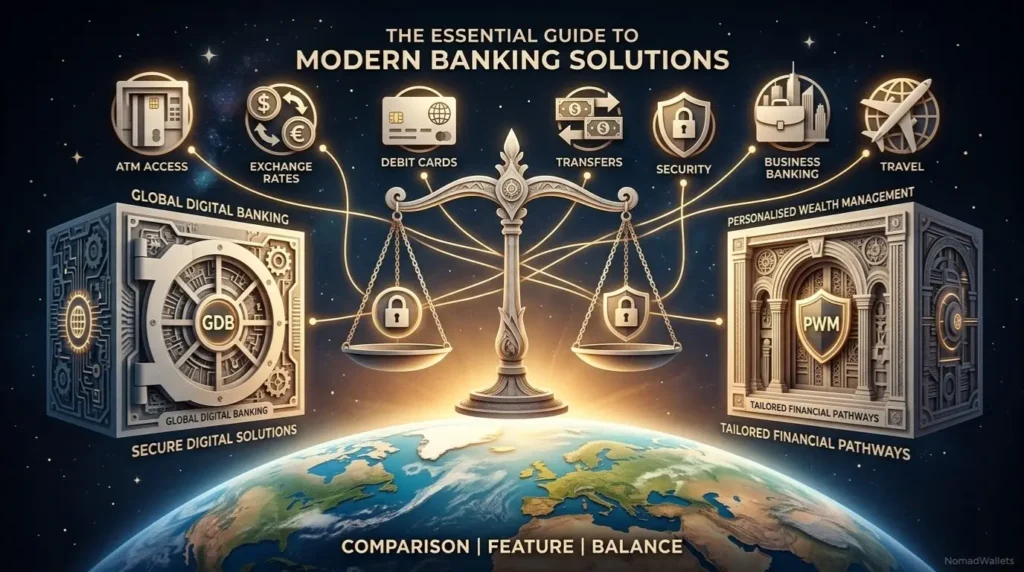
Here’s how the top options compare side by side. We evaluated each bank on multi-currency support, fees, ATM access, international transfers, mobile experience, and overall value. The table below gives you a quick overview of how each bank performs across key categories.
| Bank | Best For | Monthly Fee | Multi Currency | ATM | Business | Protection | Rating |
| Wise | Overall | Free | Yes | Good | Limited | Safeguarded funds | 5/5 |
| Revolut | Travel | Free/Paid | Yes | Good | Yes | Varies by market | 5/5 |
| N26 | Europe | Free | EUR Focus | Good | Limited | Deposit protection | 4/5 |
| Bunq | Europe | Paid | EUR | Good | Yes | Deposit protection | 4/5 |
| Airwallex | Business | Paid | Excellent | No | Excellent | Safeguarded funds | 4/5 |
| Charles Schwab | US | Free | USD | Excellent | No | FDIC insured | 4/5 |
Wise Review
Wise (formerly TransferWise) is the best overall banking platform for digital nomads. It offers the mid-market exchange rate on currency conversions with transparent, low fees. You can hold over 40 currencies and get local bank details in 10 or more currencies, including USD, EUR, GBP, AUD, and more. Wise is not a traditional bank in every country but operates as an electronic money institution with strong regulatory oversight.
Wise makes it easy to receive payments from international clients. Your USD account comes with a routing number, your EUR account comes with an IBAN, and your GBP account comes with a sort code and account number. This means clients can pay you using standard local transfers instead of expensive international wire transfers. For freelancers and remote workers, that’s a huge advantage and one of the main reasons people recommend Wise.
The Wise debit card works in 174 countries and automatically converts currencies at the mid-market rate when you spend. There are no foreign transaction fees on card purchases. The app lets you freeze your card instantly, generate virtual cards for online shopping, and set spending limits. Wise also supports Apple Pay and Google Pay in many regions.
Security is strong at Wise. Customer funds are safeguarded in separate accounts at regulated banks, meaning your money is protected even if Wise faces financial difficulties. The platform uses two-factor authentication, biometric login, and 3D Secure for online transactions. These features make Wise one of the safest options and contribute to it being one of the top banking platforms for digital nomads.
| Pros ✅ Excellent exchange rates (mid-market rate) ✅ Local bank details in 10+ currencies ✅ No hidden fees ✅ Strong app with card freeze and virtual cards ✅ 40+ currencies supported |
| Cons ❌ Not a full bank everywhere (electronic money institution) ❌ Cash deposits unavailable ❌ ATM fees after free allowance (changed May 2026) |
Quick Verdict: Best Overall
Choose Wise if you work with international clients, travel frequently, need low FX fees, receive payments in multiple currencies, or want the best overall banking platform for digital nomads.
Official sources: Wise Pricing | Wise Help Center | Wise Security
Read more: Best Multi-Currency Accounts for Digital Nomads | Best Money Transfer Service for Digital Nomads
Revolut Review
Revolut is the best bank account for digital nomads who want premium travel features. Revolut has a large and growing global customer base, and offers a full range of banking services including currency exchange, crypto trading, stock investing, and travel insurance. Revolut has expanded its banking services across several markets, with available protections depending on the user’s country and account location.
Revolut offers five plans ranging from free to premium. The Standard plan is free and includes basic features. The Premium plan at around $8 per month adds travel insurance, priority support, and better exchange rates. The Metal plan at around $15 per month includes lounge access and higher withdrawal limits. The Ultra plan at around $45 per month offers premium everything. For most digital nomads, the Premium plan offers the best value.
| Plan | Monthly Fee | Ideal User |
| Standard | Free | Casual users |
| Plus | ~$4/mo | Priority support |
| Premium | ~$8/mo | Travelers |
| Metal | ~$15/mo | Frequent travelers |
| Ultra | ~$45/mo | Premium everything |
Revolut supports 36 currencies at interbank rates, making it a strong contender for anyone who spends in multiple currencies. The app includes budgeting tools, spending analytics, and the ability to set up recurring exchanges. Virtual cards are available for online purchases, and the physical card works worldwide with Apple Pay and Google Pay support.
| Pros ✅ Banking services available across multiple markets ✅ 36 currencies at interbank rates ✅ Travel insurance on Premium+ ✅ Crypto and investment features ✅ Large, fast-growing global customer base |
| Cons ❌ Weekend exchange fees (1% surcharge) ❌ Not available in many popular nomad destinations in SE Asia and Africa ❌ US: No FDIC insurance yet (bank charter pending) |
Choose Revolut if you travel frequently and want travel insurance, need premium banking features, want a full banking licence in the UK/EU, or spend in multiple currencies regularly.
Official sources: Revolut Pricing | Revolut Features
N26 Review
N26 is a German digital bank that holds a full European banking licence with deposit protection up to 100,000 euros. It is the best bank account for digital nomads who live in the EU and need a traditional banking experience with modern features. N26 offers free worldwide card payments, Spaces sub-accounts for budgeting, and travel insurance on paid plans.
N26 is only available to residents of EU countries. If you live in Europe, it is an excellent choice. The app is clean and intuitive, with instant push notifications, spending statistics, and the ability to create sub-accounts called Spaces for different savings goals. The travel eSIM on paid plans is a nice bonus for digital nomads who need mobile data while traveling.
The main drawback of N26 is its limited multi-currency support. It is primarily a EUR account, and non-EUR ATM withdrawals carry a 1.7 percent fee on the Standard and Smart plans. For nomads who spend mostly in EUR, this is not a problem. But if you travel outside Europe frequently, you may want to pair N26 with a multi-currency account like Wise for a more complete nomad banking setup.
| Pros ✅ German banking licence with 100,000 euro deposit protection ✅ Free worldwide card payments ✅ Travel insurance on Go/Metal plans ✅ Spaces sub-accounts for budgeting ✅ Travel eSIM on paid plans |
| Cons ❌ Only available to EU residents ❌ Limited multi-currency support (EUR focus) ❌ 1.7% fee on non-EUR ATM withdrawals (Standard/Smart) |
Choose N26 if you live in the EU, want a full banking licence, primarily spend in EUR, or need travel insurance on Go/Metal plans.
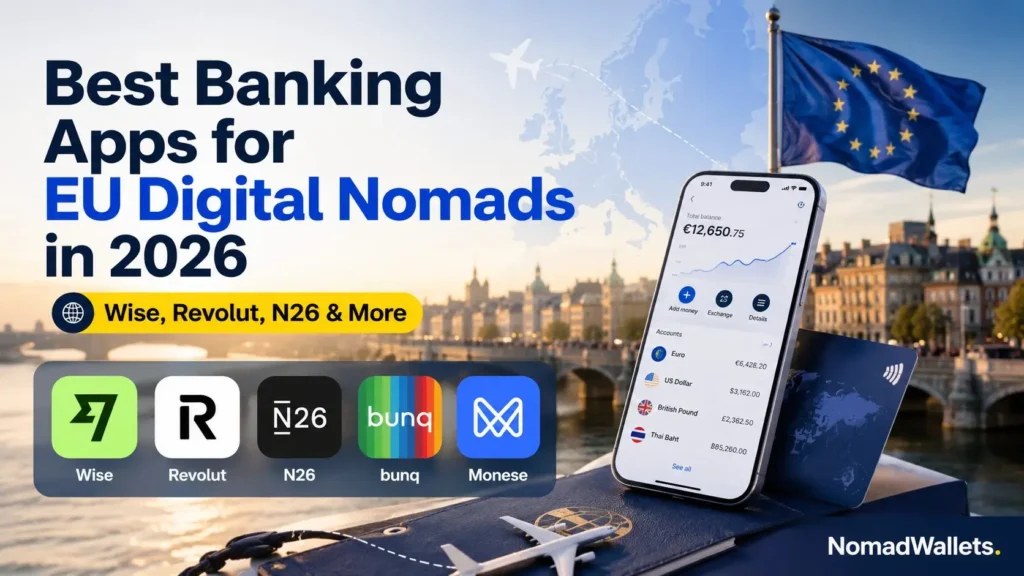
Read more: Best Banking Apps for EU Digital Nomads
Official source: N26 Plans
Bunq Review
Bunq is a Dutch digital bank that offers a unique set of features for digital nomads. It holds a Dutch banking licence, provides ZeroFX on Pro and Elite plans for real exchange rates when spending abroad, and offers joint accounts through bunq Together. If you travel with a partner, bunq is one of the best bank accounts for digital nomads because of its joint account feature.
Bunq lets you open up to 25 bank accounts on paid plans, which is useful for organizing your money by purpose or currency. The international savings accounts feature lets you earn interest on foreign currency balances. The app includes budgeting tools, instant notifications, and the ability to generate virtual cards for online purchases.
Bunq’s biggest catch is that it’s only available to EU residents. ATM fees apply on all plans, and there is no unlimited ATM fee reimbursement like Charles Schwab offers. However, for EU-based nomads who want a full banking licence with transparent foreign spending, bunq is a strong contender in the digital nomad banking space.
| Pros ✅ ZeroFX on Pro/Elite (real exchange rates) ✅ Joint accounts (bunq Together) ✅ Up to 25 bank accounts on paid plans ✅ International savings accounts ✅ Dutch banking licence |
| Cons ❌ Only available to EU residents ❌ ATM fees apply ❌ No unlimited ATM fee reimbursement |
Choose Bunq if you need a joint account with your partner, want ZeroFX for transparent spending abroad, need multiple bank accounts, or bank in the Netherlands or EU.
Official source: Bunq Plans
Airwallex Review
Airwallex is the best business banking platform for digital nomads who run international companies. It is a business-focused platform that lets you hold 20 or more currencies natively, create unlimited virtual cards, and make free local transfers to over 120 countries. If you pay contractors, manage international payroll, or need API integration for payment automation, Airwallex is the clear choice.
Airwallex supports SWIFT transfers to over 200 countries, making it easy to send money to almost anywhere in the world. The contractor payment feature lets you pay international team members in their local currency without the hassle of setting up individual wire transfers. The API allows you to automate payments and integrate with your accounting software.
The downside is that Airwallex is business-focused and does not offer personal accounts. It is also not a licensed bank, so funds are safeguarded rather than insured. The FX markup of 0.5 to 1 percent above the interbank rate is higher than Wise but still competitive compared to traditional banks. For business owners, though, Airwallex is the best business banking platform for managing international teams and payments.
| Pros ✅ Hold 20+ currencies natively ✅ Unlimited virtual cards ✅ Free local transfers to 120+ countries ✅ SWIFT transfers to 200+ countries ✅ Contractor payment features ✅ API for automation |
| Cons ❌ Business-focused (no personal accounts) ❌ Not a licensed bank (safeguarded funds only) ❌ FX markup of 0.5-1% above interbank |
Choose Airwallex if you run a business with international contractors, need to pay teams in multiple countries, want unlimited virtual cards for expense management, or need API integration for payment automation.
Read more: International Client Payment Processing
Official source: Airwallex Pricing
Charles Schwab Review
Charles Schwab Investor Checking is the best bank account for digital nomads who are US residents and need unlimited ATM fee rebates worldwide. Every ATM fee you pay, anywhere in the world, is automatically refunded at the end of each month. There are no foreign transaction fees, no minimum balance requirements, and no overdraft fees. The account is FDIC-insured and comes with a Visa Platinum debit card.
The unlimited ATM fee rebates are the standout feature. Whether you are withdrawing cash from a street ATM in Bangkok, a bank ATM in Buenos Aires, or a casino ATM in Las Vegas, Schwab will refund every fee. For digital nomads who rely on cash in countries where card acceptance is limited, this makes Charles Schwab one of the top banking options for digital nomads who need ATM access.
The catch is that Charles Schwab is only available to US residents. The account is USD-only with no multi-currency support, and you need a linked brokerage account to open the checking account. If you are a US citizen who travels frequently but maintains US residency, Charles Schwab paired with Wise for multi-currency needs creates one of the strongest banking combinations for digital nomads.
| Pros ✅ Unlimited worldwide ATM fee rebates ✅ No foreign transaction fees ✅ No minimum balance or overdraft fees ✅ FDIC-insured ✅ Visa Platinum debit card |
| Cons ❌ Only available to US residents ❌ USD-only account ❌ No multi-currency support ❌ Requires linked brokerage account |
Choose Charles Schwab if you are a US resident who travels abroad, need unlimited ATM fee rebates, want no foreign transaction fees, or primarily spend in USD.
Official source: Charles Schwab Checking
| Category | Best Choice |
| Best Overall | Wise |
| Best Premium | Revolut |
| Best Business | Airwallex |
| Best Europe | N26 |
| Best ATM | Charles Schwab |
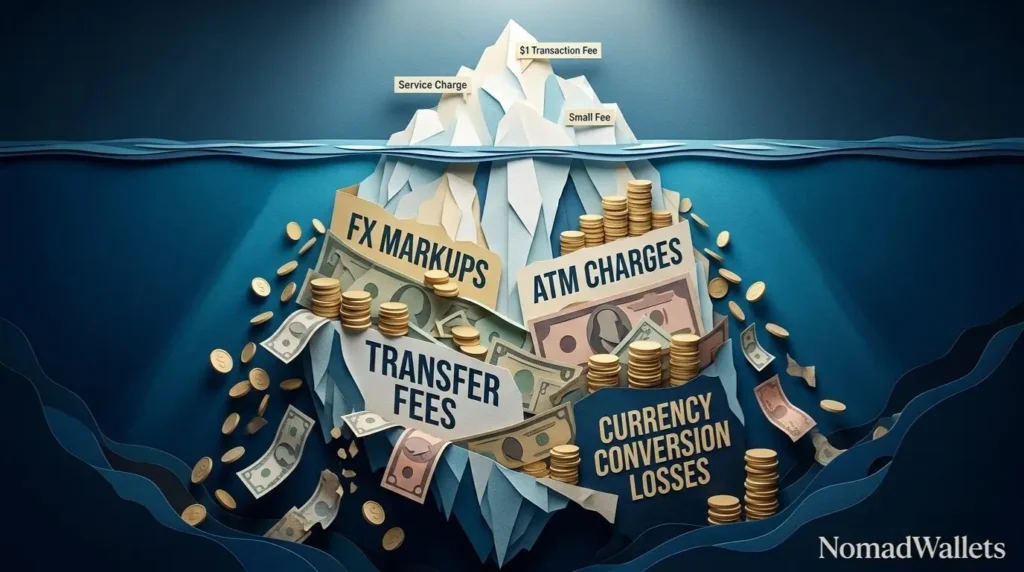
Banking Fees Every Digital Nomad Should Understand
Understanding banking fees is essential when choosing the best bank account for digital nomads. Many banks advertise free accounts but hide costs in exchange rates, transfer fees, and other charges. This section breaks down every type of fee you might encounter so you can make an informed decision.
Monthly Account Fees
Monthly account fees range from zero to over forty dollars per month. Free accounts are available from Wise, Revolut Standard, N26 Standard, and Charles Schwab. Premium accounts from Revolut, N26, and Bunq charge monthly fees but include additional features like travel insurance, higher withdrawal limits, and better exchange rates.
When deciding whether a premium account is worth paying for, calculate the total value of the included features. If the travel insurance alone would cost you more than the monthly fee, the premium plan is a good deal. But if you rarely use the extra features, stick with the free plan. The best bank account for digital nomads does not charge you for features you do not use.
Watch out for dormancy fees. Some banks charge a monthly fee if your account is inactive for a certain period. If you open multiple accounts and stop using one, you could be charged without realizing it. Always read the fee schedule before opening any account.
Currency Conversion (FX) Fees
Currency conversion fees, also called FX fees, are the most significant hidden cost for digital nomads. The mid-market exchange rate is the real rate at which banks trade currencies with each other. When you convert money as a consumer, your bank adds a markup on top of this rate. This markup can range from 0 percent (Wise) to over 3 percent (many traditional banks).
The difference between the mid-market rate and the rate your bank gives you is a hidden cost. For example, if you convert 1,000 USD to EUR and your bank charges a 2 percent markup, you lose 20 EUR on that single transaction. Over a year of regular conversions, this adds up to hundreds of dollars. The best bank account for digital nomads uses the mid-market rate or charges a transparent, low conversion fee.
| Transfer | Mid-Market Rate | Bank Rate | Difference |
| USD to EUR | Best available | Marked-up | Hidden cost |
| GBP to USD | Best available | Marked-up | Hidden cost |
| EUR to AUD | Best available | Marked-up | Hidden cost |
| Key Takeaway A free bank account can still cost more than a paid account if it uses poor exchange rates. Always compare the total cost including both the monthly fee and the exchange rate markup when choosing the best bank account for digital nomads. |
Foreign Transaction Fees
Foreign transaction fees are charged when you make a card purchase in a currency different from your account currency. These fees typically range from 0 to 3 percent. The best bank account for digital nomads charges zero foreign transaction fees. Wise, Revolut, N26, and Charles Schwab all offer zero foreign transaction fees on card purchases.
Dynamic Currency Conversion (DCC) is a common trap when paying with a card abroad. The payment terminal may ask if you want to pay in your home currency or the local currency. Always choose the local currency. When you pay in your home currency, the merchant sets the exchange rate, which is almost always worse than the rate your bank would give you. Declining DCC is one of the easiest ways to save money while traveling.
| Warning Always pay in the local currency. Declining Dynamic Currency Conversion often results in a better exchange rate. Choosing to pay in your home currency at the point of sale almost always costs you more. |
ATM Withdrawal Fees
ATM withdrawal fees come in two forms: fees charged by your bank and fees charged by the ATM operator. Your bank may charge a flat fee per withdrawal, a percentage of the amount withdrawn, or both. The ATM operator may also charge a fee, which is separate from your bank’s fee. The best bank account for digital nomads either waives these fees or reimburses them.
Daily withdrawal limits vary by bank and account type. Some banks limit you to 200 USD per day, while others allow up to 5,000 USD. Monthly free allowances also vary. Wise offers a certain number of free withdrawals per month, after which a small fee applies. Charles Schwab offers unlimited ATM fee rebates. Understanding these limits is important when choosing the best bank account for digital nomads.
International Transfer Fees
International transfer fees depend on the method used. SWIFT transfers are the most common international method but they are slow (1 to 5 business days) and expensive (15 to 50 USD per transfer). SEPA transfers are fast and cheap (usually free) but only work within Europe. ACH transfers are fast and free but only work within the United States.
| Transfer Type | Speed | Cost | Best Use |
| SWIFT | Slow | High | International |
| SEPA | Fast | Low | Europe |
| ACH | Fast | Low | US |
| Local Transfer | Fast | Low | Domestic |
| Pro Tip If you are paid in USD but spend mainly in EUR, keep separate balances and convert only when exchange rates are favorable to reduce FX costs. This strategy is one of the best ways to save money as a digital nomad, and the best bank account for digital nomads makes it easy to hold multiple currency balances. |
For more details, read our guides on Best Money Transfer Service for Digital Nomads and Best Multi-Currency Accounts for Digital Nomads.
Official sources: Wise Pricing | Revolut Fees | Visa Exchange Rates | Mastercard Currency Converter
How to Choose the Right Bank Based on Your Lifestyle
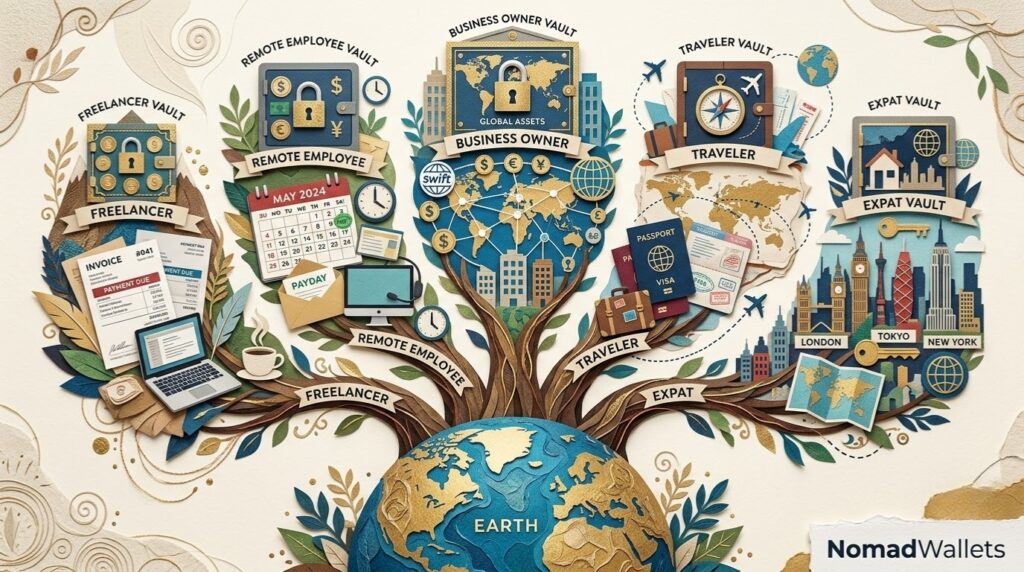
The best bank account for digital nomads depends on how you work and where you travel. A freelancer who gets paid in USD by US clients has different needs than a remote employee who receives salary in EUR. Here’s a breakdown of the best options by lifestyle type.
For Freelancers
Freelancers need to receive payments from clients in multiple currencies. You might have a US client who pays in USD, a German client who pays in EUR, and a UK client who pays in GBP. The top banking option for freelance digital nomads is Wise, because it gives you local bank details in multiple currencies so clients can pay you locally. Airwallex is also a strong option if you have a registered business and need to manage contractor payments.
For freelancers, the ability to invoice in the client’s local currency and receive payments without high transfer fees is crucial. Wise Business also offers invoice features and batch payment capabilities, making it the best bank account for digital nomads who run a freelance business.
For Remote Employees
Remote employees who receive a salary from a single employer need a bank that can receive regular deposits, provide good ATM access, and offer everyday spending features. Revolut is the best bank account for digital nomads who are remote employees because it offers a full banking experience with travel insurance, spending analytics, and premium features on paid plans.
If your employer pays you in EUR, N26 is an excellent choice because it provides a full EU banking licence with deposit protection. For USD earners, Charles Schwab offers the best ATM access. The best bank account for digital nomads who are remote employees depends on the currency of their salary and their primary spending region.
For Business Owners
Business owners need to pay contractors, manage expenses, issue virtual cards, and integrate with accounting software. Airwallex is the best business banking platform for digital nomads running international businesses because it offers unlimited virtual cards, free local transfers to over 120 countries, and contractor payment features. Wise Business is also a strong option for smaller businesses that need multi-currency accounts.
For businesses with international teams, Airwallex stands out because of its contractor payment features and API integration. You can automate payments, set up approval workflows, and integrate with tools like Xero and QuickBooks. This makes it a top banking platform for digital nomads who need to manage international payroll and expenses.
For Long-Term Expats
Long-term expats who live in one country for years need a local IBAN, may want to apply for a mortgage, and need to handle tax reporting. N26 is the best bank account for digital nomads who are long-term EU residents because it provides a full banking licence with deposit protection. Bunq is also a strong option for Netherlands-based expats who want joint accounts and ZeroFX.
For long-term expats, having a local bank account with a proper IBAN is important for rent payments, utility bills, and salary deposits. The best bank account for digital nomads who are long-term expats combines local banking features with international transfer capabilities.
For Frequent Travelers
Frequent travelers who move between countries every few weeks need a bank that works everywhere. Revolut Premium is the best bank account for digital nomads who are frequent travelers because it includes travel insurance, airport lounge access, and premium currency exchange features. Charles Schwab is also excellent for US residents who need unlimited ATM fee rebates.
For frequent travelers, the key features are ATM access, zero foreign transaction fees, and travel insurance. The best bank account for digital nomads who travel frequently also offers instant card freeze, virtual cards, and emergency card replacement.
| Lifestyle | Best Bank |
| Freelancer | Wise |
| Remote Worker | Revolut |
| Business Owner | Airwallex |
| EU Resident | N26 |
| Frequent Traveler | Charles Schwab |
Read more: International Client Payment Processing | Best Budgeting Apps for Digital Nomads | Digital Nomad Finance Guide
How to Open a Bank Account as a Digital Nomad
Opening a bank account as a digital nomad can be straightforward or complicated depending on the bank and your country of residence. The best bank account for digital nomads typically has a simple online application process. Here is what you need to know.
Documents Required
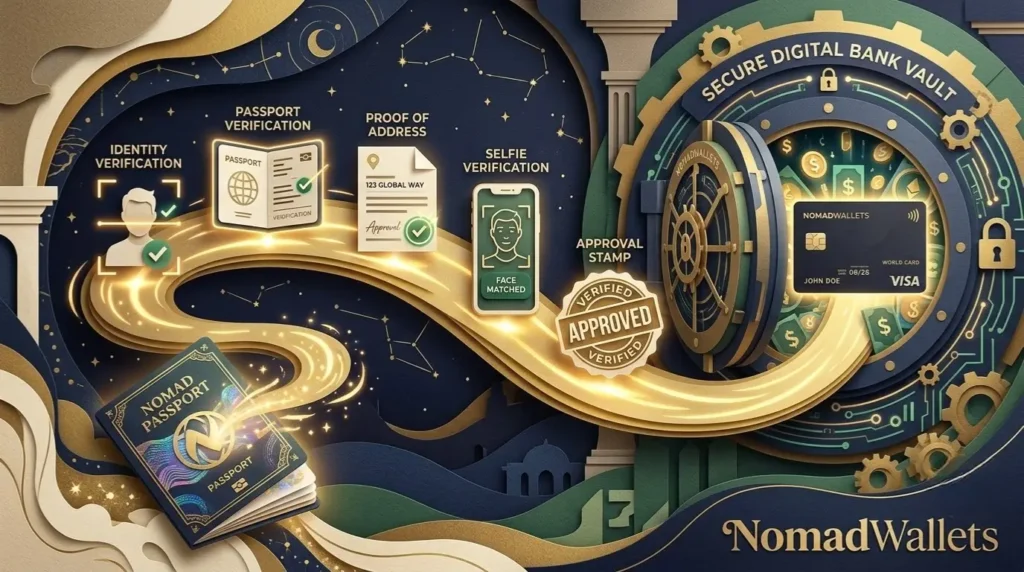
Most digital banks require the following documents to open an account: a valid passport or national ID, proof of address (utility bill, bank statement, or rental agreement from the last three months), a tax identification number from your country of residence, and in some cases a visa or residency permit. The best bank account for digital nomads accepts a wide range of documents and does not require a fixed address in a specific country.
Some banks accept a digital nomad visa as proof of residency, while others require a traditional residential address. If you do not have a fixed address, you may need to use a friend or family member’s address, a mail forwarding service, or a virtual mailbox. Always check the specific requirements before applying.
Verification Process (KYC)
The Know Your Customer (KYC) process is required by law for all financial institutions. This typically involves identity verification (uploading a photo of your ID), selfie verification (taking a selfie to match your face with your ID), address verification (uploading a proof of address document), and source of funds declaration (explaining where your income comes from). The best bank account for digital nomads completes this process quickly, often within minutes.
Approval Time
| Bank | Typical Approval |
| Wise | 1-3 days |
| Revolut | Minutes to days |
| N26 | 1-5 days |
| Bunq | Same day to few days |
| Airwallex | Several business days |
Common Reasons for Rejection
Account applications can be rejected for several reasons. The most common include being a resident of an unsupported country, providing invalid or expired documents, being a citizen of a sanctioned country, address mismatch between your documents, and compliance review flags. The best bank account for digital nomads serves a wide range of countries and has a transparent rejection process.
If your application is rejected, contact the bank’s support team to understand the reason. In some cases, you may be able to provide additional documentation to resolve the issue. Applying with a different bank that supports your country of residence is often the quickest solution.
| Expert Tip Before moving abroad, open your accounts while you are still in your home country if possible. This can simplify identity verification and reduce onboarding issues. Many banks have stricter requirements for non-residents, so having an account established before you leave can save you significant hassle. |
Official sources: Wise Help Center | Revolut Help | N26 Support | Bunq Support | Airwallex Help
Banking Security for Digital Nomads
Security is a top concern when choosing the best bank account for digital nomads. When you are traveling, you are more exposed to theft, fraud, and cyber attacks. This section covers the security features you need and the steps you should take to protect your money.
Two-Factor Authentication
Two-factor authentication (2FA) adds an extra layer of security to your bank account. Instead of just entering a password, you also need to provide a second form of verification. The most common methods are SMS codes, authenticator apps like Google Authenticator or Authy, and passkeys. The best bank account for digital nomads supports authenticator apps and passkeys, which are more secure than SMS codes.
SMS-based 2FA is vulnerable to SIM swapping attacks, where a hacker transfers your phone number to their SIM card. Authenticator apps and passkeys are not vulnerable to this attack because they do not depend on your phone number. Always use an authenticator app or passkey when available.
Card Freeze Features
The ability to freeze your card instantly from your phone is essential for digital nomads. If your card is lost or stolen, you can freeze it within seconds to prevent unauthorized transactions. The best bank account for digital nomads offers temporary freeze, permanent block, and instant replacement card features. Revolut, Wise, N26, and Bunq all offer instant card freeze through their mobile apps.
Virtual Cards
Virtual cards are disposable card numbers that you can use for online purchases. They are safer than using your physical card number because you can delete a virtual card after a single use or set spending limits on it. The best bank account for digital nomads offers unlimited virtual cards. Revolut, Wise, and Airwallex all support virtual cards, making them strong choices for online shopping security.
Use virtual cards for subscription services, online marketplaces, and any website where you do not want to share your real card number. If a virtual card is compromised, you can simply delete it without affecting your main account.
Avoiding Banking Fraud
Digital nomads are prime targets for banking fraud because they frequently use public Wi-Fi, visit ATMs in unfamiliar locations, and receive emails from international contacts. Common scams include fake ATMs that steal your card information, phishing emails that look like official bank communications, fake banking apps, and QR code scams. The best bank account for digital nomads includes fraud detection features and alerts you to suspicious activity.
To protect yourself, never use public Wi-Fi for banking without a VPN, always check ATMs for skimming devices, verify the sender of any banking email before clicking links, download banking apps only from official app stores, and never scan QR codes from untrusted sources.
Emergency Banking Plan
Every digital nomad should have an emergency banking plan. This means having backup payment methods stored separately from your primary ones. The best bank account for digital nomads is part of a broader financial setup that includes multiple payment options.
Emergency Checklist:
• Two debit cards (different banks)
• One credit card
• Emergency cash (USD/EUR)
• Backup phone
• Password manager
• Authenticator app
| Pro Tip Store your bank’s emergency phone number offline. If your phone is stolen, you need a way to freeze your cards immediately. Write the numbers on a piece of paper and keep them in your luggage, or save them in a secure note that you can access from another device. |
Read more: Best Credit Cards for Digital Nomads | Digital Nomad Finance Guide
Common Banking Mistakes Digital Nomads Should Avoid
Even experienced digital nomads make banking mistakes that cost them money and cause unnecessary stress. Here are the top 10 mistakes to avoid when choosing and using the best bank account for digital nomads.
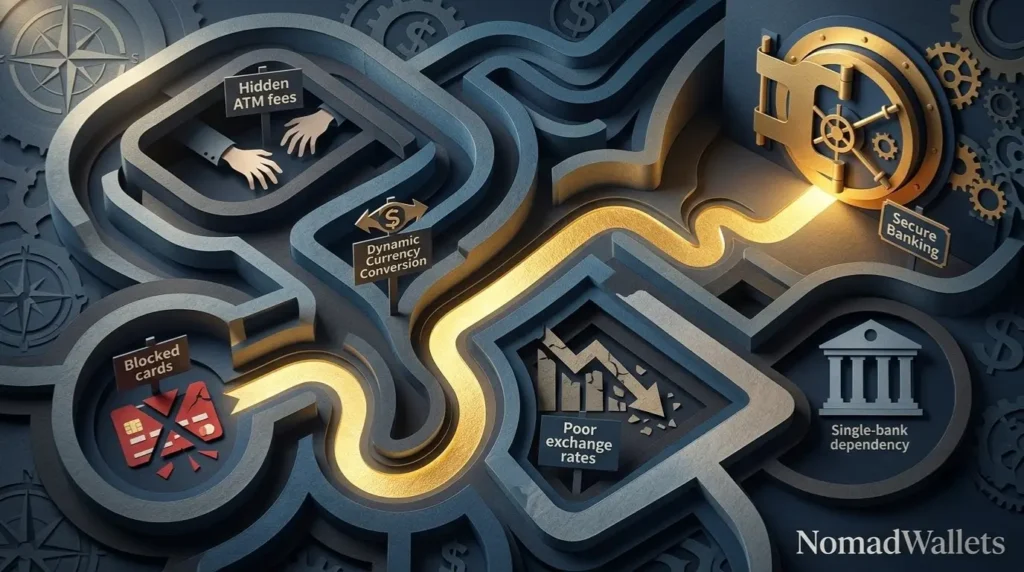
1. Using only one bank account. If your single bank has an outage, freezes your account, or blocks your card while you are abroad, you will have no way to access your money. Always have at least two bank accounts with different providers.
2. Ignoring exchange rates. A bank that offers free transfers but uses a poor exchange rate can cost you more than a bank that charges a small fee but gives you the mid-market rate. The best bank account for digital nomads is transparent about exchange rates.
3. Paying in your home currency abroad (DCC trap). When a payment terminal asks if you want to pay in your home currency or the local currency, always choose the local currency. Dynamic Currency Conversion gives you a worse exchange rate.
4. Not checking country availability. Not every bank operates in every country. Before you travel, check that your bank supports the country you are visiting. Revolut, for example, is not available in some popular nomad destinations in Southeast Asia and Africa.
5. Ignoring tax residency. Your tax obligations depend on where you are a tax resident, not where you travel. Check our Expat Tax Planning guide for more details.
6. Leaving all money on one card. If your card is lost or stolen, you will have no money until a replacement arrives. Spread your money across at least two cards and keep some emergency cash.
7. Ignoring ATM operator fees. Even if your bank does not charge ATM fees, the ATM operator might. Charles Schwab is the only bank that reimburses all ATM operator fees worldwide.
8. Using debit cards for hotel deposits. Hotels often place large holds on debit cards that can tie up your available balance for days. Use a credit card for deposits instead.
9. Ignoring banking regulations. Each country has different banking regulations. Some countries require you to declare foreign bank accounts, and failing to do so can result in penalties.
10. Not having an emergency payment method. Always carry a backup debit card, a credit card, and some emergency cash in a separate location from your primary wallet.
| Key Takeaways Good banking goes beyond just choosing the best account. It comes down to building a resilient financial setup with multiple payment methods, low-cost transfers, and strong security practices. The best bank account for digital nomads is part of a broader strategy that keeps your money accessible and safe no matter where you are. |
Read more: Expat Tax Planning | Best Budgeting Apps for Digital Nomads | Digital Nomad Finance Guide | Best Credit Cards for Digital Nomads
Best Bank Accounts by Region
The best bank account for digital nomads also depends on where you plan to live and travel. Banking infrastructure, card acceptance, ATM availability, and local regulations vary significantly by region. Here is a region-by-region breakdown.

Europe
Europe has the best digital banking infrastructure for digital nomads. SEPA transfers make it easy to move money between European countries quickly and cheaply. The best bank account for digital nomads in Europe is Wise for overall use, Revolut for premium features, N26 for EU residents, Bunq for Netherlands and EU, and Airwallex for businesses.
| Bank | Best For |
| Wise | Overall |
| Revolut | Travel |
| N26 | EU Residents |
| Bunq | Netherlands and EU |
| Airwallex | Businesses |
If you live in Europe, having a local IBAN is important for receiving salary payments, paying rent, and setting up utility bills. All of the banks listed above provide European IBANs. SEPA transfers are free or very cheap, and euro payments are widely accepted across the continent. The best bank account for digital nomads in Europe also supports local payment methods like iDEAL in the Netherlands and Giropay in Germany.
Read more: Best Banking Apps for EU Digital Nomads | Best Portuguese Banks for Non-Residents
North America
| Bank | Best For |
| Charles Schwab | Travelers |
| Wise | International |
| Revolut | Spending |
For US residents, Charles Schwab is the best bank account for digital nomads because of its unlimited ATM fee rebates and zero foreign transaction fees. Wise is the best for international transfers and multi-currency accounts. Revolut is available in the US but does not yet have FDIC insurance, as its US bank charter is still pending.
IRS reporting and FATCA considerations are important for US citizens with foreign bank accounts. If you have more than 10,000 USD in aggregate across all foreign accounts at any time during the year, you must file an FBAR (FinCEN Form 114). Read our Expat Tax Planning guide for more details.
Latin America
Latin America is a popular destination for digital nomads, but banking infrastructure varies widely. Cash is still common in many countries, and card acceptance is not universal outside major cities. USD is accepted in some countries like Ecuador and El Salvador, but you will need local currency in most others. The best bank account for digital nomads in Latin America is Wise for multi-currency and Revolut for everyday spending.
ATM availability is good in major cities but can be limited in smaller towns. Currency volatility is a significant factor in countries like Argentina and Venezuela, where exchange rates can change dramatically in a short period. Always have some USD cash as a backup when traveling in Latin America.
Asia
Asia is a diverse region for banking. In Japan and Singapore, card acceptance is high and banking infrastructure is modern. In Thailand, Indonesia, Vietnam, and the Philippines, cash is still common in many situations, and QR payments are widespread. The best bank account for digital nomads in Asia needs to support both card and cash transactions.
ATM fees vary by country. Thailand charges around 200 to 250 THB per withdrawal for foreign cards, while Indonesia charges around 25,000 to 50,000 IDR. Local payment apps like GrabPay, GoPay, and PayPay often require local residency or a local phone number. Wise and Revolut both work well in Asia, but having a Charles Schwab card for ATM fee rebates is especially valuable in this region.
Middle East
The Middle East, particularly the UAE, Saudi Arabia, and Qatar, has a modern banking system with high card acceptance. However, opening a local bank account typically requires residency. The best bank account for digital nomads in the Middle East is Wise for international transfers and Revolut for everyday spending. If you have residency in the UAE, you can open a local account with banks like Emirates NBD or Mashreq.
International transfers are generally fast and reliable in the Gulf states. The UAE has introduced virtual banking licences, making it easier for digital banks to operate in the region. Always check the latest regulations before traveling, as banking rules can change quickly.
Africa
Banking in Africa varies significantly by country. South Africa, Kenya, and Nigeria have relatively developed banking systems, while other countries have limited infrastructure. Card acceptance is low outside major cities, and mobile money platforms like M-Pesa are often more useful than traditional bank accounts. The best bank account for digital nomads in Africa is Wise for international transfers, supplemented by local mobile money solutions.
ATM access is available in major cities but can be unreliable. Always carry emergency cash in USD or EUR when traveling in Africa. International transfers can be slow and expensive, so having a Wise account with local bank details can save you significant money and time.
| Key Takeaway The best bank depends not only on features but also on the countries where you plan to live, work, and travel. Always research the banking infrastructure and regulations of your destination before choosing the best bank account for digital nomads. |
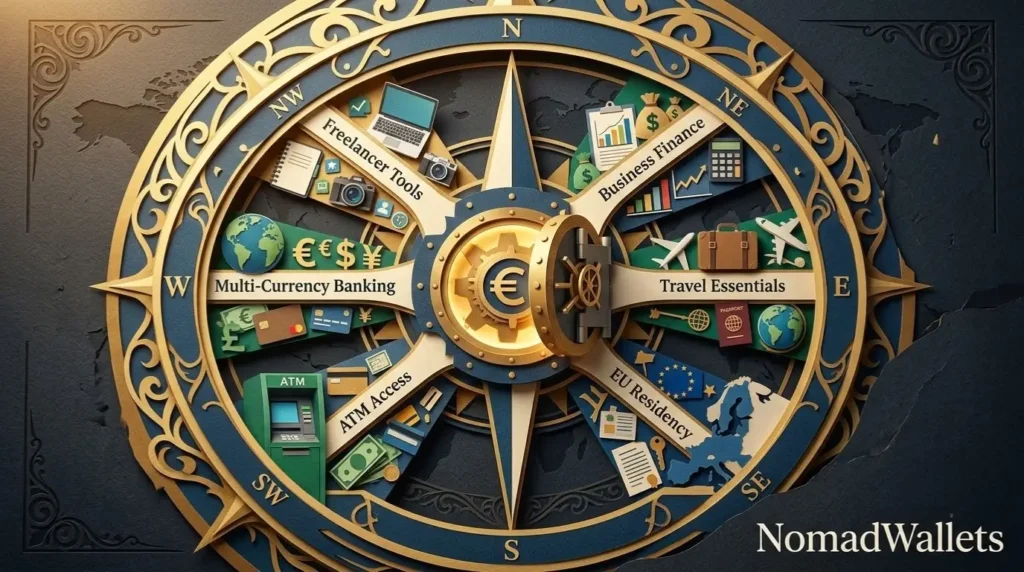
Best Bank Accounts by User Type
Different types of digital nomads have different banking needs. The best bank account for digital nomads varies based on your work style, income sources, and travel patterns. Here is a breakdown by user type.
| User | Best Bank |
| Beginner | Wise |
| Frequent Traveler | Revolut Premium |
| EU Resident | N26 |
| Business Owner | Airwallex |
| US Resident | Charles Schwab |
| Freelancer | Wise |
| Couple | Bunq |
| Long-Term Expat | N26 |
For beginners, Wise is the best overall banking platform because it is simple to set up, has no monthly fees, and offers the mid-market exchange rate. You do not need to be a financial expert to use Wise effectively. The app is intuitive and the fee structure is transparent.
For frequent travelers, Revolut Premium offers the best combination of travel features, insurance, and premium banking. The travel insurance included with the Premium plan covers medical emergencies, trip cancellations, and delayed baggage, making it the best bank account for digital nomads who travel often.
For EU residents, N26 provides a full banking licence with deposit protection, making it the safest option. For business owners, Airwallex offers the best contractor payment features and API integration. For US residents, Charles Schwab offers unlimited ATM fee rebates. For couples, Bunq offers joint accounts with ZeroFX. For long-term expats, N26 provides the local banking features needed for settling in Europe.
Each of these recommendations is based on the specific needs of each user type. The right banking solution depends on your lifestyle, income sources, travel patterns, and financial needs.
| Still Deciding? Still unsure which bank fits your travel style? Compare the providers above, or explore our detailed guides on Wise, Revolut, and multi-currency accounts to find the right option. |

Frequently Asked Questions
Q1. What is the best bank account for digital nomads?
A. The best bank account for digital nomads is Wise. It offers the mid-market exchange rate on currency conversions, local bank details in 10 or more currencies, and no monthly fees. Wise works well as an overall choice because it suits freelancers, remote employees, and business owners alike. Beyond that, your best fit depends on what matters most to you: Revolut for premium travel perks, N26 if you want a fully licensed EU bank, Airwallex for running a business, or Charles Schwab if unlimited ATM access is the priority.
Q2. Can digital nomads open a foreign bank account?
A. Yes, digital nomads can open foreign bank accounts. Digital banks like Wise, Revolut, and N26 allow you to open accounts online without being a resident of their home country. However, traditional banks usually require you to be a resident or have a local address. The best bank account for digital nomads can be opened entirely online from anywhere in the world, as long as you are from a supported country.
Q3. Is Wise a real bank?
A. Wise is not a traditional bank in every country. It operates as an electronic money institution (EMI) in most regions. This means your money is safeguarded in separate accounts at regulated banks rather than being covered by deposit insurance like FDIC or FSCS. However, Wise is regulated by financial authorities in each country where it operates, and your money is protected. The best bank account for digital nomads does not need to be a traditional bank as long as it is properly regulated and your funds are safeguarded.
Q4. Which bank has the lowest foreign transaction fees?
A. Wise, Revolut, N26, and Charles Schwab all offer zero foreign transaction fees on card purchases. However, Wise stands out because it also uses the mid-market exchange rate, which means you get the best possible rate on every transaction. The best bank account for digital nomads combines zero foreign transaction fees with transparent exchange rates.
Q5. Do I need residency to open an international bank account?
A. Not always. Digital banks like Wise and Revolut allow you to open accounts based on your country of citizenship, not your country of residence. However, you do need to provide a valid address in a supported country for verification purposes. Some banks require you to be a resident of a specific region. For example, N26 is only available to EU residents. The best bank account for digital nomads serves a wide range of countries and does not require residency in a specific location.
Q6. Can freelancers receive international payments?
A. Yes, freelancers can receive international payments through multi-currency accounts like Wise and Airwallex. Wise provides local bank details in 10 or more currencies, so your clients can pay you using standard local transfers instead of expensive international wire transfers. This is a key reason Wise is a top banking platform for freelancers. Airwallex also offers excellent contractor payment features for freelancers who operate as a business.
Q7. Which bank is best for Europe?
A. N26 is the best bank account for digital nomads in Europe. It holds a German banking licence with deposit protection up to 100,000 euros, offers free worldwide card payments, and provides travel insurance on paid plans. For overall use, Wise is also excellent because it provides European IBANs and supports SEPA transfers. Revolut is the best for premium features in Europe.
Q8. Which bank is best for remote workers?
A. Revolut is the best bank account for digital nomads who are remote workers. It offers a full banking experience with travel insurance, spending analytics, and premium features on paid plans. If your employer pays you in EUR, N26 is also a strong choice. For USD earners, Charles Schwab offers the best ATM access. The best bank account for digital nomads who are remote workers depends on the currency of their salary and their primary spending region.
Q9. Should I keep multiple bank accounts?
A. Yes, you should always have at least two bank accounts with different providers. If your primary bank has an outage, freezes your account, or blocks your card while you are abroad, you need a backup. The best bank account for digital nomads strategy involves a primary account for everyday use and a secondary account for emergencies. Keep your backup card in a separate location from your primary card.
Q10. How can I avoid ATM fees abroad?
A. The best way to avoid ATM fees abroad is to use Charles Schwab, which offers unlimited ATM fee rebates worldwide. If you are not a US resident, Wise offers a limited number of free withdrawals per month, and Revolut offers free withdrawals up to a monthly limit on paid plans. You can also minimize ATM fees by withdrawing larger amounts less frequently, using cards that reimburse ATM fees, and avoiding ATMs in tourist areas that charge higher fees.
Q11. What documents are required to open an account?
A. Most digital banks require a valid passport or national ID, proof of address, and a tax identification number. Some banks may also require a selfie for identity verification, a visa or residency permit, and a source of funds declaration. The best bank account for digital nomads has a simple application process with minimal documentation requirements. Always check the specific requirements for your country of residence before applying.
Q12. Can I receive my salary into Wise?
A. Yes, you can receive your salary into Wise. Wise provides local bank details in 10 or more currencies, so your employer can pay you using standard local transfers. For example, if your employer is in the US, they can pay you via ACH to your Wise USD account. If your employer is in the EU, they can pay you via SEPA to your Wise EUR account. This makes Wise a top banking platform for digital nomads who receive salary payments from international employers.
Q13. Which bank is best for businesses?
A. Yes, you can receive your salary into Wise. Wise provides local bank details in 10 or more currencies, so your employer can pay you using standard local transfers. For example, if your employer is in the US, they can pay you via ACH to your Wise USD account. If your employer is in the EU, they can pay you via SEPA to your Wise EUR account. This makes Wise a top banking platform for digital nomads who receive salary payments from international employers.
Q14. Is Revolut better than Wise?
A. It depends on your needs. Revolut is better for premium travel features, travel insurance, and a full banking experience in the UK and EU. Wise is better for exchange rates, international transfers, and multi-currency accounts. The best bank account for digital nomads between these two depends on whether you prioritize premium features (Revolut) or low-cost international transfers (Wise). Many digital nomads use both: Wise for transfers and Revolut for everyday spending.
Q15. What happens if my debit card is lost while traveling?
A. If your debit card is lost while traveling, you should immediately freeze it through your bank’s mobile app. Most digital banks allow you to freeze your card instantly. Then, request a replacement card. Some banks offer emergency card delivery or virtual card alternatives. This is why having a backup card from a different bank is essential. The best bank account for digital nomads includes instant card freeze, emergency card replacement, and virtual card options for situations like this.

Final Verdict
Having compared all six options across every category that matters to digital nomads, a clear front-runner emerges. Wise is the best overall choice for most digital nomads because it offers the best exchange rates, the most transparent fee structure, and the widest multi-currency support. Revolut is the best for premium travel features, with banking services across multiple markets and travel insurance. N26 is the best for EU residents who need a full banking licence. Airwallex is the best for businesses with international operations. Charles Schwab is the best for ATM access with unlimited fee rebates. Bunq is the best for joint accounts and Dutch banking.
| Situation | Best Choice |
| Best Overall | Wise |
| Best Premium | Revolut |
| Best European Bank | N26 |
| Best Business Bank | Airwallex |
| Best ATM Access | Charles Schwab |
| Best Dutch Banking | Bunq |
Before choosing the best bank account for digital nomads for your specific situation, take these steps. First, compare your travel destinations and make sure the bank supports the countries you plan to visit. Second, review the supported countries and verify that your country of residence is accepted. Third, understand all fees before opening an account, including monthly fees, FX fees, ATM fees, and transfer fees. Fourth, maintain at least one backup payment method in case your primary card is lost or blocked. Fifth, consider tax implications if you are relocating long-term.
The best bank account for digital nomads comes down to more than just features. It’s about finding a bank that matches your lifestyle, keeps your money safe, and minimizes the hidden costs of international banking. No matter your setup: freelancing, drawing a remote salary, running a business, or settled in as a long-term expat. The right bank account can save you thousands of dollars per year and give you real peace of mind while you travel.
Read more: Best Multi-Currency Accounts for Digital Nomads | Best Credit Cards for Digital Nomads | Expat Tax Planning | Digital Nomad Finance Guide
| Disclaimer Banking products, fees, eligibility requirements, and supported countries change over time. Always verify the latest information on the provider’s official website before opening an account. This article was last updated in July 2026. |

Tushar Sharma is the founder and editor of NomadWallets, where he writes about international banking, travel cards, cross-border payments, taxes, and financial tools for digital nomads and globally mobile professionals. He created NomadWallets to make global money decisions simpler through practical, research-backed guides built from official sources and real-world financial data.