

| QUICK SUMMARY: Spain Expat Tax Guide |
| • Tax residency determined by 183-day rule, centre of economic interests, or family ties |
| • Spain taxes residents on worldwide income |
| • Beckham Law offers a flat 24% rate on Spanish-source income up to €600,000 for qualifying expats |
| • Wealth Tax applies in most regions; Madrid and Andalusia offer 100% rebates |
| • Modelo 720 requires annual reporting of foreign assets above €50,000 per category |
| • Digital Nomad Visa holders may qualify for Beckham Law benefits |
| • Social Security contributions run roughly 6.5% for employees and up to 30.65% for employers (varies by category) |
| • Double tax treaties with 90+ countries help prevent dual taxation |
| • Annual tax return (Modelo 100) due by June 30 |
| WHO SHOULD READ THIS GUIDE? |
| ✓ You are moving to Spain for work and need to understand your tax residency and income tax obligations |
| ✓ You are a digital nomad considering Spain under the Digital Nomad Visa and want to know about Beckham Law eligibility |
| ✓ You are retiring in Spain and need clarity on pension taxation, Wealth Tax, and double tax treaties |
| ✓ You are self-employed (Autónomo) and want to understand quarterly filings, VAT, and social security contributions |
| ✓ You have foreign investments, bank accounts, or property and need to understand Modelo 720 reporting requirements |
| ✓ You want to understand how the Beckham Law works and whether you qualify for its 24% flat tax rate |
Introduction
Spain draws expatriates from all walks of life, including remote workers, retirees, entrepreneurs, and freelancers, thanks to its climate, culture, and cost of living. But the country’s tax system has several moving parts, and getting it wrong can cost thousands of euros. This article covers what you need to know before and after you arrive: how residency is determined, what rates apply, which special regimes can cut your bill, and what forms you must file.
For broader financial planning context, our digital nomad finance guide outlines budgeting and banking strategies for international workers. Below, the section below focuses on the Spanish tax framework: the rules, the numbers, and the deadlines that matter. Spain offers several visa pathways, including the Digital Nomad Visa, the Golden Visa, and standard work permits, each carrying distinct tax consequences that you need to evaluate before committing to a move.
The Agencia Tributaria (commonly called Hacienda) administers income tax, wealth tax, VAT, social security contributions, and a suite of reporting obligations. Expat tax planning is not optional; failing to understand the system before you relocate almost always leads to overpayment, penalties, or both. The sections that follow take you through residency tests, progressive rate structures, the Beckham Law, Modelo 720 foreign-asset reporting, double tax treaties, and practical filing guidance.
Spain also provides several regimes that can materially lower an expatriate’s tax bill: the Beckham Law’s flat 24% rate, Digital Nomad Visa tax provisions, and full Wealth Tax rebates in Madrid and Andalusia. Each section below gives you a clear picture of what applies to your situation at every stage of your relocation.
Section 1: Understanding Tax Residency in Spain
Your tax residency status determines whether Spain taxes your worldwide income or only your Spanish-source income, so getting this right is the first thing you should sort out. Spanish law uses three tests, applied in no particular order of priority, to classify individuals as tax residents.

The best-known test is the 183-day rule: if you spend more than 183 days in Spain during a calendar year, you are a tax resident. Temporary absences count toward the 183 days unless you can prove tax residency in another country during those absences. Spain also applies a centre of economic interests test: if your primary business activities or the core of your financial life is in Spain, you can be classified as a tax resident even with fewer than 183 days on the ground.
The third test looks at family ties: if your spouse (unless legally separated) and minor children live in Spain, the tax authorities will presume you are a resident too.
Split-year situations come up when someone moves to or from Spain partway through a calendar year, and this is an area where expats often assume too much. Spain does not have a simple UK-style split-year regime that automatically divides the calendar year into a resident portion and a non-resident portion. Under Spanish domestic law, residency is generally determined for the tax year as a whole, based on the 183-day count, the centre-of-economic-interests test, or the family-ties presumption; moving mid-year mainly affects how those days are counted, not whether the year itself gets split.
Where genuine relief exists for a mid-year move, it typically comes from the tie-breaker rules in the applicable double tax treaty, used when both Spain and another country could otherwise claim you as a resident for the same year, rather than from a domestic partial-year mechanism. The table below contrasts the two classifications side by side, and Agencia Tributaria’s official guidance on individual tax residency sets out the full criteria in detail.
As this guide explains, it is the treaty tie-breaker rules, not a domestic split-year mechanism, that ultimately prevent someone from being taxed as a resident by both countries for the same year — so anyone moving mid-year should check the relevant treaty rather than assume the calendar year will simply be divided in two.
| Criteria | Tax Resident | Non-Resident |
| Physical presence | More than 183 days in Spain per year | 183 days or fewer in Spain per year |
| Economic interests | Centre of economic activities in Spain | Primary economic activities outside Spain |
| Tax scope | Worldwide income taxed | Only Spanish-source income taxed |
| Filing requirement | Modelo 100 (annual) + Modelo 720 (foreign assets) | Modelo 210 (quarterly for Spanish income) |
| Social security | Contributions to Spanish system | May be exempt under A1 certificate or totalization agreements |
Section 2: How Spain Taxes Expats
Residency classification decides what Spain can tax. Residents report worldwide income: salary from a Spanish employer, rental income from a flat in London, dividends from a US brokerage account, it all goes on the return. This worldwide scope makes Spain more aggressive in its reach than some European neighbours. This distinction determines your entire tax position.
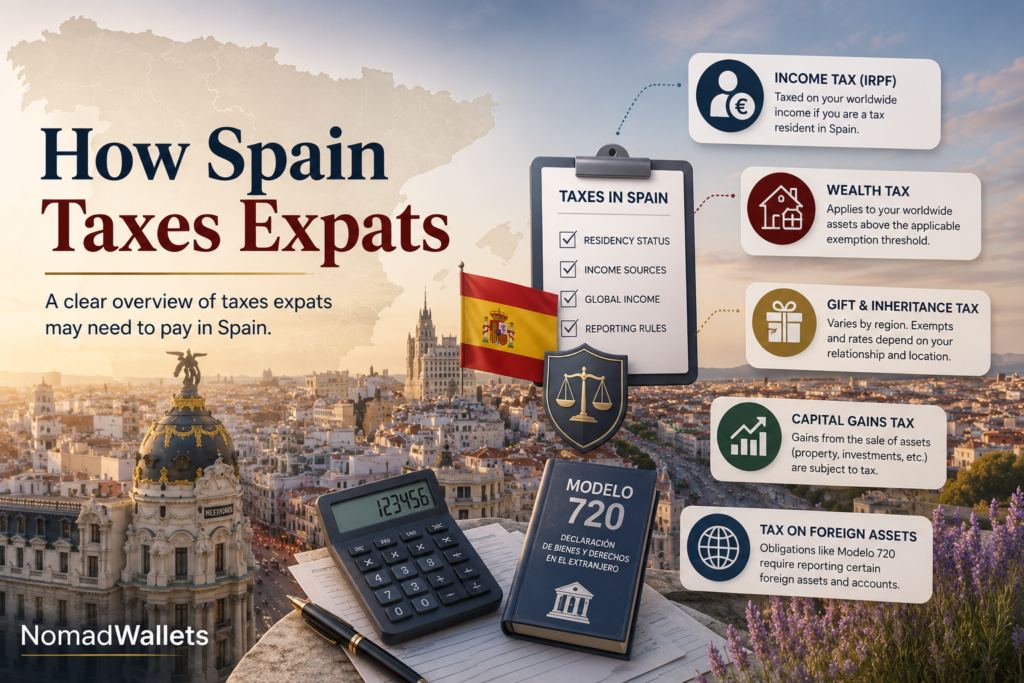
Non-residents face a narrower obligation: they are taxed only on income that originates from Spanish sources. This covers salary earned for work performed in Spain, rental income from Spanish property, dividends paid by Spanish companies, and capital gains from selling Spanish assets. The default non-resident rate is a flat 24%, though certain income types carry different withholding rates. Interest income from Spanish bank deposits is generally taxed at 19%, while dividend withholding can drop to 10% under certain treaty provisions.
Capital gains on Spanish real estate are taxed at a flat rate regardless of how long the property was held: 19% for residents of an EU/EEA country with effective tax-information exchange with Spain, and 24% for everyone else. There is no general exemption for non-residents based on holding period — that is a common misconception, and treating a gain as exempt without checking your specific nationality and treaty position is a costly mistake. The buyer is also required to withhold 3% of the sale price and pay it directly to the Agencia Tributaria on account of the seller’s liability.
See Agencia Tributaria’s official IRNR rate schedule for the current rates. If you are uncertain whether your income qualifies as Spanish-sourced, consult the detailed source rules in Article 16 of the Ley del IRPF. For a side-by-side comparison with another major European destination, our Germany Expat Tax Guide shows how a neighbouring country handles similar situations. The table below highlights the main differences between the two countries, a comparison for readers weighing their options.
The Spain Expat Tax Guide breaks down the standard regime rates and compares them with the Beckham Law in the sections that follow.
| Feature | Spain | Germany |
| Residency rule | 183 days / centre of economic interests / family ties | 183 days / centre of vital interests / habitual abode |
| Income tax system | Progressive (19%-47% combined) | Progressive (14%-45%) |
| Wealth Tax | Yes (regional; Madrid/Andalusia rebate 100%) | No |
| Digital Nomad Visa | Yes (income ≥ 200% minimum wage) | No dedicated visa |
| Special expat tax regime | Beckham Law: flat 24% (5 years) | None (1/5 rule for partial relief) |
| Foreign asset reporting | Modelo 720 (€50K per category) | No equivalent annual filing |
| Solidarity / wealth surcharge | Yes (net wealth > €3M) | No |
| Capital gains tax (resident) | 19%-28% (savings base) | 15% (assets held > 1 year) |
| Social security (employee) | 6.5% of gross salary | ~20.4% of gross salary |
| VAT standard rate | 21% | 19% |
| Non-resident income tax | Flat 24% | Flat 15% (treaty) or 25% |
| Tax treaty network | 90+ treaties | 90+ treaties |
The difference between progressive and flat rates matters more than most expats realise at first. Under the standard regime, residents pay progressively, meaning more income means a higher marginal rate. The Beckham Law flips that to a flat 24% on Spanish-source employment income up to €600,000. For someone earning €150,000 from a Spanish employer, the gap between the two regimes can exceed €20,000 per year. The sections below explain when each system applies and how to qualify.
Section 3: Spanish Income Tax Rates
Spain’s personal income tax, known as IRPF (Impuesto sobre la Renta de las Personas Físicas), is split between the state and the 17 autonomous communities. Your total bill has two components: a state share and a regional share, each with its own brackets. The regional share is where location really matters. Two people earning the same salary can owe different amounts depending on where they live.
State rates range from 9.5% on the lowest bracket up to 24.5% at the top. Regional rates vary widely: Madrid and Andalusia keep combined top rates around 45%, while Catalonia pushes past 54%. When both layers are added together, the effective range runs from roughly 19% on the first €12,450 of taxable income up to 47% (or more in certain regions) on income above €300,000. Factor regional differences into your relocation decision. The annual savings from choosing a lower-tax community can easily reach five figures.
| Taxable Income (EUR) | State Rate | Regional Rate (Avg) | Combined Rate |
| Up to €12,450 | 9.5% | 9.5% | 19% |
| €12,450 – €20,200 | 11.2% | 11.8% | 23% |
| €20,200 – €35,200 | 14.0% | 13.0% | 27% |
| €35,200 – €60,000 | 18.5% | 17.5% | 36% |
| €60,000 – €300,000 | 22.5% | 18.5% | 41% |
| Over €300,000 | 24.5% | 22.5% | 47% |
Each autonomous community sets its own rates within limits established by the central government, which is why two people earning identical incomes can owe markedly different amounts. A high earner making €200,000 would save over €10,000 per year in Madrid (combined top rate ~45%) compared with Catalonia (54%+). When choosing where to live, factor in both the lifestyle benefits and the tax bottom line.
Run the numbers for your specific income level before committing to a region. The Spain Expat Tax Guide income tax tables above break down both the state and regional components at each bracket.
According to the Spain Expat Tax Guide, regional differences in income tax rates are one of the biggest variables expats face when choosing where to live in Spain.

Section 4: Beckham Law Explained
The Beckham Law (Article 93 of the Ley del IRPF) is the single biggest tax advantage available to qualifying expatriates in Spain. Introduced in 2005 (the name comes from David Beckham’s transfer to Real Madrid) it lets qualifying individuals pay tax as if they were non-residents while actually living in Spain. The result: a flat 24% rate on Spanish-source employment income up to €600,000, with qualifying foreign-sourced capital income generally kept off the Spanish tax return (see the scope caveat below).
To qualify, you must meet several criteria. First, you need a qualifying employment relationship: a standard contract, an intra-company transfer, a Digital Nomad Visa, or startup entrepreneurship. Second, you must not have been a Spanish tax resident at any point during the five years before your relocation (recently shortened from 10 years). Third, the position you fill must not have been previously held by someone dismissed within the preceding two years.
The primary benefit is a flat 24% tax rate on Spanish-source employment income up to €600,000; income above that threshold is taxed at the standard 47% rate.
One of the biggest advantages is that foreign-sourced capital income — dividends, interest, rental income, and capital gains generated outside Spain — generally falls outside the Spanish tax base for as long as you remain validly under the regime. This is a substantial benefit, but the scope is defined precisely by Article 93 of the Ley del IRPF, and whether a specific income stream qualifies can depend on its source and your individual circumstances, so it should be confirmed against your own situation rather than assumed to be automatic.
Qualifying individuals are also generally exempt from the Modelo 720 foreign-asset reporting obligation while validly under the regime, though this exemption carries its own conditions and should be verified against your current circumstances before you rely on it; see Agencia Tributaria’s official guidance on the special impatriate regime for the current conditions. The spouse and children under 25 of the qualifying expatriate may also be eligible, making the Beckham Law a family-level planning tool.
The application deadline is unforgiving: you must submit Form 149 within six months of your Social Security registration date. The 2023 reforms widened eligibility to remote workers, digital nomads, and employees of foreign companies that lack a permanent establishment in Spain.
The regime now runs for five years (down from six). Missing the Form 149 deadline means losing the flat-rate benefit for the entire period, so engage a tax professional as soon as you arrive. The Spain Expat Tax Guide Beckham Law comparison table above illustrates the standard versus special regime side by side.
| Feature | Standard Regime | Beckham Law |
| Tax rate on employment income | Progressive 19%-47% | Flat 24% (up to €600,000) |
| Tax scope | Worldwide income | Spanish-source income only |
| Foreign dividends/interest | Taxed at 19-30% | Exempt from Spanish tax |
| Foreign rental income | Taxed at 19-28% | Exempt from Spanish tax |
| Foreign capital gains | Taxed at 19-28% | Exempt from Spanish tax |
| Modelo 720 filing | Required if thresholds met | Exempt |
| Duration | Indefinite (as resident) | 5 years |
| Application deadline | N/A | 6 months from Social Security registration (Form 149) |
Section 5: Wealth Tax and Solidarity Tax
The Wealth Tax (Impuesto sobre el Patrimonio) is an annual levy on your net assets as of December 31 each year. Residents report worldwide assets; non-residents report only Spanish-situated assets. Rates climb from 0.2% at the bottom bracket to 3.5% at the top. Where things get complicated is the regional patchwork: each autonomous community can apply its own rebate, and some eliminate the tax entirely.
Madrid and Andalusia both grant a 100% rebate (bonificación), wiping out the Wealth Tax entirely for their residents. Catalonia, by contrast, sets a minimum exemption of €500,000 and applies the tax in full above that. For someone with €2 million in net assets, living in Madrid rather than Barcelona can save upwards of €30,000 per year in Wealth Tax alone. To put concrete numbers on it: at €1 million in net wealth, the tax in Catalonia would be roughly €2,400-€3,000 per year, while in Madrid it is zero.
The Solidarity Tax (Impuesto Solidario de Grandes Fortunas) was introduced in 2023 and applies nationwide, regardless of regional Wealth Tax rebates. It targets individuals with net wealth exceeding €3 million. Even if you live in Madrid or Andalusia and benefit from a 100% Wealth Tax rebate, you will still owe Solidarity Tax on the portion of your wealth above €3 million.
The Solidarity Tax uses similar progressive rates and is filed alongside your annual income tax return. See Agencia Tributaria’s official Solidarity Tax guidance for the current thresholds and filing details.
The two taxes interact as follows: between €700,000 and €3 million in net wealth, regional rules dictate whether you owe anything (in Madrid or Andalusia, you owe nothing). Above €3 million, the Solidarity Tax kicks in regardless of region, and the combined rate cannot fall below a legally defined floor. Anyone relocating with substantial assets should model both taxes together.
The Spain Expat Tax Guide wealth tax table below lists the asset categories that fall within scope. The effective rate can swing several percentage points depending on total net worth and where you register your address.
To illustrate the impact of regional choices, consider a resident with €3.5 million in net assets. In Catalonia, the Wealth Tax alone would be approximately €47,000 per year (using progressive rates from 0.2% to 3.5% across the brackets). In Madrid, the regional 100% rebate eliminates this entirely, but the national Solidarity Tax would apply to the €500,000 exceeding the €3 million threshold, adding roughly €3,500.
The net saving from choosing Madrid is therefore around €43,500 per year. The difference between regions is not theoretical: it is money in your pocket.
The Spain Expat Tax Guide wealth tax analysis emphasises that regional choice can save or cost tens of thousands of euros per year.
| Asset Category | Resident (Worldwide) | Non-Resident (Spain Only) | Notes |
| Real estate | Yes | Yes | Market value as of Dec 31 |
| Bank accounts | Yes | Yes | Balance as of Dec 31 |
| Investment portfolios | Yes | Yes | Market value of securities |
| Business assets | Yes | Yes | Net business equity |
| Pension plans | Yes (certain types) | No | Depends on plan structure |
| Life insurance | Yes | Yes | Surrender value as of Dec 31 |
Section 6: Taxes on Foreign Income
Most expats arrive in Spain with at least one income stream from abroad: a foreign employer, overseas rental property, or an investment portfolio. As a resident, salary from a foreign employer is fully taxable in Spain. There is, however, a useful exemption: income up to €60,100 earned for work performed entirely outside Spain may be exempt, provided the foreign employer has no permanent establishment in Spain.
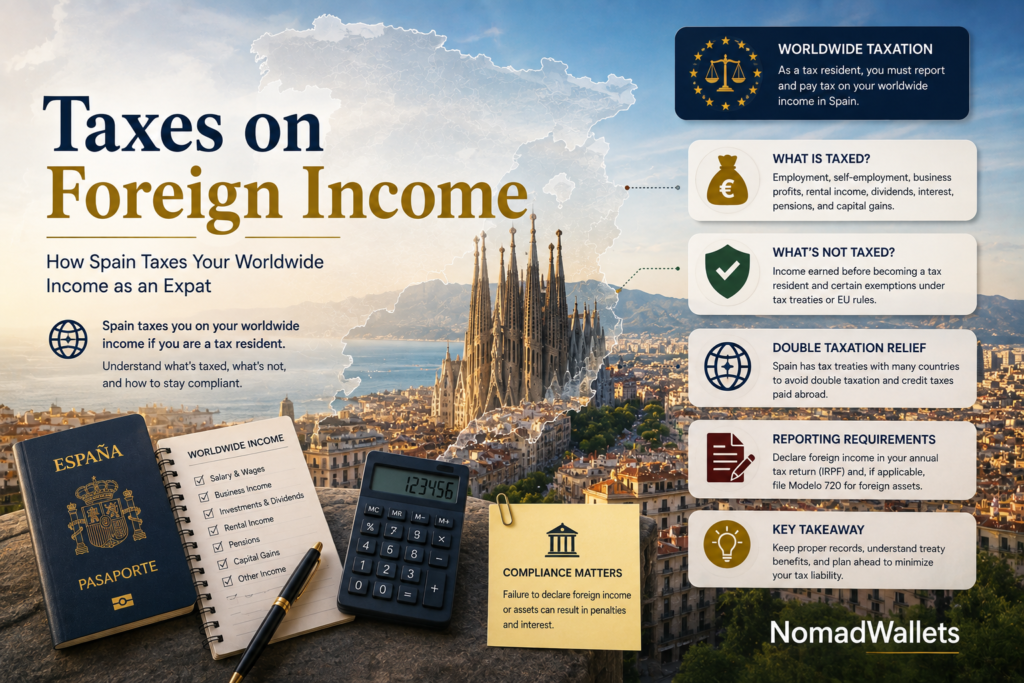
Foreign dividends and interest fall into the savings income base (base del ahorro) and are taxed at progressive rates. As of 2025, the top savings rate rose to 30%. The brackets are: 19% on the first €6,000, 21% on €6,000-€50,000, 23% on €50,000-€200,000, 27% on €200,000-€300,000, and 30% above that. Interest income follows the same scale. Double taxation treaties may lower the effective rate on foreign dividends and interest via foreign tax credits.
Foreign rental income is also classified as savings income, subject to the same progressive rates. Foreign pensions are generally taxable in Spain as general income, though many bilateral treaties carve out exemptions for government pensions and certain private distributions. UK government pensions, for example, are exempt under the UK-Spain treaty, while US Social Security is taxed at a reduced rate. German pension income follows the exemption-with-progression method under the Germany-Spain treaty.
Capital gains on foreign assets follow a similar structure: 19% on the first €6,000, 21% on €6,000-€50,000, 23% on €50,000-€200,000, and 28% above €200,000. For expats holding substantial foreign investment portfolios, the interaction between Spanish savings tax rates and foreign withholding taxes can be complex. If your home country withholds tax on dividends or interest at source, you may need to claim a foreign tax credit on your Spanish return rather than a straight exemption. Timing and structuring of disposals matters. Spreading gains across multiple years can keep you in a lower bracket..
The Spain Expat Tax Guide foreign income section walks through the interaction between Spanish savings tax rates and common foreign withholding scenarios.
Section 7: Self-Employed Expats (Autónomos)
Freelancing in Spain means registering as an autónomo. The process starts with obtaining a NIE (Número de Identidad de Extranjero) and enrolling in the Régimen Especial de Trabajadores Autónomos (RETA). The self-employment route gives you flexibility but brings a heavier administrative load. Key obligations include: quarterly VAT returns, quarterly advance income-tax payments, and income-based social security contributions.
Since 2023, social security contributions for the self-employed are calculated on declared net income rather than a fixed base. Monthly contributions range from roughly €206 to €607 depending on income level. New autónomos get a reduced rate of €80-€88 per month for the first 12 months, extendable to 24 months under certain conditions. On the payment side, our guide on international client payment processing covers efficient routing for cross-border invoices, and choosing the best money transfer services for digital nomads can cut the cost of receiving foreign income.
For self-employed expats, the Spain Expat Tax Guide self-employment section walks through quarterly filing obligations and deductible expenses.
Quarterly filings are the bread and butter of autónomo compliance: Modelo 303 for VAT (IVA) and Modelo 130 for advance income tax (IRPF). The standard VAT rate is 21%, with reduced rates of 10% and a super-reduced 4% for essentials. Deductible business expenses include office rent, software subscriptions, internet, professional insurance, accountant fees, professional training courses, business travel, and a proportion of home-office costs if you work from home.
Meals with clients are 50% deductible if the meeting has a clear business purpose. Vehicle expenses related to business use are also deductible, calculated as a percentage based on business-versus-personal mileage. The Spain Expat Tax Guide self-employment section explains how RETA contributions work. Track every expense from day one, every single receipt, and every invoice. Poor records are the fastest route to an overpayment.
| Feature | Employee | Autónomo (Self-Employed) |
| Tax filing | Employer withholds tax; file Modelo 100 annually | File Modelo 130 quarterly + Modelo 100 annually |
| Social security rate | 6.5% (employee) + 30.65% (employer) | Income-based: €206-€607/month |
| VAT obligations | None | File Modelo 303 quarterly (IVA) |
| Income tax | Withheld by employer (retención) | Self-assessed via quarterly payments |
| Quarterly payments | None | Modelo 130 (IRPF) + Modelo 303 (VAT) |
| Deductions | Standard deductions applied by employer | Business expenses: rent, software, insurance, etc. |
| Sick pay | Covered by employer/social security | Limited coverage after 4th day of illness |
| Unemployment benefits | Eligible after contributions | Not eligible (unless voluntary contributions) |
Section 8: Digital Nomad Taxes in Spain
Spain’s Digital Nomad Visa, introduced in 2023 and refined for 2026, created a new taxpayer category. Applicants need income of at least 200% of Spain’s minimum wage (Salario Mínimo Interprofesional, or SMI). For 2026 the SMI is €1,221 per month across 14 payments, set by Real Decreto 126/2026, which puts 200% at roughly €2,442 per month — but because the SMI is revised annually (sometimes more than once), and the exact calculation basis used for visa purposes should be confirmed with the immigration authority (Unidad de Grandes Empresas y Colectivos Estratégicos) rather than assumed from last year’s figure, always check the current published SMI before relying on a specific number.
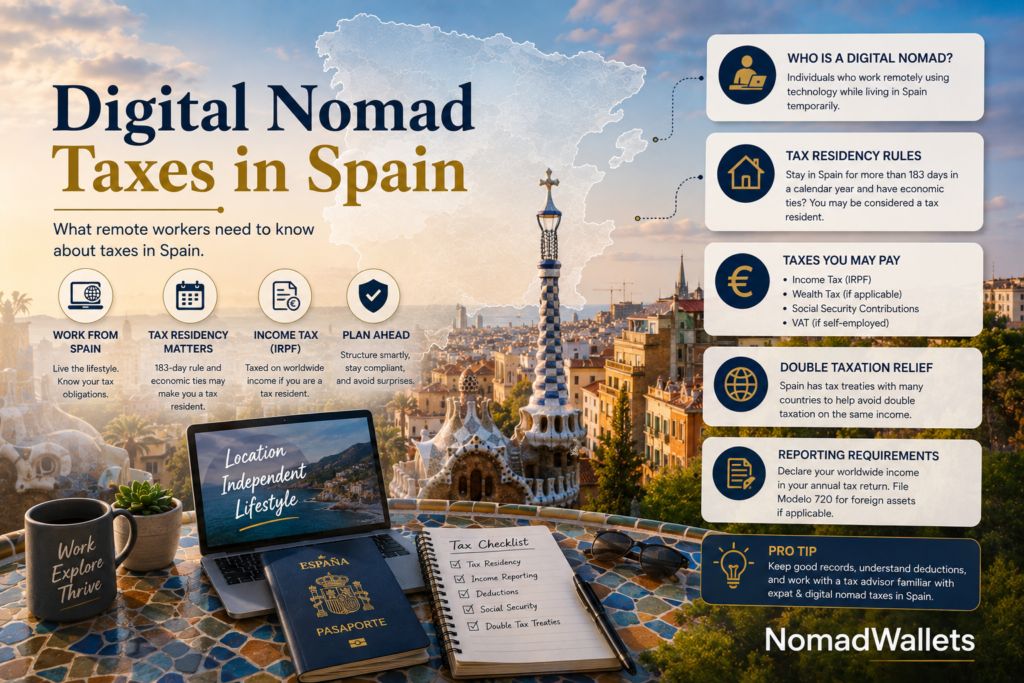
Our digital nomad visa guide covers the visa requirements; the section below focuses on the tax side. The visa grants up to five years of residence, and that duration carries material tax consequences from day one.
Simply holding a Digital Nomad Visa and spending months in Spain will likely trigger tax residency under the 183-day rule or the centre-of-interests test. There is also a corporate risk: if your foreign employer has Spanish clients or any operations in Spain, your remote work could create a permanent establishment, exposing the employer to Spanish corporate tax. If that situation applies to you, seek professional advice before relocating.
Digital Nomad Visa holders who qualify for the Beckham Law gain two major potential benefits: a flat 24% rate on Spanish-source employment income up to €600,000, and generally exempt treatment of qualifying foreign-sourced dividends, interest, rental income, and capital gains (see Section 4 for the scope and conditions that determine what actually qualifies). For a comparison with another popular destination, our Portugal Digital Nomad Visa (D8) outlines Portugal’s own incentives through the IFICI regime.
Even with the Beckham Law’s favourable treatment, you still file an annual Modelo 100 return and maintain proper invoicing records for any Spanish clients. Set up a relationship with a qualified Spanish tax adviser from the outset. The filing calendar is unforgiving, and missed deadlines carry real penalties. Between the Beckham Law and Spain’s quality of life, the country has become a serious contender for remote workers weighing their options.
Beyond the income threshold, Digital Nomad Visa applicants must hold a university degree or at least three years of professional experience, and they must work remotely for companies outside Spain or for their own foreign-registered business. The visa initially grants one year of residence, renewable for up to five years.
Spain’s cost of living remains lower than in most Northern European countries and major US cities: a comfortable one-bedroom apartment in Madrid or Barcelona runs €1,000-€1,500 per month, and a meal at a mid-range restaurant costs €12-€18. The Spain Expat Tax Guide digital nomad section provides the tax-specific analysis you need before applying.
Section 9: Social Security
Social security contributions are deducted directly from payroll. As a general reference point, employees contribute roughly 6.5% of gross salary and employers roughly 30.65%, plus accident-insurance premiums, though the exact split depends on contribution group, contract type, and additional items such as the Mecanismo de Equidad Intergeneracional, and these percentages are revised periodically, so treat them as illustrative rather than fixed.
For 2026, the maximum monthly contribution base is €5,101.20; minimum bases vary by professional category. These payments fund public healthcare, unemployment insurance, and the state pension. Because rates, bases, and category rules change from year to year, confirm the current figures against Seguridad Social’s official contribution-rate tables before budgeting around them.
EU citizens posted to Spain by a home-country employer may hold an A1 Certificate, which keeps their social security contributions in the home country. That can produce real savings, especially for employees from lower-contribution states. Spain also has totalization agreements with the US, Canada, Australia, and others that prevent dual contributions. For day-to-day money management, the best banking apps for EU digital nomads and the best mobile banks for travelers can simplify your financial operations.
The Spain Expat Tax Guide social security overview covers contribution bases, A1 certificates, and totalization agreements that prevent dual contributions.
Self-employed workers contribute through RETA based on declared net income. Since the 2023 reform, higher earners pay proportionally more. Estimate your expected income before choosing a contribution level. Adjustments are only permitted at specific windows during the year.
Those contributions buy access to Spain’s public healthcare system, which ranks among the best in the world. Contributors and their dependents receive free or low-cost medical care. Contributions also build pension entitlements, and for expats from countries with totalization agreements, Spanish contribution years can be combined with home-country years to meet minimum pension thresholds. Understand the full benefits you are paying for, as they represent a real portion of the total compensation package,
Section 10: Double Tax Treaties
Spain has double tax treaties with more than 90 countries. These agreements prevent the same income from being taxed twice and allocate taxing rights between Spain and the partner state. Most Spanish treaties use the Foreign Tax Credit method: you credit tax paid abroad against your Spanish liability on the same income, rather than receiving a blanket exemption.

Treaty terms differ by country. The USA-Spain treaty cuts withholding tax on dividends to 15% and on interest to 10%. The UK-Spain treaty exempts UK government pensions. The Germany-Spain treaty uses exemption with progression: German-source income is exempt from Spanish tax but still raises the rate applied to your remaining Spanish income.
The India-Spain treaty offers reduced rates on dividends, interest, and royalties, while the Canada-Spain treaty provides business-profits exemptions and lower withholding rates. For a different approach to attracting foreign capital, the Portugal IFICI tax regime shows how Portugal structures its own incentives.
Treaties can materially lower your bill, but claiming the benefit requires understanding both the treaty text and your specific situation. Review the relevant provisions before you establish residency. The timing of your move can affect which country has the right to tax particular income streams.
A tie-breaker rule may also apply if you could be deemed a resident of both Spain and another country simultaneously. In practice, claiming treaty benefits means filing the correct forms with your Spanish return and providing documentation of the foreign tax paid. Keep certificates from foreign tax authorities on file; Hacienda will ask for them.
Dual residency is more common than many expats expect. If you spend part of the year in Spain and part in another country, both states may consider you a tax resident under their domestic rules. When this happens, the tie-breaker article in the applicable double tax treaty determines which country gets the right to tax your worldwide income.
Most Spanish treaties use a hierarchy: permanent home available, then centre of vital interests, then habitual abode, then nationality. If none of these resolves the tie, Spain may negotiate with the other state through mutual agreement procedures. The Spain Expat Tax Guide treaties section includes country-specific examples for the USA, UK, Germany, India, and Canada.
The Spain Expat Tax Guide treaty breakdown covers the specific provisions that matter most for common expat origin countries.
Section 11: Filing Your Spanish Tax Return
Every Spanish tax resident must file an annual IRPF return (Modelo 100) between April 2 and June 30 of the following year. The Agencia Tributaria (Hacienda) administers the process. Late filing triggers penalties of 1% to 20% of the outstanding amount, plus statutory late-payment interest.
Most people file through Renta WEB, accessible with a digital certificate or Cl@ve PIN. The system pre-populates data reported by employers, banks, and investment platforms, which speeds things up considerably. Non-residents use Modelo 210 for each quarterly period. Keep detailed records of all Spanish-source income, as the quarterly filing cycle leaves little room for catch-up.
Deductions worth knowing about: mortgage interest on properties bought before 2013, charitable donations (up to 80% tax-base reduction for regular donors who have donated to the same entity for at least two prior years), pension-plan contributions (up to €1,500/year or 30% of net income), a maternity deduction for working mothers with children under three (up to €1,200 per year for each child), and deductions for dependents (€2,400 per descendant under 25 or disabled dependents of any age).
Rental income from your primary residence can also reduce your tax base: up to 60% of rental income is exempt if the property is rented as a primary residence, and 50% if used as a seasonal second home. For everyday spending, the best credit cards for digital nomads can help you manage expenses and earn rewards while building a financial footprint in Spain.
The Spain Expat Tax Guide filing calendar outlines every deadline and the forms required for both residents and non-residents.
First-time filers who do not speak Spanish will find Renta WEB easier than in past years. Key functions now support English navigation. If you prefer hands-off compliance, tax advisers (asesores fiscales) typically charge €150 to €500 for a standard Modelo 100. Engage someone for at least your first two returns to make sure all income sources, deductions, Beckham Law benefits, and treaty credits are applied correctly.
Section 12: Modelo 720 Explained
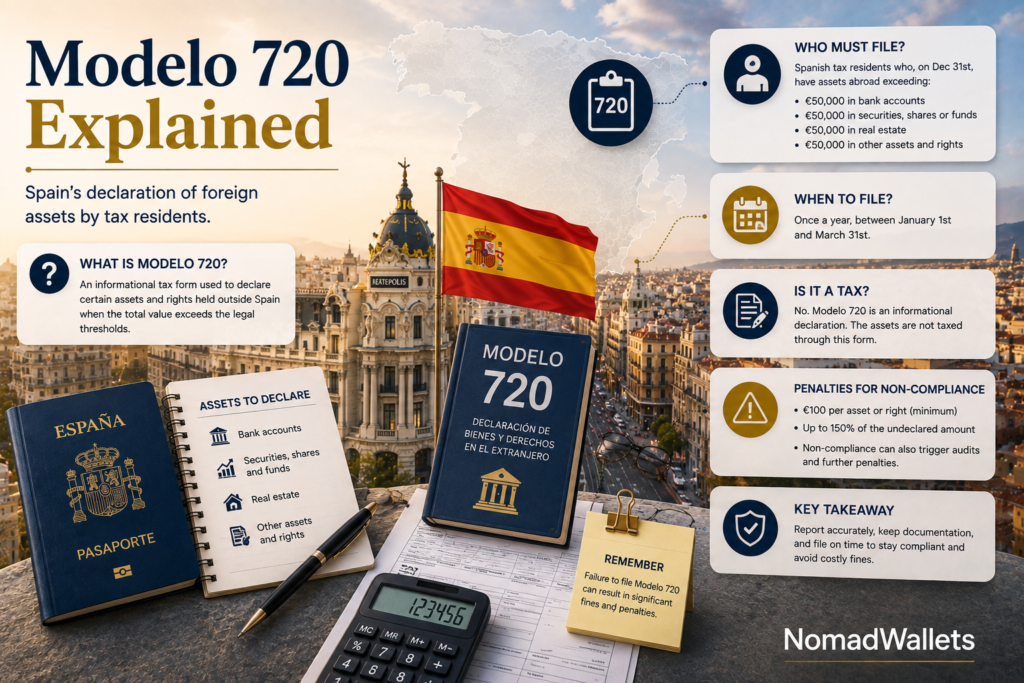
Modelo 720 is an annual informational return, not a tax, but rather a reporting requirement that requires residents to disclose foreign assets when the total in any of three categories exceeds €50,000. The categories are: (1) bank accounts at foreign institutions, (2) securities, funds, and other financial assets held abroad, and (3) real estate located outside Spain. The €50,000 threshold applies per category, not as an aggregate across all three.
The filing window runs January 1 to March 31, covering assets held as of December 31 of the previous year. No tax is due on filing. Penalties for non-compliance start at €1,500 following a 2022 CJEU ruling that forced Spain to reduce them from earlier, harsher levels. Set a calendar reminder for March 31. There is no extension.
Common Myths About Modelo 720 Debunked
• Myth: Modelo 720 is a tax. Fact: It is an informational filing requirement only. No tax is levied as a result of filing Modelo 720. The Spanish tax authority uses the information for verification and enforcement purposes.
• Myth: Modelo 720 only applies to wealthy individuals. Fact: The threshold is €50,000 per category, which many middle-class expats can easily exceed with a single foreign bank account and a modest investment portfolio.
• Myth: Beckham Law exempts you from Modelo 720. Fact: This is generally true: Beckham Law beneficiaries are exempt from the Modelo 720 filing requirement while validly under the regime, which is one of its major advantages. Because this exemption depends on your specific asset types and reporting circumstances, and rules can be updated, verify your current position against Agencia Tributaria’s official Modelo 720 guidance before relying on it, ideally with a tax adviser.
• Myth: Modelo 720 is a one-time filing. Fact: It is an annual obligation. Once you exceed the threshold in any category, you must file every year thereafter, even if the value subsequently drops below €50,000.
Even though Modelo 720 is informational, the Spanish tax authority uses the data cross-referenced against your income tax return and information exchanged under the EU’s Common Reporting Standard (CRS) and the Automatic Exchange of Information (AEOI) framework. Banks and financial institutions in most countries now report Spanish-resident account holders to Hacienda automatically.
If your Modelo 720 disclosure does not match what Hacienda receives through these channels, expect follow-up questions and potential penalties for inaccuracies. Many expats assume no one will know about their foreign accounts, but in practice, the information flow is largely automated. The Spain Expat Tax Guide Modelo 720 section also debunks common myths about the filing requirement that trip up new arrivals every year.
The Spain Expat Tax Guide Modelo 720 guide includes the thresholds, deadlines, and penalties that every new resident should understand.
Section 13: Common Tax Mistakes
Expat tax errors in Spain tend to cluster around a handful of recurring themes.
• Assuming under 183 days always avoids tax residency: Many expats believe that staying in Spain for fewer than 183 days automatically prevents them from being classified as tax residents. However, the centre of economic interests test and the family ties presumption can both trigger tax residency regardless of the number of days spent in Spain. If your core business activities, primary investments, or family are based in Spain, you may be deemed a tax resident even with limited physical presence.
• Ignoring Wealth Tax obligations: Some expats focus exclusively on income tax and overlook the Wealth Tax entirely. If your worldwide net assets exceed the threshold applicable in your autonomous community (which can be as low as €700,000 in some regions), you must file a Wealth Tax return. Failing to account for the Wealth Tax can result in unexpected liabilities and penalties, particularly in regions that do not offer a full rebate.
• Forgetting Modelo 720 filing: Many new residents are unaware of the Modelo 720 requirement or mistakenly believe it applies only to ultra-high-net-worth individuals. The €50,000 per-category threshold is relatively modest, and many expats with foreign bank accounts, investment portfolios, or overseas properties will exceed it. Missing the March 31 deadline triggers penalties starting at €1,500.
• Missing double taxation treaty benefits: Spain’s treaty network can materially lower your bill, yet many expats never claim the credits they are owed, often because they do not know which treaty applies or fail to document foreign tax paid for credit purposes.
• Poor record keeping: Spanish tax authorities expect detailed documentation of income, expenses, and asset values. Expats who do not maintain organized records throughout the year often struggle to complete their tax returns accurately and may miss out on legitimate deductions. This is especially important for self-employed individuals who must substantiate business expense claims.
• VAT registration and invoicing mistakes: Self-employed expats must register for VAT (IVA) and issue compliant invoices. Common errors include failing to charge the correct VAT rate, not issuing invoices within the required timeframe, and neglecting to file quarterly VAT returns. The Spanish tax authority imposes penalties for each of these violations.
• Late filing penalties: Missed deadlines trigger penalties of 1% to 20% of the outstanding amount, plus interest from the original due date. A simple calendar reminder or a standing arrangement with a tax adviser eliminates this risk entirely.
• Failing to plan for the exit: Expats who leave Spain without filing a final tax return and properly closing their tax residency can face ongoing obligations and penalties. Spain may still consider you a tax resident for the year of departure depending on when you left and where you moved. File your exit-year return and notify Hacienda of your change of address to avoid problems.
• Not accounting for the Solidarity Tax: Some high-net-worth expats move to Madrid or Andalusia assuming the Wealth Tax rebate eliminates all wealth-related taxes. The Solidarity Tax, introduced in 2023, catches individuals with net wealth above €3 million regardless of region. If your assets exceed this threshold, model the Solidarity Tax into your planning from the start.
The Spain Expat Tax Guide mistakes list is designed to help you identify and avoid the most common pitfalls before they become costly problems.
Section 14: Practical Tax Planning Tips
Tax planning does not end once you file your first return.

• Register correctly with tax authorities: Your first step upon arriving in Spain should be to obtain your NIE number and register with the Agencia Tributaria. Ensure that your registration reflects your actual circumstances, including your employment status, income sources, and residency status. Incorrect registration can lead to misclassification and unexpected tax liabilities. If you qualify for the Beckham Law, register for it promptly using Form 149.
• Keep detailed travel records: Maintain a detailed log of all your travel dates, including passport stamps, boarding passes, and accommodation receipts. These records are essential for substantiating your physical presence claims if the tax authority questions your residency status. A well-maintained travel log can be the difference between being classified as a resident or non-resident, which has major consequences for your tax obligations.
• Understand residency implications before moving: Before relocating to Spain, analyse how the move will affect your tax residency in both your home country and Spain. Consider the interaction between domestic law and applicable tax treaties. Planning your move timing (such as arriving after a country’s tax year ends) can sometimes optimise your overall tax position across multiple jurisdictions.
• Review Beckham Law eligibility early: The six-month application deadline from Social Security registration is strict and cannot be extended. As soon as you arrive in Spain and register with Social Security, consult a tax professional to determine whether you qualify for the Beckham Law and initiate the application process. Missing this deadline means losing access to the flat 24% tax rate and foreign income exemptions for the entire five-year period.
• Use double tax treaties strategically: Review the specific treaty between Spain and your home country to identify opportunities for tax optimisation. Pay particular attention to provisions regarding dividends, interest, royalties, pensions, and capital gains. Some treaties offer reduced withholding rates, exemptions for specific income types, or tie-breaker rules that can determine your residency status. Proper expat tax planning means reading the actual treaty text, not just summaries.
• Organise documentation year-round: Do not wait until tax season to gather your financial documents. Set up a systematic filing system for income statements, expense receipts, investment reports, and tax certificates from both Spanish and foreign sources. Year-round organisation reduces stress during filing season and ensures that you do not miss deductions or reporting obligations. Consider using the best multi-currency accounts for digital nomads to centralise and track international financial activity.
• Consider tax-loss harvesting: If you have investment portfolios with both gains and losses, realise losses before the end of the tax year to offset gains. Spanish tax law allows losses to be carried forward for four years. This strategy can meaningfully reduce your savings-base tax bill, especially in years when you have substantial capital gains.
The Spain Expat Tax Guide planning tips section provides strategies for every stage, from initial registration through ongoing portfolio management.
• Time your relocation strategically: If you are moving mid-year, consider whether arriving early or late in the calendar year produces a better outcome. Arriving late in the year may give you a short first-year tax window, while arriving early lets you establish Beckham Law eligibility sooner. Model both scenarios with a tax adviser before booking your move.
Section 15: Important Limitations and Considerations
This guide is written for a general audience and should be supplemented with professional advice. Regional tax rules vary across Spain’s 17 autonomous communities. The rates and tables below generally reflect national-level rules and average regional rates, but your actual obligations may differ depending on where you register your address. Catalonia, Valencia, and the Basque Country all have distinct regional provisions that can shift your total liability.
The Spain Expat Tax Guide limitations note reminds readers that regional rules vary and that this article should be supplemented with professional advice.
Spanish tax legislation changes frequently. The Beckham Law, Wealth Tax, and Solidarity Tax have all been amended in recent years, and further changes are likely. This article reflects the law as of mid-2026. Verify current rates with the Agencia Tributaria or a qualified adviser before making financial decisions. Your nationality, income sources, family structure, investment portfolio, and long-term plans all affect which rules apply to you.
Nothing here constitutes legal, tax, or financial advice. Engage a Spanish tax adviser (asesor fiscal) who can tailor guidance to your situation. The Spain Expat Tax Guide limitations section reminds readers that regional rules vary and legislation changes frequently.
Key Takeaways from the Spain Expat Tax Guide
• Establish tax residency before anything else: The 183-day rule is the best-known test, but the centre of economic interests and family ties tests can also trigger residency regardless of days spent in Spain. Classify your status correctly before making financial decisions.
• Apply for the Beckham Law within six months: If you qualify, Form 149 must reach the Agencia Tributaria within six months of your Social Security registration. The flat 24% rate on Spanish-source employment income up to €600,000, plus generally exempt treatment of qualifying foreign capital income, makes this one of the most valuable tax benefits available to expats in Spain.
• Choose your region with taxes in mind: Madrid and Andalusia rebate 100% of the Wealth Tax, while Catalonia applies it in full. The difference for someone with €2 million in net assets can exceed €30,000 per year. The Spain Expat Tax Guide income tax tables show how regional rates compound this effect.
• Do not ignore Modelo 720: If your foreign bank accounts, investment portfolios, or overseas property exceed €50,000 in any single category, you must file by March 31. Beckham Law beneficiaries are generally exempt from this requirement while validly under the regime (verify your specific circumstances), which is another reason to apply early.
• Use your double tax treaty: Spain has treaties with over 90 countries. Claiming the foreign tax credit or exemption you are entitled to can reduce your bill by thousands of euros. Keep certificates from foreign tax authorities on file and review the relevant treaty before you relocate.
• Plan your filing calendar from day one: Modelo 100 is due by June 30, Modelo 720 by March 31, and quarterly payments (Modelo 130 and 303) fall on April 20, July 20, October 20, and January 30. Miss a deadline and penalties start at 1% of the outstanding amount plus interest. The Spain Expat Tax Guide filing section covers each obligation with the exact dates.
• Budget for professional advice: Engage a Spanish tax adviser (asesor fiscal) for at least your first two returns. The cost of €150 to €500 per return is modest compared with the penalties for incorrect filings or the savings from claiming deductions, treaty credits, and Beckham Law benefits you might otherwise miss.
Conclusion
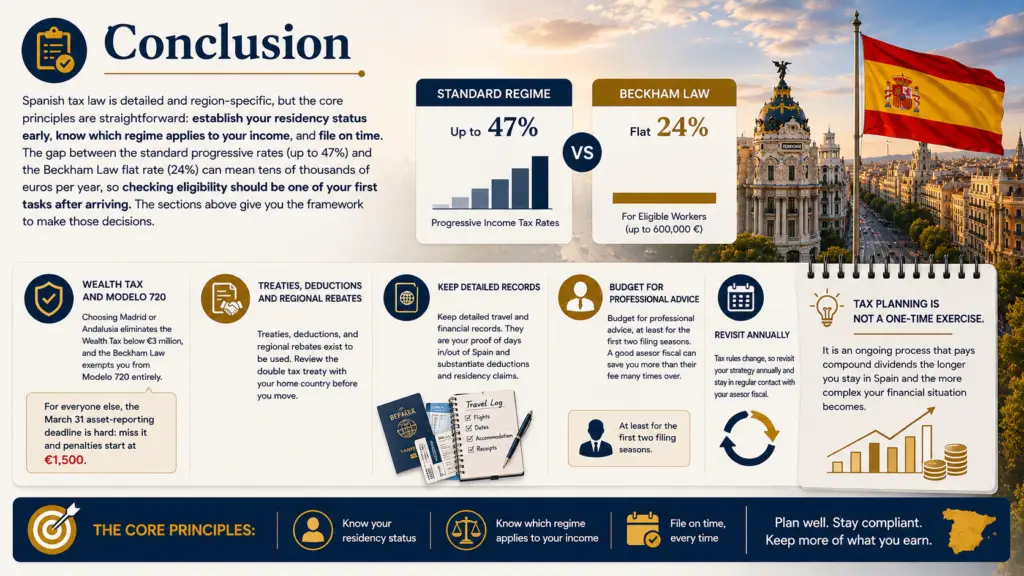
Spanish tax law is detailed and region-specific, but the core principles are straightforward: establish your residency status early, know which regime applies to your income, and file on time. The gap between the standard progressive rates (up to 47%) and the Beckham Law flat rate (24%) can mean tens of thousands of euros per year, so checking eligibility should be one of your first tasks after arriving. The sections above give you the framework to make those decisions.
Wealth Tax and Modelo 720 catch many expats off guard. Choosing Madrid or Andalusia eliminates the Wealth Tax below €3 million, and the Beckham Law exempts you from Modelo 720 entirely. For everyone else, the March 31 asset-reporting deadline is hard: miss it and penalties start at €1,500.
Treaties, deductions, and regional rebates exist to be used. Review the double tax treaty with your home country before you move, keep detailed travel and financial records, and budget for professional advice, at least for the first two filing seasons. Tax rules change, so revisit your strategy annually and stay in regular contact with your asesor fiscal. Tax planning is not a one-time exercise. It is an ongoing process that pays compound dividends the longer you stay in Spain and the more complex your financial situation becomes.
| Planning to relocate to Spain? Before moving, read our Expat Tax Planning Guide to understand residency, tax treaties, and international tax rules that apply across multiple countries. Proper planning before you arrive can save you thousands of euros and prevent costly compliance mistakes. |
Frequently Asked Questions
Q1: Do expats pay tax in Spain?
A. Yes. Expat tax obligations depend on residency status. Spanish tax residents pay tax on their worldwide income at progressive rates of 19% to 47%. Non-residents pay a flat 24% on Spanish-source income only. Residency tests, filing obligations, and rate tables are covered in the sections above.
Q2: Is Spain good for taxes?
A. Spain can be favourable for expats who qualify for the Beckham Law (flat 24% rate) or live in low-tax regions like Madrid and Andalusia (100% Wealth Tax rebate). However, standard progressive rates can reach 47% nationally and up to 54% in Catalonia. Sections 3 and 5 break down regional rate differences.
Q3: What is Beckham Law?
A. The Beckham Law (Article 93 LIRPF) is a central topic in any Spain Expat Tax Guide. It is a special tax regime allowing qualifying expats to pay a flat 24% on Spanish-source employment income up to €600,000, with qualifying foreign-sourced capital income generally kept outside the Spanish tax base (see Section 4 for the scope and conditions). It lasts for 5 years and requires application within 6 months of Social Security registration via Form 149.
Q4: Does Spain tax foreign pensions?
A. Generally yes. Spanish tax residents must include foreign pension income in their taxable income. However, many bilateral tax treaties provide relief or exemptions, particularly for government pensions. The UK-Spain treaty exempts UK government pensions from Spanish taxation. Section 10 covers key treaty provisions by country.
Q5: Does Spain tax crypto?
A. Yes. Since 2023, Spain has introduced specific reporting requirements for cryptocurrency holdings. Crypto transactions are subject to capital gains tax at the savings income rate (19% to 28%). Foreign-held crypto assets are reported separately from Modelo 720 on Modelo 721, per the thresholds and categories set out in Agencia Tributaria’s official Modelo 721 guidance, which should be checked directly since crypto reporting rules are still actively evolving. The Spain Expat Tax Guide covers crypto tax reporting as part of its broader discussion of Spanish tax compliance.
Q6: Do digital nomads pay tax in Spain?
A. Yes, if they become Spanish tax residents under the 183-day rule or centre of economic interests test. Digital Nomad Visa holders may qualify for the Beckham Law, which offers a flat 24% rate on Spanish-source income. Section 8 covers digital nomad taxation in detail.
Q7: Is Wealth Tax still active?
A. Yes, but it varies by region. Madrid and Andalusia offer 100% rebates, effectively eliminating it. The national Solidarity Tax (2023) applies to net wealth exceeding €3 million regardless of regional rebates. Section 5 explains both taxes.
Q8: What is Modelo 720?
A. Modelo 720 is a key filing obligation covered in the Spain Expat Tax Guide. It is an annual informational filing requiring Spanish tax residents to report foreign assets exceeding €50,000 per category (bank accounts, securities, real estate). The deadline is March 31. It is not a tax, but penalties for non-compliance start at €1,500. Beckham Law beneficiaries are generally exempt while validly under the regime — see Section 12 for the conditions.
Q9: What happens after 183 days?
A. If you spend more than 183 days in Spain in a calendar year, you are generally classified as a Spanish tax resident and become liable for tax on your worldwide income. Temporary absences count toward the 183 days unless you can prove tax residency elsewhere. Section 1 of the Spain Expat Tax Guide covers all three residency tests in detail.
Q10: Can I avoid double taxation?
A. Yes, through Spain’s 90+ double tax treaties. These typically use the foreign tax credit method, allowing you to credit foreign taxes paid against your Spanish liability. Section 10 covers key treaty provisions.
Q11: Does Spain tax overseas property?
A. Spanish tax residents must include worldwide rental income and report foreign real estate on Modelo 720 if the value exceeds €50,000. Capital gains from selling overseas property are also taxable. Non-residents pay tax only on Spanish property income and gains. The Spain Expat Tax Guide discusses property-related tax obligations throughout.
Q12: What is the filing deadline?
A. Modelo 100 (annual income tax return) is due by June 30. Modelo 720 (foreign assets) is due by March 31. Modelo 130 (quarterly IRPF) and Modelo 303 (quarterly VAT) are due by April 20, July 20, October 20, and January 30. Section 11 details all deadlines.
Q13: Can retirees benefit from any tax advantages?
A. Retirees in Spain may benefit from reduced rates on pension income under certain treaties, regional tax discounts, and the general personal allowances available to all taxpayers. Living in Madrid or Andalusia eliminates Wealth Tax. Relevant provisions are covered throughout the sections above.
Q14: Are remote workers taxed in Spain?
A. Yes, if they are Spanish tax residents. Remote workers for foreign employers should consider the permanent establishment risk for their employer and evaluate Beckham Law eligibility. Digital Nomad Visa holders may qualify for special tax treatment. Section 8 of the Spain Expat Tax Guide addresses remote-worker tax issues in detail.
Q15: Is Spain territorial or worldwide taxation?
A. Spain uses worldwide taxation for tax residents, meaning all income from any source is taxable. Non-residents are subject to territorial taxation on Spanish-source income only. The Beckham Law creates a hybrid: residents taxed only on Spanish-source income for 5 years. The Spain Expat Tax Guide explains both systems and shows how the Beckham Law creates a third option.
Q16: How much tax do freelancers pay?
A. Self-employed expats (autónomos) pay income tax at progressive rates (19% to 47%), social security contributions (€206-€607/month), and VAT (21% standard rate). New autónomos benefit from a reduced rate of €80-€88/month for 12-24 months. Section 7 of the Spain Expat Tax Guide covers freelancer taxes, social security, and VAT obligations.
Q17: Do I need a tax representative?
A. Non-residents with Spanish income who do not reside in an EU/EEA country are required to appoint a tax representative in Spain. Tax residents are not legally required to have one but are strongly advised to engage an asesor fiscal for complex situations. The Spain Expat Tax Guide recommends professional advice at every relevant stage.
Q18: How are dividends taxed in Spain?
A. Dividends are savings income taxed at progressive rates: 19% up to €6,000, 21% (€6,000-€50,000), 23% (€50,000-€200,000), 27% (€200,000-€300,000), and 30% (over €300,000). Foreign dividends are exempt under the Beckham Law. Section 6 covers dividend taxation.
Q19: How are capital gains taxed?
A. Capital gains follow savings income rates: 19% on the first €6,000, 21% (€6,000-€50,000), 23% (€50,000-€200,000), and 28% (over €200,000). Foreign capital gains are exempt under the Beckham Law. Section 6 of the Spain Expat Tax Guide details capital gains rules and the savings income rate structure.
Q20: When should I hire a tax adviser?
A. You should engage a Spanish tax adviser (asesor fiscal) as soon as you arrive in Spain, particularly if you qualify for the Beckham Law (6-month application deadline), have foreign income or assets, are self-employed, or have complex cross-border financial arrangements. The Spain Expat Tax Guide explains why and when to engage one.
Disclaimer
This article is provided for general informational and educational purposes only and does not constitute legal, tax, or financial advice. Spanish tax rules can vary depending on your individual circumstances, autonomous community, residency status, income sources, and applicable tax treaties, and regulations may change over time. Always verify the latest requirements with the Spanish Tax Agency (Agencia Tributaria) or consult a qualified Spanish tax professional before making tax, financial, or relocation decisions. NomadWallets is not responsible for any loss, liability, or penalties arising from reliance on the information provided in this article.

Tushar Sharma is the founder and editor of NomadWallets, where he writes about international banking, travel cards, cross-border payments, taxes, and financial tools for digital nomads and globally mobile professionals. He created NomadWallets to make global money decisions simpler through practical, research-backed guides built from official sources and real-world financial data.