
UAE Expat Tax Guide: What Expats Need to Know
Ask people why they moved to Dubai, Abu Dhabi or Sharjah and tax comes up in the first minute. Salaries arrive without deductions, personal investment gains sit untouched, and the tax authority publishes its rules in plain English. After years of losing 35 or 45 percent of every paycheck in London, Munich or Toronto, that feels like a cheat code.
It is not one, exactly. The UAE is a normal country that chose not to tax personal income. What it taxes instead is consumption and business profit: VAT on what you buy, Corporate Tax on business profits, excise duties on a short list of products. And your home country may keep taxing you for years unless you end that relationship properly.
So here is the quick answer: does the UAE tax expat income? No. The government states it plainly on its official taxation portal: the country does not levy income tax on individuals u.ae, Taxation. Salary, bonuses and personal investment income are generally not subject to UAE personal income tax. Freelance and other business income can be subject to UAE Corporate Tax when the applicable business rules are met.
Why the UAE is considered a low-tax destination: oil revenue paid the bills after 1971, and personal income tax was never introduced. VAT arrived in 2018 and Corporate Tax in 2023, yet the deal for individuals never changed. Add one of the largest double tax treaty networks on earth, and the pitch writes itself.
Who this guide is for:
- Employees on UAE payrolls who want to know what lands in the bank
- Freelancers and consultants on permits who need to know when taxes actually start
- Digital nomads working for foreign clients from a laptop in Dubai Marina
- Business owners choosing between mainland and free zone structures
- Investors holding stocks, ETFs or crypto across borders
- Retirees living on pensions and portfolios
One warning before we start: the most expensive mistakes in UAE expat taxes rarely involve the FTA. They happen at home, when people assume moving here switched off their previous country’s tax system. It does not.

UAE Expat Tax 2026: Quick Guide
- Personal income tax: 0%. The UAE does not tax salaries, wages, bonuses or personal investment income.
- VAT: 5% on most goods and services. Residential rent is exempt.
- Corporate Tax: 0% on the first AED 375,000 of taxable profit, then 9%.
- Freelancer Corporate Tax registration: required once business turnover exceeds AED 1 million in a calendar year.
- Small Business Relief: revenue up to AED 3 million treated as zero taxable income for tax periods ending on or before 31 December 2026.
- Tax residency: 183 days in any 12 month period, or the conditional 90 day route with a residence visa plus a permanent home, employment or business in the UAE.
- Tax Residency Certificate: issued by the FTA via EmaraTax; AED 50 submission fee plus certificate fees.
- Foreign income: not taxed by the UAE, but your previous country may still tax you until you break residency formally.
| Tax or charge | Rate in 2026 | Who it hits |
| Personal income tax | 0% | Nobody. No federal income tax on individuals |
| VAT | 5% | Everyone who buys goods and services |
| Corporate Tax | 0% up to AED 375,000 profit, then 9% | Businesses, including individuals in business |
| Excise tax | 50% to 100% | Buyers of tobacco, energy drinks, sweetened drinks, vapes |
| Customs duties | Typically 5% | Imported goods |
| Property charges | Varies by emirate | Buyers, sellers and tenants |
| Tax Residency Certificate | AED 50 plus fees | Expats who need proof of UAE tax residence |
Does the UAE Have Income Tax for Expats?
Is there personal income tax in the UAE?
No. There is no federal personal income tax on individuals and no emirate level income tax either. Employed salaries and wages are paid gross, and bonuses, commissions, overtime, housing allowances and other benefits are treated the same way. The end of service gratuity you build up over the years is not taxed either.
For freelancers and sole traders, Sections 6 and 10 explain when business profits can attract Corporate Tax.
What income is generally not subject to UAE personal income tax?
- Salary and wages from UAE employment
- Bonuses, commissions and employment benefits
- Personal investment income, including dividends and interest
- Personal savings and bank interest
- Capital gains from investments you hold personally
- Foreign income such as overseas rent, foreign pensions and foreign dividends
Notice how broad that list is. UAE individuals generally do not pay personal income tax on it. One caveat runs through this guide: income from a business or business activity can fall within the UAE Corporate Tax regime instead, which Sections 6 and 10 cover.
Important distinction: no personal income tax does not mean no taxes
The UAE government’s own wording is worth reading: the country does not levy income tax on individuals, but does levy 5 percent value added tax on goods and services u.ae, Taxation. That sentence is the model in miniature, so here is what actually exists:
- VAT: 5% on most goods and services, paid by everyone, every day
- Corporate Tax: 0% then 9% on business profits above AED 375,000
- Excise tax: 50% or 100% on products like tobacco, energy drinks, sweetened drinks and vapes
- Customs duties: typically around 5% on imported goods, more for alcohol and tobacco
- Property related charges: transfer fees, housing fees and municipality charges, set emirate by emirate
- Foreign taxation: your previous country’s system, which does not switch off just because you moved
UAE Tax System for Expats at a Glance
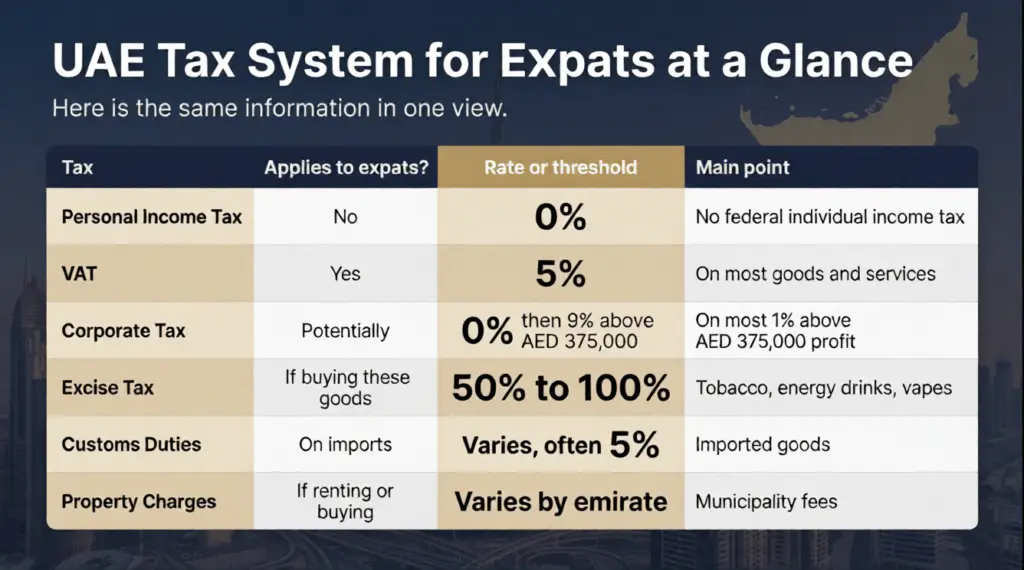
Here is the same information in one view.
| Tax | Applies to expats? | Rate or threshold | Main point |
| Personal income tax | No | 0% | No federal individual income tax |
| VAT | Yes | 5% | On most goods and services |
| Corporate Tax | Potentially | 0% then 9% above AED 375,000 profit | Business profits, including individuals in business |
| Excise tax | If buying these goods | 50% to 100% | Tobacco, energy drinks, sweetened drinks, vapes |
| Customs duties | On imports | Varies, often 5% | Imported goods |
| Property charges | If renting or buying | Varies by emirate | Municipality and transfer fees, not income tax |
UAE Tax Residency: Are You a UAE Tax Resident?
This is the most important section of the guide. Tax residency decides which countries can tax you as a resident, whether you can claim treaty benefits, and whether your home country finally leaves you alone. Get it wrong and you can owe tax in two countries for the same income.
What is tax residency?
Three concepts get confused constantly. Immigration residence is your visa: it lets you live and work here. UAE tax residency is a separate status that decides where you count as tax resident. And your previous country’s residency is whatever its own laws say about people who leave, which is usually less automatic than people hope.
UAE tax residency rules for individuals
Natural person tax residency is governed by Cabinet Decision No. 85 of 2022, with further detail in Ministerial Decision No. 27 of 2023, and the FTA’s current guidance builds on both. The routes and their conditions differ:
- 183 days or more of physical presence in the UAE within any 12 month period
- 90 to 182 days of physical presence, which only works as a conditional route: hold the legal right to live in the UAE (residence visa, or UAE or GCC nationality) plus one further condition, a permanent home, employment or business in the UAE
- Separately, the Corporate Tax Law treats a natural person as a Resident Person where their usual place of residence or their centre of financial and personal interests is in the UAE
The FTA’s current guidance, updated in August 2026, sets out these routes and the supporting documents expected for each one FTA, Tax Residency Certificate service. Days are calendar days, they do not need to be consecutive, and emergency days generally do not count.
Two practical notes: treat these as legal tests with documents attached, not a day counting exercise, and expect TRC requirements to differ between domestic and treaty claim applications.
Does having a UAE residence visa automatically make you tax resident?
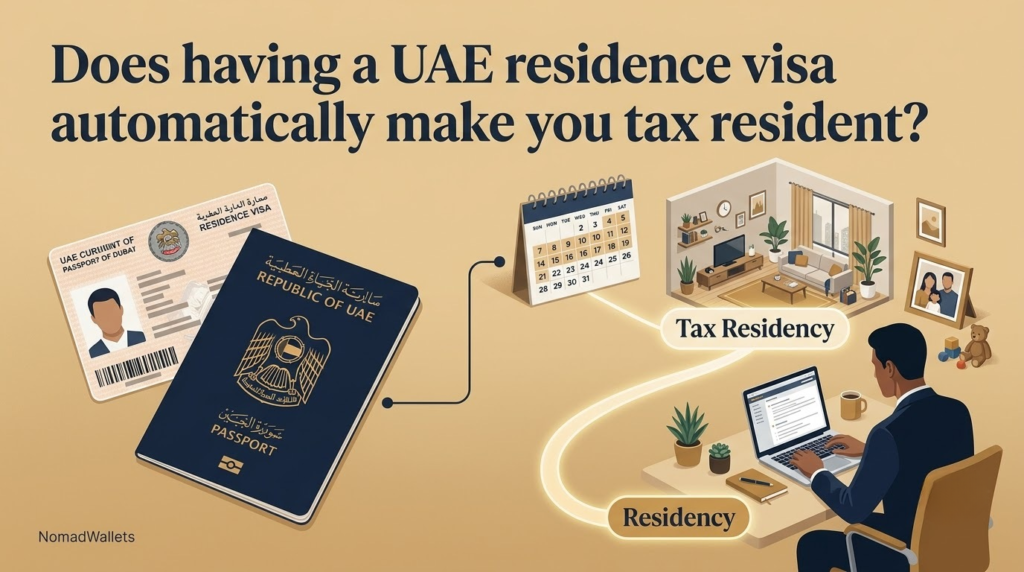
No. A visa proves you are allowed to live in the UAE, not that you actually do. Tax authorities look at facts: where your days go, where your family sleeps, where your work happens. A visa plus an apartment you barely use invites exactly that trouble.
How many days do you need to live in the UAE to become a tax resident?
| Your situation | Potential UAE tax residency |
| 183 or more days in any 12 months | Can meet the 183 day route on its own, subject to the detail in the FTA guidance |
| 90 to 182 days | Possible only through the conditional route: residence visa (or UAE or GCC nationality) plus a permanent home, employment or business in the UAE |
| Fewer than 90 days | Day count routes do not apply, but other criteria such as your centre of interests can still matter |
Keep proof of your days: passport stamps, boarding passes, hotel confirmations and the entry and exit report from the ICP portal ICP. When a foreign tax authority starts asking, that paper trail beats any argument.
What is your centre of interests?
The phrase sounds vague, but the questions behind it are practical:
- Home: where is your permanent, available year round home?
- Family: where do your spouse and children actually live?
- Work: where do you perform your job or run your business?
- Economic interests: where are your bank accounts and major assets?
- Personal connections: where is your social and community life?
If most answers point to the UAE, your centre of interests is here; if they point elsewhere, a foreign tax office will notice, visa or not.
UAE Tax Residency Certificate (TRC)
What is a UAE Tax Residency Certificate?
A Tax Residency Certificate is an official Federal Tax Authority document confirming your UAE tax residency for a specified tax period or eligible 12-month period. It is commonly used to demonstrate UAE tax residency to foreign tax authorities, treaty partners and financial institutions when required.
Why do expats need a UAE TRC?
The certificate matters most when money crosses borders. The FTA issues TRCs for domestic purposes and for double tax treaty purposes FTA, TRC service. Expats typically use theirs to:
- Claim reduced withholding tax on dividends, interest and royalties under a tax treaty
- Prove UAE tax residence to a foreign authority so it stops taxing them as a resident
- Avoid double taxation on income two countries could otherwise both tax
- Satisfy bank, broker and investment platform documentation requests
- Support residency based claims in visa or pension processes
Who can apply?
Individuals who meet the residency rules in Section 4 can apply, and so can companies with real operations and management in the country. You apply for a completed or current year, and your documents need to match that year. Entities without genuine UAE presence generally do not qualify. Requirements also differ depending on whether the certificate is for domestic purposes or a treaty claim, so match your documents to the purpose.
Documents required
- Emirates ID and passport copy with the residence visa page
- Entry and exit report showing UAE travel
- Evidence of UAE residence: tenancy contract and utility bills
- Employment or business evidence: salary certificate, employment contract or trade licence
- Proof of the source of income you are declaring
- Additional proof of UAE interests where relevant, like bank statements
How to apply for a UAE TRC
Applications run through the EmaraTax portal FTA eServices. The sequence is straightforward:
1. Create or log in to your EmaraTax account
2. Select Other Services from the dashboard
3. Select Tax Residency Certificate
4. Choose the application type that matches your situation
5. Upload the required documents
6. Pay the applicable fees
7. Submit, track the review, then download the certificate
UAE TRC cost and processing time
| Fee item | Amount |
| Submission fee, per application | AED 50 |
| Electronic TRC for applicants registered with the FTA | AED 500 |
| Electronic TRC for individuals not registered with the FTA | AED 1,000 |
| Printed hard copy | AED 250 per certificate |
These figures come from the FTA’s current service page, updated in August 2026, and fees are not refunded if an application is rejected FTA, TRC service. The same page sets out current submission details and any special processing rules, so build in buffer time rather than planning around a fixed number of days. Apply before December, when banks and brokers start asking, and remember each year of treaty claims needs a fresh certificate.
UAE Corporate Tax for Expats

What is UAE Corporate Tax?
Corporate Tax arrived under Federal Decree-Law No. 47 of 2022 and applies to financial years starting on or after 1 June 2023. It taxes business net profit at 0% up to AED 375,000 of taxable income and 9% above that. The FTA’s Corporate Tax FAQ page is the best primary source for the details FTA, Corporate Tax FAQs.
Does Corporate Tax apply to individuals?
It can, and this surprises people. Corporate Tax applies when you conduct a business or business activity in the UAE, not because you live here or hold a job. Salaried employees and personal investors are outside it.
Freelancers, sole traders, online sellers and consultants come into scope when business revenue exceeds AED 1 million in a Gregorian calendar year, which triggers mandatory FTA registration FTA, guide for natural persons. Salary, personal investment income and real-estate investment income stay out of that calculation.
Freelancer Corporate Tax
Natural persons conducting business generally do not have to register for UAE Corporate Tax unless their business turnover exceeds AED 1 million in a Gregorian calendar year. Other taxes, such as VAT, can still apply separately at lower thresholds. Once crossed, registration is due by 31 March of the following year, and Corporate Tax works in bands: 0% on the first AED 375,000 of taxable profit, 9% on the rest.
Small Business Relief can zero the bill: businesses with revenue up to AED 3 million can elect to be treated as having no taxable income for tax periods ending on or before 31 December 2026 FTA, Small Business Relief.
Digital nomad and online business owners
Running an online business from a laptop in Dubai is still conducting a business in the UAE, whatever passports your clients hold. The same thresholds apply, and if you are still tax resident elsewhere, your home country may tax that income too.
Sole proprietors
A sole proprietorship has no legal separation from its owner, so the freelancer rules apply: turnover counts across business activities, registration kicks in above AED 1 million, and profit above AED 375,000 is taxed at 9% unless relief applies. Personal salary, investments and rental income stay outside Corporate Tax.
UAE LLCs and companies
Companies register for Corporate Tax regardless of size and file within nine months of their financial year end. The standard 9% rate applies above AED 375,000 of taxable profit, while dividends and capital gains from qualifying shareholdings are generally exempt.
Free zone businesses
Free zone status does not automatically mean 0% Corporate Tax. A Qualifying Free Zone Person can benefit from 0% on qualifying income if the applicable conditions are met. Non qualifying income can be subject to the standard Corporate Tax rate, so the details of your activity, not the licence, decide the outcome.
Corporate Tax vs personal income tax
| Income type | UAE personal income tax | UAE Corporate Tax |
| Salary and employment income | 0%, never taxed | Not applicable |
| Personal investments and savings | 0% | Outside the tax unless activity is business-like |
| Freelance and business profits | 0% | 0% up to AED 375,000 profit, then 9%, generally once business turnover exceeds AED 1 million |
VAT in the UAE
What is UAE VAT?
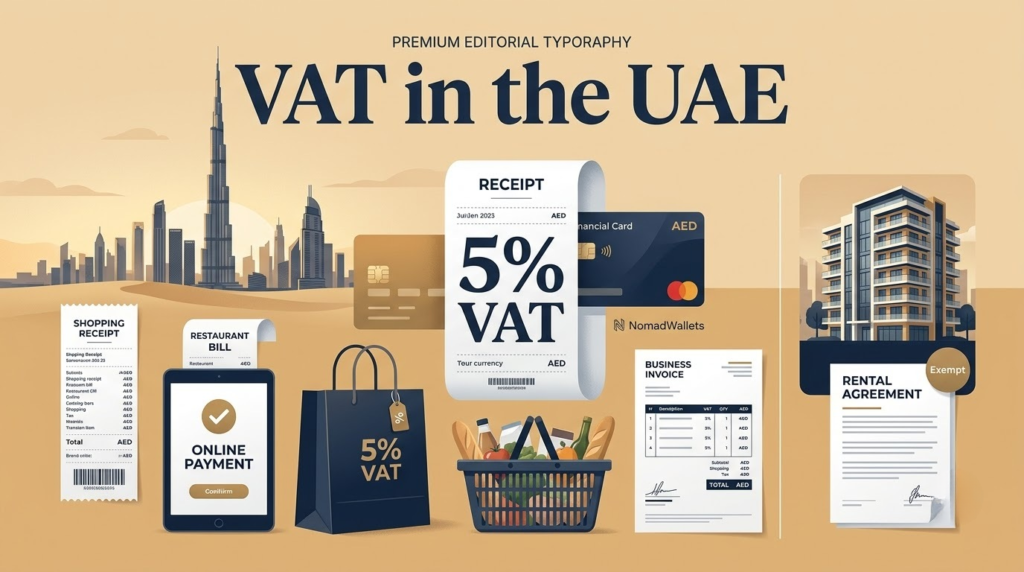
VAT is a consumption tax charged through the supply chain and paid by the final consumer. It has applied since 1 January 2018, with official rules on the government portal u.ae, VAT.
UAE VAT rate
5% on most goods and services. A short list, like exports and international transport, sits at 0%, and residential rent is exempt.
When does an expat need to register for VAT?
Registration follows turnover, not visa status. A business must register when taxable supplies and imports exceed AED 375,000 over the previous 12 months, or are expected to in the next 30 days FTA, VAT registration. Voluntary registration is available above AED 187,500, which can pay for itself through input VAT recovery.
VAT for freelancers
Freelance turnover counts fully toward the thresholds. Cross AED 375,000 and registration becomes mandatory: charge 5% on most local services, file quarterly returns and keep clean invoices. Services to customers abroad may be zero-rated or outside the scope of UAE VAT depending on the customer and the place of supply rules, so check before invoicing at 0%.
VAT for online businesses
Zero-rated supplies are still taxable supplies and generally count toward the registration thresholds, so all my sales are exports is not a reason to ignore VAT. Treatment of particular supplies can be nuanced, and marketplaces, warehousing and digital delivery each carry their own rules, with real penalties for late registration.
VAT when selling services internationally
International services may qualify for zero-rating or fall outside UAE VAT depending on the customer, their location, the nature of the service and the applicable place-of-supply rules. The FTA’s exported services rules set specific conditions around the recipient’s residence and location, so do not assume every overseas customer automatically means 0% VAT. An hour with an adviser, or the FTA guidance itself, is cheap insurance.
VAT refunds
Businesses reclaim input VAT through their returns, so voluntary registration can save money for a business with heavy expenses. Tourists reclaim VAT at the airports through approved schemes.
Taxes on Investments and Capital Gains

UAE tax on stocks
The UAE does not tax personal investment gains on shares: buy, hold, sell, and the profit is yours. What needs watching is the other side of the border. UAE residents generally receive US-source dividends subject to the applicable US withholding rules, and because the UAE does not have a comprehensive US income tax treaty providing a reduced dividend withholding rate, the standard US withholding rate generally applies to US-source dividends, subject to applicable exceptions. Many European countries withhold 15% to 25% at source unless a treaty and TRC say otherwise.
UAE tax on ETFs
Same story: no UAE tax on ETF gains or distributions. One issue worth labelling correctly, because it is an estate tax matter rather than an income tax one: US situs assets, including US listed ETFs, can fall within the scope of US estate tax for nonresident noncitizens. A $60,000 filing threshold generally applies for Form 706-NA, while exceptions and estate-tax treaty rules can affect the outcome. It is one reason many investors consider Irish-domiciled funds.
UAE tax on dividends
Dividends from UAE and foreign companies are not taxed by the UAE when received personally. Foreign withholding tax at source is the real cost. For most countries other than the US, a TRC plus the relevant treaty reduces it; for US-source dividends, see the note in Section 8.1.
UAE tax on cryptocurrency
For individuals buying, holding and selling crypto as a personal investment, there is currently no UAE income tax or capital gains tax on the gains. Crypto businesses and professional trading operations are a different matter and can fall into Corporate Tax. Exchanges are regulated by VARA in Dubai and the SCA elsewhere, and a home country that still taxes you will want records.
UAE tax on capital gains
There is no federal capital gains tax for individuals in the UAE. Shares, crypto, funds and personally held property can all be sold without a UAE tax bill. The exceptions: business-like activity pulls Corporate Tax back in, and home country rules do not vanish on their own.
Personal investments vs business activity
The distinction between personal investment and business activity can become important for Corporate Tax purposes. The treatment depends on the facts and the nature of the activity, so frequent or commercial style trading should not automatically be assumed to remain personal investment. The closer your activity moves to an enterprise, the more sense it makes to get advice before the FTA forms its own view.
UAE Property Taxes and Charges for Expats
Property in the UAE mixes federal rules with emirate level charges, and mixing the two up causes avoidable confusion.
Rental income from UAE property
Rent from property you own personally is not income taxed in the UAE. The costs that surprise newcomers are emirate level charges instead. In Dubai, tenants pay a housing fee of 5% of annual rent through DEWA bills, and tenancies must be registered with Ejari. Residential rent itself is exempt from VAT.
Selling UAE property
Individuals pay no capital gains tax when they sell UAE property. What they pay are transaction charges, most famously the 4% Dubai Land Department transfer charge, a Dubai fee rather than a UAE-wide tax. Your home country may still tax the gain if it still considers you tax resident there, so UK, German and Indian owners should check.
Property investment through a company
Property held inside a UAE company sits with a separate taxable person. The company’s taxable income is determined under the Corporate Tax rules, and the standard rate structure applies to the taxable income that results, so the outcome depends on how the company’s activities fit those rules. Some investors use structures for succession or financing reasons; the maths should be modelled honestly before copying anyone else’s setup.
Property income for foreign investors
Non resident individuals earning rent from UAE property are not taxed by the UAE on that income, because there is no personal income tax to apply. They face the same municipal charges, their own countries may tax the rent, and most treaties give the country where the property sits the first right to tax it.
Dubai property charges vs federal taxes
A common mistake is calling every property charge a tax. Dubai has no annual property tax in the American or British sense. What people usually mean are one-off transfer fees, the housing fee on rent and municipality charges. None of them are income tax, and rental income itself still goes untaxed.
UAE Tax for Freelancers and Digital Nomads
This is where the tax free story gets real texture. Freelancers and nomads keep 0% personal income tax, but they sit closest to the business tax rules, so the thresholds here are the ones to memorise. If you are still building your money setup, our digital nomad finance guide covers the banking and currency side.

Do UAE freelancers pay income tax?
No. There is no personal income tax on freelance income. What can apply separately are Corporate Tax, generally once business turnover exceeds AED 1 million in a Gregorian calendar year, and VAT, once taxable supplies cross AED 375,000.
Freelance licence vs tax registration
A freelance permit, issued by free zones and authorities like Dubai Media City, is a licence to work legally, not a tax registration. Corporate Tax and VAT registration happen separately with the FTA, driven purely by turnover thresholds.
When can Corporate Tax apply?
In one line: natural persons conducting business generally do not have to register for Corporate Tax unless business turnover exceeds AED 1 million in a Gregorian calendar year, and profit above AED 375,000 is then taxed at 9% on the excess unless Small Business Relief applies. Salary, personal investments and real-estate investment income stay out of the turnover calculation, while VAT runs on its own, lower thresholds.
VAT obligations
Track your 12 month rolling turnover. Above AED 375,000, registration is mandatory; between AED 187,500 and AED 375,000 it is optional but can pay for itself through input VAT recovery.
Remote work for a foreign company
Working from Dubai for an overseas employer is fine from the UAE side: your salary is not taxed here and you have no filing obligation. The risk sits in your previous country, which may still call you resident if the move was not clean. If you are weighing short lets against longer leases, our digital nomad accommodation guide compares the options.
Running an online business from the UAE
An online business is a business. The UAE taxes its profits on the same Corporate Tax terms as any other, and VAT follows the same thresholds. Personal withdrawals from the business go untaxed, a quiet but huge advantage.
YouTube creators and influencers
AdSense, sponsorships, affiliate deals and product lines are all business income. Below the thresholds, untaxed. Above them, Corporate Tax and VAT apply as for any other trader. Foreign platforms may also withhold tax depending on their rules.
Affiliate marketers
Commission income is business income, with identical thresholds. If your customers are overseas businesses, look carefully at the zero rating rules before you invoice.
SaaS founders
Software founders usually set up in a free zone and chase Qualifying Free Zone Person status for 0% on qualifying income. Mainland sales, non qualifying income and VAT on UAE customers still need attention, so structure before you scale.
Selling digital products
Courses, templates, ebooks and software sold to UAE consumers sit inside the 5% VAT net once you are registered. Sales to consumers outside the UAE can fall outside UAE VAT under the place of supply rules for e-services, but the conditions matter, so confirm rather than assume.
UAE Tax for Employees
Salary income
Your salary is not taxed: no withholding, no annual return for employment income, no tax code. The number in your contract is effectively the number in your bank account, which is why gross versus net barely exists in UAE offers.
Bonuses
Bonuses, commissions and profit shares are treated exactly like salary: 0% UAE personal income tax.
Employee benefits
Housing allowances, schooling support, flights and medical insurance are not taxed either. The end of service gratuity is also free of income tax.
Stock options and RSUs
Equity that vests while you are a UAE tax resident generally attracts no UAE tax. The complications come from elsewhere: the country where the shares are based may withhold at source, and your home country may still claim you in the year of vesting. Reclaiming overwithheld US withholding on RSUs is usually possible with paperwork.
Working remotely for an overseas employer
The UAE does not tax salary paid by an overseas employer, and you have nothing to file here. Your employer may care where you perform the work for its own reasons, but your personal position in the UAE stays simple.
Does your foreign employer create UAE tax obligations?
Not for you personally. There is no UAE income tax return and no payroll tax to reconcile. The obligations worth tracking sit in your previous country until its residency rules have clearly stopped applying.
UAE Tax and Foreign Income

Does the UAE tax foreign income?
No. The UAE does not tax individuals on their worldwide income, so foreign salary, rent, dividends, interest and pensions sit outside the UAE net. The critical follow up: the UAE not taxing you does not mean nobody taxes you. Whatever you keep earning from sources back home sits inside your previous country’s rules until you break residency there properly.
Foreign bank accounts
Interest on foreign accounts is not taxed by the UAE. US-linked readers should expect FBAR and FATCA reporting to continue wherever they live. Other countries usually stop demanding reports once you are non resident, but they may tax the interest until then.
Foreign dividends
No UAE tax applies. Source countries withhold at their domestic or treaty rates. For most countries other than the US, a UAE TRC plus the relevant treaty gets a reduced rate applied. For US-source dividends, the standard US withholding rate generally applies, since the UAE has no comprehensive US income tax treaty providing a reduced dividend rate.
Foreign rental income
Rental income is taxed where the property sits, whatever the UAE says. A flat in London or a house in Munich falls under those countries’ rules first, and most treaties allow it. Your TRC still matters: it stops your former country also taxing you as a resident on top.
Foreign investments
Same pattern: no UAE tax, foreign withholding and reporting to manage.
Foreign business income
If you run a business from the UAE, Section 6 applies whatever passports your clients hold. A business operating in another country may be subject to that country’s rules first, but the UAE Corporate Tax treatment still depends on where and how the business is conducted. Do not assume that calling a business ‘foreign’ automatically removes it from UAE Corporate Tax.
Foreign pensions
Pensions received while living in the UAE are not taxed by the UAE. The source country may withhold, with treaty reductions available if you hold a TRC. State and private pensions are often treated differently, so this is a classic area for a one-off review before you move.
Leaving Your Home Country for the UAE: Tax Residency Issues
Generic articles stop at the UAE has no income tax. The expensive questions live in this section, because your old tax office does not lose your file just because you got a Dubai visa. Our expat tax planning guide covers the sequencing of a whole move.
Can your home country still consider you tax resident?
Yes, easily. Residency rules at home look at ties, not visas. Keep a home available, leave your family behind, or spend too many days there, and you can stay fully taxable at home while paying VAT in the UAE.
Breaking tax residency
Most countries have a process: deregister, file a leaving return, sometimes notify the tax office directly. Do it formally and keep the paperwork. A quiet fade, with accounts left open and a flat available, is exactly the fact pattern authorities read as continuing residency.
Permanent home
A permanent home available to you year round is one of the strongest residency anchors. Sell it, or convert it to a genuine long term rental, and the anchor lifts. A spare room at your parents’ place is weaker, but not nothing.
Family and centre of interests
If your spouse and children stay home while you work in the UAE, most tax systems will keep treating your real home as theirs. This is the most common reason dual residency disputes go against expats, and no certificate fixes it, because the facts genuinely point at home.
Economic ties
Bank accounts, investment platforms, business interests and even memberships feed the picture. Close or consolidate what you do not need and move your financial centre deliberately.
Number of days spent in your previous country
Count your days in the old country every year, not just the first. Rules vary: some countries switch you off below 183 days, others use lower counts plus ties tests, and a few run layered day and connection rules. Track days from day one, on both sides.
Exit tax considerations
Some countries tax unrealised gains when you leave. Canada runs a deemed disposal of most assets at departure, the US makes renunciation expensive for covered expatriates, and Spain and a few others tax large unrealised gains at exit. Model this before you move, not after.
UAE Double Tax Treaties

What is a Double Tax Agreement?
A DTA, also called a tax treaty, is a deal between two countries that splits taxing rights: which country taxes salaries, dividends, interest, rents and business profits, and at what rate. It also has tie breakers for dual residents.
Does the UAE have tax treaties?
Yes, more than 140 of them, one of the largest treaty networks in the world UAE Ministry of Economy and Tourism. For most major nationalities, your country is on the list.
How tax treaties help expats
Treaties cut withholding tax on cross border income, stop the same income being taxed twice, and give you a formal path to prove residence when two countries disagree.
UAE TRC and treaty benefits
Treaties are claimed with paperwork, and the FTA’s TRC is that paperwork. Banks, brokers and foreign payers usually will not apply treaty rates without it.
Can a UAE resident use a DTA with their previous country?
Often, yes, once you are genuinely UAE tax resident. The treaty’s tie breaker, usually a permanent home test and then centre of vital interests, decides which country wins when both claim you. If your life has genuinely moved, the treaty works for you; if it has not, no treaty will save the setup.
Why a UAE residence visa is not enough
Treaties attach to tax residence, not immigration status, which is exactly why the TRC exists.
Country-Specific UAE Expat Tax Considerations
The UAE side of your move is the same for everyone. The home country side is where nationalities diverge. Treat the rows below as key issues to check, and each linked guide goes deep.
| Home country | Key issues to check before and after the move |
| UK | How the Statutory Residence Test and split year rules shape the exit year; UK property and work days keep pulling. |
| US | US federal filing obligations generally continue abroad; the Foreign Earned Income Exclusion and Foreign Tax Credit may apply, with FBAR and FATCA reporting on top. |
| India | NRI status, the RNOR transition window and DTAA positions can affect how salary and NRE interest are treated. |
| Canada | Whether departure triggers a deemed disposal of most assets, making the exit year expensive without planning. |
| Australia | Residency tests and the capital gains treatment of the exit year, plus student debt and Medicare considerations. |
| Germany expat tax guide | Extended limited tax liability, which can keep Germany taxing certain income for years if German sourced income continues. |
| France expat tax guide | How heavily France weighs property, family and economic ties, and whether some French taxes on French assets survive a move. |
| Italy expat tax guide | AIRE registration, incentives for new residents and Italian asset taxes all interact with the move. |
| Spain expat tax guide | The exit tax on large unrealised gains and strict foreign asset reporting, which make timing worth planning. |
If your country is not listed, the mechanics are similar: learn the exit rules, count your days, cut ties deliberately and claim the treaty once settled.
UAE Tax for Retirees
Pension income
Pensions paid to you while you live in the UAE are not taxed by the UAE. No return, no withholding, no surcharge.
Foreign pensions
The source country may withhold tax on payments sent abroad, with treaty cuts available if you hold a TRC. Some countries tax their own pensions wherever you live.
Investment income
Dividends, interest and fund distributions are not taxed in the UAE. Source withholding is the only leak to manage, with the same TRC and treaty toolkit.
Rental income
UAE rent is untaxed; foreign property rent is taxed where the property sits.
Tax residency for retirees
Retirees usually cross the 183 day mark comfortably, which makes UAE tax residency straightforward and the TRC worth having for pension treaties.
UAE retirement residence options vs tax residency
The UAE offers 5 year retirement visas with financial thresholds around property, savings or monthly income, and 10 year golden visas for larger investments. They are immigration products, not tax statuses; the Section 4 rules still decide tax residency.
UAE Tax for High-Net-Worth Expats

Wealthy newcomers get the same 0% personal income tax, but the reporting webs are bigger. Areas worth structuring carefully:
- International investments: no UAE tax on gains or income, but source country withholding and reporting continue, and US estate tax can apply to the US situs assets of nonresident noncitizens above certain thresholds (historically $60,000), subject to exceptions and treaty considerations
- Offshore companies: a UAE company pays Corporate Tax like any other, and home country CFC rules can still pull foreign company income back to you personally
- Trusts and foundations: DIFC and ADGM structures are popular for succession, but home country trust and reporting rules are unforgiving, so model before you migrate assets
- Foreign property: taxed where it sits, reported to both countries, and sometimes caught by wealth type taxes at home
- Investment portfolios: the personal versus business line in Section 8.6 matters more as the account grows
- Estate and inheritance: no UAE inheritance tax, but default succession follows Sharia principles unless registered wills are in place, and home country estate taxes may still apply
- Tax residency planning: substance, day counts, a clean exit and an annual TRC are the foundation; treaties do the heavy lifting after that
Common UAE Expat Tax Mistakes
Ten mistakes show up again and again, and all are avoidable.
- Assuming a residence visa automatically makes you tax resident. Facts and days do.
- Assuming UAE residency automatically ends home country tax residency. It ends when you break it properly.
- Ignoring Corporate Tax because there is no personal income tax. Freelancers above AED 1 million turnover have obligations.
- Ignoring VAT for a business above the thresholds. Late registration penalties sting.
- Not keeping entry and exit records. Reconstructing three years of travel after an audit is misery.
- Not obtaining a Tax Residency Certificate. Without it, treaty rates and double tax relief stay theoretical.
- Confusing UAE tax rules with tax treaty rules. They are different layers.
- Assuming foreign income is automatically tax free everywhere. The UAE’s zero does not travel.
- Treating personal investing and business activity as identical. The FTA looks at what you actually do.
- Relying on outdated pre-2023 information. Corporate Tax changed the rules; half the internet has not caught up.
UAE Expat Tax Planning Checklist
Work through this in order; each step depends on the one before it.
- ☐ Determine whether you are a UAE tax resident under the Section 4 rules
- ☐ Determine whether your previous country still considers you tax resident
- ☐ Check whether a tax treaty exists between the UAE and your home country
- ☐ Keep complete travel records from day one
- ☐ Obtain a UAE TRC if you need treaty benefits or proof of residence
- ☐ Review foreign bank and investment accounts for reporting duties
- ☐ Decide honestly whether you conduct a business or business activity
- ☐ Check Corporate Tax registration and Small Business Relief requirements
- ☐ Check VAT thresholds and registration deadlines
- ☐ Keep business records, invoices and contracts organised
- ☐ Review your home country reporting obligations for the transition years
- ☐ Consult a qualified tax professional for anything involving exit taxes, trusts or dual residency
For the fuller method, our expat tax planning guide covers sequencing, timing and documentation across a whole move.
UAE Expat Tax Example Scenarios
Numbers make the rules click. All scenarios assume 2026 rules unless stated.
Example 1: UAE employee
Salary AED 250,000, bonuses AED 25,000. UAE personal income tax: AED 0, nothing to file in the UAE. The old country only matters if residency there never actually ended.
Example 2: UAE freelancer
Turnover AED 600,000, profit AED 420,000. No Corporate Tax registration, because business turnover is under AED 1 million. But VAT registration is mandatory, because taxable supplies exceeded AED 375,000 in 12 months. Personal income tax: still AED 0.
| One takeaway worth pinning up: the Corporate Tax registration threshold is not the VAT registration threshold. A freelancer under the AED 1 million Corporate Tax line can still be required to register for VAT once taxable supplies pass AED 375,000. Track both. |
Example 3: Digital nomad with foreign clients
Income AED 400,000 from clients in three countries, 210 days in the UAE with a visa and a yearly rental. Meets the conditional 90 day route for UAE tax residency, and VAT registration is required above AED 375,000 of taxable supplies. Corporate Tax does not apply at this turnover. Watchlist: the previous country, since 210 days here still leaves 155 elsewhere.
Example 4: Indian expat living in Dubai
Salary AED 300,000. UAE tax: AED 0. India tests residency with its own day rules and the RNOR transition, and NRE account interest stays tax free in India for non residents.
Example 5: UK expat moving to Abu Dhabi
Arrives in October, family stays in the UK until March. Split year treatment may apply, but the family tie and available UK home keep pulling, so the first full tax year is the risky one.
Example 6: US citizen living in Dubai
The US taxes citizens wherever they live, so they file a US return every year. Depending on circumstances, the Foreign Earned Income Exclusion and Foreign Tax Credit may reduce US tax on an AED 700,000 salary, and FBAR reporting applies to foreign accounts.
The UAE taxes them AED 0. US-source dividends in their brokerage generally face the standard US withholding rate, since the UAE has no comprehensive US income tax treaty providing a reduced rate.
Example 7: Investor with US stocks
AED 2 million of gains on US shares, held personally. UAE capital gains tax: AED 0. US dividend withholding: generally the standard rate, with no treaty relief available. US estate tax on the US situs assets of nonresident noncitizens is the quiet issue, an estate tax matter rather than an income tax one, which is why many investors rebalance into Irish domiciled ETFs.
Example 8: UAE resident earning foreign rental income
Owns a rented flat in Madrid while living in Dubai. Spain taxes the rental income where it arises; the UAE taxes nothing. The thing to have broken cleanly is Spanish tax residency, or Spain will also tax them as a resident.
UAE Expat Tax Rates and Thresholds 2026
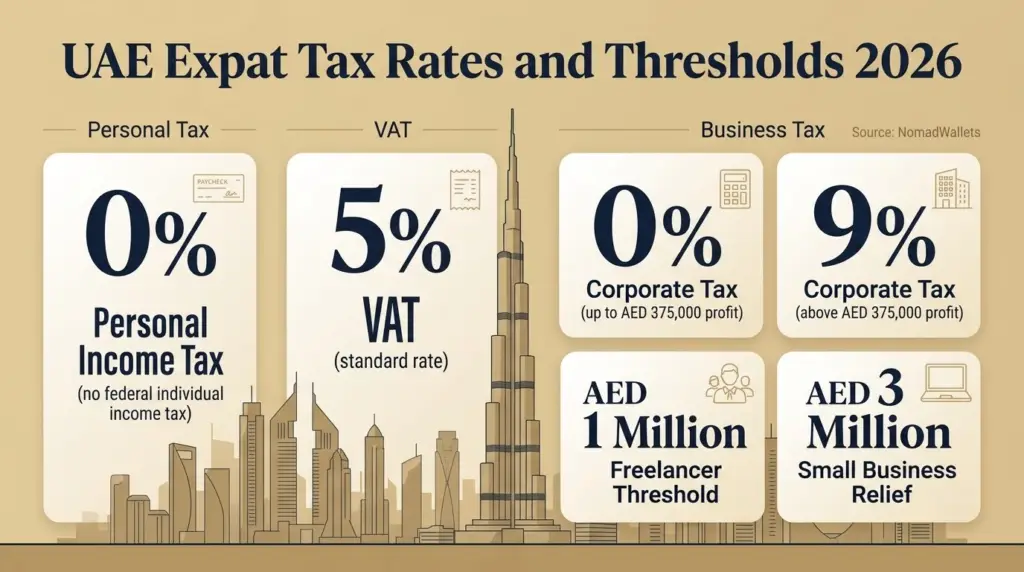
One reference table, worth bookmarking.
| Item | 2026 figure |
| Personal income tax | 0% |
| VAT rate | 5% |
| Corporate Tax rate | 0% up to AED 375,000 taxable profit, then 9% |
| CT registration, natural persons | Generally required once business turnover exceeds AED 1 million in a Gregorian calendar year |
| CT registration deadline, natural persons | 31 March of the following year |
| Small Business Relief | Revenue up to AED 3 million, for tax periods ending on or before 31 December 2026 |
| VAT mandatory registration | AED 375,000 of taxable supplies and imports in 12 months |
| VAT voluntary registration | AED 187,500 |
| TRC submission fee | AED 50 |
| TRC electronic certificate | AED 500 for FTA registrants, AED 1,000 for unregistered individuals |
| TRC hard copy | AED 250 per certificate |
| Tax residency day counts | 183 or more days, or the conditional 90 or more day route (visa plus home, employment or business) |
| Free zone rate | 0% on qualifying income for Qualifying Free Zone Persons |
| Excise tax | 50% or 100% on listed products |
Frequently Asked Questions
Q1. Does the UAE have income tax for expats?
A. No. There is no federal personal income tax on individuals, salaried or self employed.
Q2. Do expats pay tax on salary in Dubai?
A. No. Salaries are paid gross, with no income tax withholding and no annual return for employment income.
Q3. Is Dubai completely tax free?
A. Not completely. Personal income is untaxed, but there is 5% VAT, Corporate Tax on business profits, excise duties and property related charges.
Q4. How many days do I need to live in the UAE to be a tax resident?
A. 183 days or more in any 12 month period, or the conditional 90 day route, which additionally requires a residence visa and a permanent home, employment or business in the UAE.
Q5. Does a UAE residence visa make me tax resident?
A. No. The visa is immigration status. Tax residency depends on facts like days, home, family and work.
Q6. What is a UAE Tax Residency Certificate?
A. An official FTA document confirming you were a UAE tax resident for a specific year. It is the key to treaty benefits and to proving residence abroad.
Q7. How do I get a UAE Tax Residency Certificate?
A. Apply through the EmaraTax portal with your Emirates ID, passport, entry and exit report, residence evidence and income documents, then pay and submit. Requirements differ between domestic and treaty claim applications.
Q8. How much does a UAE Tax Residency Certificate cost?
A. AED 50 to submit, plus AED 500 for FTA registrants, AED 1,000 for unregistered individuals, and AED 250 per printed copy.
Q9. Do UAE residents pay tax on foreign income?
A. The UAE does not tax it. Your previous country might, until you have clearly ended residency there.
Q10. Do UAE freelancers pay tax?
A. No personal income tax. Corporate Tax registration generally applies only above AED 1 million of business turnover in a Gregorian calendar year, and VAT can apply above AED 375,000 of taxable supplies.
Q11. Do digital nomads pay tax in the UAE?
A. Not on personal income. The same business thresholds apply if they run a business, and home country rules always need checking.
Q12. Do expats pay VAT in the UAE?
A. Yes, 5% on most purchases. Residential rent and some other categories are exempt or zero rated.
Q13. What is the UAE Corporate Tax rate?
A. 0% on the first AED 375,000 of taxable profit and 9% above that. Qualifying free zone income can be 0%.
Q14. Do UAE residents pay tax on stocks?
A. Not in the UAE. Foreign withholding on dividends still applies, and home countries may have their own claims.
Q15. Do UAE residents pay tax on cryptocurrency?
A. No, not on personal investing gains. Business-like crypto activity can fall under Corporate Tax.
Q16. Do Americans living in Dubai pay US taxes?
A. Yes. US citizens and green card holders generally keep US federal filing obligations abroad. Depending on circumstances, the Foreign Earned Income Exclusion and Foreign Tax Credit may help, and FBAR and FATCA reporting can apply.
Q17. Do UK expats in Dubai still pay UK tax?
A. Only while the Statutory Residence Test says they are UK resident. Split year rules cover the moving year.
Q18. Can I be tax resident in the UAE and another country?
A. You can be claimed by both, which is the problem. Treaty tie breakers and your actual facts decide the winner.
Q19. Does the UAE have a tax treaty with my country?
A. The UAE has more than 140 agreements. Check the Ministry of Finance list for yours.
Q20. Is the UAE still tax free in 2026?
A. For personal income, yes. For consumption and business profits, no, true since VAT in 2018 and Corporate Tax in 2023.
Final Verdict: Is the UAE Tax-Friendly for Expats?
Yes, and the honest version of the answer is stronger than the marketing version.
- Personal income tax: 0%, with no return to file and no withholding
- Consumption: 5% VAT, noticeable but mild by global standards
- Business profits: 9% Corporate Tax above AED 375,000, with real relief for small businesses
- Tax residency: straightforward if your days and ties genuinely move, and provable with a TRC
- Home country: still the biggest risk, and the part most expats underestimate
The UAE does its part cleanly: no personal income tax, a simple business tax with generous thresholds, and a treaty network that protects cross border income. What it cannot do is switch off your previous country’s system. Break the old residency properly, document the new one, and the numbers speak for themselves.
Official Sources
Primary sources used throughout this guide:
- UAE Government, Taxation portal
- UAE Government, Value Added Tax
- Federal Tax Authority, Tax Residency Certificate service
- Federal Tax Authority, Corporate Tax FAQs
- Federal Tax Authority, VAT registration
- Federal Tax Authority, Small Business Relief
- Federal Tax Authority, natural persons Corporate Tax guide
Disclaimer
This UAE Expat Tax Guide is general information only and reflects rules and guidance as of August 2026. Tax law, thresholds and fees change. Nothing here is tax, legal or investment advice, and reading it creates no advisory relationship. Your home country’s rules and treaty position can change the outcome completely, so speak with a qualified tax adviser before acting on anything here. NomadWallets accepts no liability for decisions taken based on this content.

Tushar Sharma is the founder and editor of NomadWallets, where he writes about international banking, travel cards, cross-border payments, taxes, and financial tools for digital nomads and globally mobile professionals. He created NomadWallets to make global money decisions simpler through practical, research-backed guides built from official sources and real-world financial data.