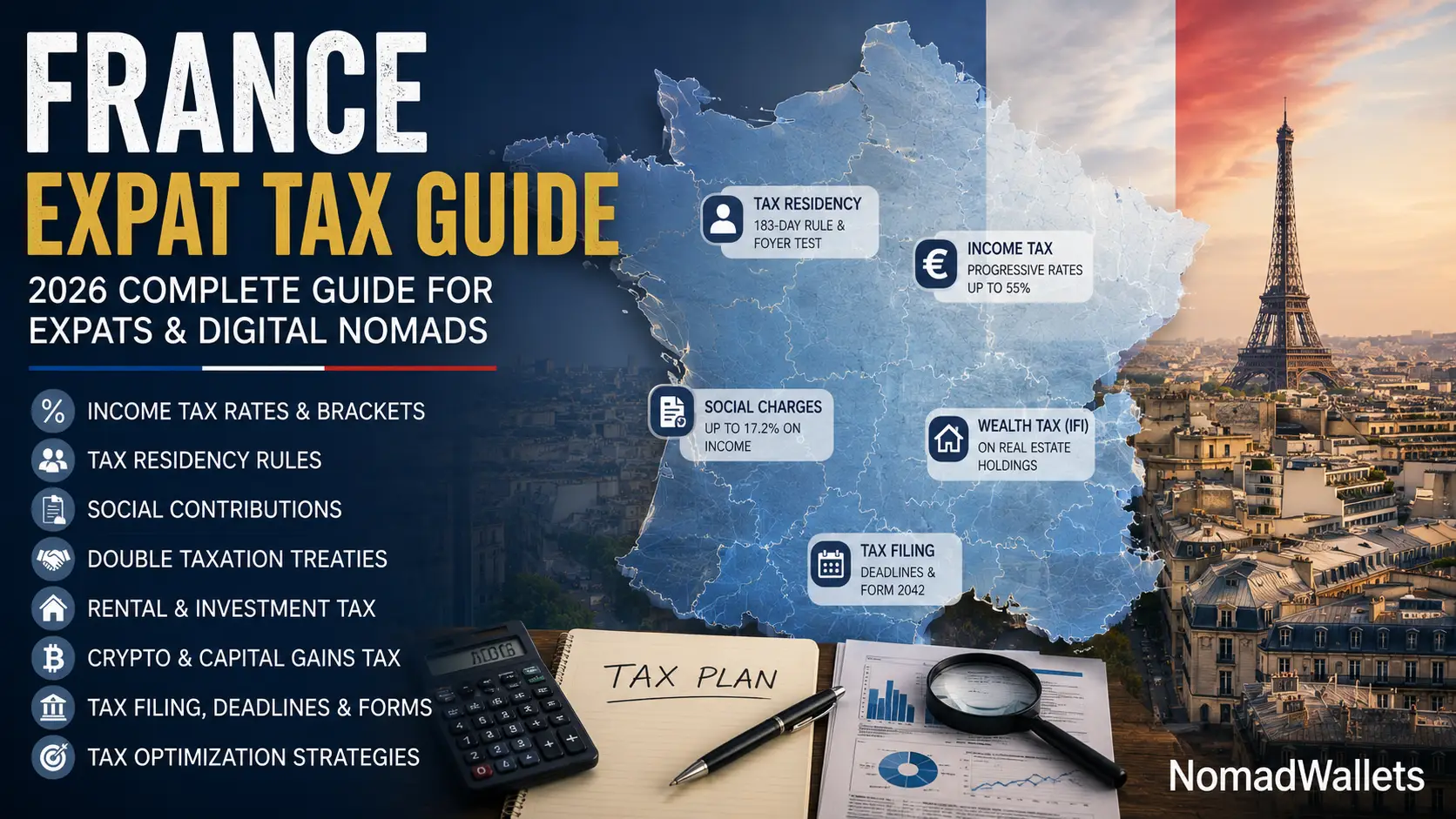
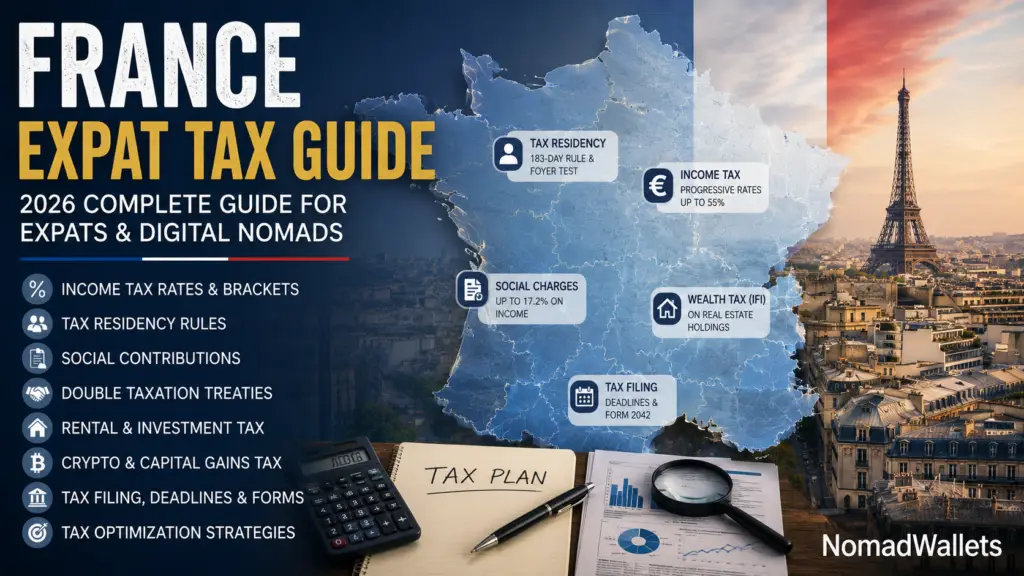
Everything you need to know about French taxes as an expat in 2026. Residency rules, income tax brackets, the PFU flat tax at 31.4%, IFI wealth tax, the impatriate regime, filing deadlines, and real examples.
Quick Answer: Do Expats Pay Tax in France?
| Yes, if you meet any of France’s four tax residency tests, you become a French tax resident and must pay income tax on your worldwide income at progressive rates from 0% to 45%. Investment income such as dividends and interest is typically taxed through the PFU (flat tax) at 31.4% in 2026, which combines 12.8% income tax and 18.6% social contributions. If your net real estate holdings exceed 1.3 million euros, you may also owe IFI wealth tax on a sliding scale from 0.5% to 1.5%. Residents file an annual return using Form 2042, usually between May and June. France has double taxation treaties with over 125 countries to prevent you from being taxed twice on the same income. Non-residents are generally taxed only on French-source income, subject to the applicable treaty. This France Expat Tax Guide walks you through every major tax obligation, bracket, and filing requirement you will face. |
1. How France Determines Your Tax Residency
Most expats assume that spending 183 days in France automatically makes them a tax resident. That assumption is wrong. France uses four separate tests, and meeting just one of them is enough for the French tax authority (the DGFiP) to classify you as a resident. This distinction matters more than almost anything else in this France Expat Tax Guide, because residency determines whether France taxes your worldwide income or generally only your French-source income, subject to the provisions of any applicable double taxation treaty.
The four tests are laid out in Article 4 B of the Code General des Impots (CGI). The first and most important test is whether your foyer, meaning your household or main home, is in France. If your spouse and children live in a Lyon apartment while you travel for work, France considers you resident regardless of how many days you actually spend on French soil. The second test looks at your principal place of stay. Spending more than 183 days in France during a calendar year is a strong indicator, but it is not a rigid threshold. The tax authority examines the overall pattern of your life.
The third test focuses on professional activity. If you exercise your main professional activity in France, whether as an employee, freelancer, or business owner, France claims you as a resident. The fourth test examines where your centre of economic interests sits. If the bulk of your investments, bank accounts, and income streams are tied to France, the DGFiP will argue you belong to the French tax system. The practical takeaway: residency is not a simple day-count. It is a factual assessment of where your life actually centres.
| Test | What It Means | Examples |
| Foyer | Household or main home in France | Your spouse and children live in a rented apartment in Lyon |
| Principal Stay | You spend most of your year in France | You are physically present on French soil for 184 days in the calendar year |
| Professional Activity | Main professional activity exercised in France | You work full-time for a Paris-based employer, even if you travel frequently |
| Centre of Economic Interests | Bulk of investments and income tied to France | Most of your bank accounts, investment portfolios, and rental properties are in France |
If you are comparing destinations, our Spain Expat Tax Guide breaks down how Spain handles residency quite differently, using a more straightforward 183-day rule with fewer subjective tests.
2. French Income Tax Brackets for 2026
France taxes personal income through a progressive scale with five brackets, ranging from 0% at the bottom to 45% at the top. The 2026 Finance Act (LOI n. 2026-103, signed 19 February 2026) raised every bracket threshold by 0.9% to account for inflation. This means a single person with no dependents pays zero income tax on the first 11,600 euros of taxable income. A married couple without children, who holds two shares under the quotient familial system, enjoys a combined tax-free threshold of 23,200 euros.

These brackets apply per share (part) of your household, not per person in the simple sense. The quotient familial system, which this France Expat Tax Guide covers in the next section, divides your total household income by the number of shares assigned to your family situation before applying these rates. Understanding that distinction is critical for calculating your actual bill.
| Income per Share (Annual) | Tax Rate | Notes |
| EUR 0 to EUR 11,600 | 0% | Tax-free threshold, up from EUR 11,497 in 2025 |
| EUR 11,601 to EUR 29,579 | 11% | First taxable band where most middle earners begin |
| EUR 29,580 to EUR 84,577 | 30% | Applies to income above EUR 29,579 per share |
| EUR 84,578 to EUR 181,917 | 41% | High-income bracket |
| Above EUR 181,917 | 45% | Top marginal rate |
On top of these rates, high earners face additional surcharges. A 3% surtax applies to the portion of income exceeding 250,000 euros for a single person or 500,000 euros for a couple filing jointly. Above 500,000 euros (single) or 1,000,000 euros (couple), the surtax rises to 4%. Starting in 2025, a new differential contribution on high incomes (CDHR) may also apply for residents whose adjusted taxable income crosses those same thresholds. The source for these brackets is the 2026 Finance Act as published on Service-Public.gouv.fr and confirmed by PwC’s Tax Summaries.
3. The Quotient Familial System Explained
France does not tax individuals in isolation. It taxes households, or foyers fiscaux. The quotient familial system works by dividing your total net taxable income by the number of shares assigned to your household, applying the progressive brackets to that per-share figure, and then multiplying the result back up by the number of shares. The practical effect is straightforward: more family members mean more shares, and more shares push your per-share income into lower brackets.
A family of four earning 90,000 euros pays significantly less tax than a single person earning the same amount.
| Household Composition | Number of Shares |
| Single person | 1 |
| Married or PACS couple | 2 |
| Couple + 1 child | 2.5 |
| Couple + 2 children | 3 |
| Couple + 3 children | 4 |
| Each additional child beyond the third | +1 per child |
The tax saving from each additional half-share is capped at 1,794 euros in 2026. This cap means the quotient familial provides the greatest benefit to upper-middle-income families. Very high earners still benefit, but the per-half-share saving is limited. Every expat household in France should understand this system, because it directly affects how much you owe.
Tax Example 1: The Quotient Familial in Action
Consider a married couple with two children earning a combined 90,000 euros per year. With three shares (two for the couple, one for two children at 0.5 each), their per-share income is 30,000 euros.
Tax calculation: 0% on the first 11,600 euros plus 11% on the remaining 18,400 euros equals 2,024 euros per share. Multiply by three shares and the total tax bill is 6,072 euros. If this were a single person with one share, the tax would be approximately 18,296 euros. The quotient familial saves this family roughly 12,224 euros per year.
| What this example shows: The quotient familial can cut a family tax bill by roughly 67%. The more children you have, the bigger the impact, up to the per-half-share cap of 1,794 euros. |
4. Social Contributions: CSG and CRDS
Income tax is only part of the picture in France. On top of your impot sur le revenu, you also pay social contributions, primarily the CSG (Contribution Sociale Generalisee) and the CRDS (Contribution au Remboursement de la Dette Sociale). These contributions fund the French social safety net, including healthcare, pensions, and family benefits. For employees, the CSG is levied at 9.2% on gross salary, and the CRDS adds another 0.5%.

Together with other employee social contributions, the total withholding from a French paycheck runs approximately 22 to 23 percent of gross salary. It is important to understand that French tax residency and social-security affiliation are separate determinations: you can be affiliated to the French social-security system without being a French tax resident, and vice versa, depending on EU regulations, bilateral agreements, and the nature of your work.
For 2026, the CSG rate on capital income (dividends, interest, capital gains) increased from 9.2% to 10.6%. This change pushed total social charges on financial income from 17.2% to 18.6%, which is why the PFU flat tax rose from 30% to 31.4% starting 1 January 2026.
The CLEISS (the French liaison body for social security) confirms that persons affiliated to the French scheme but not domiciled for tax purposes in France are not subject to CSG and CRDS, though they do pay a health insurance contribution of 5% on total salary. Understanding these layers is essential for any complete France Expat Tax Guide.
Understanding how VAT works in France helps you see the full picture of French consumption taxes and how they affect your day-to-day cost of living. For a broader overview of managing money across borders, see our Digital Nomad Finance Guide.
5. The PFU (Flat Tax) at 31.4% for 2026
The Prelevement Forfaitaire Unique, commonly called the flat tax or PFU, is France’s default withholding system for certain categories of investment income under the 2026 rules. Starting 1 January 2026, the PFU rate is 31.4% for the relevant income and gains, broken down into 12.8% income tax and 18.6% social contributions.
This represents an increase from the previous 30% total (12.8% plus 17.2%), driven solely by the rise in social charges on capital income. The PFU applies by default to dividends, interest, and most capital gains on securities, but not to all types of investment income; certain gains, such as those on cryptocurrency or certain real estate transactions, are taxed under different rules and rates.
Crucially, you are not locked into the PFU. At tax filing time, you can opt for the progressive bareme (also known as the bareme progressif) instead, which applies the standard 0% to 45% brackets to your investment income. The progressive option becomes attractive if your total income keeps you in the 0% or 11% bracket, because the combined rate would be lower than 31.4%.
The trade-off is complexity. Under the progressive bareme, dividends benefit from a 40% abatement (meaning only 60% of dividends are taxable) and a portion of the CSG becomes deductible. However, you lose these simplifications under the PFU.
Investors who earn in multiple currencies should also read Best Multi-Currency Accounts for Digital Nomads.
| Factor | PFU (31.4%) | Progressive Bareme |
| Dividend tax component | 12.8% flat | 0% to 45% based on bracket |
| Social charges | 18.6% | 17.2% |
| 40% dividend abatement | Not available | Available |
| CSG deductibility | Not available | Partial (6.8%) |
| Best suited for | Middle-to-high earners, simplicity | Non-taxable or 11% bracket taxpayers |
Tax Example 2: Choosing Between PFU and Progressive Tax
Sophie earns a 45,000 euro salary and receives 8,000 euros in dividends. She needs to decide whether the PFU or the progressive bareme will save her more money.
Under the PFU: dividend tax equals 8,000 multiplied by 31.4%, which comes to 2,512 euros. Under the progressive bareme: dividends get a 40% abatement, so only 4,800 euros enter her taxable income. Added to her salary, this pushes part of her income into the 30% bracket. Her dividend tax is roughly 1,716 euros, plus social charges of approximately 1,376 euros, totaling 3,092 euros. The PFU saves Sophie about 580 euros.
| What this example shows: The PFU is often cheaper for middle-to-high earners with moderate dividend income. The bareme only wins if your total income keeps you firmly within the 0% or 11% bracket. |

6. France Has NO Digital Nomad Visa or Beckham Law
This is one of the most important points in this France Expat Tax Guide, and it surprises many remote workers. Unlike Spain, which offers the Beckham Law regime with a flat 24% tax rate for qualifying expatriates, France has no equivalent special tax regime for digital nomads. The French Tech Visa exists as an expedited work permit for tech employees, but it provides zero tax advantages.
Your tax treatment depends on whether you meet any of the four residency tests described in Section 1, the source of your income, the terms of the applicable double taxation treaty, and your social-security affiliation. France does not offer a reduced flat rate or special bracket for remote workers, so income that falls within French taxing jurisdiction under these rules is generally taxed at the standard progressive rates.
Remote workers who spend significant time in France, even without a formal work contract with a French company, can find themselves classified as French tax residents based on the centre of economic interests test or the foyer test. The absence of a dedicated nomad visa or special regime means you need to plan carefully before arriving.
If your goal is to minimize taxes while working remotely from Europe, countries like Portugal (with its NHR regime) or Spain (with its Beckham Law regime, sometimes referenced in French commentary as the regime Beckham) may offer more attractive structures.
Our Portugal Digital Nomad Visa (D8) Guide explains one of Europe’s most popular residency routes for remote workers, offering a useful comparison with France.
7. The Regime des Impatres (Article 155 B)
France does offer one meaningful tax break for certain expatriates, and it comes through the regime des impatres, governed by Article 155 B of the Code General des Impots. This is not a blanket digital nomad incentive. It targets a specific group: employees recruited from abroad by French companies, whether through intra-group transfer or direct hire. If you qualify, the regime can reduce your effective tax rate significantly.
The exemptions are available until 31 December of the eighth calendar year following the year in which you take up your employment in France, provided the eligibility conditions continue to be met.
Three conditions must all be met.
- First, you must not have been a French tax resident during any of the five calendar years before the year you take up employment.
- Second, you must be recruited directly by a company established in France.
- Third, your tax residence must transfer to France from the date your employment begins.
The regime applies regardless of your nationality: a Canadian recruited in Toronto, a French citizen returning from Singapore, or an American relocating to Lyon all qualify if they meet these conditions.
| Feature | Detail |
| Legal basis | Article 155 B, Code General des Impots |
| Eligibility | Not resident in France during 5 prior years; recruited from abroad |
| Duration | Until 31 December of the 8th calendar year following the year employment begins |
| Exempt: Impatriation bonus | Qualifying impatriation compensation; if contract does not specify bonus, up to 30% of remuneration may be treated as such |
| Exempt: Foreign activity income | Capped at 20% of taxable remuneration |
| Overall cap | Total exemptions cannot exceed 50% of total remuneration |
| Foreign investment income | Exempt from French income tax during the regime period |
The regime provides specific income-tax exemptions for three distinct categories of income, each subject to its own conditions.
- First, qualifying impatriation compensation, meaning the additional remuneration you receive for accepting a position in France. If your employment contract does not fix a specific bonus amount, the tax authority may allow you to treat up to 30% of your total remuneration as the impatriation bonus.
- Second, the portion of your compensation that corresponds to activities you carry out abroad in the interests of your French employer; this exemption is capped at 20% of your taxable remuneration.
- Third, certain foreign-source investment income, including dividends, interest, and capital gains from non-French investments, as well as income from certain intellectual property rights held abroad, may be exempt from French income tax, although social contributions generally still apply.
These three exemptions are subject to an overall cap: the total exempt amount cannot exceed 50% of your total remuneration. This France Expat Tax Guide emphasizes this regime because it is the single largest tax advantage available to expats moving to France.
Tax Example 3: Impatriate Regime Savings
James, a UK citizen, is transferred from London to a Paris tech company on a salary of 120,000 euros plus a 30,000 euro impatriation bonus.
Under the impatriate regime: the entire 30,000 euro bonus is exempt from income tax, assuming the bonus qualifies as an impatriation premium and the applicable reference-remuneration and exemption limits are satisfied. Additionally, 15% of his salary relates to foreign activity for the employer, exempting another 18,000 euros. Total exempt: 48,000 euros.
Taxable income: 102,000 euros, producing a tax bill of roughly 27,000 euros. Without the regime: 150,000 euros fully taxable, producing a bill of approximately 42,000 euros. The regime saves James about 15,000 euros per year.
| What this example shows: The impatriate regime can reduce effective tax from around 28% to roughly 18% for senior hires. The regime runs until 31 December of the eighth calendar year following the year employment begins. |
Germany has its own expat-friendly regime with a similar rationale. See our Germany Expat Tax Guide for a detailed comparison of how the two systems compare.
8. Taxation of Employment Income
Most expats working as employees in France will encounter the prelevement a la source, a pay-as-you-earn withholding system introduced in 2019. Your employer deducts tax directly from your monthly paycheck based on a rate the DGFiP assigns you. For your first year as a French tax resident, the default withholding rate applies because the authority does not yet have a return on file. From the second year onward, your rate reflects your actual tax situation from the previous year’s declaration.
The gross-to-net conversion in France often shocks new arrivals. On top of income tax withholding, your employer pays approximately 42 to 45 percent in employer social contributions. These are separate from the roughly 22 to 23 percent deducted from your gross salary as employee contributions (including CSG and CRDS). What lands in your bank account is typically 67 to 78 percent of your gross salary, depending on your income level and specific situation.
Non-residents subject to French tax on employment income face a minimum withholding rate of 20% on relevant French-source income, rising to 30% for income above 29,315 euros. These are minimum rates that may apply by default, but non-residents may in some cases elect to be taxed at the average effective rate applicable to their total French-source income if that produces a lower liability.
9. Taxation of Self-Employment Income
Self-employed expats in France face a different set of rules depending on their business structure and turnover. The three main frameworks are the micro-entrepreneur regime (also called auto-entrepreneur), the BNC regime for liberal professions, and the BIC regime for commercial and industrial activities. Each comes with its own tax treatment, deduction rules, and social contribution rates. Choosing the right structure from the start is one of the most impactful financial decisions a self-employed expat can make.

| Regime | Best For | Turnover Limit (2026) | Tax Treatment |
| Micro-Entrepreneur | Freelancers, small businesses | EUR 83,600 (services) / EUR 203,100 (goods) | Social contributions 21.1-21.2%; optional versement liberatoire 1-2.2% for income tax |
| BNC (Declaration controlee) | Consultants, lawyers, doctors | No limit | Real expenses deducted, taxed at progressive rates |
| BIC (Reel) | Traders, larger businesses | No limit | Real expenses deducted, taxed at progressive rates |
| BIC (Micro) | Small commercial operations | EUR 203,100 (goods) / EUR 83,600 (services) | 50% (goods) or 30% (services) flat deduction |
The micro-entrepreneur regime is by far the simplest. Social contributions are levied as a flat percentage of turnover: the rate is 21.2% for most commercial activities and 21.1% to 21.2% for services, with liberal professions at 21.2% under the standard regime. These rates cover only social contributions, not income tax. For income tax, the default is that your micro-entrepreneur income is taxed at the progressive rates alongside your other income.
Alternatively, you can opt for the versement liberatoire, an optional flat income-tax prepayment of 1% to 2.2% on top of social contributions, depending on your turnover band. This option is only available if your total reference tax income in the prior year was below a certain threshold.
The trade-off for this simplicity is that you cannot deduct actual business expenses. The flat deduction (30% or 50% under Micro-BIC) is your only relief. For expats with significant expenses, the reel regime with its real-cost deduction almost always produces a lower tax bill.
10. Taxation of Rental Income
Rental income is a major consideration for expats who own property in France or who invest in French real estate. The tax treatment depends on two things: whether the property is furnished or unfurnished, and which tax regime you choose. For unfurnished properties, the micro-foncier regime offers a flat 30% deduction on gross rent if your annual rental income stays below 15,000 euros.
Above that threshold, or by choice, you can use the regime reel, which allows you to deduct actual expenses such as maintenance, insurance, property taxes, and mortgage interest.
Furnished rentals fall under the BIC (benefices industriels et commerciaux) framework through the LMNP (location meublee non professionnelle) regime. The LMNP micro-BIC option gives you a 50% flat deduction if your furnished rental income falls below the micro-BIC threshold.
For non-classified furnished tourist rentals, this threshold is 15,000 euros per year. Other furnished rental activities may qualify for higher thresholds depending on classification. If your income exceeds the applicable threshold, or if your actual expenses are high, the LMNP reel regime lets you deduct real costs plus claim depreciation on the property.
If your income exceeds the threshold, or if your actual expenses are high, the LMNP reel regime lets you deduct real costs plus claim depreciation on the property. Depreciation is the game-changer here: a property purchased for 400,000 euros might yield 10,000 to 16,000 euros in annual depreciation deductions, which can reduce or eliminate your taxable rental income for years.
| Property Type | Regime | Deduction | Turnover Limit |
| Unfurnished | Micro-foncier | 30% flat deduction | EUR 15,000 per year |
| Unfurnished | Regime Reel | Actual costs deducted | No limit |
| Furnished | LMNP Micro-BIC | 50% flat deduction | EUR 15,000 per year (non-classified furnished tourist rentals) |
| Furnished | LMNP Reel | Actual costs plus depreciation | No limit |
Tax Example 4: Rental Income Tax Comparison
Marc rents out a furnished Paris apartment for a gross annual rent of 24,000 euros. His actual expenses run 6,000 euros per year, and the property value supports roughly 8,000 euros in annual depreciation.
Under LMNP Micro-BIC: taxable income equals 24,000 minus the 50% deduction, leaving 12,000 euros. Income tax at the 30% bracket produces 3,600 euros, plus social charges of approximately 2,208 euros, for a total of 5,808 euros. Under LMNP Reel: taxable income equals 24,000 minus 6,000 in expenses minus 8,000 in depreciation, leaving just 10,000 euros. Income tax is roughly 3,000 euros plus social charges of 1,840 euros, totalling 4,840 euros.
The reel regime saves Marc about 968 euros per year.
| What this example shows: The reel regime wins when your actual expenses plus depreciation exceed 50% of gross rent. Most furnished landlords with properties worth over 200,000 euros benefit from reel. |
11. Capital Gains Tax on Stocks and Securities
Capital gains on the sale of stocks and securities fall under the PFU by default where the 2026 rules apply, resulting in a flat 31.4% rate (12.8% income tax plus 18.6% social contributions) for the relevant holdings. This treatment covers shares listed on EU-regulated markets as well as most international holdings, though certain categories of gains may be subject to different rules.
If you prefer, you can opt for the progressive bareme at filing time, which may be beneficial if your total income places you in a lower bracket. Losses on securities can be carried forward for up to ten years to offset future capital gains, which is a useful planning tool for active investors managing a portfolio.
For shares in non-EU companies, the social charges portion may differ depending on tax treaty provisions. American expats in particular should note that while the US-France tax treaty provides mechanisms to avoid double taxation, the IRS still expects reporting of French financial accounts through FBAR and FATCA.
The interaction between US and French capital gains reporting can be complex, and this France Expat Tax Guide recommends seeking advice from a cross-border tax specialist if you hold significant securities in both countries.
12. The IFI (Real Estate Wealth Tax)
The Impot sur la Fortune Immobiliere, or IFI, replaced the older ISF in 2018 and now applies exclusively to real estate wealth. If the net value of your taxable real estate assets exceeds 1.3 million euros on 1 January of the tax year, you owe IFI. For French tax residents, this means your worldwide real estate.

For non-residents, it covers only property located in France. New residents receive a five-year partial exemption on non-French property, which gives you time to restructure holdings if needed.
The IFI uses progressive rates starting at 0.5% and rising to 1.5% on the highest bracket. A 30% deduction on the market value of your primary residence provides meaningful relief. Mortgages and loans used to acquire or renovate properties are deductible from the tax base. For assets valued between 1.3 million and 1.4 million euros, a special decote (rebate) smooths the transition into liability.
| Net Taxable Real Estate | Rate |
| EUR 0 to EUR 800,000 | 0% |
| EUR 800,001 to EUR 1,300,000 | 0.5% |
| EUR 1,300,001 to EUR 2,570,000 | 0.7% |
| EUR 2,570,001 to EUR 5,000,000 | 1.0% |
| EUR 5,000,001 to EUR 10,000,000 | 1.25% |
| Above EUR 10,000,000 | 1.5% |
Note that the 0% band below 800,000 euros exists within the calculation but does not eliminate liability. If your total assets exceed 1.3 million euros, the tax is calculated on the amount above 800,000 euros. This is a nuance that trips up many expats reading this France Expat Tax Guide for the first time.
If you’re planning to buy or rent before relocating, our Digital Nomad Accommodation Guide can help.
The source for these rates is the DGFiP and has been confirmed by multiple French tax advisory firms including Sassi Avocats and Riviera Wealth Management for the 2026 tax year.
Tax Example 5: IFI Bill Calculation
A married couple owns a Paris apartment (net value 2 million euros) and a Provence villa (net value 1 million euros). Their Paris apartment is their primary residence.
Total gross real estate: 3 million euros. After the 30% primary residence deduction on the Paris apartment (600,000 euros off), the taxable base becomes 2.4 million euros. IFI calculation: 0.5% on the band from 800,001 to 1,300,000 (500,000 euros) equals 2,500 euros. Then 0.7% on the band from 1,300,001 to 2,400,000 (1,100,000 euros) equals 7,700 euros. Total IFI bill: 10,200 euros per year.
| What this example shows: The primary residence 30% deduction saves this couple thousands of euros per year in IFI. Without it, their bill would be significantly higher. Structuring which property qualifies as your primary residence matters. |
13. Exit Tax When Leaving France
France imposes an exit tax on residents who transfer their tax domicile abroad if two conditions are met. First, you must have been a French tax resident for at least six of the ten years preceding your departure. Second, you must hold shares or securities with an aggregate value of at least 800,000 euros, or you must own at least 50% of the profits in a company.
When triggered, the exit tax treats your unrealized capital gains as if you had sold everything on the day before you leave, and taxes those gains at the standard rate.
The practical impact depends heavily on where you move and whether the conditions for deferral are met. If you transfer to another EU or EEA member state, you may be entitled to a suspension of payment (sursis d’imposition) for the exit tax, subject to providing the required guarantees and designating a representative in France where applicable. The tax liability is suspended but not eliminated.
If you sell the securities during a monitoring period (two years for portfolios below 2.57 million euros, five years above that), the suspension is revoked and the tax becomes immediately due. If you hold the securities beyond the monitoring period without selling, the exit tax liability is cancelled entirely.
For moves outside the EU/EEA, deferral requires a specific request, supporting documentation, and generally a security deposit. This France Expat Tax Guide recommends planning any departure from France at least a year in advance if you hold significant assets.
14. Double Taxation Treaties
France has signed double taxation treaties with more than 125 countries, making it one of the most extensively networked tax systems in the world. These treaties prevent the same income from being taxed by both France and your home country. The specific mechanism varies by treaty: some use the exemption method (income is taxed only in one country), while others use the credit method (income is taxed in both countries but you receive a credit for the foreign tax paid).
The US-France treaty, for instance, allows American citizens to claim a foreign tax credit for French income tax against their US liability, though it does not eliminate the US filing obligation itself.
The tiebreaker rules in these treaties are particularly relevant for expats who could be considered resident in two countries simultaneously. Most French treaties follow the OECD Model Convention, which resolves dual residency by looking first at permanent home, then centre of vital interests, habitual abode, nationality, and finally mutual agreement.
Understanding which treaty applies to your situation is fundamental, and this France Expat Tax Guide always recommends checking the specific treaty text on the impots.gouv.fr website.
For US citizens specifically, our US Expat Tax Guide explains the American side of this equation, including FBAR, FATCA, and the foreign earned income exclusion.
15. Foreign Tax Credits
When income has already been taxed in another country, a foreign tax credit (credit d’impot) prevents you from paying tax twice on the same euros. The credit method is the most common approach in French treaties.
You declare the foreign income and the foreign tax paid, and the French system reduces your French tax liability by the amount already paid abroad. There is an important cap: the credit cannot exceed the amount of French tax that would have been due on that same income.
If the foreign tax rate is higher than the French rate, you will not receive a refund for the difference. The credit simply ensures you are not double-taxed up to the French rate.
16. Filing Requirements: Forms 2042, 2047, and More
Filing your French tax return means navigating a handful of forms. The main return, Form 2042, is where most residents declare salary, pension, and French-source income. If you have self-employment income or furnished rental income, you also file Form 2042-C PRO.

Foreign-source income goes on Form 2047, which is where you declare salaries, dividends, interest, and rental income from outside France. This form is essential for expats and ties directly into the foreign tax credit mechanism.
Perhaps the most frequently overlooked filing obligation for expats is Form 3916, the declaration of foreign bank accounts. Every French tax resident must declare each foreign bank account, including checking accounts, savings accounts, and brokerage accounts.
Whether specific retirement accounts such as IRAs and 401(k)s must be reported on Form 3916 depends on the type and characteristics of the account; some retirement arrangements may not meet the definition of a reportable account. Form 3916-bis is used for accounts held through trusts or certain entities.
The penalties for non-declaration are severe: 1,500 euros per undeclared account, rising to 10,000 euros if the authorities determine the omission was deliberate.
| Form | Purpose | Who Needs It |
| 2042 | Main income tax return | All French tax residents |
| 2042-C PRO | Professional income and furnished lettings | Self-employed workers and LMNP landlords |
| 2047 | Foreign-source income declaration | Anyone with income originating abroad |
| 3916 | Foreign bank account declaration | Residents holding non-French bank accounts |
| 3916-bis | Foreign accounts via trusts or entities | Trust beneficiaries and structured account holders |
| 2042-IFI | Real estate wealth tax return | Property owners with net assets exceeding EUR 1.3M |
| 2042-NR | Non-resident income tax return | Non-residents with French-source income |
Source: impots.gouv.fr. The DGFiP provides all forms as downloadable PDFs and has an online filing portal that is mandatory for most taxpayers.
17. Filing Deadlines for 2026
The 2026 tax declaration campaign covers income earned during the 2025 calendar year. Online filing is mandatory for all residents with internet access, and the deadlines are fixed as follows. Paper returns must be filed by 19 May 2026.
Online filing is staggered by department zone: Zone 1 (departments 01 through 19) must file by 21 May 2026; Zone 2 (departments 20 through 54) by 28 May 2026; Zone 3 (departments 55 through 976, including overseas territories) by 4 June 2026. Non-residents filing Form 2042-NR must also observe the zone-based online deadlines.
The IFI return follows the same schedule. Missing the filing deadline can result in a 10% surcharge on your tax bill, subject to the applicable French tax rules and circumstances.
18. Withholding Tax (Prelevement a la Source)
Introduced in January 2019, the prelevement a la source system means your employer withholds income tax directly from your monthly salary. The withholding rate is based on your previous year’s tax assessment. For your first year in France, the DGFiP applies a default rate (typically the rate for a single person with no children on your income level) until you file your first return.
Self-employed workers pay quarterly or monthly instalments based on the same principle. You can request a rate adjustment at any time through your online impots.gouv.fr account if your circumstances change significantly, such as a marriage, divorce, birth of a child, or job loss.
19. Tax on Cryptocurrency
Cryptocurrency gains in France are taxed under the category of plus-values sur biens meubles, meaning capital gains on movable property. For 2026, the applicable rate for relevant private-investor crypto gains is 31.4%, which breaks down into 12.8% income tax and 18.6% social contributions.
This aligns with the PFU rate following the CSG increase on capital income. Each taxable disposal of cryptocurrency triggers a tax calculation based on the gain realized, using a weighted-average cost basis. Exchanges of digital assets that do not involve a balancing payment, such as certain token swaps, may benefit from tax deferral rather than immediate taxation.
Losses on crypto disposals are not deductible against other income, which is a notable difference from securities gains where carry-forward is allowed. Mining income is treated as BNC (benefices non commerciaux) and taxed at the progressive rates. This France Expat Tax Guide recommends keeping detailed records of every transaction, because the French tax authority has begun auditing crypto holdings more aggressively.
Freelancers accepting international payments should also read International Client Payment Processing.

20. Tax on Pensions and Retirement Income
Pension income received by French tax residents is generally taxable at the progressive rates. State pensions benefit from a standard 10% allowance for expenses, which reduces the taxable portion. Private pensions receive the same progressive treatment but without any special allowance.
The taxation depends in part on the source country: French-source pensions are always fully taxable in France, while foreign pensions may be partially or fully exempt depending on the applicable double taxation treaty. UK state pensions, for example, are taxable only in the UK under the UK-France treaty, but the progressive exemption-with-progression mechanism means they still push up the rate applied to your other French income.
US Social Security benefits are taxable only in the US under the US-France treaty. Retirees considering a move to France should model their total tax burden carefully, because social contributions on pension income may also apply depending on the type of pension.
21. Inheritance and Gift Tax
France levies inheritance tax (droits de succession) and gift tax (droits de donation) at rates that vary dramatically depending on your relationship to the beneficiary. Children receive an allowance of 100,000 euros per parent per 15 years, after which the progressive rates start at 5% and climb to 45% above 1.805 million euros.
A surviving spouse or PACS partner is entirely exempt from inheritance tax since the 2007 reform, and receives an allowance of 80,724 euros for gifts. Siblings benefit from a 15,932 euro allowance and rates from 35% to 45%. Unrelated beneficiaries face the harshest treatment, with rates starting at 60%.
For expats with assets in multiple countries, the EU Succession Regulation (Brussels IV) determines which country’s law governs your estate, but France will still tax any French-situated assets.
22. VAT in France
Value Added Tax (TVA in French) is not a direct tax on your income, but it affects every euro you spend. The standard rate is 20%, a reduced rate of 10% applies to restaurant meals, transport, and certain renovation work, 5.5% covers basic food items and books, and a super-reduced rate of 2.1% applies to press publications and certain medicines.
Non-resident businesses may be able to reclaim French VAT under certain conditions, but individual consumers generally cannot. Understanding VAT matters for your overall cost-of-living calculation when comparing France to other European destinations.
23. Tax Penalties and How to Avoid Them
The French tax authority takes compliance seriously, and the penalty framework reflects that. A single tax penalty can be costly, so understanding what triggers each one matters. Filing your return late triggers a 10% surcharge on the assessed tax. Late payment adds interest of 0.2% per month.
If the DGFiP determines that you underreported income in bad faith, the penalty jumps to 40% of the underpaid amount. For deliberate fraud or concealment, the rate reaches 80%. Failing to declare a foreign bank account costs 1,500 euros per account, and if the authority decides the omission was intentional, that rises to 10,000 euros per account.
The standard audit window is three years from the filing date, but for cases involving fraud or undeclared foreign assets, this extends to six years. This France Expat Tax Guide cannot overstate the importance of filing on time and declaring everything, including accounts you think are too small to matter.
24. Tax Optimization Strategies for Expats
Tax optimization in France is legal and expected. The following strategies are widely used by tax-aware expats.

- First, if you qualify for the impatriate regime under Article 155 B, ensure your employment documentation properly reflects the qualifying elements: your prior residency, how you were recruited, and when you begin working in France.
- Second, evaluate the PFU versus the progressive bareme every year; the right choice depends on your income level and can change as your circumstances evolve.
- Third, consider opening an assurance-vie life insurance policy, which is one of the most tax-efficient investment vehicles available in France. After eight years of holding, gains benefit from a 4,600 euro annual tax-free allowance (9,200 for a couple) and a reduced tax rate of 7.5% on the excess.
- Fourth, if you own significant real estate, holding it through an SCI (societe civile immobiliere) can facilitate succession planning and, in some cases, reduce IFI exposure.
- Fifth, maximize your quotient familial by understanding how children, dependents, and certain family situations increase your share count.
- Sixth, never forget to file Form 3916 for every foreign account; the penalty for forgetting far exceeds the few minutes it takes to complete.
- Seventh, furnished landlords should seriously consider the LMNP reel regime, because depreciation deductions often eliminate taxable rental income entirely for the first decade or more.
- Eighth, if you hold significant stock options or shares, plan your departure from France well before the exit tax thresholds trigger, or ensure you move to an EU country where the applicable conditions for payment deferral are satisfied.
Want to estimate your own tax liability before moving? Try our Nomad Tax Calculator to compare different residency scenarios, effective tax rates, and take-home income across multiple countries.
25. France vs Other European Tax Environments
How does France stack up against other popular expat destinations in Europe? The table below provides a high-level comparison of the factors that matter most to nomads and remote workers considering a move.
| Feature | France | Spain | Portugal | Germany |
| Top income tax rate | 45% | 47% | 48% | 45% |
| Standard securities/investment gains | 31.4% PFU | 19% to 28% | 28% | 26.375% |
| Wealth tax | IFI above EUR 1.3M | None | None | None |
| Expat tax regime | Impatriate (8 years) | Beckham Law (5-10 years) | NHR (10 years) | 1/5 rule (5 years) |
| Digital nomad visa | No | Yes | Yes | No |
| Social contributions on salary | ~22-23% | ~6.35% | ~11% | ~20% |
France is not the cheapest option in Europe, but it offers a mature legal system, excellent healthcare, and a quality of life that many expats find justifies the higher tax burden. The impatriate regime narrows the gap for qualifying employees, and the assurance-vie framework provides investment advantages that few other countries match. For digital nomads without a French employer, however, France is one of the less tax-friendly choices in Western Europe.
For a deeper Spain comparison, read our Spain Expat Tax Guide which covers the Beckham Law, the new digital nomad visa, and how Spanish tax residency differs from the French approach.
26. Common Mistakes Expats Make with French Taxes
After reading this France Expat Tax Guide, you should be able to avoid these seven mistakes that catch expats year after year.
- The first and most damaging is believing that staying under 183 days automatically protects you from French tax residency. As Section 1 explained, the foyer and centre of economic interests tests can pull you in regardless of your day count.
- The second is forgetting to declare foreign bank accounts on Form 3916. The 1,500 euro per-account penalty adds up fast if you have multiple accounts.
- The third is learning about the impatriate regime only after arriving in France. The regime depends on your prior residency, how you were recruited, and when you begin working in France, so understanding these conditions early helps ensure your employment arrangements qualify.
- The fourth is assuming the PFU is always the best choice for investment income, when in fact the progressive bareme can save significant money for lower earners.
- The fifth is underestimating the total tax burden by looking only at income tax and ignoring social contributions, which can add 9.7% to 18.6% on top.
- The sixth is ignoring the exit tax when planning a departure from France, which can crystallize a large phantom tax bill.
- The seventh is failing to file Form 2047 for foreign-source income, which is required even if no additional French tax is due.
27. Pre-Move Tax Checklist
Before you move to France, work through this checklist. It is not exhaustive, but it covers the major decisions and obligations that every expat should address in their first month of planning.

- Determine your likely French tax residency status using all four tests from Section 1 of this France Expat Tax Guide
- Check whether the impatriate regime applies to your employment offer based on your prior residency, recruitment method, and start date
- Inventory every foreign bank account and investment account you hold, and assess whether any retirement accounts meet the reporting criteria for Form 3916
- Understand which of your income streams are French-source and which are foreign-source, because the tax treatment differs significantly
- Review the double taxation treaty between France and your home country, paying attention to how specific income types (dividends, pensions, real estate) are handled
- Decide whether the PFU or the progressive bareme is likely better for your investment income, and prepare to make that election at your first filing
- Assess your IFI exposure if you plan to buy property in France with a total value above 1.3 million euros
- Set up prelevement a la source with your employer as soon as you receive your tax identification number
- Mark the May-June filing deadlines in your calendar, because late filing can result in a 10% surcharge, subject to applicable rules and circumstances
- Consult a qualified French tax advisor (expert-comptable or avocat fiscaliste) if your situation involves significant assets, multiple countries, or business ownership
28. FAQ: France Expat Tax Questions Answered
Q1: Do I need to pay French tax if I stay less than 183 days?
A. Yes, you might. The 183-day rule is only one of four residency tests France uses. If your household (foyer) is in France, your main professional activity is in France, or your centre of economic interests is in France, you can be classified as a tax resident regardless of how many days you spend on French soil. This is one of the most misunderstood aspects of the French tax system and a point this France Expat Tax Guide emphasizes repeatedly.
Q2: What is the PFU in France for 2026?
A. The PFU (Prelevement Forfaitaire Unique) is a flat tax of 31.4% that applies under the 2026 rules to relevant investment income, including dividends, interest, and capital gains on securities. It combines 12.8% income tax and 18.6% social contributions. The rate increased from 30% to 31.4% on 1 January 2026 because the CSG on capital income rose from 9.2% to 10.6%. Not all investment income is automatically taxed at the PFU rate; cryptocurrency gains, certain real estate gains, and other specific categories fall under different rules. You can opt out of the PFU at tax filing time and choose the progressive bareme instead for income types that are eligible.
Q3: How does the quotient familial work for expats?
A. The quotient familial works the same way for expats as it does for French citizens. Your total household taxable income is divided by the number of shares assigned to your family situation, the progressive tax brackets are applied to that per-share figure, and the result is multiplied back up by the number of shares. A married couple without children gets two shares. Each of the first two children adds half a share, and each additional child adds a full share. The tax saving per additional half-share is capped at 1,794 euros in 2026.
Q4: Can I be tax resident in both France and my home country?
A. Yes, dual residency is possible. When two countries both claim you as a resident under their domestic laws, the applicable double taxation treaty provides tiebreaker rules. Most French treaties follow the OECD Model Convention, which looks first at where you have a permanent home, then at your centre of vital interests, then habitual abode, then nationality, and finally allows the authorities of both countries to resolve the question by mutual agreement.
Q5: What happens to my taxes when I leave France?
A. When you leave France, the year of departure is typically treated as a split year for tax purposes. Worldwide income earned before your departure date is generally taxed under resident rules, while qualifying French-source income earned after departure is taxed under non-resident rules, subject to the provisions of the applicable tax treaty.
Separately, if you have been a French resident for at least six of the last ten years and hold shares worth 800,000 euros or more (or 50%+ of a company), the exit tax may apply. This tax treats unrealized gains as if sold at departure. If you move to another EU country, deferral may be available subject to the applicable conditions. The monitoring period is two years for portfolios under 2.57 million euros and five years above that.
Q6: Do retirees pay income tax in France?
A. Yes. Pension income received by French residents is taxable at the progressive rates. State pensions benefit from a 10% expense allowance. Foreign pensions may be partially or fully exempt depending on the applicable treaty. The UK-France treaty, for example, makes UK state pensions taxable only in the UK, but they still push up the rate applied to your other French income through the exemption-with-progression mechanism.
Q7: Is cryptocurrency taxed in France?
A. Yes. For 2026, cryptocurrency gains by private investors are taxed at a flat 31.4% (12.8% income tax plus 18.6% social contributions), aligning with the PFU rate. Each sale is a taxable event, calculated on a weighted-average cost basis. Losses are not deductible against other income. Mining income is taxed as BNC at the progressive rates. The French tax authority has increased its scrutiny of crypto holdings in recent years.
Q8: How do I declare foreign bank accounts in France?
A. Use Form 3916, which is filed alongside your annual income tax return. You must list every foreign bank account, savings account, and brokerage account. Whether retirement accounts such as IRAs and 401(k)s require reporting depends on the specific type and characteristics of the account. For accounts held through trusts or certain entities, use Form 3916-bis. The penalty for non-declaration is 1,500 euros per account, rising to 10,000 euros if the omission is deemed deliberate.
Q9: What is the IFI threshold for 2026?
A. The Impot sur la Fortune Immobiliere applies when your net taxable real estate exceeds 1.3 million euros on 1 January of the tax year. Residents are liable on worldwide real estate, while non-residents are liable only on French property. A five-year partial exemption for new residents applies to non-French real estate. The rates are progressive, from 0.5% to 1.5%.
Q10: Does France have a digital nomad visa or special tax regime?
A. No. France has the French Tech Visa for tech employees, but it provides no tax advantages. Whether a remote worker or digital nomad owes French tax depends on the four residency tests, the source and nature of their income, the applicable double taxation treaty, and their social-security affiliation. There is no equivalent to Spain’s Beckham Law or Portugal’s NHR regime.
Q11: What is the impatriate regime (Article 155 B)?
A. The impatriate regime provides income-tax exemptions for qualifying employees recruited from abroad. Three categories of income may qualify for exemption: the impatriation bonus (up to 30% of remuneration if not fixed in contract), income relating to foreign activity carried out for the employer (capped at 20% of taxable remuneration), and certain foreign-source investment and IP income. Total exemptions cannot exceed 50% of total remuneration. The regime runs until 31 December of the eighth calendar year following the year employment begins. You must not have been a French tax resident in the five calendar years before the year you take up employment.
Q12: How much are social contributions in France?
A. Employee social contributions total roughly 22 to 23% of gross salary. This includes the CSG at 9.2%, the CRDS at 0.5%, and various other levies for unemployment, pension, and health insurance. On capital income, social contributions total 18.6% in 2026 (up from 17.2% in 2025 due to the CSG increase on financial income).
Q13: Can I opt out of the PFU flat tax?
A. Yes. At tax filing time, you can elect the progressive bareme instead of the PFU for any tax year. This is not a permanent election; you can switch back and forth each year. The progressive option is advantageous if your total income places you in the 0% or 11% bracket, because the effective rate would be lower than 31.4%. Under the bareme, dividends also receive a 40% abatement and a portion of CSG becomes deductible.
Q14: What forms do French expats need to file?
A. The main form is 2042 (standard income tax return). Self-employed workers add 2042-C PRO. Foreign-source income goes on Form 2047. Foreign bank accounts are declared on Form 3916 (or 3916-bis for trust-held accounts). Wealth tax filers use 2042-IFI. Non-residents use 2042-NR. All of these are filed together, typically between May and June.
Q15: Are there tax penalties in France?
A. Yes, and they are significant. Late filing triggers a 10% surcharge. Under-declaration in bad faith draws a 40% penalty. Deliberate fraud results in an 80% penalty. Failing to declare a foreign bank account costs 1,500 euros per account (10,000 if deliberate). The standard audit window is three years, extending to six for fraud cases.
Q16: How does France compare to Spain for expat taxes?
A. France has a higher capital gains rate (31.4% vs 19-28% in Spain) and imposes IFI wealth tax above 1.3 million euros, which Spain does not. Spain offers the Beckham Law with a flat 24% rate for qualifying expats and a dedicated digital nomad visa, neither of which France provides. France’s impatriate regime can be competitive for senior employees, but for remote workers and digital nomads, Spain generally offers a more tax-friendly structure.
Conclusion
France is not a low-tax country, but it is a country where understanding the system pays real dividends. The progressive income tax brackets from 0% to 45%, combined with the quotient familial, mean that your effective rate is often lower than the headline 45% might suggest. The PFU at 31.4% provides simplicity for investment income, and the impatriate regime offers meaningful savings for eligible employees during their first eight years of French residency.
The IFI wealth tax is a genuine consideration if your real estate holdings exceed 1.3 million euros, but the 30% primary residence deduction and five-year exemption for new residents soften the initial impact.
What makes French taxation particularly challenging for expats is not any single rule, but the layering of income tax, social contributions, wealth tax, and various reporting obligations on top of each other. Missing a Form 3916 declaration for a forgotten foreign bank account can cost you 1,500 euros per account. Misunderstanding the residency tests can pull you into the French tax net months or years before you expected.
This France Expat Tax Guide has covered every major obligation, but tax law changes, and individual circumstances vary. A session with a qualified French tax professional is not a luxury; for anyone with cross-border income or significant assets, it is a practical necessity.
Disclaimer: This France Expat Tax Guide is for informational purposes only and does not constitute tax, legal, or financial advice. Tax laws change frequently. Consult a qualified French tax professional (expert-comptable or avocat fiscaliste) before making any decisions. NomadWallets is not responsible for any errors or omissions.

Tushar Sharma is the founder and editor of NomadWallets, where he writes about international banking, travel cards, cross-border payments, taxes, and financial tools for digital nomads and globally mobile professionals. He created NomadWallets to make global money decisions simpler through practical, research-backed guides built from official sources and real-world financial data.