

Introduction: Why Expat Tax Planning Matters
More than 18.5 million Americans identified as digital nomads in 2025, and globally, an estimated 40 million or more individuals now live and work outside their country of citizenship. With over 55 countries offering dedicated digital nomad visa programs as of 2026, that number is climbing fast. Yet the vast majority of these internationally mobile professionals have no structured plan for handling their taxes across multiple jurisdictions.
This gap can cost them 40 to 60 percent of their earnings to double taxation if left unaddressed. Expat tax planning closes that gap.
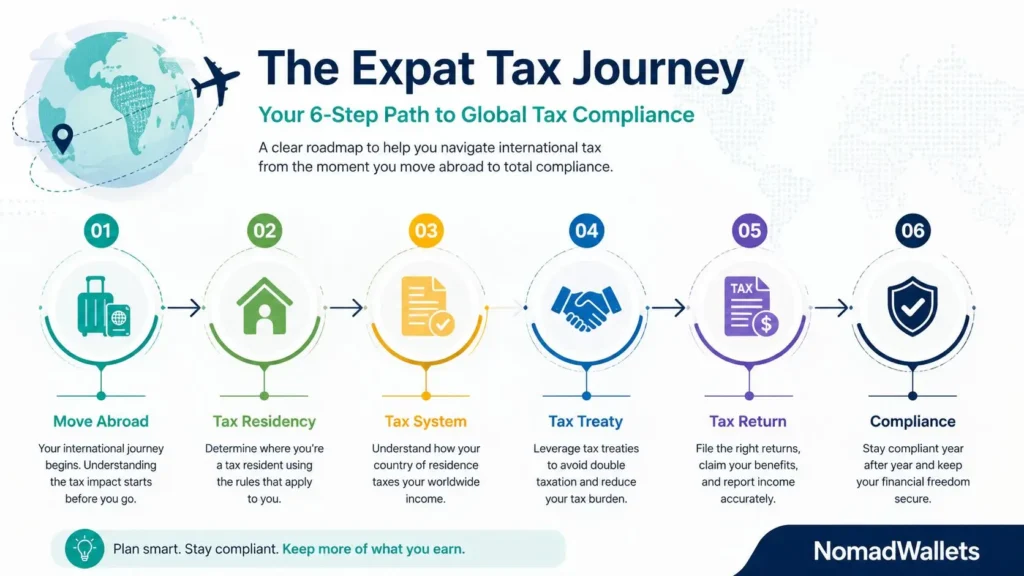
Expat tax planning is the strategic process of organizing your financial affairs across borders to minimize your tax burden while remaining fully compliant with every jurisdiction where you have obligations. It covers tax residency analysis, treaty applications, filing requirements, and structural decisions like where to incorporate a business or which country to call home for tax purposes.
The stakes are high: poor planning can leave you paying far more than necessary, while the right approach can free up significant capital for the life you moved abroad to build.
The financial consequences of inaction add up quickly. Late filing penalties for forms like the US FBAR can reach $10,000 per violation, and willful failure to report foreign accounts carries penalties of $100,000 or more, or half the account balance. Even when double taxation does not reach the extreme end of the range, the cumulative effect of paying tax in two jurisdictions on the same income, year after year, can erode the very freedom that motivated the decision to live abroad in the first place.
Digital nomads face unique challenges that traditional expats rarely encounter. A corporate assignee relocating to London through their employer typically has a relocation package, an in-house tax team, and a clear tax equalization policy. A freelance web developer working from Bali one month, Tbilisi the next, and Mexico City the month after has none of these safety nets.
They must determine their own tax residency, understand which country has the primary right to tax their income, track days across borders, manage multiple bank accounts in different currencies, and file returns in jurisdictions whose rules may change with little notice.
This guide covers tax residency rules, the three major types of tax systems worldwide, double taxation treaties, country-specific strategies for the US, UK, Canada, Australia, India, and Europe, the best tax-friendly countries for 2026, business structures for internationally mobile entrepreneurs, and more.
Quick summary: expat tax planning
What Is Expat Tax Planning?
Expat tax planning is the deliberate, lawful organization of a person’s financial affairs to reduce tax liabilities that arise from living, working, or doing business across international borders. It differs from tax evasion (the illegal concealment of income or assets) in both method and legality. Tax planning uses treaties, exclusions, credits, deductions, and structural choices to minimize what you owe. Tax evasion uses deception, false reporting, or hidden accounts. The legal consequences separate the two sharply: one is a routine financial practice, the other carries criminal penalties including imprisonment.
To understand expat tax planning, it helps to define the key populations it serves. An expat (short for expatriate) is any individual who resides outside their country of citizenship or origin. This broad category includes corporate employees on international assignments, retirees living abroad, and individuals who have simply chosen to relocate.
A digital nomad is a subset of expats who leverage technology to work remotely while traveling between countries, often without a fixed home base. Remote workers are similar to digital nomads but may maintain a more stable location while working for a company in another country. Freelancers are self-employed individuals who serve clients across borders, and business owners abroad encompass entrepreneurs who have incorporated or operate enterprises outside their home country.
Each of these profiles faces a different set of tax challenges. A US citizen freelancer working from Portugal must contend with American worldwide taxation, Portuguese resident tax rates, and the US-Portugal tax treaty, all while potentially qualifying for the Foreign Earned Income Exclusion. A Canadian corporate employee seconded to Singapore needs to understand departure tax rules, the Canada-Singapore DTAA, and whether they maintain sufficient residential ties to Canada. An Indian NRI earning rental income in Mumbai while working in Dubai must navigate India’s complex residency tests and the provisions of the India-UAE DTAA.
Tax avoidance involves using legal mechanisms, such as establishing residency in a territorial tax jurisdiction, claiming treaty benefits, or structuring income through a legitimate business entity, to reduce tax liability. Every strategy discussed in this guide falls into this category. Tax evasion, by contrast, involves illegal acts such as failing to report income, hiding assets in undisclosed bank accounts, or filing false returns.
Tax evasion carries criminal penalties including imprisonment, and it can result in permanent bans from financial systems. The OECD’s Common Reporting Standard (CRS) and the US FATCA regime have made it increasingly difficult to hide assets abroad, making legitimate tax planning more important than ever.
Understanding Tax Residency
Tax residency is the single most important concept in international taxation. It determines which country has the primary right to tax your worldwide income, and it serves as the gateway to your obligations under that country’s tax laws. Get your tax residency wrong, and everything else (your filing requirements, your eligibility for exclusions and credits, your exposure to double taxation) falls apart. Despite its importance, tax residency is surprisingly poorly understood by most internationally mobile individuals.
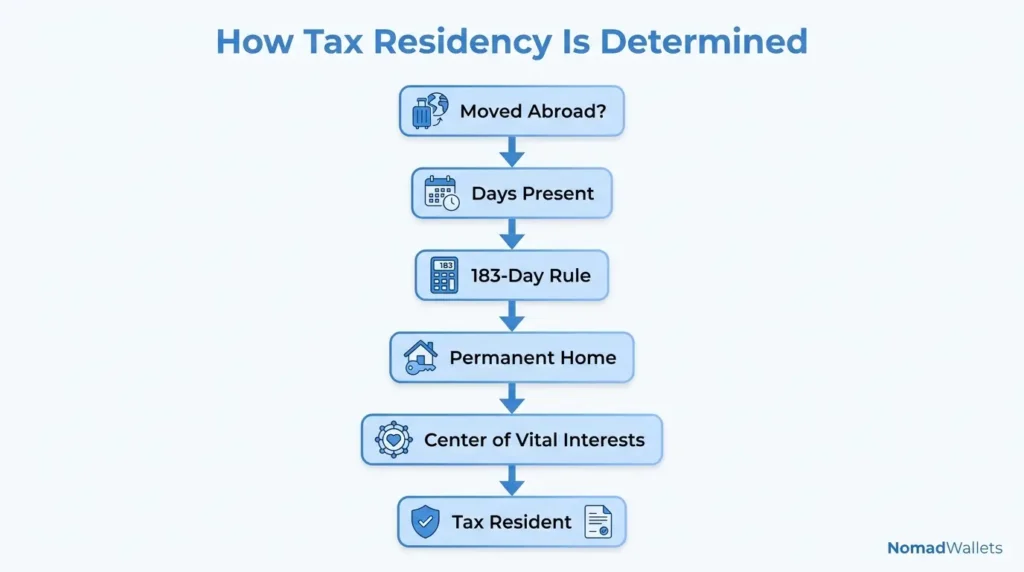
Tax residency means that a country considers you a resident for tax purposes, typically because you spend sufficient time there or because you have established significant connections to that jurisdiction. But the definition varies dramatically from country to country. Some nations use a simple physical presence test: if you are physically present in the country for more than a specified number of days in a calendar year, you are a tax resident. Others use a more nuanced analysis that considers where your permanent home is located, where your center of vital interests lies, and where your personal and economic ties are strongest.
The 183-Day Rule
The 183-day rule is the most widely recognized tax residency threshold in the world, used in some form by the United States, the United Kingdom, Canada, Australia, and dozens of other nations. The principle is straightforward: if you spend 183 days or more in a country during a tax year, you are generally considered a tax resident of that country. The 183-day threshold represents roughly half the year, and it serves as a bright-line test that provides certainty for both taxpayers and tax authorities.
However, the 183-day rule is rarely as simple as counting days on a calendar. Many countries apply look-back provisions that can pull in days from previous years. The US Substantial Presence Test, for example, counts all days present in the current year, plus one-third of days from the previous year, plus one-sixth of days from the year before that. If the total equals or exceeds 183 days, you are considered a US tax resident, even if you spent only 120 days in the US in the current year. The UK’s Statutory Residence Test uses a complex matrix of automatic tests, sufficient ties tests, and connecting factors that go well beyond a simple day count.
Center of Vital Interests and Permanent Home
For many countries, and particularly under the OECD Model Tax Convention, the center of vital interests test is used as a tie-breaker when a person could be considered resident in two countries simultaneously. This test asks where the center of your life is: where your family lives, where your primary employment or business is located, where your social connections are concentrated, where your children attend school, and where you maintain your habitual abode. The permanent home test looks at where you have a permanent place of abode available to you, not necessarily where you own property, but where you have a home that is available to you on a continuing basis.
Split Residency and Dual Residency
Split residency occurs when you are considered a tax resident for only part of a tax year, typically because you moved into or out of a country mid-year. Many jurisdictions offer split-year treatment, which taxes you as a resident only for the portion of the year you were actually living there. The UK, for instance, provides split-year treatment for eight specific qualifying scenarios, including starting full-time work overseas, ceasing to have a home in the UK, and beginning or ending overseas employment. Dual residency occurs when two countries simultaneously consider you a tax resident under their domestic laws.
In this situation, the tie-breaker rules in the relevant tax treaty determine which country has the primary right to tax you. The standard OECD tie-breaker hierarchy is: permanent home, center of vital interests, habitual abode, and finally, nationality.
Types of Tax Systems Around the World
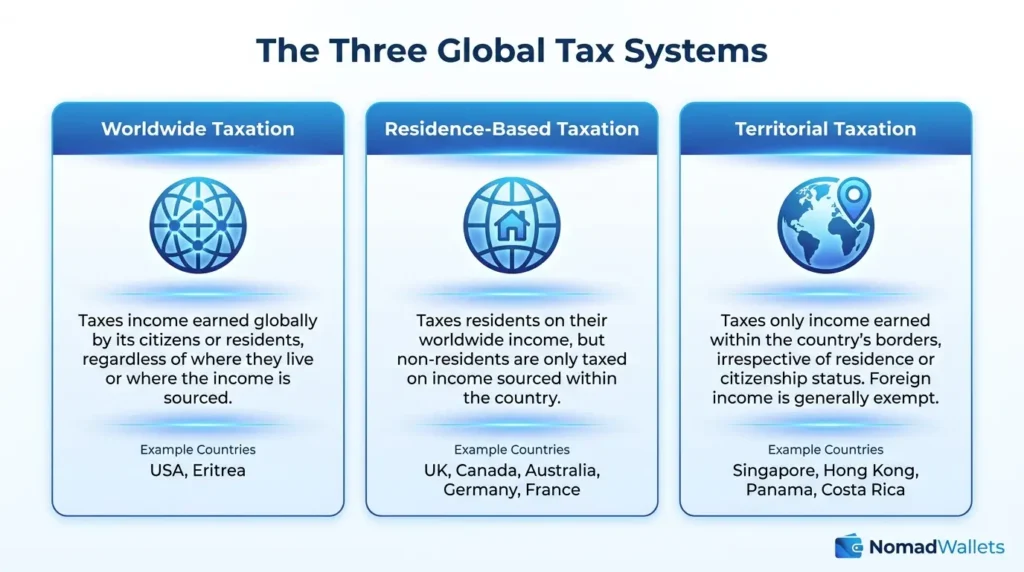
Not all countries tax income the same way. The fundamental architecture of a country’s tax system has an enormous impact on how much tax an expat will pay, and understanding these differences is essential for effective expat tax planning. There are three primary models of income taxation used around the world: worldwide taxation, residence-based taxation, and territorial taxation. While the boundaries between these categories can sometimes blur, the distinctions are meaningful and have direct practical implications for internationally mobile individuals.
The distinction between worldwide and territorial taxation has direct, tangible financial consequences for expats. A British citizen living in Singapore benefits from Singapore’s territorial system and pays no Singapore tax on their foreign-source income. If that same individual were a US citizen, they would still owe US tax on that income (subject to the FEIE or FTC).
The concept of tax residency, combined with the type of tax system in your country of residence, forms the cornerstone of every expat tax planning strategy: your choice of where to live, how to structure your income, and which planning tools are available all flow from these two variables.
Worldwide Taxation
Under a worldwide (also called citizenship-based) taxation system, a country taxes its citizens and sometimes its residents on their income regardless of where in the world that income is earned or sourced. The United States is the most prominent example of a country that taxes based on citizenship: every US citizen, regardless of where they live or how long they have been abroad, must file an annual US tax return reporting their worldwide income.
Eritrea is the only other country that applies a pure citizenship-based tax model, though Hungary also taxes its citizens on worldwide income in certain circumstances even if they are not residents.
Germany provides an example of worldwide taxation applied on a residency (rather than citizenship) basis. German tax residents are taxed on their worldwide income, including income from foreign sources, though tax treaties and foreign tax credits can mitigate double taxation. The practical impact of worldwide taxation is significant for expats: even if you live in a zero-tax jurisdiction like the UAE, a country with worldwide taxation will still expect you to report and potentially pay tax on your income.
For US citizens, this is why tools like the Foreign Earned Income Exclusion and the Foreign Tax Credit are so critical: without them, Americans abroad would face double taxation on virtually all of their income.
Japan, South Korea, Brazil, and Mexico are additional examples of countries that tax residents on worldwide income. Japan’s progressive income tax rates reach up to 45 percent plus local inhabitant taxes, making it one of the highest-taxed developed nations for residents. South Korea imposes similar progressive rates up to 45 percent. Brazil’s tax system is complex, with a top marginal rate of 27.5 percent on income plus additional social contributions that can push the effective rate significantly higher.
All of these countries have extensive treaty networks that can modify the default tax treatment for expats, making it essential to look beyond just the domestic rates.
Residence-Based Taxation
Under a residence-based system, a country taxes individuals who are considered tax residents, but generally does not tax non-residents on their foreign-source income. The United Kingdom, Canada, and Australia all use residence-based taxation. In the UK, tax residents pay tax on their worldwide income, while non-residents generally pay tax only on UK-source income.
Canada follows a similar model: residents are taxed on worldwide income, while non-residents are subject to a withholding tax on Canadian-source income. Australia taxes residents on worldwide income but provides a temporary resident exemption for certain foreign-sourced income of individuals holding temporary visas.
Territorial Taxation
Territorial taxation is the most favorable system for internationally mobile individuals. Under a territorial tax system, a country taxes only income that is sourced within its borders. Foreign-source income (whether earned from remote work for clients abroad, investment income from foreign portfolios, or rental income from property overseas) is generally not taxed at all. Panama, Singapore, Hong Kong, Georgia, Costa Rica, and Malaysia are among the countries that use territorial taxation.
The United Arab Emirates introduced a corporate tax of 9 percent in 2023, but personal income tax remains at zero for the vast majority of individuals, making it one of the world’s most attractive jurisdictions for expats and digital nomads.
The following table compares the three major tax systems:
| Tax System | Basis | Foreign Income | Example Countries |
| Worldwide | Citizenship or residency | Taxed (with credits/exclusions) | USA, Germany, Hungary |
| Residence-Based | Residency only | Taxed if resident; exempt if non-resident | UK, Canada, Australia |
| Territorial | Source within borders | Not taxed | Panama, Singapore, UAE, Hong Kong, Georgia |
Double Taxation Explained
A French software developer working remotely for a US technology company can owe tax on the same salary to both France and the United States simultaneously: France because she is a resident, and the US because the employer is US-based and the compensation may be considered US-source. France, as her country of residence, claims the right to tax her worldwide income under its residence-based system. The US may also claim a right to tax that income through withholding obligations. Without any mechanism to prevent it, this developer could lose a massive portion of her earnings to two tax systems simultaneously.
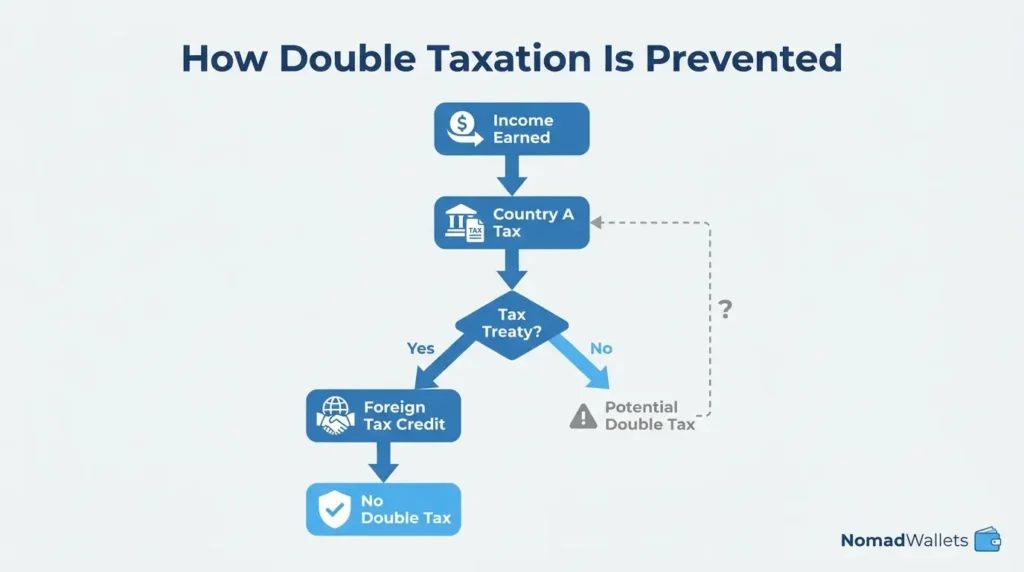
The primary mechanism for preventing double taxation is the Double Taxation Agreement (DTA), also known as a tax treaty. The OECD Model Tax Convention on Income and on Capital serves as the template for most of the 3,000+ bilateral tax treaties currently in force worldwide. These treaties allocate taxing rights between the two contracting states, typically giving the residence country the primary right to tax most types of income, while the source country retains limited taxing rights on certain categories such as cross-border dividends and interest, and royalties, subject to reduced withholding rates specified in the treaty.
When double taxation cannot be fully prevented by a treaty, countries typically provide one of two relief mechanisms. The exemption method simply exempts the foreign-source income from domestic taxation: this is the approach most commonly used in Europe. The credit method allows taxpayers to claim a credit for foreign taxes paid against their domestic tax liability, effectively reducing their home-country tax bill by the amount already paid abroad.
The United States uses the credit method through the Foreign Tax Credit (FTC), while European nations tend to favor the exemption method. Which method applies in your situation (and how you document and claim it) can make a difference of thousands of dollars per year in total tax paid.
Tax Planning Strategies That Work Globally
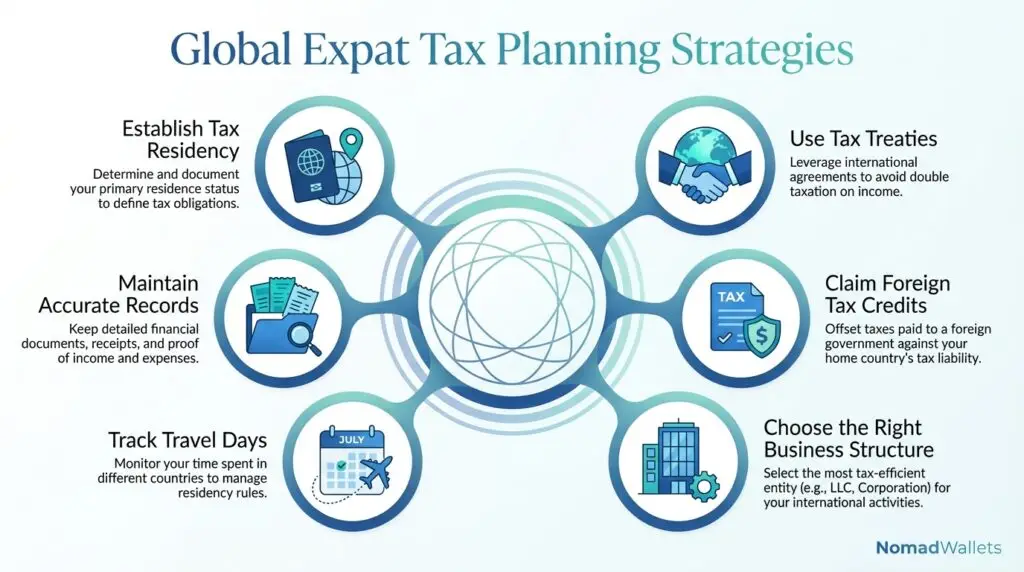
Effective expat tax planning comes down to understanding the interplay of multiple legal provisions and making informed decisions that, taken together, significantly reduce your total tax burden. The following strategies have been proven to work across multiple jurisdictions and are applicable to a wide range of internationally mobile individuals, from digital nomads to corporate expats to business owners.
Become Tax Resident Intentionally
One of the most powerful strategies in international tax planning is to proactively choose your tax residency. If you are a citizen of a country with worldwide taxation (such as the United States), choosing to become tax resident in a territorial tax country (such as Panama or the UAE) does not eliminate your home-country tax obligations: it can dramatically reduce or eliminate the tax you owe in your country of residence.
For citizens of countries with residence-based taxation (such as the UK or Canada), becoming a non-resident by severing residential ties and establishing a new tax home abroad can eliminate domestic tax obligations on foreign-source income entirely. Start by mapping out the residency rules of both your home country and your target country, plan your move timing carefully, and document the steps you take to establish or sever residency.
Understand and Maximize Treaty Benefits
Tax treaties contain specific provisions that can save you thousands of dollars per year. Most treaties reduce withholding rates on passive income streams like royalties and interest between the two contracting countries. Many also address independent personal services, dependent personal services, and capital gains in ways that alter which country has the right to tax specific types of income.
For example, Article 14 of the US-UK tax treaty provides that income from independent personal services is taxable only in the country where the individual is resident, unless they have a fixed base in the other country. Reading and understanding the relevant treaty articles for your specific situation is one of the highest-ROI activities in expat tax planning.
Time Your Income and Capital Gains
The timing of when you receive income or realize capital gains can have a significant impact on your tax liability, particularly around the time of a cross-border move. If you are planning to become a tax resident of a new country, it may be advantageous to realize capital gains before establishing residency, particularly if your new country taxes capital gains more heavily than your current one.
Conversely, if you are leaving a high-tax country, deferring income recognition until after you have established non-resident status can save thousands. The UK’s temporary non-residence rules, for example, provide that certain income earned during a period of non-residence may be taxed upon return, making it essential to plan both your departure and potential return.
Optimize Your Business Structure
For internationally mobile entrepreneurs and freelancers, the choice of business structure can have significant tax implications. A US LLC, for example, is treated as a disregarded entity by default for US tax purposes, meaning the LLC’s income flows through to the owner’s personal return. For a non-resident alien, this means the LLC is generally only taxed on effectively connected income (income that is connected to a US trade or business).
Income that is not effectively connected (such as consulting services performed entirely outside the United States for non-US clients) may not be subject to US tax at all. However, care must be taken to avoid creating a Permanent Establishment (PE) in a foreign country, which could trigger corporate tax obligations there. Other structures, such as limited companies in the UK, corporations in Singapore, or offshore entities in jurisdictions like the BVI, each carry their own tax implications and regulatory requirements.
Leverage Pension Contributions, Dividend Planning, and Foreign Tax Credits
Many countries offer tax-advantaged pension or retirement savings vehicles that can reduce your current taxable income. In the UK, pension contributions can reduce your taxable income by up to £60,000 per year (or 100% of relevant earnings if lower). In the US, contributions to traditional IRAs or 401(k) plans can reduce taxable income, though the rules for expats differ. Dividend planning is another powerful strategy: in many jurisdictions, dividend income is taxed at a lower rate than employment income, and some countries offer a dividend allowance that exempts a certain amount of dividends from tax entirely.
Foreign tax credits allow you to offset taxes paid to a foreign government against your domestic tax liability, preventing double taxation on the same income. Without meticulous records of all foreign taxes paid (including the specific income to which they relate, the date of payment, and the exchange rate used), you have nothing to fall back on if a tax authority questions your filings.
Currency Planning and Record Keeping
Living and working across borders inevitably involves managing multiple currencies, and currency fluctuations can have a significant impact on your tax liability. When you earn income in one currency, hold assets in another, and report taxes in a third, exchange rate differences between the time you earn income and the time you convert or report it can create taxable gains or losses. Using multi-currency accounts from providers like Wise, Revolut, or Airwallex can help you manage currency exposure more efficiently.
For detailed guidance, see our guides on the best multi-currency accounts for digital nomads and the best money transfer service for digital nomads. In many countries, keeping bank statements, income receipts, tax returns, and treaty documentation is a legal requirement: failing to maintain adequate records can result in penalties even if your tax position is technically correct.
United States: The World’s Most Complex Expat Tax System
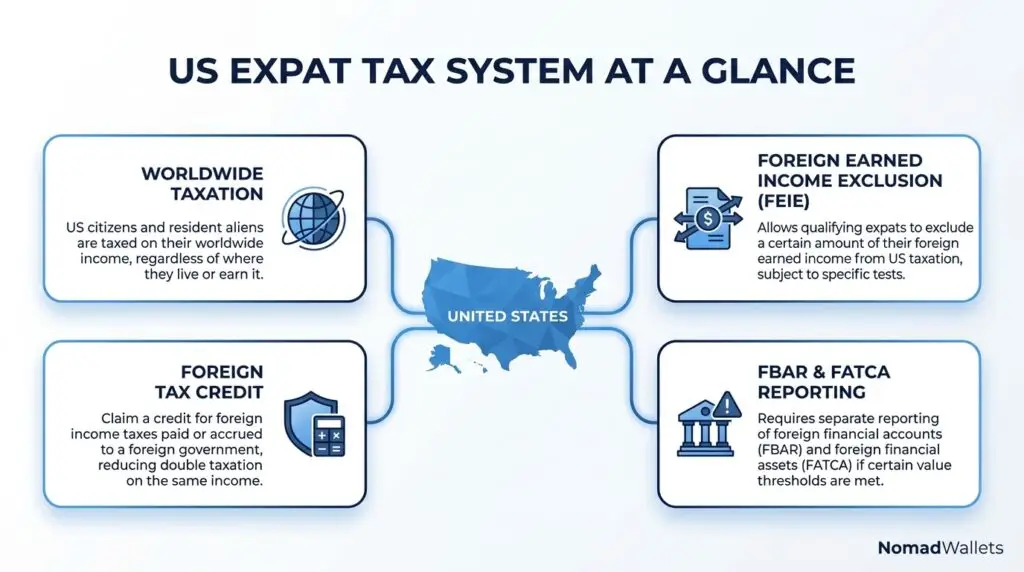
The United States is one of only two countries in the world (along with Eritrea) that taxes its citizens on their worldwide income regardless of where they live. This citizenship-based taxation system means that every American abroad (approximately 5.4 to 9 million individuals, depending on which estimate you use) must file an annual US tax return reporting their worldwide income, even if they owe no tax. The US has over 68 bilateral income tax treaties that can modify this default position, and it offers several key mechanisms to prevent or mitigate double taxation for its expats.
Foreign Earned Income Exclusion (FEIE)
The FEIE is the most widely used tax benefit for Americans living abroad. For the 2025 tax year, the exclusion amount is $130,000, and for 2026 it rises to $132,900. In practice, qualifying lets you exclude up to this amount of your foreign earned income from US taxation. To qualify, you must meet either the Physical Presence Test (330 full days outside the US during any consecutive 12-month period) or the Bona Fide Residence Test (you are a bona fide resident of a foreign country for an uninterrupted tax year).
The FEIE applies only to earned income (including wages, self-employment income, and professional fees) and does not cover passive income such as dividends, interest, or capital gains. For detailed guidance on how the FEIE applies to your situation, see our comprehensive guide to US expat tax filing.
Foreign Tax Credit (FTC)
The FTC allows US citizens and residents to offset their US tax liability dollar-for-dollar for foreign income taxes paid or accrued. Unlike the FEIE, the FTC can be used for any type of foreign-source income, including passive income. The FTC is subject to several limitations: it cannot exceed the US tax that would be attributable to your foreign-source income, and different categories of income (general and passive) must be calculated separately.
In many cases, expats must choose between claiming the FEIE or the FTC, as you cannot double-dip on the same income. The right choice depends on your specific circumstances, including your income level, the tax rates in your country of residence, and the composition of your income. The IRS provides detailed guidance on the FTC at irs.gov.
FBAR and FATCA
Two of the most commonly overlooked filing requirements for Americans abroad are the FBAR (Foreign Bank and Financial Accounts Report, filed with FinCEN) and FATCA (Foreign Account Tax Compliance Act, reported on IRS Form 8938). The FBAR requires US persons to report any foreign financial account if the aggregate value of all such accounts exceeds $10,000 at any point during the calendar year.
FATCA requires reporting of specified foreign financial assets above certain thresholds: $200,000 for single filers living abroad on the last day of the tax year, or $300,000 at any point during the year. The penalties for failing to file FBAR are severe: up to $10,000 per violation for non-willful failures, and the greater of $100,000 or 50 percent of the account balance for willful failures. For details, see FinCEN’s official guidance at fincen.gov.
State Taxes and Domicile
Even after moving abroad, many US expats remain subject to state income tax if they do not properly sever their state domicile. State domicile is a matter of intent and factual connections, not just physical presence. Factors that states consider include whether you maintain a home in the state, where your driver’s license is issued, where you are registered to vote, where your bank accounts are located, and where your professional licenses are held.
States like California and New York are particularly aggressive in pursuing former residents who they believe have not sufficiently demonstrated an intent to change domicile. If you are planning to move abroad from a high-tax state, it is essential to understand the rules and take deliberate steps to establish a new domicile. Our guide on how to change state domicile provides a detailed walkthrough.
LLC Structures for US Expats and Digital Nomads
Many US expats and digital nomads operate through a Single-Member LLC. For US citizens, a Single-Member LLC is treated as a disregarded entity by default, meaning the LLC’s income is reported on the owner’s personal tax return on Schedule C. For non-resident aliens, a US LLC that does not have a US trade or business and earns only foreign-source income may not be subject to US federal income tax at all.
This makes the US LLC an attractive structure for internationally mobile entrepreneurs. Our digital nomad LLC setup guide covers the formation process in detail, and our BOI reporting guide for nomad LLCs explains the FinCEN Beneficial Ownership Information reporting requirements. For help with filing, consult our recommendations for the best digital nomad tax software or consider hiring a specialized digital nomad tax accountant.
Key US Tax Deadlines
US expats receive an automatic two-month extension to file their federal tax returns, making the deadline June 15 (or October 15 with a further extension). However, any tax owed is still due by April 15, and interest accrues on late payments from that date. FBAR filings are due by April 15 with an automatic extension to October 15. For a complete calendar of all relevant deadlines, see our guide to the 2026 US tax deadlines for expats.
The US tax treaty network extends to over 68 countries and covers nearly every major economy. Each treaty is bilateral, meaning the provisions differ from one treaty to the next. For instance, the US-UK treaty provides specific rates for dividends (15 percent), interest (0 percent), and royalties (0 to 5 percent), while the US-Canada treaty has different withholding rates. Understanding the specific provisions of the relevant treaty is essential for any American abroad. The IRS maintains a complete list of US income tax treaties at irs.gov, and comprehensive guidance for international taxpayers is available at IRS Abroad.
United Kingdom: Navigating Post-Non-Dom Tax Rules
On April 6, 2025, the UK replaced its non-domiciled (non-dom) regime with the Foreign Income and Gains (FIG) regime. For decades, the non-dom rules allowed individuals living in the UK but domiciled elsewhere to pay no UK tax on their foreign income and gains, provided they did not remit those funds to the UK. The new FIG regime provides a 4-year relief period for new arrivals, during which foreign income and gains are not subject to UK tax, but after this period expires, individuals are taxed on their worldwide income like any other UK resident.
Statutory Residence Test (SRT)
The UK uses a comprehensive Statutory Residence Test to determine whether an individual is a UK tax resident in any given tax year. The SRT consists of three parts: automatic overseas tests (if any apply, you are non-UK resident), automatic UK tests (if any apply, you are UK resident), and the sufficient ties test (used only if no automatic test applies). The automatic UK tests include being present in the UK for 183 or more days in the tax year, having your only home in the UK, or working full-time in the UK.
The sufficient ties test weighs five connecting factors against your day count: having a family member in the UK, maintaining accommodation there, working in the UK, having visited 90+ days in either of the prior two years, and having your country of origin be the UK. The more days you spend in the UK, the fewer ties you need to be considered resident. Full details are available from HMRC.
The abolition of the non-dom regime represents one of the most significant changes to the UK tax system in decades. Previously, an individual who was UK-resident but domiciled abroad (for example, an Indian citizen living in London) could use the remittance basis to avoid UK tax on foreign income and gains, provided those funds were not brought into the UK.
This created a powerful incentive for wealthy individuals to establish UK residency while shielding their overseas wealth from UK taxation. Under the new FIG regime, new arrivals to the UK receive a four-year window during which foreign income and gains are not taxed, but after this period, they are fully subject to UK tax on worldwide income. This change makes careful timing of relocation to the UK critically important: arriving too early or too late can have significant financial consequences.
Split Year Treatment and Non-Resident Rules
The UK provides split-year treatment for individuals who move into or out of the UK partway through a tax year. There are eight qualifying cases for split-year treatment, including starting full-time overseas work, beginning or ending overseas employment, and ceasing to have a UK home available. When split-year treatment applies, you are treated as UK resident only for the part of the year during which you met the residency criteria, and non-resident for the remainder.
For individuals who are non-UK residents, the rules are relatively straightforward: non-residents generally pay UK tax only on UK-source income, including income from UK property, UK employment, and UK pensions. The withholding tax rates on different types of UK-source income paid to non-residents are specified in the relevant tax treaty.
Canada: Residential Ties and Departure Tax
Canada determines tax residency based on the concept of residential ties, rather than a strict day-count test. Under Canadian tax law, an individual is a factual resident if they maintain significant residential ties to Canada, even if they spend considerable time outside the country.
The primary residential ties that the CRA considers are: maintaining a dwelling place (home) in Canada, having a spouse or common-law partner in Canada, and having dependants in Canada. Secondary ties include personal property (such as a car or furniture), social ties (memberships in Canadian organizations), economic ties (Canadian bank accounts, credit cards, investments), and health insurance with a Canadian province.
Canada also has a deemed residency rule under Section 250 of the Income Tax Act: any individual who is physically present in Canada for 183 days or more in a tax year is deemed to be a Canadian resident for that entire year, regardless of their actual residential ties. Even a brief visitor who stays in Canada for more than half the year could be caught in the Canadian tax net.
Departure Tax
When an individual ceases to be a Canadian tax resident, they are subject to departure tax: a deemed disposition of most of their capital property at fair market value. In practice, if you own stocks, investment properties, or other capital property that has appreciated in value, you must report and pay tax on the capital gain as if you had sold the property on the day before you left Canada. Form T1243 (Deemed Disposition of Property by an Emigrant of Canada) must be filed to report these deemed dispositions. The CRA provides detailed guidance on residency determination at canada.ca.
Canada’s tax system also provides a foreign tax credit for taxes paid to other countries on foreign-source income. The foreign tax credit is designed to prevent double taxation, but like the US FTC, it is subject to limitations. The credit cannot exceed the Canadian tax that would be payable on the foreign-source income, and unused foreign tax credits can generally be carried back one year and forward up to ten years.
For Canadian expats who earn income in high-tax jurisdictions (such as many European countries), the foreign tax credit will typically eliminate any additional Canadian tax. However, for those earning income in low-tax or zero-tax jurisdictions, there may be residual Canadian tax owing. The interaction between the foreign tax credit, the departure tax rules, and the deemed residency provisions makes Canadian cross-border tax planning particularly complex, and professional advice is strongly recommended for anyone with significant financial ties to Canada.
The practical implications of Canadian departure tax are significant. If you own a portfolio of Canadian stocks that has appreciated by CAD 200,000 over the years you lived in Canada, you will owe capital gains tax on that appreciation in the year you leave, even though you have not actually sold the stocks. This can create a cash-flow problem: you owe tax on a gain you have not realized, and you may need to liquidate assets to pay the tax bill.
The CRA does allow you to post security (such as a letter of credit or a pledge of assets) to defer the actual payment of departure tax, but the tax liability is crystallized at the time of departure. Proper planning (including potentially realizing gains before departure or restructuring your portfolio to minimize the deemed gain) is essential.
Australia: Residency Tests and Temporary Residents
Australia uses a multi-factor residency test to determine whether an individual is an Australian tax resident. There are four statutory tests: the resides test, the domicile test, the 183-day test, and the Commonwealth superannuation test. The resides test is the primary test and considers whether the individual lives in Australia in a manner that suggests they are a resident: this is a factual determination based on the individual’s lifestyle, intentions, and connections to Australia. If an individual does not reside in Australia under the first test, the domicile test asks whether their domicile is in Australia and whether they have permanently moved to another country.
The 183-day test provides that an individual who is present in Australia for more than half the income year (183 days or more) is generally considered an Australian resident, unless they can demonstrate that their usual place of abode is outside Australia and they do not intend to take up residence in Australia.
The temporary resident exemption is a particularly valuable provision for certain visa holders: individuals on temporary visas (such as 457, 482, or student visas) who do not become permanent residents are generally exempt from Australian tax on their foreign-source income. So a temporary resident who earns salary from an Australian employer and also receives investment income from their home country would only pay Australian tax on the Australian salary. The ATO provides detailed guidance at ato.gov.au.
The temporary resident exemption has made Australia a popular destination for skilled workers on temporary visas. However, the exemption applies automatically based on your visa status and residency determination: it does not require a separate claim. If you are a temporary resident, you should still file an Australian tax return to report your Australian-source income and claim the exemption for your foreign-source income.
The ATO provides detailed guidance on residency determination and the temporary resident exemption at its website. Australia’s tax rates for residents are progressive, ranging from zero percent on the first $18,200 of taxable income up to 45 percent on income above $180,000. A Medicare Levy of 2 percent also applies to most taxpayers, though temporary residents from countries with a Reciprocal Health Care Agreement with Australia may be exempt.
India: NRI Tax Rules and DTAA Benefits
India has one of the most complex tax residency systems in the world, and it is of enormous practical importance given the size of the Indian diaspora (estimated at over 32 million worldwide). Under Indian tax law, individuals are classified into three categories: Resident and Ordinarily Resident (ROR), Resident but Not Ordinarily Resident (RNOR), and Non-Resident Indian (NRI). The classification determines which income is taxable in India and at what rates.
NRI Status and Residency Rules
An individual is considered an NRI if they spend less than 182 days in India during the financial year (April to March). For Indian citizens earning above INR 15 lakh per year, a special rule applies: if they spend 120 days or more in India, they may be deemed resident. However, India’s new Income Tax Bill 2025, expected to take effect from April 2026, relaxes this threshold back to 182 days for all taxpayers, simplifying the residency determination.
NRIs are taxed only on income that is earned or received in India, or that accrues or arises in India. This includes salary for services rendered in India, rental income from Indian property, capital gains on the sale of Indian assets, and interest on Indian bank deposits. Foreign-source income earned by an NRI is generally not taxable in India.
RNOR Status
The RNOR (Resident but Not Ordinarily Resident) status is a valuable transitional category for individuals who are returning to India after an extended period abroad. To qualify as RNOR, an individual must be a resident of India (meeting the 182-day test) AND must have been a non-resident for nine out of the ten previous financial years. RNORs enjoy a significant tax advantage: like NRIs, they are not taxed on foreign-source income.
This grace period can last for up to two years, providing a window to reorganize financial affairs before becoming fully taxable on worldwide income as an ROR.
DTAA Benefits for NRIs
India has an extensive network of over 94 Double Taxation Avoidance Agreements (DTAAs) that can significantly reduce the tax burden on NRIs. Under most of India’s DTAAs, income such as royalties, interest, and dividend payments received by an NRI may be subject to reduced withholding rates compared to the domestic Indian rates. For example, under the India-UAE DTAA, certain types of income may be exempt from Indian taxation altogether.
The DTAA also provides mechanisms for claiming foreign tax credits and resolving disputes between the Indian tax authorities and the tax authorities of the treaty partner country. The Indian Income Tax Department provides detailed information at incometax.gov.in.
Europe: A Patchwork of Tax Systems
Europe’s tax landscape is complex for expats. Despite the EU’s efforts to harmonize certain aspects of taxation, each member state retains sovereignty over its income tax rules, rates, and residency criteria. Moving from Germany to Portugal, or from Spain to Italy, can dramatically alter your tax position. The following is a brief overview of key European jurisdictions; for detailed country-specific guidance, consult our dedicated tax guides for each nation.
Portugal
Portugal has been one of Europe’s most attractive destinations for expats and digital nomads, thanks in large part to its former Non-Habitual Resident (NHR) program. The original NHR, which offered a flat 20 percent tax rate on certain foreign-source income and a complete exemption on foreign passive income for ten years, was closed to new applicants in 2024.
It has been replaced by the IFICI (Incentive for Fiscal Competitiveness for Income) regime, which took effect in 2025 and provides a flat 20 percent tax rate on qualifying income for a period of ten years for eligible new residents. Our Portugal NHR 2.0 (IFICI) guide provides a comprehensive analysis of the new regime, and our guide for US expats in Portugal covers the specific interactions between US citizenship taxation and Portuguese residency.
Spain
Spain introduced the Beckham Law (Special Tax Regime for Expatriates) in 2005, which allows qualifying expats to pay a flat 24 percent tax rate on Spanish-source income for the year of relocation and the following five years, instead of the progressive rates that can reach up to 47 percent. To qualify, individuals must not have been Spanish tax residents in the previous ten years and must be relocated to Spain as a result of an employment contract.
Spain also offers a dedicated digital nomad visa with an income threshold requirement of approximately €2,849 per month. For detailed analysis, see our upcoming Spain Expat Tax Guide.
Germany’s tax system is governed by the Einkommensteuergesetz (Income Tax Act) and the Abgabenordnung (Tax Code). German tax residents are subject to progressive income tax rates ranging from 14 percent to 45 percent, plus a solidarity surcharge of 5.5 percent on the income tax liability (though the solidarity surcharge was largely abolished for most individuals in 2021).
Germany also imposes a church tax of 8 to 9 percent of the income tax liability for registered church members. Social security contributions, which include health insurance, pension insurance, unemployment insurance, and long-term care insurance, add approximately 20 percent to the cost of employment for employees (with the employer paying a matching amount). For expats moving to Germany, the ability to claim foreign tax credits and the provisions of Germany’s extensive tax treaty network (covering over 95 countries) are essential tools for managing the tax burden.
Italy, Germany, and France
Italy offers a flat tax regime for new residents under its “flat tax for new residents” program, which provides a substitute tax of €100,000 per year on all foreign-source income for a period of 15 years. Germany taxes residents on their worldwide income with progressive rates reaching up to 45 percent plus a solidarity surcharge, and it applies a strict residency test based on habitual abode and the center of life interests.
France taxes residents on worldwide income with rates up to 45 percent, and it offers an expat exemption for certain types of income earned by individuals who transfer their tax residency to France. For country-specific guidance, see our upcoming guides on Italy expat taxes, Germany expat taxes, and France expat taxes.
Best Countries for Tax-Friendly Living in 2026
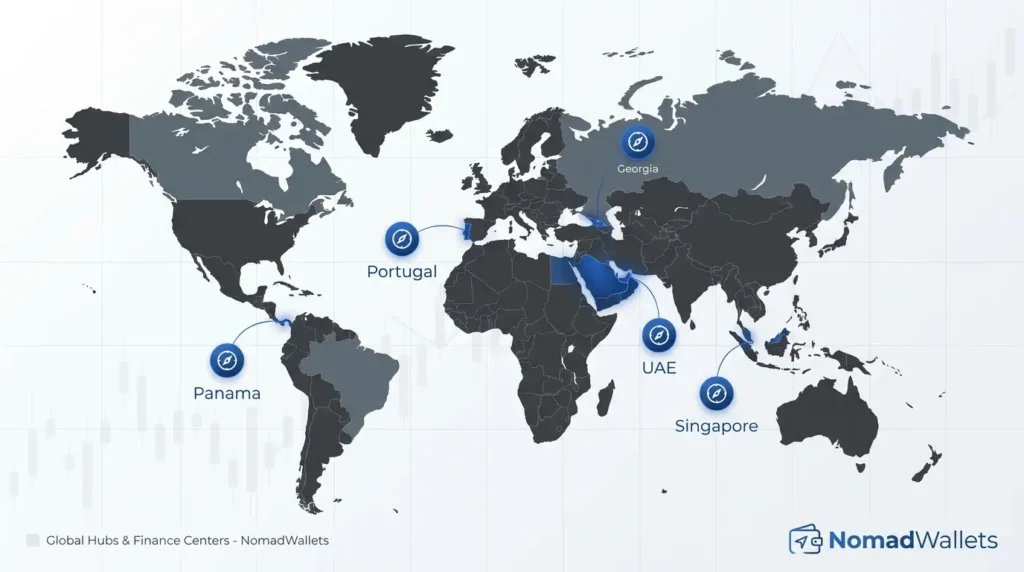
For expats and digital nomads seeking to minimize their tax burden legally, the choice of where to establish tax residency is one of the most impactful financial decisions they will make. The following table summarizes the key tax characteristics of the world’s most tax-friendly jurisdictions for internationally mobile individuals.
| Country | Personal Income Tax | Tax System | Digital Nomad Visa |
| UAE | 0% (no personal tax) | Territorial | Yes – remote work visa |
| Panama | 0% on foreign income | Territorial | Friendly Nations Visa |
| Georgia | 0% (under small business) / 1% to GEL 500K | Territorial | Remotely from Georgia |
| Portugal | 20% flat (IFICI regime) | Worldwide (resident) | D8 Digital Nomad Visa |
| Paraguay | 8–10% on local income; 0% foreign | Territorial | No specific DNV |
| Andorra | 0% on first €24K; max 10% | Worldwide (resident) | Passive income / remote work |
| Singapore | 0–24% progressive | Territorial | No specific DNV |
The United Arab Emirates stands out as the world’s most tax-friendly jurisdiction, with zero personal income tax, zero capital gains tax, and a rapidly growing digital infrastructure. While a 9 percent corporate tax was introduced in 2023, it applies only to businesses with profits exceeding AED 375,000, and the vast majority of individual digital nomads and freelancers remain completely untaxed.
Panama’s territorial tax system is equally attractive for those whose income is generated entirely from outside Panama, while Georgia’s “small business” status allows individual entrepreneurs to pay just 1 percent tax on income up to approximately GEL 500,000. Portugal, while not a zero-tax jurisdiction, remains compelling due to the IFICI regime’s flat 20 percent rate and the quality of life it offers.
Tax Planning for Digital Nomads
Digital nomads represent one of the fastest-growing and most tax-challenged demographics in the world. The defining characteristic of a digital nomad (mobility) is precisely what creates tax complexity. Unlike a traditional expat who moves to a single country for an extended period, a digital nomad may work from a different country every month, creating potential tax residency obligations in multiple jurisdictions simultaneously. Understanding how different countries approach the taxation of nomadic workers is essential for anyone living this lifestyle.
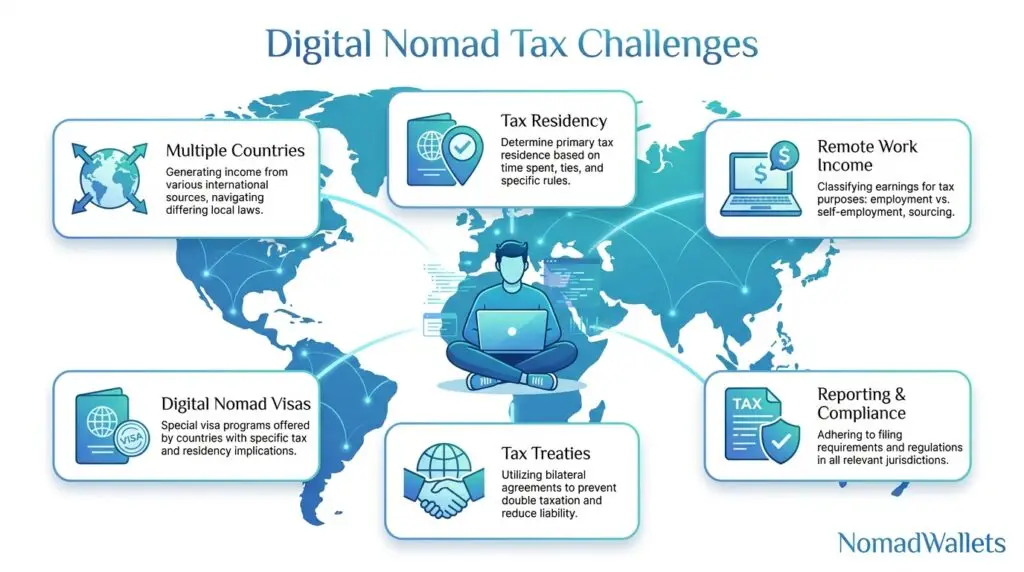
Freelancers and Remote Employees
Freelancers and remote employees face different tax challenges. A freelancer who serves clients in multiple countries must determine where their services are considered to be performed (which determines the source of the income), which country has the right to tax that income, and whether any applicable tax treaties modify the default position. A remote employee who works for a single employer in their home country while living abroad may still be subject to withholding tax in the employer’s country, and may also trigger tax obligations in their country of physical presence.
The distinction between being an employee and being self-employed is also crucial, as many countries tax employment income and business income differently. Our guide to US digital nomad taxes provides detailed analysis for American nomads.
The growing number of digital nomad visa programs worldwide is creating a new category of taxpayer that existing tax frameworks were not designed to accommodate. Traditional tax residency rules assume that individuals have a single, stable place of residence. Digital nomads, by definition, do not. A nomad who holds a Spain visa but spends three months there before moving to Croatia may find that neither country is certain of its right to tax. Some countries, such as Portugal and Spain, have specifically designed their digital nomad visa programs with clear tax residency implications.
Others, including many countries in Southeast Asia and Latin America, have introduced nomad visas without clearly addressing the tax residency consequences. As a digital nomad, you cannot rely on the visa program itself to determine your tax obligations: you must independently analyze the domestic tax laws and any applicable treaties of every country where you spend significant time.
Agency Owners, SaaS Founders, and Content Creators
Digital nomads who run businesses (whether agencies, SaaS companies, e-commerce stores, or content creation enterprises) face additional layers of complexity. The location of the business, the location of the customers, the location of the servers, and the location of the founder all factor into the tax analysis. A SaaS founder who lives in Bali but whose company is incorporated in the US and whose customers are primarily in Europe may trigger tax obligations in all three jurisdictions.
Content creators who earn income from advertising, sponsorships, and affiliate marketing must consider where that income is sourced and how it is characterized: is it business income, royalty income, or something else? Affiliate marketers face similar questions, particularly when the affiliate programs they promote are operated by companies in different countries.
Consultants
Consultants who travel frequently must pay careful attention to the duration of their stays in each country. Many countries have specific rules that treat income from independent personal services as taxable if the individual spends more than a certain number of days in the country (often 183 days, but sometimes as few as 90 days under domestic law, even if a treaty provides a different threshold). A detailed travel log that tracks days spent in each country is the primary evidence you rely on if a tax authority challenges your residency position.
Business Structures for Internationally Mobile Entrepreneurs
Choosing the right business structure is one of the most consequential decisions an internationally mobile entrepreneur will make. The structure you choose affects your personal liability, your tax rate, your filing requirements, and your ability to access certain tax benefits. The following is an overview of the most common structures used by expats and digital nomads.
LLC (Limited Liability Company)
The US LLC is the most popular business structure for internationally mobile entrepreneurs, and for good reason. For US citizens, a Single-Member LLC is a disregarded entity by default, meaning income flows through to the owner’s personal return. For non-resident aliens, a US LLC that does not conduct a US trade or business (and therefore has no Effectively Connected Income) may have zero US tax liability on its foreign-source income.
For a non-US entrepreneur serving non-US clients, a US LLC with no Effectively Connected Income can have zero US federal tax liability. However, the LLC must not create a Permanent Establishment (PE) in any country where the owner is physically present and conducting business activities.
For US citizens, the LLC structure interacts with the FEIE in important ways. If you operate as a sole proprietor or through a Single-Member LLC and perform all of your services outside the United States for non-US clients, your self-employment income may qualify for the Foreign Earned Income Exclusion. However, the self-employment tax (Social Security and Medicare) still applies to this income, regardless of where you live or work.
The total self-employment tax rate is 15.3 percent on the first $168,600 of net self-employment earnings (for 2026), and the FEIE does nothing to offset it. The US does have Totalization Agreements with approximately 30 countries that can prevent dual social security taxation.
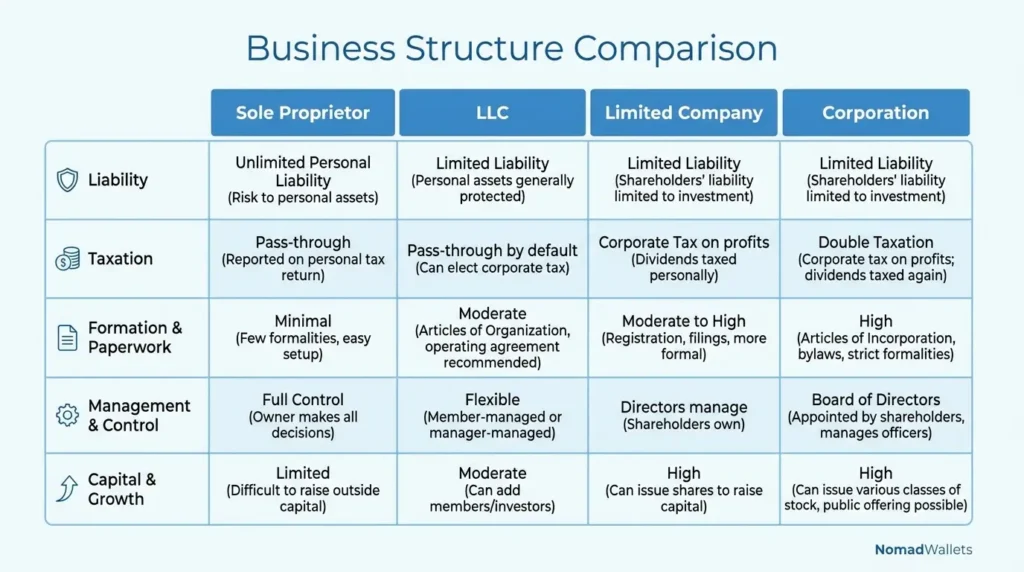
Sole Proprietor, Limited Company, Corporation, and Offshore Company
A sole proprietorship is the simplest structure but offers no personal liability protection. A UK Limited Company provides a separate legal entity with limited liability and can be tax-efficient for profits retained in the company (currently taxed at 19 to 25 percent), though extracting funds as salary or dividends creates additional tax considerations.
A corporation (whether in the US, Singapore, or elsewhere) provides strong liability protection but involves double taxation in most jurisdictions: the corporation pays tax on its profits, and then shareholders pay tax on dividends. Offshore companies incorporated in jurisdictions like the British Virgin Islands, Seychelles, or Belize can offer low or zero corporate tax rates, but they carry significant compliance risks, including increased scrutiny under the OECD’s Base Erosion and Profit Shifting (BEPS) framework and the EU’s list of non-cooperative tax jurisdictions.
The banking landscape for expats has evolved dramatically in recent years. Traditional banks are being supplemented (and in some cases replaced) by fintech platforms that offer multi-currency accounts, real-time exchange rates, and low-cost international transfers. Wise (formerly TransferWise) has become the default choice for many digital nomads due to its transparency, competitive exchange rates, and the ability to hold over 50 currencies.
Revolut offers a similar suite of features with the addition of stock trading and cryptocurrency access. For business banking, Airwallex and Payoneer provide solutions specifically designed for internationally operating businesses. Your banking setup needs to support your overall tax planning strategy, though: for example, maintaining a US bank account may be necessary to demonstrate ongoing ties (or lack thereof) to the United States, and the location of your primary bank account can be a factor in tax residency determinations.
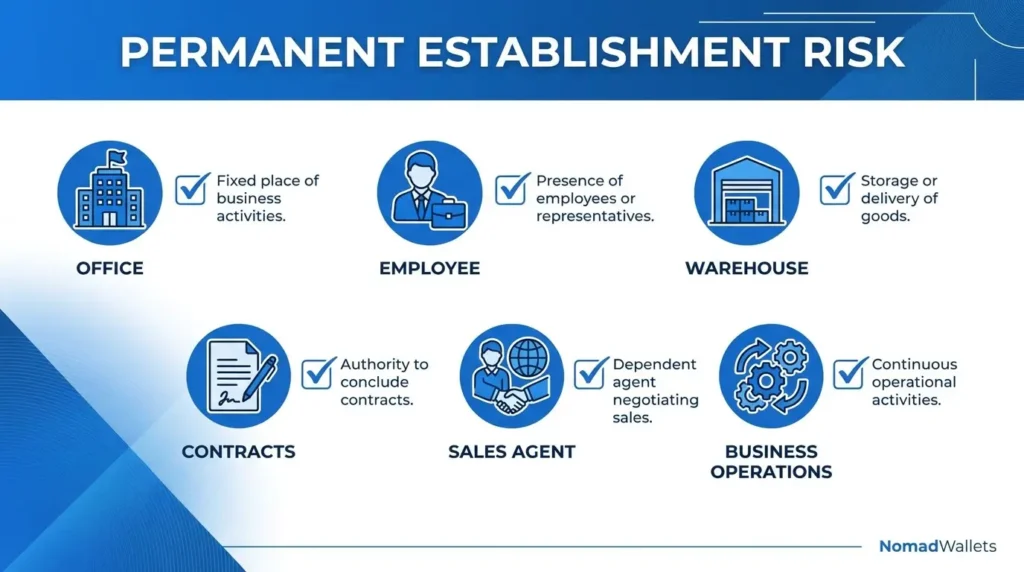
Permanent Establishment Risk
One of the most underappreciated risks facing internationally mobile business owners is the creation of a Permanent Establishment (PE). Under most tax treaties and domestic tax laws, if a business carries on its activities through a fixed place of business in a country (which can include a home office, a co-working space used regularly, or even, in some interpretations, significant digital presence), it may be deemed to have a PE in that country, triggering corporate tax obligations.
A digital nomad who runs a US LLC from a co-working space in Chiang Mai for six months could, under certain treaty interpretations, trigger Thai corporate tax on the LLC’s income: a liability that might run into thousands of dollars. Careful structuring, including the use of appropriate legal agreements, transfer pricing documentation, and geographic limitations on business activities, is essential to managing PE risk.
Banking and Money Management for Expats

Managing money across borders is a daily reality for expats and digital nomads, and the banking choices you make can have both practical and tax implications. Traditional banks often charge exorbitant fees for international transfers, currency conversion, and maintaining accounts in foreign currencies. Modern fintech solutions have dramatically improved the landscape, making it easier and cheaper to hold, convert, and transfer money in multiple currencies.
Wise (formerly TransferWise) offers multi-currency accounts with real exchange rates and low, transparent fees, making it one of the most popular choices for digital nomads. Revolut provides a similar multi-currency account with additional features like cryptocurrency trading and stock investing. Payoneer is widely used by freelancers who receive payments from international clients and marketplaces.
Airwallex and Bunq offer business-focused multi-currency solutions, and N26 provides a European banking alternative with no foreign transaction fees. For US expats, Charles Schwab offers a checking account with unlimited ATM fee rebates worldwide and no foreign transaction fees, making it an excellent companion for international travel.
For comprehensive guidance on choosing the right banking solutions, see our guides on the best bank account for digital nomads, the best multi-currency accounts for digital nomads, and the best money transfer service for digital nomads. These guides compare fees, features, and suitability for different types of internationally mobile individuals.
Expat Tax Planning Checklist
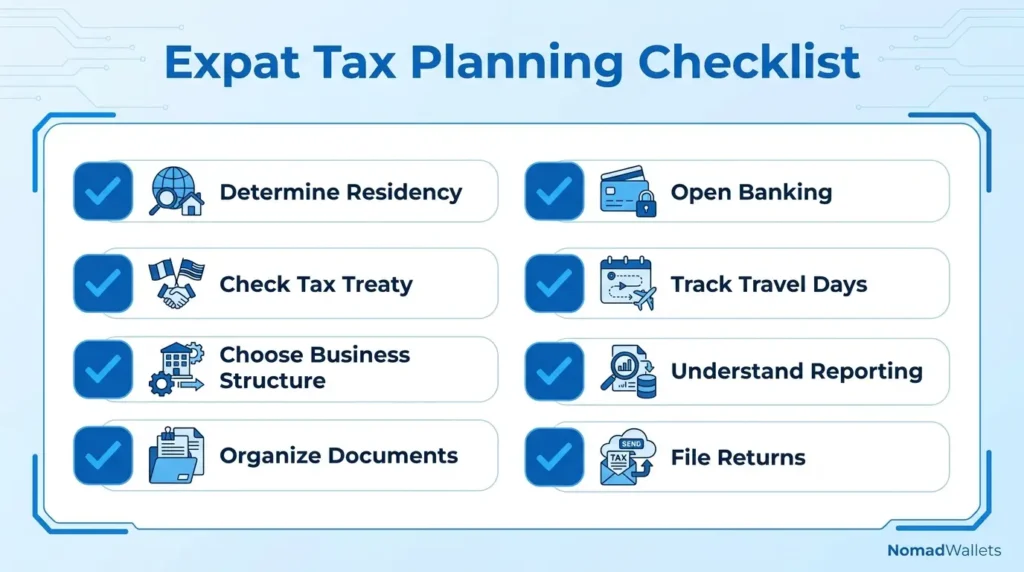
Before Moving Abroad
Before you board that flight, take these critical steps: determine your current tax residency status and understand your home country’s exit tax rules; research the tax system and residency requirements of your destination country; review any applicable tax treaties between your home and destination countries; consult with a qualified cross-border tax advisor to model your expected tax position; establish a plan for managing your bank accounts, investments, and pension contributions; notify relevant tax authorities of your departure if required; gather and organize all financial documents including tax returns, investment statements, and property records; and consider the timing of your move in relation to the tax year to optimize your position.
After Moving
Once you have arrived in your new country, take these steps immediately: register with the local tax authority and obtain any required tax identification numbers; open a local bank account and set up multi-currency banking solutions; track your days of presence in each country from day one; document the steps you have taken to establish residency in your new country (or to sever residency in your former country); set up a system for organizing receipts, invoices, and financial records; review your employer’s payroll arrangements to ensure correct withholding; and determine whether you need to file any provisional or estimated tax payments.
Every Year
Annual tax hygiene is essential: review your tax residency status at the start of each year, as changes in your circumstances (a new job, a move, a change in family situation) can alter your status; file all required tax returns in every jurisdiction where you have filing obligations, on time and with complete and accurate information; claim all available exclusions, credits, and deductions; review and update your business structure if your circumstances have changed; and maintain a detailed travel log documenting dates of entry and exit for every country you visit.
Before Filing
Before submitting any tax return: reconcile all income records against bank statements; verify that you have claimed the correct exclusions and credits; check that your foreign tax credit calculations are accurate and supported by documentation; ensure all required information returns (FBAR, FATCA, etc.) have been completed; consider whether any treaty provisions apply to your situation that you have not yet utilized; and, if in doubt, engage a qualified tax professional who specializes in cross-border taxation.
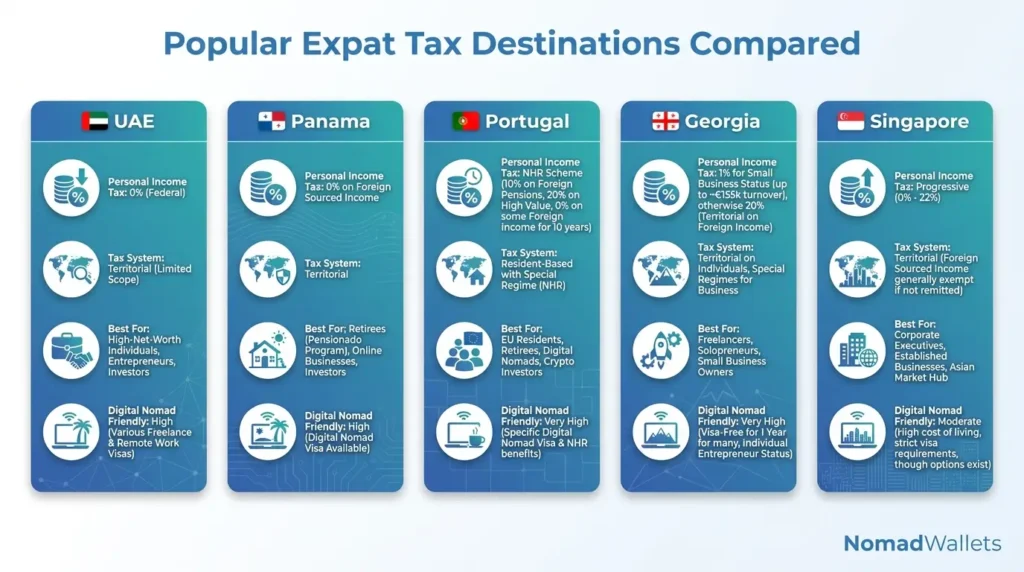
Country Comparison Table
The following comprehensive comparison table provides a side-by-side view of key tax characteristics for the major jurisdictions covered in this guide. This table is designed to serve as a quick reference for expats evaluating their options.
| Country | Residency Rule | Worldwide Tax? | Treaty Network | Digital Nomad Visa |
| USA | Citizenship + Substantial Presence | Yes (citizenship-based) | 68+ treaties | No (B1/B2 for visits) |
| UK | Statutory Residence Test | Yes (residents) | 130+ treaties | No specific DNV |
| Canada | Residential ties + 183-day | Yes (residents) | 94+ treaties | No specific DNV |
| Australia | Multi-factor test + 183-day | Yes (residents) | 45+ treaties | No specific DNV |
| India | 182-day rule | Yes (ROR); Partial (RNOR) | 94+ treaties | No specific DNV |
| Germany | Habitual abode + center of life | Yes (residents) | 95+ treaties | No specific DNV |
| France | 183-day + center of vital interests | Yes (residents) | 120+ treaties | No specific DNV |
| Spain | 183-day + center of vital interests | Yes (residents) | 100+ treaties | Yes (€2,849/mo) |
| Portugal | 183-day + permanent home | Yes (residents) | 80+ treaties | Yes (D8 visa) |
| Italy | 183-day + center of interests | Yes (residents) | 100+ treaties | No specific DNV |
| UAE | 183-day + ties | No (territorial/personal 0%) | 115+ treaties | Yes (remote work visa) |
| Singapore | 183-day + permanent home | No (territorial) | 95+ treaties | No specific DNV |
| Panama | 183-day + ties | No (territorial) | 30+ treaties | Friendly Nations Visa |
| Georgia | 183-day | No (territorial) | 55+ treaties | Remotely from Georgia |
Common Mistakes in Expat Tax Planning
Even well-informed expats make mistakes when navigating the complexities of international taxation. The following are the most common (and most costly) errors that we see, along with guidance on how to avoid them.
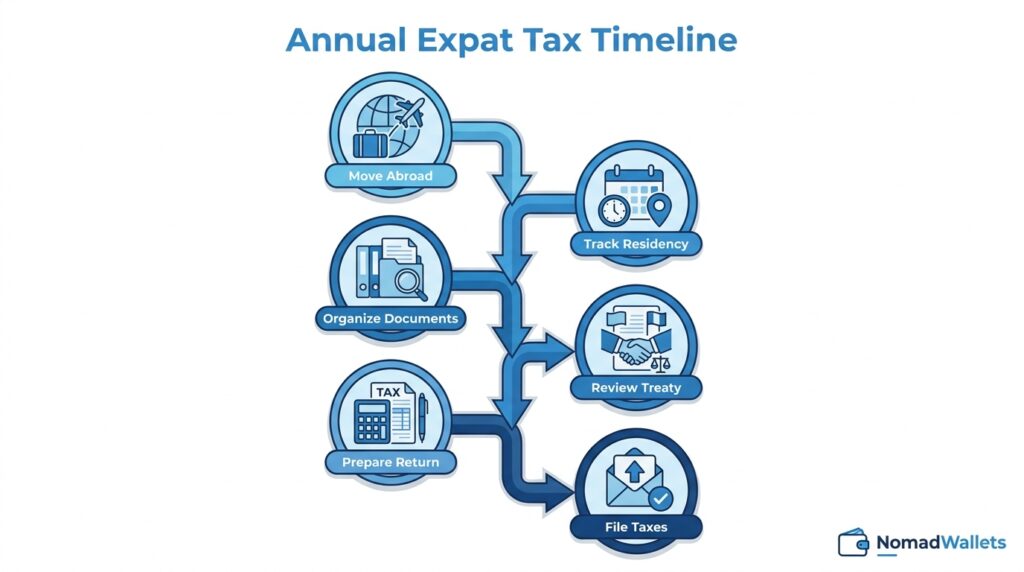
Ignoring Tax Residency Rules
The single most common and most expensive mistake is failing to understand your tax residency status. Many expats assume that if they are not citizens of a country, they do not need to pay tax there. This is wrong. Tax residency is determined by factors like physical presence and residential ties, not citizenship. Similarly, many US citizens abroad are unaware that they must continue filing US tax returns regardless of where they live, and many UK expats do not realize that maintaining a home in the UK can be enough to keep them within the UK tax net even if they spend most of the year overseas.
Failing to understand the interaction between different countries’ tax years is another common error. The US tax year runs from January to December, the UK tax year runs from April 6 to April 5, the Australian tax year runs from July 1 to June 30, and India’s financial year runs from April 1 to March 31. When you move between countries with different tax years, you may need to file returns for overlapping or partial periods, and the timing of income recognition can vary.
This misalignment creates complexity that, if not carefully managed, can lead to double taxation on income that falls within two different tax years in two different countries. A qualified cross-border tax advisor can help you navigate these timing issues and ensure that income is reported in the correct year in each jurisdiction.
Ignoring Tax Treaties
Tax treaties exist specifically to prevent double taxation and to allocate taxing rights between countries, yet many expats never read the relevant treaty for their situation. This is a missed opportunity of potentially thousands of dollars per year. Treaties can reduce withholding rates on passive income; they can exempt certain types of income from taxation in one of the two countries; and they provide dispute resolution mechanisms.
The OECD Model Tax Convention, available at oecd.org, serves as the template for most bilateral treaties and is a valuable reference for understanding how treaty provisions work.
Ignoring FBAR and FATCA Requirements
As discussed in the US section, FBAR and FATCA filing requirements apply to US persons with foreign financial accounts above certain thresholds. The penalties for non-compliance are severe and can far exceed the tax that would have been owed. Every US expat with a foreign bank account should file FBAR, and those with significant foreign assets should file FATCA Form 8938. There is no good reason to skip these filings, and the cost of non-compliance is simply not worth the risk.
Mixing Business and Personal Finances, Filing Late, and Failing to Keep Records
Using a single bank account for both business and personal transactions is a recipe for tax trouble. It makes it extremely difficult to track deductible expenses, calculate profits accurately, and respond to queries from tax authorities. Filing late is another common mistake that can result in penalties and interest charges that accumulate quickly.
And failing to keep adequate records (receipts and invoices, bank statements, tax returns, and travel logs) is perhaps the most pervasive error of all. Without records, you cannot substantiate your tax position if challenged, and you cannot claim deductions or credits to which you are entitled. Good record keeping is the foundation of effective expat tax planning.
The Future of Expat Taxation
The landscape of international taxation is evolving rapidly, driven by the OECD’s Base Erosion and Profit Shifting (BEPS) project, the implementation of the Global Minimum Tax (Pillar Two), the expansion of the Common Reporting Standard (CRS), and the growing popularity of digital nomad visas. Understanding these trends is essential for anyone planning their financial future across borders.

OECD Pillar Two: Global Minimum Tax
The OECD’s Pillar Two framework establishes a global minimum tax rate of 15 percent for multinational enterprises with consolidated revenues of €750 million or more. While this directly affects only very large companies, the framework has broader implications for international tax policy. It signals a global consensus that aggressive tax competition between countries has limits, and it may influence how countries design their tax incentives for attracting internationally mobile individuals.
As of 2025-2026, over 140 countries have committed to implementing Pillar Two, with most implementations taking effect during this period. For individual expats and small business owners, Pillar Two is unlikely to have a direct impact in the near term, but it represents a shift in the global tax environment that could eventually affect personal taxation as well.
Remote Work, Digital Nomad Visas, and Cross-Border Compliance
The explosive growth of remote work and digital nomad visas is creating new challenges for tax authorities worldwide. Over 55 countries now offer digital nomad visas as of 2026, up from fewer than 10 just five years ago. These visa programs are designed to attract remote workers and the economic activity they generate, but they also create potential conflicts with existing tax treaties and domestic tax laws.
A person who holds a digital nomad visa from Spain but spends only three months there before moving to Croatia may create a situation where neither country is entirely sure of its right to tax. The OECD and individual countries are beginning to address these issues, but clear, harmonized rules for taxing highly mobile digital workers remain a work in progress.
The Common Reporting Standard (CRS), developed by the OECD and now implemented by over 100 countries, requires financial institutions to report information about the financial accounts of non-resident individuals to the tax authorities of those individuals’ countries of residence. If you open a bank account in Portugal as a UK tax resident, the Portuguese bank will automatically report the account details to HMRC. The CRS has effectively ended the era of banking secrecy for most of the world, making it virtually impossible to hide assets abroad.
For compliant expats, this is not a problem: tax authorities now have unprecedented visibility into the international financial activities of their residents. This transparency reinforces the importance of proactive, legitimate tax planning: with information automatically flowing between countries, the risk of undetected non-compliance has dropped to near zero.
AI, Automation, and the Future of Tax Compliance
Artificial intelligence and automation are transforming the tax compliance landscape. Tax authorities are increasingly using AI-powered tools to detect non-compliance, identify hidden income, and cross-reference information from multiple sources including the CRS, FATCA, and domestic data. For taxpayers, the cost of non-compliance is rising while the tools for compliance are improving.
Tax software platforms are incorporating AI to automate form preparation, identify optimal filing strategies, and flag potential issues before they become problems. For expats, this trend is a double-edged sword: it makes compliance easier, but it also makes detection of non-compliance more likely. Legitimate tax planning has always mattered, and with AI-powered enforcement tools, its importance is only increasing.
Frequently Asked Questions About Expat Tax Planning
Q1. What is expat tax planning?
A. It is the legal process of organizing your finances across borders to reduce your tax bill while staying compliant. The main levers are choosing where to establish tax residency, applying the right treaty provisions, claiming available exclusions and credits, and selecting a business structure that fits your situation.
Q2. Do digital nomads pay taxes?
A. Yes. Where they pay depends on tax residency (determined by physical presence and ties, not citizenship for most nationalities), the source of their income, and any applicable treaties. A nomad who establishes residency in a territorial-tax country and has no home-country citizenship tax can reduce their burden significantly, but zero-tax everywhere is not a realistic goal.
Q3. How do tax treaties work?
A. Two countries sign a bilateral agreement that decides who gets to tax what. Most follow the OECD Model Convention: the residence country gets the primary right to tax most income, while the source country keeps limited rights on things like royalties and interest, usually at reduced withholding rates. Tie-breaker rules also determine residency when two countries both claim you.
Q4. Can I avoid double taxation legally?
A. Yes. The main tools are tax treaties (which allocate taxing rights), the foreign tax credit (offsetting foreign taxes against domestic liability), the Foreign Earned Income Exclusion (US only), and the exemption method used by many European countries. All of these are standard, legally sanctioned mechanisms: not loopholes.
Q5. What is tax residency?
A. A legal status that determines which country has the primary right to tax your income. It is established by physical presence (e.g., the 183-day rule), where your permanent home is, where your center of vital interests lies, or a combination. Crucially, tax residency is separate from citizenship and immigration status.
Q6. Do expats pay taxes twice?
A. It can happen if you do nothing: two countries both claim the right to tax the same income, and you fail to claim any relief. But treaties, foreign tax credits, and exclusions exist specifically to prevent this. The mechanics vary by country, so the specific combination of tools you use will depend on which jurisdictions are involved.
Q7. What is territorial taxation?
A. The country taxes only income sourced within its borders. Foreign income is left alone. Panama, Singapore, Hong Kong, the UAE, and Georgia all use this model, making them attractive to internationally mobile workers whose income comes from clients or employers outside those countries.
Q8. What is worldwide taxation?
A. The country taxes you on all income, no matter where you earn it. The US applies this based on citizenship (one of only two countries to do so). Germany, Japan, and others apply it based on residency. Credits and exclusions can reduce the bill, but the filing obligation remains.
Q9. What is an NRI?
A. A Non-Resident Indian: an Indian citizen who spends fewer than 182 days in India during a financial year (April–March). NRIs pay Indian tax only on India-sourced income: salary for work done in India, rental income from Indian property, Indian capital gains, and Indian bank interest. Foreign income is generally exempt.
Q10. What is FEIE?
A. The Foreign Earned Income Exclusion, a US tax provision. If you qualify (via the Physical Presence Test of 330 days abroad or the Bona Fide Residence Test), you can exclude up to $132,900 of foreign earned income from your US return for 2026. It covers earned income only (wages, professional fees, and self-employment income), not passive income like dividends or capital gains.
Q11. What is FATCA?
A. A 2010 US law with two prongs: US persons must report foreign financial assets above certain thresholds on Form 8938, and foreign banks must disclose accounts held by US persons to the IRS. For expats living abroad, the thresholds are $200,000 on the last day of the tax year or $300,000 at any point during the year.
Q12. What is FBAR?
A. A FinCEN filing (not an IRS form) that requires US persons to report foreign financial accounts if the aggregate value exceeds $10,000 at any point during the calendar year. File electronically through FinCEN’s BSA E-Filing System. Deadline: April 15, with automatic extension to October 15. Non-willful violations carry a $10,000-per-account penalty; willful violations can reach $100,000 or 50% of the balance.
Q13. How long can I stay abroad without losing my original tax residency?
A. It depends on your home country. US citizens: never. Citizenship-based taxation means the filing obligation follows you permanently. UK: you can become non-resident by meeting the automatic overseas tests or failing the sufficient ties test. Canada: you need to sever residential ties (home, spouse, dependants). There is no universal answer.
Q14. Can I choose my tax residency?
A. You can influence it significantly by controlling where you spend your time, where your family lives, and where you maintain economic and social ties. You cannot simply declare residency in any country, but by planning these factors, you can often select a jurisdiction with favorable tax treatment. What matters is documentation: tax authorities look at evidence, not intentions.
Q15. Which countries have zero income tax?
A. As of 2026: the UAE, Bahrain, Monaco, the Bahamas, the Cayman Islands, Kuwait, Oman, Qatar, Saudi Arabia, Somalia, and Vanuatu. The UAE, Bahrain, and Qatar are the most practical for digital nomads due to infrastructure and visa programs.
Q16. Is Dubai tax-free?
A. For individuals, effectively yes: zero personal income tax, zero capital gains tax, zero inheritance tax. The caveats: a 9% corporate tax applies to businesses with profits over AED 375,000 (introduced 2023), and 5% VAT applies to most goods and services. Most individual nomads and expats are unaffected by the corporate tax.
Q17. How do digital nomads file taxes?
A. They file in every jurisdiction where they have tax residency or where they earn taxable income. For US citizens this means Form 1040 annually regardless of location. Others file based on their country of residence. Many nomads use specialized software or a cross-border accountant, especially when multiple countries are involved.
Q18. Should freelancers open an LLC?
A. A US LLC is a strong option for non-resident aliens with no US trade or business, as it may generate zero US tax on foreign-source income. US citizens benefit from liability protection, though the self-employment tax (15.3%) still applies to FEIE-eligible income. The decision hinges on your citizenship, where your clients are, and whether you need a formal business presence.
Q19. Can I use Wise for business?
A. Yes. Wise Business provides multi-currency accounts with local account details in multiple currencies, low-cost transfers, and accounting software integrations. The limitation: Wise is an electronic money institution, not a licensed bank, so it does not offer lending, credit lines, or deposit insurance in the traditional sense.
Q20. Do I need a tax accountant?
A. If your situation involves multiple countries, treaty claims, business structures, or significant income, the answer is yes: at least for the first year. The cost of a cross-border tax specialist (typically $500–$2,000 for an initial consultation and return) is small compared to the penalties for getting residency status, treaty applications, or filing obligations wrong.
Q21. Which tax software is best for expats?
A. It depends on your home country. US expats commonly use Sprintax, MyExpatTaxes, or TurboTax with the Foreign Earned Income module. UK expats have TaxScouts and Taxfix. Match the software to your filing complexity: simple W-2 income needs less than a multi-country freelancer with foreign tax credits to reconcile.
Q22. How often should expats file taxes?
A. Annually, in every jurisdiction with filing obligations. US citizens file Form 1040 every year. Most other countries also require annual returns, with deadlines varying by jurisdiction. Some countries also require quarterly estimated payments.
Q23. Can I change my tax residency?
A. Yes, by moving to a new country, establishing the connections that make you resident there, and simultaneously severing the ties that keep you resident in your former country. The timing matters: moving mid-year can trigger split-year treatment in both countries. Professional advice before the move is strongly recommended.
Q24. What happens if I don’t file taxes abroad?
A. Penalties accumulate fast. In the US: 5% of unpaid tax per month for failure to file (up to 25%), plus 0.5% per month for failure to pay (up to 25%). FBAR violations start at $10,000 per account for non-willful failures. Other countries impose similar interest, fines, and in extreme cases criminal prosecution.
Q25. What is the best country for expats?
A. No single answer: it depends on whether you prioritize tax savings, visa accessibility, cost of living, healthcare, or quality of life. The UAE and Panama lead on tax. Portugal and Spain offer moderate taxes with high quality of life. Singapore and the UAE suit entrepreneurs.
Disclaimer
This guide is provided for general informational and educational purposes only and does not constitute tax, legal, or financial advice. The information contained herein is based on tax laws, regulations, and treaties as of July 2026 and may not reflect the most current legal requirements. Tax laws change frequently, and the application of tax rules depends heavily on individual circumstances.
You should not act or refrain from acting based on any information in this guide without seeking professional advice from a qualified tax advisor, accountant, or attorney who is licensed in the relevant jurisdiction(s) and familiar with your specific situation. Nomadwallets.com, its authors, contributors, and affiliates shall not be liable for any loss or damage (including, without limitation, consequential, special, or similar damages) arising from the use of or reliance on any information contained in this guide.
Tax obligations vary by individual circumstances, and past results do not guarantee future outcomes. Always verify current requirements directly with the relevant tax authorities (IRS at irs.gov, HMRC at gov.uk, CRA at canada.ca, ATO at ato.gov.au, and the India Income Tax Department) before making any tax-related decisions.
References to specific tax treaties, exclusions, credits, and strategies in this guide are for illustrative purposes and may not apply to your situation. All data points, statistics, and thresholds cited in this article are sourced from official government publications and reputable research organizations. For complete source information, consult the official publications directly.

Tushar Sharma is the founder and editor of NomadWallets, where he writes about international banking, travel cards, cross-border payments, taxes, and financial tools for digital nomads and globally mobile professionals. He created NomadWallets to make global money decisions simpler through practical, research-backed guides built from official sources and real-world financial data.