
This Italy Expat Tax Guide is for anyone moving to Italy or already living there as a foreign national. Understanding how the Italian tax system applies to expats is one of the most important steps you can take before or during your relocation. Italian taxation is layered, detailed, and in many cases tied to your residency status rather than your nationality.
The difference between an immigration resident and a tax resident is not always obvious, and getting it wrong can lead to unexpected liabilities or missed opportunities for tax savings. This guide walks you through every major tax consideration so you can make informed decisions before and after your move.
This guide covers the fundamentals that every expat should know: how Italy determines tax residency, what taxes you may encounter, the special regimes available to newcomers, and how digital nomads, retirees, and high-net-worth individuals are treated under current rules. It reflects the post-2023 residency framework, the 2026 Budget Law changes to IRPEF rates, the updated flat tax for new residents, and the latest filing and reporting guidance from the Agenzia delle Entrate.
Italy taxes its residents on their worldwide income. Non-residents, by contrast, are generally only taxed on Italian-source income. Several special regimes can significantly reduce the tax burden for qualifying individuals, including a substitute flat tax for high-net-worth newcomers, a partial exemption for relocating workers, and a 7% flat rate for qualifying foreign pensioners.
Each of these has specific eligibility criteria and time limits that are worth understanding before you make any commitments. Navigating taxes in Italy for foreigners can feel overwhelming at first, but breaking it down by category makes it manageable.
For broader guidance on structuring your taxes across borders, see our complete expat tax planning guide.
Key Takeaways
- Italy generally taxes residents on their worldwide income, while non-residents are taxed only on Italian-source income.
- Tax residency is not determined by your visa or residence permit alone; it depends on your factual circumstances under a four-criteria test.
- High-net-worth newcomers may qualify for the EUR 300,000 flat-tax regime on qualifying foreign-source income.
- Remote workers and digital nomads should analyze both tax residency and social-security obligations separately from their visa status.
- Foreign bank accounts and foreign investments may trigger reporting obligations through Quadro RW (or Quadro W when using the 730), IVIE, and IVAFE.
Quick Answer: Do Expats Pay Tax in Italy?
Yes, most expats who become Italian tax residents will pay tax in Italy. It depends on your tax residency status and where your income comes from. Italian tax residents are generally subject to tax on their worldwide income, including foreign salary, dividends, interest, rental income, and capital gains. Non-residents are typically only taxed on income sourced from Italy. Foreign income is generally outside the scope of Italian taxation for non-residents.
That said, several special tax regimes can reduce or simplify your obligations. The Impatriate Regime offers a partial income tax exemption for qualifying workers. The new-resident flat tax provides a fixed annual levy on certain foreign income for high-net-worth individuals. The 7% pensioner regime offers a deeply discounted rate for qualifying foreign retirees. Understanding which regime, if any, applies to your situation is the first step toward effective tax planning in Italy.
Italy Tax System at a Glance
Italy levies a range of taxes that can affect expats depending on their residency status, income sources, and asset holdings. The core personal income tax is IRPEF, a progressive tax applied to your total taxable income. On top of IRPEF, regional and municipal surcharges add a further percentage depending on where you live. Social security contributions are mandatory for employees and self-employed workers. Capital gains, property taxes, and wealth taxes on foreign assets add further layers that catch many newcomers off guard.
The following table summarizes the main taxes that expats may encounter in Italy. For official guidance, consult the Agenzia delle Entrate website.
| Tax | What It Applies To | Who May Pay |
| IRPEF | Personal income | Residents and certain non-residents |
| Regional surcharge | Income | Taxpayers |
| Municipal surcharge | Income | Taxpayers |
| Social security | Employment/self-employment | Workers |
| Capital gains tax | Investments, crypto, securities | Investors |
| IVIE | Foreign real estate | Qualifying residents |
| IVAFE | Foreign financial assets | Qualifying residents |
| VAT/IVA | Goods and services | Businesses and consumers |
Who Is a Tax Resident in Italy?

Italy’s Tax Residency Rules
Italy overhauled its tax residency framework with Legislative Decree no. 209 of 27 December 2023, which took effect from the 2024 tax year. Under the current rules, an individual is considered an Italian tax resident if, for the greater part of the fiscal year (meaning more than 183 days, counting even partial days), any one of the following four criteria is met: physical presence on Italian territory, habitual abode (residence) in Italy, domicile in Italy, or registration on the municipal list of resident population. In other words, Italy tax residency is determined by these four criteria working together
The concept of domicile was redefined in this reform. It now refers to the principal centre of your business, professional, and personal interests, not just where you intend to return after temporary absences. Your tax domicile under Italian law is therefore narrower than the everyday meaning of the word, and the Agenzia delle Entrate can establish fiscal residence even when you spend relatively few days in the country.
This is a narrower definition than the previous standard and gives the tax authorities a clearer basis for establishing residency when someone spends significant but not overwhelming time in Italy. Personal and family relationships, such as where your spouse and minor children live, are also relevant factors in the overall assessment.
Registration on the municipal population registry (anagrafe) is an additional indicator. While it is not determinative on its own, it creates a strong presumption of tax residency that you would need to rebut with evidence. The Agenzia delle Entrate looks at the totality of circumstances, so no single factor is treated in isolation. For official guidance on residency determination, see the Agenzia delle Entrate residency page.
The 183-Day Rule in Italy
The 183-day threshold remains part of the Italian tax residency framework, but it is no longer the sole or even primary test. Under the reformed rules, you are considered a tax resident for the greater part of the fiscal year if you meet any one of the four criteria for more than 183 days. Physical presence is just one of those criteria. You could spend fewer than 183 days in Italy and still be classified as a tax resident if, for example, your habitual abode or the centre of your vital interests is in Italy for more than half the year.
Days are counted inclusively, and even partial days count toward the total. The date of arrival and the date of departure each count as one day. This means a person who arrives on 3 July and departs on 31 December has accumulated 182 days of presence and would be one day short of the 183-day physical-presence threshold.
The practical takeaway is that the 183-day rule should not be treated as a safe harbour. Any one of these criteria can be sufficient to establish Italian tax residency when the statutory conditions are met. If you have a long-term rental in Italy, your family lives there, or you run your business from Italian soil, you may be deemed tax resident even if your physical presence falls below 183 days.
Tax Residency vs Legal Residency
It is important to understand that your visa or residence permit status does not determine your tax residency. A visa is an immigration concept. A permesso di soggiorno allows you to live in Italy legally. Tax residency is a separate, fiscal determination based on the four criteria described above.
You can hold a valid Italian residence permit and still be a non-resident for tax purposes if your life centre remains abroad. Conversely, you can be in Italy on a short-stay visa and still trigger tax residency if your circumstances meet the criteria for more than 183 days.
What If Two Countries Consider You a Tax Resident?
Dual tax residency is more common than many people realize. If both Italy and another country claim you as a tax resident, the tie-breaker rules in the applicable double tax treaty determine which country has the primary right to tax you. The standard OECD hierarchy applies in most of Italy’s treaties: first, the country where you have a permanent home available to you takes priority.
If you have a permanent home in both countries, the tie-breaker looks to your centre of vital interests, meaning the country where your personal and economic ties are closer. If that does not resolve it, habitual abode is considered, then nationality, and finally a mutual agreement procedure between the two tax authorities.
Italy Tax Residents vs Non-Residents
The distinction between tax residents and non-residents is fundamental to understanding your Italian tax obligations, and it drives so many other outcomes that we return to it throughout. The table below summarizes the key differences across several dimensions.
| Tax Resident | Non-Resident | |
| Italian-source income | Generally taxable | Generally taxable |
| Foreign income | Generally taxable (worldwide) | Generally outside Italian tax |
| Foreign assets | Potential reporting (IVIE/IVAFE/Quadro RW) | Different obligations |
| Special regimes | Potentially available | Generally unavailable |
Does Italy Tax Worldwide Income?
Yes. Italian tax residents are subject to the worldwide taxation principle, which means the Italian tax authorities consider essentially all income regardless of where it is earned or sourced. Italy foreign income tax rules mean your foreign salary, dividends, interest, and capital gains all fall within the Italian tax net once you are a resident.
This includes foreign employment income, foreign business and freelance income, foreign dividends and interest, foreign rental income, foreign pension income, and foreign capital gains. The rationale is that your tax residence creates a comprehensive tax obligation, not one limited to Italian borders.
Non-residents are in a markedly different position. This Italy Expat Tax Guide covers both situations in depth. They are only taxed on income that has an Italian source, such as salary earned for work performed in Italy, rental income from Italian property, or Italian investment income. Income earned entirely abroad by a non-resident generally falls outside the scope of Italian taxation.
Foreign Tax Credits & Double Taxation
Italy provides relief from double taxation through foreign tax credits and its extensive network of double tax treaties. If you pay tax on the same income in another country, you can generally claim a credit against your Italian tax liability for that income, though the credit is limited to the amount of Italian tax attributable to the foreign income. The mechanism is calculated proportionally and is assessed carefully by the Agenzia delle Entrate.
For detailed information on foreign tax relief and treaty listing, see the Agenzia delle Entrate treaties page.
Italy Income Tax Rates 2026
IRPEF Tax Brackets
Italy’s personal income tax, known as IRPEF (Imposta sul Reddito delle Persone Fisiche), is a progressive tax with three brackets. The 2026 Budget Law reduced the second bracket rate from 35% to 33% for income between EUR 28,000 and EUR 50,000. The Italy tax rates 2026 brackets shown below apply to income that is not subject to a substitute tax regime. These are the rates that matter most if you don’t qualify for a special regime.
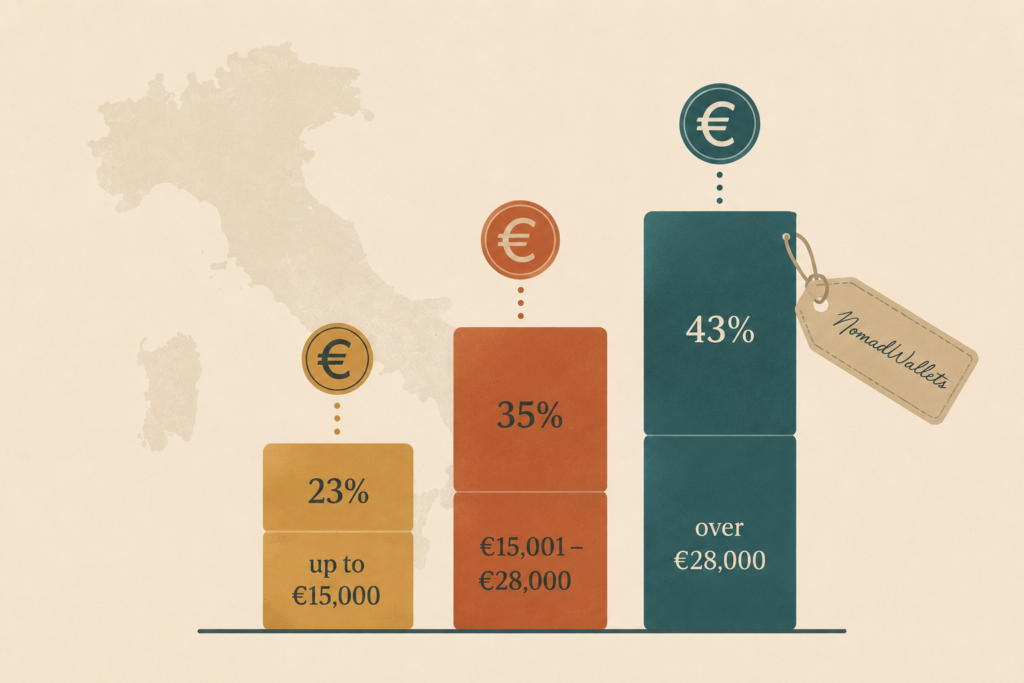
| Taxable Income | IRPEF Rate |
| Up to EUR 28,000 | 23% |
| EUR 28,001 to EUR 50,000 | 33% |
| Over EUR 50,000 | 43% |
A no-tax area applies to employment income below the applicable threshold, meaning income below this level is not subject to IRPEF. For 2026, the no-tax area is approximately EUR 8,500. Deductions for social security contributions, dependent family members, medical expenses, and other permitted items reduce your taxable income before the brackets are applied.
Marginal vs Effective Tax Rate
Your marginal rate is the rate applied to your last euro of income. Your effective rate is the total tax you pay divided by your total income. For example, if you earn EUR 60,000, your first EUR 28,000 is taxed at 23% (EUR 6,440), the next EUR 22,000 at 33% (EUR 7,260), and the remaining EUR 10,000 at 43% (EUR 4,300). Your total IRPEF would be EUR 18,000, which is an effective rate of 30% on gross income, even though your marginal rate is 43%.
Regional & Municipal Tax Surcharges
On top of IRPEF, taxpayers pay a regional surcharge (addizionale regionale) and a municipal surcharge (addizionale comunale). The regional rate generally ranges from 1.23% to 3.33% depending on the region. The municipal rate ranges from 0% to 0.9% depending on the comune. These are applied to your taxable income after IRPEF deductions. Where you live in Italy matters because a taxpayer in Milan may pay a combined surcharge of roughly 2.6%, while someone in a small southern town might pay less than 1.8%.
How Italy Taxes Different Types of Income
Employment Income
Employment income earned in Italy is subject to IRPEF through payroll withholding. Foreign employers with Italian-resident remote workers face the same withholding obligations. Your employer calculates the withholding based on your declared exemptions and deducts it directly from your salary.
If you work for a foreign employer but perform your work from Italy, the income is generally considered Italian-source and subject to Italian tax. Benefits in kind, such as company cars and housing, may also be included in your taxable income according to specific valuation rules.
Self-Employment & Freelance Income
Self-employed individuals and freelancers working in Italy must register for a Partita IVA (VAT number) and report their income through the Italy tax return known as Modello Redditi PF. Income is generally taxed under the progressive IRPEF rates after allowable business deductions.
Freelancers may also qualify for the Regime Forfettario, a simplified flat-rate regime with a substitute tax rate of 15% (or 5% for the first five years for new entrants), provided their annual revenue does not exceed EUR 85,000. Social security contributions under the Gestione Separata INPS are additional and typically range around 25-26% of income.
Rental Income
Rental income from Italian property can be taxed under the ordinary IRPEF regime or under the Cedolare Secca, a flat-rate substitute tax. From 1 January 2026, the standard Cedolare Secca rate is 21% for qualifying long-term leases and 26% for short-term rental contracts and additional properties. Under this regime, the tax is calculated on the gross rent with no deductions allowed, and the landlord opts out of any rent increases tied to inflation.
Foreign rental income earned by Italian tax residents is generally included in worldwide income and taxed at the standard IRPEF rates.
Investment Income
Dividends are generally taxed at a flat rate of 26%. Interest income from bonds and bank deposits is also taxed at 26%. Qualified foreign dividends may be eligible for a foreign tax credit if withholding tax was paid in the source country. Italian-resident individuals holding foreign brokerage accounts must report these holdings through Quadro RW and may be subject to IVAFE, a wealth tax on foreign financial assets.
Capital Gains
Capital gains on the sale of shares, ETFs, and other securities are generally taxed at 26%. Italian real-estate gains can be taxable in specific circumstances, including certain sales occurring within five years of acquisition. Exceptions and special rules can apply, including for inherited property, principal residences and certain properties affected by recent renovation incentives.
Cryptocurrency capital gains are taxed at 33% as of 1 January 2026, and the previous EUR 2,000 annual exemption has been removed. All crypto holdings must be reported in the annual tax return via Quadro RW (or Quadro W when using the 730).
Pension Income
Italian pensions are taxed as ordinary income under the progressive IRPEF rates. Foreign pensions received by Italian tax residents are also generally included in worldwide income. For anyone researching Italy pension tax obligations, the interaction between domestic rules and treaty provisions is critical, though the treatment may be modified by an applicable double tax treaty.
Several treaties, including those with the United States and the United Kingdom, contain specific provisions on how pension income is allocated between the two countries. Qualifying foreign pensioners who relocate to eligible southern regions may instead benefit from the 7% flat tax regime described later in this guide.
Italy’s Special Tax Regimes for Expats

Italy offers several preferential tax regimes designed to attract specific categories of foreign nationals, and figuring out which one, if any, fits your situation. The right regime for you depends on your income structure, wealth profile, and personal circumstances. The table below provides a quick comparison before we examine each in detail.
| Regime | Best For | Main Benefit |
| New Resident Flat Tax | High-net-worth individuals | Substitute tax on qualifying foreign income |
| Impatriate Regime | Qualifying workers | 50-60% tax relief on qualifying income |
| 7% Pensioner Regime | Qualifying foreign pensioners | 7% substitute tax |
| Ordinary Regime | Everyone else | Progressive IRPEF taxation |
Italy’s EUR 300,000 New Resident Flat Tax

What Is Italy’s New Resident Flat Tax?
Italy’s new-resident flat tax is a substitute tax regime that allows qualifying high-net-worth individuals to pay a fixed annual amount of EUR 300,000 on certain foreign-source income, instead of subjecting that income to the progressive IRPEF rates. The regime was first introduced in 2017 at EUR 100,000 per year as a way to attract wealthy foreigners to Italy.
The Italian government has since increased the levy twice: first to EUR 200,000 in 2024, and then to EUR 300,000 under the 2026 Budget Law. For individuals with substantial foreign investment income, dividends, capital gains, or business profits, the flat tax can represent significant savings compared to ordinary Italian taxation.
Who Can Qualify?
To qualify, you must transfer your tax residence to Italy. You must generally not have been tax resident in Italy for at least nine of the ten tax periods preceding the period in which the regime becomes effective. The regime is elective, meaning you must actively opt in when filing your first Italian tax return as a resident. Once elected, the benefit generally lasts for 15 years.
During this period, you are treated as a qualifying new resident and pay the EUR 300,000 substitute tax on eligible foreign-source income. Italian-source income remains subject to the standard IRPEF rates and surcharges.
Why Did the Flat Tax Increase From EUR 100,000 to EUR 300,000?
The original EUR 100,000 rate was set in 2017 under a centre-left government. In 2024, the Meloni administration doubled it to EUR 200,000 as part of a broader fiscal strategy. The 2026 Budget Law further increased the levy to EUR 300,000.
The government’s stated rationale is that the regime was increasingly seen as underpriced relative to the benefits it provides, and that high-net-worth individuals who derive substantial value from Italian residency should contribute more. The increases apply prospectively only: individuals who already elected the regime at a lower rate retain their original rate for the applicable period.
What Foreign Income Does the Flat Tax Cover?
The substitute tax covers foreign-source income including dividends, interest, capital gains, and foreign business income. Essentially, income generated outside of Italy that would otherwise be subject to IRPEF under the worldwide taxation principle is instead covered by the single EUR 300,000 payment.
This makes the regime particularly attractive for individuals with significant foreign investment portfolios or international business operations. The flat tax does not replace Italian-source taxation, so any income earned within Italy continues to be taxed at the standard rates.
What Is Not Covered?
Italian-source income is explicitly excluded from the flat tax. If you earn a salary from an Italian employer, receive rental income from Italian property, or realize capital gains on Italian assets, that income is taxed under the ordinary regime. Certain categories of foreign income may also be excluded depending on the specific structure and source. Professional advice is strongly recommended to determine exactly which of your income streams qualify.
Flat Tax for Family Members
Family members who transfer their tax residence to Italy alongside the main applicant can also benefit from the regime at a reduced rate of EUR 50,000 per year per qualifying family member. This applies to qualifying spouses, children, and other dependent relatives. The reduced rate makes the regime more viable for families relocating together.
Advantages & Disadvantages
The main advantages are predictability and potential savings. A single fixed payment of EUR 300,000 per year covers a wide range of foreign income, regardless of how high that income is. For someone with EUR 2 million in foreign investment income, the effective rate under the flat tax is 15%, well below the top marginal IRPEF rate of 43%. The regime also simplifies reporting for certain foreign income streams.
The disadvantages are equally clear. EUR 300,000 per year is a substantial cost, and the regime only makes financial sense if your foreign income significantly exceeds that threshold.
The eligibility requirements are strict, particularly the nine-year foreign-residency requirement. Italian-source income is not covered, so if you plan to work or earn money within Italy, you will still face ordinary Italian taxes on that portion. Professional advice is essential before committing to this regime.
Who Should Consider Italy’s Flat Tax?
The regime is best suited to high-net-worth investors, international entrepreneurs, and individuals with substantial foreign investment income such as dividends, interest, and capital gains. The regime may be particularly relevant for individuals with substantial foreign-source income, although the financial break-even point varies depending on the type and amount of income.
If you meet the residency requirements, the flat tax is worth exploring with a qualified Italian tax advisor. For individuals with modest foreign income or those who plan to earn significant Italian-source income, the ordinary regime or the Impatriate Regime may be more appropriate. For more details, see the Agenzia delle Entrate guidance on benefits for transferees.
Italy Impatriate Tax Regime 2026

What Is the Impatriate Regime?
The Impatriate Regime (also known as Lavoratori Impatriati) is a preferential tax regime designed to attract skilled workers, professionals, and managers to Italy. Under this regime, a percentage of your qualifying employment or self-employment income is excluded from Italian taxation, effectively reducing your taxable income and your overall tax burden.
The regime has undergone significant reform under Legislative Decree no. 209/2023, with the updated rules applying to individuals who transfer their tax residence to Italy from 2024 onward.
Who Can Qualify?
To qualify under the current rules, you must not have been an Italian tax resident in the three tax years preceding your relocation. You must commit to maintaining Italian tax residence for at least four years. The regime is available to both Italian nationals returning from abroad and foreign nationals moving to Italy.
A degree or professional qualification, or at least three years of work experience in the relevant field, is typically required. For individuals relocating to southern Italy or certain smaller municipalities, some requirements may be relaxed.
What Income Qualifies?
The regime applies to employment income and self-employment income earned in Italy. The exemption is generally capped at EUR 600,000 of qualifying income per year. Income exceeding this cap is fully taxable under the ordinary regime. The benefit starts in the tax year when you transfer your tax residency to Italy.
How Much Tax Relief Is Available?
Under the current regime, the exemption is generally 50%, increasing to 60% where the applicable minor-child condition is satisfied.
How Long Does the Benefit Last?
The benefit applies for the tax year in which you transfer your residence plus the following four years, giving a total of five years of reduced taxation. After this period, your income is fully subject to standard Italian taxation. There is no automatic extension, so planning around the five-year window is essential for long-term residents.
New 2026/2027 Changes
The current Impatriate Regime rules apply consistently to individuals relocating in 2024, 2025, and 2026. No further legislative changes have been enacted as of August 2026 that would alter the fundamental structure for 2026 relocators. However, the government has signalled ongoing interest in refining Italy’s attractiveness for international talent, so future changes remain possible.
For transfers of tax residence in 2026, the two regimes can still be relevant under their respective rules. A new incompatibility applies to taxpayers transferring tax residence from the 2027 tax period onward.
Impatriate Regime vs EUR 300,000 Flat Tax
| Feature | Impatriate Regime | New Resident Flat Tax |
| Target | Workers and professionals | High-net-worth new residents |
| Income covered | Qualifying employment/self-employment | Qualifying foreign income |
| Tax mechanism | 50-60% partial exemption | EUR 300,000 substitute tax |
| Main advantage | Reduced taxable income | Fixed annual foreign-income tax |
| Best suited to | Relocating professionals | Investors with substantial foreign income |
| Duration | 5 years | 15 years |
For official information on the Impatriate Regime, see the Italian Government’s direct taxes page.
Italy’s 7% Tax Regime for Foreign Pensioners

What Is the 7% Pensioner Regime?
The Italy 7% tax regime offers a flat 7% substitute tax on certain foreign-source income for qualifying foreign pensioners who relocate to specific municipalities in southern Italy and central Italian earthquake-affected areas. The regime was introduced to revitalize depopulating areas by attracting retirement-age individuals from abroad.
It covers foreign pensions, investment income, rental income, and capital gains for up to ten years. Importantly, individuals under this regime are also exempt from IVIE and IVAFE and are not required to report foreign assets in their Italian tax return.
Who Qualifies?
You must receive pension income from a non-Italian source and satisfy the other statutory conditions of the regime. You must transfer your tax residence to Italy and register as a resident in one of the qualifying municipalities. You must generally not have been tax resident in Italy during the five tax periods preceding the period in which the option becomes effective. The regime applies for ten years from the year you become tax resident.
Eligible Regions & Municipalities
The eight main eligible regions are Sicily, Calabria, Sardinia, Campania, Basilicata, Abruzzo, Molise, and Puglia. Additionally, certain municipalities in Lazio, Marche, and Umbria that were affected by the 2016-2017 earthquakes also qualify. From 7 April 2026, the population threshold for qualifying municipalities covered by the updated rules was increased from 20,000 to 30,000 inhabitants, expanding the range of eligible locations.
What Income Is Covered?
The 7% rate applies to foreign pensions, foreign investment income, foreign rental income, and foreign capital gains. Italian-source income is not covered and remains subject to standard taxation. The regime provides a comprehensive shield on foreign income streams, which makes it particularly attractive for retirees with diverse international income sources.
How Long Does the Regime Last?
The initial benefit period is ten years. There is no renewal after the ten-year period, so the maximum duration of the regime is ten years.
Is Italy Good for Retirees From a Tax Perspective?
For qualifying foreign pensioners willing to relocate to the eligible southern regions, Italy can be exceptionally tax-efficient. When people research Italy retirement tax options, the 7% regime stands out as one of the best deals in Europe. The 7% flat rate, combined with the exemption from IVIE, IVAFE, and foreign-asset reporting, creates a straightforward and low-cost tax environment.
If you are thinking about retiring to Italy, taxes should be a central part of your planning, and the 7% regime makes a strong case. The quality of life, healthcare access, and cultural amenities in many southern Italian towns add further appeal. The key constraints are the geographic restriction and the requirement to source your pension from outside Italy.
Taxes for Digital Nomads in Italy

Do Digital Nomads Pay Tax in Italy?
Yes, if they become Italian tax residents. A digital nomad who spends enough time in Italy to trigger tax residency under the applicable rules becomes subject to Italian taxation on their worldwide income. This is true regardless of whether they hold an Italian Digital Nomad Visa. The visa governs your legal right to be in the country; tax residency is determined by your factual circumstances.
Italy Digital Nomad Visa vs Tax Residency
The Italian Digital Nomad Visa, introduced in 2022 and refined since, allows non-EU nationals who work remotely to live in Italy for up to one year, renewable. It requires proof of income of at least three times the applicable minimum threshold used for healthcare-contribution exemption, health insurance, and qualifying professional activity. Crucially, holding this visa does not automatically make you an Italian tax resident.
Tax residency is determined by your physical presence, domicile, habitual abode, and municipal registration. If you spend more than 183 days in Italy during a calendar year, you will generally be considered tax resident, but other factors can pull you in even with fewer days.
For a comprehensive look at managing finances as a location-independent worker, see our digital nomad finance guide.
When Does a Digital Nomad Become Tax Resident?
A digital nomad becomes an Italian tax resident when, for more than 183 days of the fiscal year, any one of the four criteria is met: physical presence in Italy, habitual abode in Italy, domicile in Italy, or registration on the municipal population registry. In practice, a digital nomad who rents an apartment in Italy, enrolls their children in local school, and spends more than half the year there will almost certainly be classified as tax resident.
A nomad who bounces in and out of Italy for shorter periods, with no fixed home and no family ties, may avoid it. The analysis is always fact-specific.
How Is Foreign Freelance Income Taxed?
If you are an Italian tax resident working as a freelancer for foreign clients, your worldwide freelance income is subject to Italian tax. You will need to register for a Partita IVA and report your income through the annual tax return. The Regime Forfettario may be available if your annual revenue is below EUR 85,000, offering a flat 15% rate. Social security contributions under Gestione Separata INPS (around 25-26%) are additional.
If you qualify for the Impatriate Regime, 50-60% of your qualifying income may be exempt.
Remote Employee Working for a Foreign Company
If you are employed by a foreign company but physically work from Italy, your employment income is generally considered Italian-source and taxable in Italy. Your employer may or may not withhold Italian tax, depending on whether they have an Italian payroll presence. If they do not, you are responsible for declaring and paying the tax yourself through your annual return. Double taxation treaties may affect how this income is treated, particularly if you are still partially resident in another country.
Do Digital Nomads Need an Italian VAT Number?
If you are carrying out a professional or business activity while physically present in Italy, you generally need to register for a Partita IVA with the applicable declaration-of-commencement deadlines depending on the activity. This applies to freelancers, consultants, and self-employed individuals regardless of whether their clients are Italian or foreign. The Regime Forfettario is a common choice for new entrants because it simplifies compliance and offers a reduced flat tax rate.
Digital Nomad Tax Example
Illustrative example only, not personal tax advice. Consider a foreign freelancer who spends 220 days in Italy during the 2026 tax year, renting an apartment in Milan and registering at the local anagrafe. With 220 days of physical presence and habitual abode in Italy, this individual meets the tax residency threshold. Their EUR 100,000 foreign freelance income is subject to Italian IRPEF.
Under the progressive brackets, the tax would be approximately EUR 35,200 in IRPEF, plus regional and municipal surcharges (roughly EUR 2,000-2,500 in Milan), plus INPS Gestione Separata contributions (roughly EUR 25,000-26,000). The total burden could approach EUR 62,000-64,000. If the freelancer qualified for the Impatriate Regime with a 50% exemption, only EUR 50,000 would be taxable, significantly reducing the IRPEF and surcharge components.
For practical guidance on finding accommodation as a digital nomad in Italy, see our digital nomad accommodation guide.
Foreign Bank Accounts & Investments in Italy
Does Italy Tax Foreign Bank Accounts?
Italy does not directly tax the balance in your foreign bank accounts, but the reporting obligations are what catch people off guard. However, Italian tax residents who hold foreign financial assets are subject to IVAFE (Imposta sul Valore delle Attivita Finanziarie all’Estero), a wealth tax on foreign financial assets. IVAFE generally applies at 0.20% to qualifying foreign financial products. Foreign current and savings accounts are generally subject to a fixed annual charge of EUR 34.20 when the applicable average-balance threshold is exceeded.
Do Expats Have to Report Foreign Accounts?
Yes. Italian tax residents are required to report their foreign financial assets and foreign financial transactions in Quadro RW of their annual tax return. Italy foreign bank account reporting is a serious obligation that should not be overlooked. This includes foreign bank accounts, foreign brokerage accounts, foreign stocks and ETFs, foreign pensions, and foreign investment platforms.
The reporting obligation exists in most cases, although there is an important monitoring exception for foreign bank and current accounts where the maximum aggregate value during the year does not exceed EUR 15,000. However, IVAFE obligations can still create a reporting requirement. Failure to report can result in penalties ranging from 3% to 15% of the undeclared value, doubled for assets held in countries on Italy’s former black list.
What Is Quadro RW?
Quadro RW is a section of the Italian tax return (Modello Redditi PF) dedicated to monitoring foreign assets and financial transactions. Understanding Italy Quadro RW requirements is essential for any resident with foreign holdings. It serves both a reporting function and a tax assessment function. Through Quadro RW, the Agenzia delle Entrate collects information about foreign bank accounts, foreign investments, foreign insurance policies, and other foreign financial holdings.
The data is used to calculate IVAFE and IVIE liabilities and to feed into international automatic information-exchange systems. For the 2026 tax year, the Quadro RW instructions are available on the Agenzia delle Entrate website.
Foreign Brokerage Accounts
Foreign brokerage accounts holding stocks, ETFs, bonds, and other securities must be reported in Quadro RW. IVAFE applies to qualifying foreign financial assets at the applicable rates. For financial products other than current and savings accounts, the rate is generally 0.20%. Capital gains and dividends from these accounts are also subject to Italian tax at the standard rates of 26% and 26% respectively.
Foreign Pensions
Foreign pension entitlements must generally be reported in the Italian tax return. The tax treatment depends on the type of pension and any applicable double tax treaty. Some treaties allocate the exclusive right to tax pensions to the country of residence, while others allow the source country to tax them. Reporting is mandatory regardless of whether Italian tax is ultimately due.
IVAFE: Tax on Foreign Financial Assets
What Is IVAFE?
IVAFE (Imposta sul Valore delle Attivita Finanziarie all’Estero) is an annual wealth tax levied on the value of financial assets Italian residents hold outside the country. Italian residents who hold foreign financial assets may be subject to IVAFE. It was introduced in 2011 alongside IVIE as part of Italy’s fiscal consolidation measures.
The rate is generally 0.20% for qualifying financial products other than current and savings accounts, while qualifying foreign current and savings accounts are generally subject to a fixed annual charge of EUR 34.20 under the applicable conditions.
Who Pays IVAFE?
All Italian tax residents who hold qualifying foreign financial assets are subject to IVAFE. This includes foreign bank accounts, foreign brokerage accounts, foreign investment funds, and certain foreign insurance policies. The tax applies regardless of whether the assets generate income during the year.
Which Financial Assets Are Covered?
IVAFE covers a broad range of foreign financial holdings: bank accounts (current accounts, savings accounts, term deposits), brokerage accounts, shares, bonds, mutual funds, ETFs, and certain life-insurance policies linked to financial markets. Separate reporting and wealth-tax rules may apply to crypto-assets under the Italian rules in force for the relevant tax year. The taxable value is generally the highest balance or market value reached during the year.
IVAFE and Quadro RW
IVAFE is reported and paid through Quadro RW (or Quadro W when using the 730) in the annual tax return. The form generally requires you to list each foreign financial asset, its location, and its value information for the relevant period. The Agenzia delle Entrate uses this information both for IVAFE assessment and for automatic exchange of information with other countries’ tax authorities.
IVIE: Tax on Foreign Property
What Is IVIE?
IVIE (Imposta sul Valore degli Immobili situati all’Estero) is an annual wealth tax on foreign real estate owned by Italian tax residents. The rate was increased from 0.76% to 1.06% by the 2024 Budget Law and remains at 1.06% for 2026. The tax is calculated on the value of the property as determined under the rules of the country where it is located.
Who Has to Pay It?
Any Italian tax resident who owns real estate abroad is potentially subject to IVIE. This includes residential property, vacation homes, land, and commercial real estate located outside of Italy. The tax applies whether or not the property generates rental income.
Foreign Property Covered by IVIE
All categories of foreign real estate are covered: apartments, houses, land parcels, commercial buildings, and building plots. For properties in EU/EEA countries, the taxable value is generally the cadastral (land-registry) value as determined under the local country’s rules. For properties in non-EU/EEA countries, the cost shown in the deed of purchase is used, or the market value if the purchase price is not available.
IVIE Reporting
IVIE is reported and paid through Quadro RW (or Quadro W when using the 730) in the annual tax return. You must declare each foreign property, its location, its type, and its taxable value. Foreign property taxes paid in the country where the property is located may be creditable against the IVIE due in Italy.
Cryptocurrency Taxes in Italy
Does Italy Tax Crypto?
Yes. Italy classifies cryptocurrency as a financial asset for tax purposes. Under Italy crypto tax 2026 rules, the capital gains tax rate on cryptocurrency transactions has increased from 26% to 33% as of 1 January 2026. The previous annual exemption threshold of EUR 2,000 has been removed, meaning all crypto capital gains are now taxable regardless of the amount. Crypto-to-crypto exchanges are treated as taxable disposal events.
Crypto Capital Gains
Capital gains arise when you sell or exchange cryptocurrency for fiat currency, other cryptocurrencies, or goods and services at a price higher than your acquisition cost. The Italy crypto-assets tax rate is 33% under the 2026 rules. Losses can generally be offset against gains in the same tax year. For taxpayers who hold crypto as part of a broader investment portfolio, the interaction with other capital gains rules should be carefully considered.
Crypto Reporting
All Italian tax residents who hold cryptocurrency must complete their Italy crypto reporting obligations by declaring holdings in Quadro RW (or Quadro W when using the 730) of their annual tax return. This includes crypto held on foreign exchanges, in hardware wallets, and on any other platform. The reporting obligation applies even if no transactions took place during the year. A separate 0.2% tax on crypto-assets may also apply under the Italian rules.
Crypto Tax Example
Illustrative example only. A taxpayer buys Bitcoin for EUR 10,000 in March 2026 and sells it for EUR 15,000 in September 2026, realizing a gain of EUR 5,000. In this example, the tax on the gain would be EUR 1,650. Crypto-asset gains are generally taxed at 33% from 2026, subject to specific statutory exceptions. The taxpayer must also report the holding in Quadro RW. Separate reporting and wealth-tax rules may apply to crypto-assets under the Italian rules in force for the relevant tax year.
Capital Gains Tax in Italy
Capital gains in Italy are taxed differently depending on the type of asset. Gains on shares, ETFs, bonds, and other listed securities are generally taxed at 26%. Dividends are also taxed at 26%. Interest income from bonds and deposits is taxed at 26%. Cryptocurrency gains are taxed at 33% as of 2026.
Real estate capital gains are taxable only if the property is sold within five years of acquisition; gains on property held longer than five years are generally exempt. Foreign investments follow the same rates, though double tax treaties may modify the treatment in specific cases.
Property & Rental Taxes in Italy

Buying Property in Italy
When you purchase property in Italy, you may pay registration tax (imposta di registro), a land registry tax (imposta ipotecaria), and a cadastral tax (imposta catastale). For residential property purchased from a private seller, the registration tax is generally 9% of the declared value (or 2% if it becomes your primary residence within 18 months). VAT (IVA) at 10% applies instead if you buy new construction or from a developer. Additional notary fees and agent commissions also apply.
Owning Italian Property
Owning property in Italy triggers IMU (Imposta Municipale Unica), a municipal property tax. The standard rate is 0.86% of the cadastral value, though each municipality can adjust this within a defined range. Primary residences are generally exempt from IMU, with exceptions for luxury properties (categorie A/1, A/8, and A/9).
Rental Income
Rental income can be taxed under the ordinary IRPEF regime or under Cedolare Secca. Under ordinary taxation, rental income is generally taxed on 95% of the gross rent (a standard 5% flat-rate deduction applies, rising to a larger deduction for recognized historic or artistic building), with the taxable portion added to your other income and taxed at the progressive IRPEF rates.
Under Cedolare Secca, the tax is a flat percentage of gross rent with no deductions: 21% for long-term leases (or 10% for qualifying canone concordato/agreed-rent contracts), regardless of how many properties you own. Short-term rentals (30 days or less) are taxed at 21% on one property of your choice and 26% on each additional short-term unit, with a 30% rate applying to a third or fourth short-term unit under the 2026 Budget Law. Cedolare Secca also freezes rent and prevents index-linked increases.
Foreign Property Owned by Italian Residents
Foreign real estate owned by Italian tax residents is subject to IVIE at 1.06% of the property’s taxable value. The property must also be reported in Quadro RW. Foreign property taxes paid in the source country may be credited against the Italian IVIE liability.
Social Security in Italy
Employees
Employees in Italy are subject to mandatory INPS social security contributions (freelancers and EU coordination rules are covered separately below). The total social security burden is approximately 40% of gross remuneration, with roughly 30% borne by the employer and 10% withheld from the employee’s salary, although actual rates vary according to employment category, earnings and applicable contribution rules.
The employee’s share is deductible from taxable income for IRPEF purposes. For 2026, the social security earnings cap is EUR 122,295 for employees who began contributing after 1 January 1996. An additional 1% contribution applies to incomes over EUR 56,224.
Freelancers
Freelancers and self-employed individuals registered under a Partita IVA generally pay INPS contributions through the Gestione Separata at a rate of approximately 25-26% of income. Professionals subject to another mandatory professional fund instead of Gestione Separata may have different rates. Social security contributions are generally deductible from taxable income.
EU Social Security Coordination
Under EU regulations, if you work in multiple EU countries, your social security is generally determined by where you perform the substantial part of your activity. An A1 certificate can confirm which country’s social security system applies to you. This coordination prevents double payment of social security contributions across EU member states.
Social Security Agreements With Non-EU Countries
Italy has bilateral totalization agreements with several non-EU countries, including the United States, the United Kingdom, Canada, and Australia. These agreements coordinate social security coverage and can prevent dual contributions. The specific terms vary by country, so checking the applicable agreement is important before you start working in Italy.
VAT / IVA for Expats & Freelancers
When Do Freelancers Need VAT Registration?
If you carry out a professional or business activity in Italy, you generally need to register for a Partita IVA (VAT number) when starting a qualifying professional or business activity, with the applicable declaration-of-commencement deadlines depending on the activity. Failure to register can result in penalties.
VAT for EU Clients
When providing services to other EU-based businesses, the reverse-charge mechanism often applies, meaning the client accounts for VAT in their own country rather than you charging Italian IVA. For EU consumers, the VAT treatment depends on the type of service and the applicable place-of-supply rules. Digital and electronically supplied services have specific EU VAT rules for digital services.
VAT for Non-EU Clients
Services provided to non-EU businesses are generally outside the scope of Italian VAT. Services to non-EU consumers may require Italian VAT depending on the nature and location of the service. The rules for digital services provided to non-EU consumers have specific thresholds and registration requirements.
Digital Nomads & VAT
Digital nomads working from Italy who provide services to foreign clients generally need a Partita IVA if they are carrying out a continuous professional activity. The Regime Forfettario is the most common choice for new entrants, offering simplified compliance and a flat 15% income tax rate. Under this regime, VAT is not charged on invoices, and no periodic VAT returns are required.
Double Taxation & Tax Treaties
What Is Double Taxation?
Double taxation occurs when the same income is taxed by two different countries. Italy addresses this through foreign tax credits and an extensive network of over 100 double tax treaties. The treaties allocate taxing rights between Italy and the other country and provide mechanisms for relief, including credits, exemptions, and reduced withholding rates.
Foreign Tax Credits
Italian residents who pay tax on foreign-source income in another country can generally claim a credit against their Italian tax liability. The credit is limited to the proportion of Italian tax that corresponds to the foreign income. Unused credits can generally be carried forward. The calculation is detailed in the annual tax return instructions.
Tax Treaty Tie-Breaker Rules
When dual residency arises, the tie-breaker rules in the applicable treaty determine which country has primary taxing rights. The standard hierarchy is: permanent home, centre of vital interests, habitual abode, nationality, and mutual agreement procedure.
Italy-US Tax Treaty
The Italy-US Double Tax Treaty, in force since 1985, allocates taxing rights on employment income, pensions, dividends, interest, and capital gains. However, US citizens remain subject to US worldwide taxation regardless of where they live, due to the treaty’s saving clause. The foreign tax credit, rather than the treaty alone, is the primary tool for managing dual taxation. Americans in Italy must also comply with FBAR and FATCA reporting obligations independently of the treaty.
Italy-UK Tax Treaty
The Italy-UK treaty governs the taxation of income flowing between the two countries. UK pensions received by Italian residents may be taxed in Italy, subject to treaty provisions. The treaty also provides reduced withholding rates on dividends and interest. Following Brexit, the treaty continues to apply, though some aspects of social security coordination have changed.
Italy-India Tax Treaty
The India-Italy Double Taxation Agreement covers employment income, business profits, dividends, interest, royalties, and capital gains. It provides for reduced withholding rates on certain payments and includes a mutual agreement procedure for resolving disputes. Indian citizens living in Italy should examine both the treaty provisions and Indian domestic tax rules, as India also taxes its residents on worldwide income.
Italy-Canada & Australia Treaties
Italy has double tax treaties with both Canada and Australia. These treaties follow the standard OECD model and provide mechanisms for allocating taxing rights and avoiding double taxation. Specific provisions on pensions, dividends, and capital gains vary, so reviewing the applicable treaty text is recommended.
Italy Taxes for US Expats
US citizens living in Italy face a unique dual-compliance burden because the United States taxes its citizens on worldwide income regardless of where they live. This means Americans in Italy must file both Italian tax returns and US federal tax returns. The Italy-US tax treaty helps allocate taxing rights between the two countries, but its saving clause allows the US to continue taxing its citizens as if many treaty provisions did not exist. The foreign tax credit is the primary mechanism for avoiding double taxation: you credit Italian taxes paid against your US tax liability.
US expats in Italy must also comply with FBAR (Report of Foreign Bank and Financial Accounts) and FATCA (Foreign Account Tax Compliance Act) reporting requirements. FBAR requires annual reporting of foreign bank accounts with aggregate balances exceeding USD 10,000 at any point during the year. FATCA requires reporting of specified foreign financial assets above certain thresholds. These obligations exist independently of the tax treaty and carry significant penalties for non-compliance.
Italy Taxes for UK Expats
UK citizens who move to Italy must consider both Italian domestic tax rules and the Italy-UK double tax treaty. Under UK rules, you are generally no longer a UK tax resident once you have left the UK and meet the conditions of the statutory residence test. Italy-UK treaty provisions affect how UK pensions, rental income, and investment income are taxed in Italy.
UK state pensions are generally taxable only in the country of residence, which for Italian residents means Italy, subject to the specific treaty article and the type of pension. Private UK pensions may have different treatment depending on the specific treaty article.
Italy Taxes for Indian Expats
Indian citizens who become Italian tax residents should consider both Italian domestic rules and the India-Italy tax treaty, which can provide mechanisms for relieving double taxation. The India-Italy Double Taxation Agreement provides mechanisms for relief, including reduced withholding rates on dividends (generally 15%) and interest. India also taxes its residents on worldwide income, so dual filing obligations may arise.
The treaty’s tie-breaker rules determine which country has primary taxing rights, and foreign tax credits in each country provide relief from double taxation.
Italy Taxes for Other Foreign Expats
Canadian expats benefit from the Italy-Canada tax treaty, which follows the standard OECD model and covers the main income categories. Australian expats are covered by a similar treaty. EU citizens enjoy additional protections under EU law, including freedom of establishment and non-discrimination principles, though post-Brexit UK citizens no longer benefit from these EU provisions. Nationals of other non-EU countries should check whether Italy has a tax treaty with their home country and, if so, review its specific provisions on their types of income.
Filing Taxes in Italy

Who Needs to File?
Italian tax residents must file an annual tax return if they have income that is not fully covered by withholding at source, or if they have foreign assets to report. Non-residents with Italian-source income above certain thresholds must also file. Employees and retirees with straightforward income situations may use the pre-completed Form 730, which is available from late April. All other taxpayers, including the self-employed and non-residents, file Form Redditi PF.
Modello 730
Form 730 is the simplified tax return used by employees and retirees. It is submitted through a CAF (Fiscal Assistance Centre) or a qualified professional, or directly online via the Agenzia delle Entrate portal. The pre-completed version, available from 30 April, contains data already held by the tax authority. You can modify or supplement this pre-filled data before submission.
Modello Redditi PF
Form Redditi PF is the standard personal income tax return used by self-employed individuals, non-residents, and taxpayers with more complex situations. It includes Quadro RW (or Quadro W when using the 730) for foreign-asset reporting and allows for a wider range of deductions and credits. The form is filed electronically.
Quadro RW
Quadro RW (or Quadro W when using the 730) is the section of the tax return dedicated to foreign assets and financial transactions. It must be completed by all Italian tax residents who hold foreign financial assets, foreign real estate, or who have engaged in foreign financial transactions during the year.
Filing as a Non-Resident
Non-residents file Form Redditi PF. If you are abroad at the time of filing and cannot submit electronically, you may send the return by registered post by 30 November. Non-residents only declare Italian-source income and are not subject to IVIE or IVAFE.
Italy Tax Deadlines 2026
The following table shows the key tax deadlines for the 2026 filing season, which covers income earned in 2025. Exact dates should be verified against the Agenzia delle Entrate before filing.
| 30 April 2026 | Pre-filled 730 available |
| 14 May 2026 | 730 submission window opens |
| 20 May 2026 | Redditi PF pre-filled version available |
| 27 May 2026 | Redditi PF submission window opens |
| 30 June 2026 | Main balance/advance payment deadline |
| 30 July 2026 | 30-day payment extension with 0.40% interest, where applicable |
| 30 September 2026 | Final 730 filing deadline |
| 2 November 2026 | Final Redditi PF filing deadline |
| 30 November 2026 | Second/only advance payment where applicable |
Documents Expats Need for Italian Taxes
When preparing your Italian tax return, having the right documents ready can save time and reduce errors. The following checklist covers the most commonly required items for expats.
- Passport and residence permit/visa
- Codice Fiscale (Italian tax code)
- Residence registration (certificato di residenza)
- Employment records and payslips
- Foreign tax returns and tax payment receipts
- Foreign bank statements for all accounts held
- Brokerage and investment account statements
- Pension statements (Italian and foreign)
- Property records (purchase deeds, rental contracts)
- Evidence of foreign taxes paid
- Investment transaction records (including crypto)
- Social security contribution receipts
Italy Expat Tax Examples
The examples below are simplified illustrations and do not replace professional tax advice. Individual circumstances vary, and you should consult a qualified Italian tax advisor before making any decisions based on these scenarios.
Example 1: Employee Earning EUR 70,000
Illustrative example only. An Italian tax resident employed by a local company earns EUR 70,000 per year. Under the 2026 IRPEF brackets, the tax is EUR 6,440 on the first EUR 28,000 (23%), EUR 7,260 on the next EUR 22,000 (33%), and EUR 8,600 on the remaining EUR 20,000 (43%), for a total IRPEF of EUR 22,300.
Adding regional and municipal surcharges of approximately EUR 2,100, and employee social security of approximately EUR 7,000, the total deduction is roughly EUR 31,400. Net take-home pay is approximately EUR 38,600.
Example 2: Digital Nomad Earning EUR 100,000
Illustrative example only. A foreign freelancer who becomes an Italian tax resident after spending 220 days in Italy earns EUR 100,000 from foreign clients. Under ordinary taxation, IRPEF would be approximately EUR 35,200 (assuming EUR 100,000 of taxable income), plus surcharges and INPS contributions, bringing the total burden to roughly EUR 62,000-64,000.
If the freelancer qualifies for the Impatriate Regime, only 50% of income (EUR 50,000) is taxable, reducing the IRPEF to approximately EUR 13,700 and significantly lowering surcharges. Total cost could drop to around EUR 44,000.
Example 3: Retiree With EUR 45,000 Foreign Pension
Illustrative example only. A UK national retires to a qualifying municipality in Puglia with a foreign pension of EUR 45,000 per year. Under the 7% pensioner regime, the tax on this pension income is EUR 3,150 (7% of EUR 45,000). No IVIE, IVAFE, or Quadro RW reporting is required. The 7% regime produces significant savings compared to the standard IRPEF treatment.
Example 4: Investor With EUR 300,000+ Foreign Income
Illustrative example only. A high-net-worth individual with EUR 2 million in foreign dividends, interest, and capital gains transfers tax residence to Italy and elects the EUR 300,000 flat tax. Under ordinary taxation, the income could face substantial progressive taxation, depending on the income categories and applicable deductions, while the qualifying flat-tax regime would impose the fixed EUR 300,000 substitute tax. Italian-source income, if any, is taxed separately under the standard rates.
Example 5: Foreign Property + Investment Portfolio
Illustrative example only. An Italian tax resident owns a vacation apartment in Spain (cadastral value EUR 150,000) and a foreign brokerage account with a peak value of EUR 200,000 during the year. IVIE on the Spanish property is 1.06% of EUR 150,000 (assuming EUR 150,000 is the applicable IVIE taxable value), equalling EUR 1,590.
IVAFE on the brokerage account is 0.2% of EUR 200,000, equalling EUR 400. Both assets must be reported in Quadro RW (or Quadro W when using the 730). Spanish property tax paid may be credited against the IVIE.
Italy vs Germany vs Spain vs France
How does Italy compare to other popular European destinations for expats? The table below highlights key differences across four major expat destinations.
| Feature | Italy | Germany | Spain | France |
| Worldwide taxation | Yes, generally | Yes | Yes | Yes |
| Special expat regimes | Yes | Different incentives | Yes | Different incentives |
| HNW flat-tax regime | Yes (EUR 300K) | Different system | Notable expat tax incentive | Different system |
| Pensioner incentives | Yes (7% regime) | Varies | Varies | Varies |
| Digital nomad pathway | Yes | Different | Yes | Yes |
| Foreign asset reporting | Yes (Quadro RW) | Yes | Yes | Yes |
For detailed country-specific guidance, see our Germany expat tax guide, Spain expat tax guide, and France expat tax guide.
Is Italy Tax-Friendly for Expats?
Italy Can Be Attractive For
Italy can be genuinely tax-efficient for certain categories of expats. High-net-worth individuals with substantial foreign income may find the EUR 300,000 flat tax compelling, particularly if their foreign income well exceeds the threshold. Qualifying workers who relocate for employment can benefit from the Impatriate Regime’s 50-60% income exemption for five years.
Foreign pensioners willing to live in southern Italy can access one of Italy’s most tax-efficient regimes for qualifying foreign pensioners. International entrepreneurs with foreign-sourced business income and digital nomads who plan carefully around tax residency timing may also find Italy to be a favourable base.
Italy May Be Less Attractive For
Italy is less attractive for high earners who do not qualify for any special regime, as the top marginal IRPEF rate of 43% plus surcharges and social security can produce a substantial overall burden. Individuals with complex foreign-asset structures face potentially onerous reporting obligations through Quadro RW and the IVIE/IVAFE system.
Those who fail to understand or comply with foreign-asset reporting face significant penalties. The tax system is also known for its administrative complexity, and professional advice is often necessary to navigate it correctly.
How to Reduce Your Italian Tax Legally
There are several legitimate strategies for managing your Italian tax burden. First, choose the correct tax regime: the Impatriate Regime, flat tax, pensioner regime, or Regime Forfettario may each offer significant savings depending on your situation. Second, understand tax residency timing: the exact date you transfer your tax residency can affect which year’s income is subject to Italian tax. Third, review foreign tax credits carefully: ensure you are claiming every credit available for taxes paid abroad.
Fourth, use applicable treaty benefits to reduce withholding taxes and avoid double taxation. Fifth, plan your investment structure: Review whether your investment structure is compatible with Italian tax rules and applicable treaty provisions before relocating. Sixth, review your pension structure and consider how Italian tax treatment interacts with your home-country pension rules. Seventh, maintain accurate records for all income, deductions, and foreign-asset holdings.
Finally, obtain professional advice: Italian tax law is complex, and the cost of expert guidance is typically far less than the cost of getting it wrong.
For a structured approach to planning your taxes across borders, see our international tax planning guide.
Italy Expat Tax Planning Before Moving
Before relocating to Italy, work through the following checklist. Determine your likely tax residency status based on your planned length of stay and living arrangements. Review your foreign investments to understand how they will be taxed as an Italian resident. Review any foreign property you own for IVIE and Quadro RW implications. Check how your pensions will be treated under Italian domestic rules and any applicable treaty.
Review your employment or business structure to identify opportunities for the Impatriate Regime or Regime Forfettario. Check whether a double tax treaty applies between Italy and your current country of residence. Investigate which special regime, if any, you may qualify for. Organize your tax records for the past several years.
Review your social-security obligations, particularly if you are moving from a country with a totalization agreement. Obtain your codice fiscale. And consult a qualified Italian tax professional before you make the move.
Italy Expat Tax Planning After Moving
First 30 Days
Register at the local anagrafe (municipal registry). Apply for your codice fiscale if you do not already have one. If you plan to work, register for a Partita IVA within 30 days. Begin organizing your financial records for the Italian tax year.
First 6 Months
Track your days of physical presence in Italy. Open an Italian bank account if needed for daily expenses and tax payments. Review whether you need to make advance tax payments. If you qualify for a special regime, ensure you make the appropriate election in your tax return.
Before Year-End
Review whether you have met any of the statutory tax-residency criteria for the greater part of the tax year. Review your foreign-asset holdings for Quadro RW reporting. Organize documentation for foreign tax credits. If you are considering timing the disposition of investments, evaluate the Italian tax implications before executing.
Before Filing
Gather all required documents. Decide whether to file Form 730 or Redditi PF. Engage a CAF or tax professional if needed. Ensure Quadro RW is completed accurately for all foreign assets. Review your return for completeness before submission.
Common Italy Tax Mistakes Expats Make
- Assuming a visa or residence permit determines tax residency.
- Treating the 183-day rule as the only test for tax residency.
- Ignoring foreign income when calculating Italian tax liability.
- Forgetting to report foreign assets in Quadro RW.
- Confusing IVIE (foreign property) with IVAFE (foreign financial assets).
- Confusing the EUR 300,000 flat tax with the Impatriate Regime.
- Ignoring social security obligations, particularly for freelancers.
- Missing tax filing deadlines and incurring penalties.
- Using outdated Italian tax rules that no longer apply after the 2023 reform.
Frequently Asked Questions About Italy Expat Taxes
Q1. Does Italy tax worldwide income?
A. Yes. Italian tax residents are generally taxed on their worldwide income from all sources. Non-residents are taxed only on Italian-source income.
Q2. How many days can I spend in Italy without becoming a tax resident?
A. There is no single safe number. The 183-day threshold is part of the framework, but you can be classified as a tax resident with fewer days if your domicile, habitual abode, or municipal registration is in Italy for more than half the year.
Q3. Is the 183-day rule still used in Italy?
A. Yes, but as one of four criteria. Under the post-2023 rules, you are a tax resident if any one of the four criteria is met for more than 183 days.
Q4. What is Italy’s EUR 300,000 flat tax?
A. It is a substitute tax regime for high-net-worth new residents, allowing them to pay a fixed EUR 300,000 per year on qualifying foreign-source income instead of progressive IRPEF.
Q5. Who qualifies for Italy’s flat-tax regime?
A. Individuals who transfer tax residence to Italy after generally having been non-resident in Italy for at least nine of the preceding ten tax periods, and who elect the regime in their first Italian tax return.
Q6. What is Italy’s Impatriate Regime?
A. A preferential regime offering 50-60% exemption on qualifying employment or self-employment income for five years, available to qualifying workers who relocate to Italy.
Q7. Can I use the flat tax and Impatriate Regime together?
A. For transfers of tax residence in 2026, the two regimes may still be available under their respective rules. For transfers from the 2027 tax period onward, the new incompatibility rule prevents the two regimes from being combined.
Q8. Do digital nomads pay tax in Italy?
A. If they become Italian tax residents, yes. Tax residency depends on factual circumstances, not visa status.
Q9. Do digital nomads need a VAT number?
A. Generally yes, if they carry out a professional activity from Italy. Registration is required in accordance with the applicable declaration-of-commencement deadlines for the activity.
Q10. Does Italy tax foreign bank accounts?
A. Italy does not tax account balances directly, but IVAFE applies to qualifying foreign financial assets. The rate is generally 0.20% for financial products other than current and savings accounts, while qualifying foreign current and savings accounts are generally subject to a fixed EUR 34.20 charge under the applicable conditions, and Quadro RW reporting is mandatory.
Q11. What is Quadro RW?
A. The section of the Italian tax return for reporting foreign financial assets, foreign real estate, and foreign financial transactions.
Q12. Does Italy tax cryptocurrency?
A. Yes. Capital gains are taxed at 33% as of 2026, the EUR 2,000 exemption has been removed, and all holdings must be reported in Quadro RW (or Quadro W when using the 730).
Q13. How are foreign pensions taxed in Italy?
A. Foreign pensions received by Italian tax residents are generally included in worldwide income, though treaty provisions may modify the treatment. The 7% pensioner regime is available for qualifying retirees.
Q14. How does Italy avoid double taxation?
A. Through foreign tax credits and an extensive network of over 100 double tax treaties.
Q15. Is Italy a tax-friendly country for expats?
A. It can be, depending on your circumstances. Special regimes for high-net-worth individuals, workers, and pensioners offer significant savings. The ordinary regime for high earners without special eligibility is less favourable.
Final Verdict: Is Italy a Good Country for Expats?
The answer depends heavily on who you are and what you earn. A high-net-worth investor with substantial foreign income should investigate the EUR 300,000 flat-tax regime, which could dramatically reduce the effective rate on foreign dividends, interest, and capital gains. A relocating professional should look into the Impatriate Regime, which offers five years of meaningful tax relief on qualifying employment or self-employment income.
A foreign pensioner willing to relocate to southern Italy should explore the 7% regime, which provides one of the most generous pensioner tax environments in Europe.
Digital nomads should approach Italy with clear eyes, analyzing tax residency separately from visa status. The Digital Nomad Visa gives you the right to live and work in Italy, but if you become an Italian tax resident under the applicable rules, you can become subject to Italian taxation on worldwide income. Timing and structure matter enormously.
For ordinary employees without access to special regimes, calculate your expected Italian tax burden, including IRPEF, surcharges, and social security, before making the move. The top marginal rate of 43% plus additional charges can produce a significant combined burden. Understanding the full picture before you arrive is the best way to avoid surprises.
For a structured approach to planning your international tax position, see our complete expat tax planning guide.
Disclaimer
This guide is provided for general informational purposes only and does not constitute tax, legal, or financial advice. While every effort has been made to ensure accuracy based on current Italian tax law, including the 2026 Budget Law and guidance from the Agenzia delle Entrate, tax rules can change and individual circumstances vary significantly. Nothing in this article should be relied upon as a substitute for professional advice tailored to your specific situation.
Before making any decisions related to your tax residency, relocation, or filing obligations in Italy, we strongly recommend consulting a qualified Italian tax advisor (commercialista) or cross-border tax specialist. NomadWallets is not liable for any actions taken based on the information provided in this guide.

Tushar Sharma is the founder and editor of NomadWallets, where he writes about international banking, travel cards, cross-border payments, taxes, and financial tools for digital nomads and globally mobile professionals. He created NomadWallets to make global money decisions simpler through practical, research-backed guides built from official sources and real-world financial data.