

One Wrong Step, One Missing Policy, One Life-Changing Bill
In March 2025, a 36-year-old Canadian named Sophie Chen was mountain biking through the volcanic trails of Guatemala when her front tire caught a loose rock at speed. She went over the handlebars, tumbled down a steep embankment, and fractured her collarbone and three ribs. A local farmer found her unconscious and called emergency services. Sophie was airlifted to a private hospital in Guatemala City, where she spent six days in intensive care before being medically evacuated to Toronto. The total cost of her rescue, hospitalization, surgery, and repatriation came to $67,400.
Note: (Name changed for privacy. Based on a documented 2025 travel insurance dispute shared publicly in a Canadian travel forum.)
Sophie had travel insurance. She had purchased it the night before her flight, clicking through the checkout process in under three minutes. She never read the policy document. When she filed her claim from her hospital bed back in Canada, the insurer denied her claim.“Claim denied. Mountain biking on unpaved, non-designated trails is classified as a hazardous activity and is excluded under your standard policy.”
Sophie did not have adventure sports travel insurance. That single omission cost her nearly $70,000.
Thousands of travelers find themselves in Sophie’s position every year. They assume their basic travel insurance covers them. They assume the tour company’s waiver includes medical protection. They assume their credit card benefits extend to helicopter rescues and emergency surgeries. In nearly every case, they are wrong.
This guide exists to make sure you are not one of them. Over the next several thousand words, you will learn exactly what adventure sports travel insurance is, why it is non-negotiable for active travelers, what it covers and what it excludes, how to compare the best providers in 2026, how much it actually costs, and how to file a claim successfully if the worst happens.
By the time you finish reading, you will have everything you need to choose the right adventure sports travel insurance policy with confidence and travel knowing you are genuinely protected.
Quick Definition
Adventure sports travel insurance is a specialized travel insurance policy that covers medical expenses, emergency evacuation, search and rescue, and trip interruption resulting from high-risk activities such as scuba diving, skiing, mountaineering, skydiving, and rock climbing — activities typically excluded under standard travel insurance.
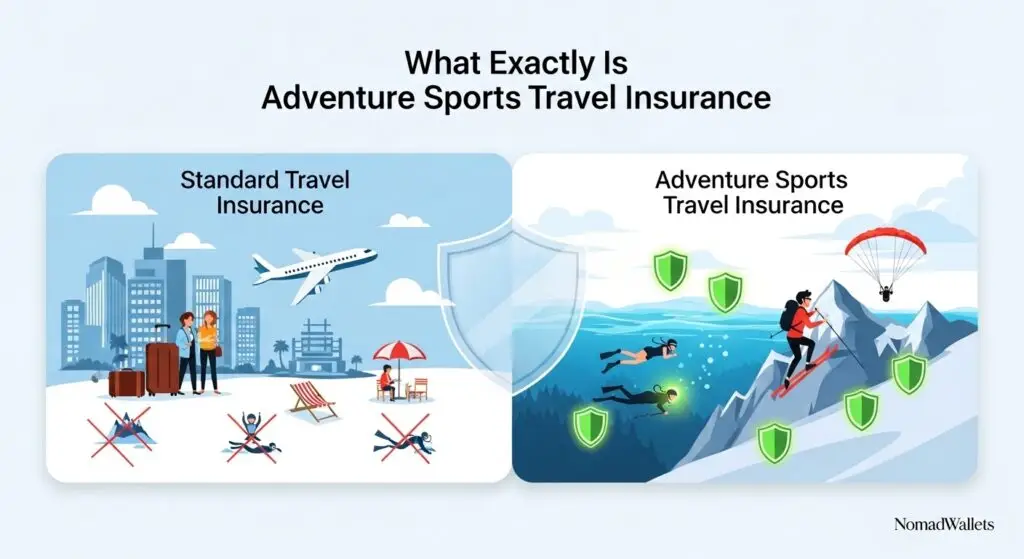
What Exactly Is Adventure Sports Travel Insurance and Why Does It Exist?
Adventure sports travel insurance is a specialized insurance product either a standalone policy or an add-on to a base travel insurance plan. That provides financial protection for injuries, medical emergencies, evacuations, and related costs arising from activities that standard travel insurance classifies as hazardous or high-risk. These activities include things like scuba diving, skydiving, mountaineering, rock climbing, white-water rafting, bungee jumping, paragliding, heli-skiing, surfing, and dozens more.
Standard travel insurance was designed for a different kind of traveler. It covers flight cancellations, lost luggage, minor illnesses, and the kinds of medical emergencies that might happen to someone exploring a city, relaxing at a resort, or taking a guided bus tour. The moment you introduce physical risk — altitude, depth, speed, exposure to remote environments, or reliance on specialized equipment — standard policies draw a hard line. They exclude these scenarios because the statistical likelihood and potential cost of a claim increase dramatically.
Adventure sports travel insurance exists to fill that gap. It acknowledges that millions of people travel specifically to climb, dive, ski, surf, jump, and paddle — and that these travelers deserve a financial safety net just as much as anyone else.
The distinction between the two is not subtle. It is the difference between a $0 hospital bill and a $67,000 one.
Standard vs. Adventure Sports Travel Insurance: Side-by-Side
| Coverage Area | Standard Travel Insurance | Adventure Sports Travel Insurance |
| Trip cancellation and interruption | ✅ Yes | ✅ Yes |
| General medical emergencies | ✅ Yes | ✅ Yes |
| Casual hiking on marked, low-altitude trails | ✅ Usually yes | ✅ Yes |
| Scuba diving beyond 18 meters | ❌ No | ✅ Yes (often to 40m+) |
| Skiing or snowboarding off-piste | ❌ No | ✅ Yes (varies by provider) |
| Skydiving | ❌ No | ✅ Yes (tandem usually; solo varies) |
| Bungee jumping | ❌ No | ✅ Yes |
| Rock climbing | ❌ No | ✅ Yes (guided; free solo varies) |
| Helicopter evacuation from remote terrain | ❌ Excluded or minimal | ✅ Yes (typically $100K–$500K) |
| Search and rescue operations | ❌ No | ✅ Yes |
| Specialized gear and equipment | ❌ No | ✅ Optional add-on available |
| Third-party liability (injuring someone else) | ❌ Rarely | ✅ Often included |
If any activity in the right column is on your travel itinerary, you need adventure sports travel insurance. It is that straightforward.
The Real Cost of Going Without Coverage
Understanding why you need adventure sports travel insurance requires understanding what happens financially when things go wrong in remote, high-risk environments and you are uninsured.
Consider the scale of potential costs.
According to Swiss Air-Rescue Rega’s 2024 annual report, helicopter rescues in the Swiss Alps typically range from €8,000 to €25,000 depending on duration, terrain, and medical complexity.
The U.S. Department of State Bureau of Consular Affairs notes that international emergency medical evacuations by air ambulance can exceed $150,000, particularly when long-distance repatriation is required.
Global healthcare cost comparisons published in the 2024 report by Pacific Prime show that private orthopedic surgery in major Asian medical hubs can vary widely, with procedures such as ACL reconstruction often costing between $12,000 and $30,000 depending on the country and facility.
Guidelines from the Nepal Tourism Board confirm that search and rescue operations for trekkers are billed directly to the individual rescued and frequently range between $5,000 and $20,000 based on altitude and logistics.
These figures are drawn from official reports and published cost data. For uninsured travelers, they represent direct out-of-pocket exposure.
Beyond medical and evacuation expenses, there are additional financial risks that travelers often overlook. Non-refundable deposits for guided expeditions, dive liveaboards, and heli-ski packages can total thousands of dollars if an injury forces cancellation. Specialized gear including dive computers, climbing hardware, and high-performance bicycles may not be covered under standard policies. In some jurisdictions, liability claims arising from accidental injury to another participant may also become the traveler’s personal financial responsibility.
Because medical costs vary dramatically by country, evacuation coverage is often the most important benefit in your policy.
The financial rationale is straightforward: a comprehensive adventure sports travel insurance policy typically costs a few hundred dollars. The potential uninsured exposure can reach tens or even hundreds of thousands.
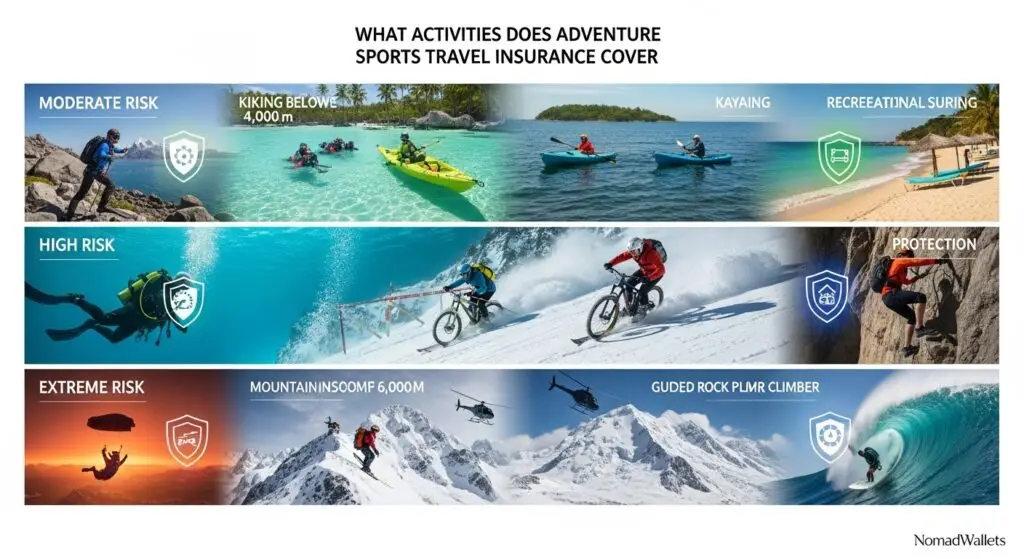
What Activities Does Adventure Sports Travel Insurance Cover?
Coverage varies from provider to provider, and there is no universal industry standard for how activities are categorized. However, most adventure sports travel insurance providers organize activities into risk tiers, with each tier requiring a progressively higher level of coverage and premium.
Activity Coverage by Risk Tier
| Risk Tier | Example Activities | Covered by Most Adventure Policies? | Extra Premium Typically Required? |
| Moderate | Hiking below 4,000m, snorkeling, kayaking, surfing (recreational), horseback riding, zip-lining, road cycling, sailing | ✅ Yes | Rarely |
| High | Scuba diving (18–40m), white-water rafting (Grade 3–4), on-piste skiing and snowboarding, guided rock climbing, paragliding, mountain biking on trails | ✅ Most policies | Sometimes |
| Extreme | Skydiving, bungee jumping, heli-skiing, mountaineering above 5,000m, cave diving, kitesurfing, base jumping, big wave surfing, ice climbing | ⚠️ Varies significantly | Usually yes |
| Professional / Competitive | Any sport performed professionally, in organized competition, or for financial reward | ❌ Excluded by nearly all standard adventure policies | Specialist policy required |
Several activities deserve specific attention because they are commonly searched, frequently misunderstood, and responsible for a disproportionate number of denied claims.
Scuba Diving Coverage Explained
Scuba diving coverage in adventure sports travel insurance almost always includes depth limits. Most policies cover recreational diving to 30 meters. Some extend to 40 meters for divers holding PADI Advanced Open Water or equivalent certification. Technical diving, cave diving, and dives beyond 40 meters typically require additional coverage or a specialist dive insurance policy. If you are planning a dive trip, verify your depth limit and certification requirements before you book.
Skiing and Snowboarding Coverage Explained
Skiing and snowboarding create a coverage spectrum that catches many travelers off guard. On-piste skiing at a recognized resort is covered by virtually all adventure sports travel insurance policies. Off-piste skiing — venturing outside the marked and patrolled boundaries — is where coverage becomes inconsistent. Some policies include it, others exclude it entirely, and some cover it only with a certified mountain guide. Backcountry skiing and heli-skiing are almost always classified as extreme and require top-tier or specialized coverage.
Mountaineering and High-Altitude Limits
Mountaineering and high-altitude trekking are subject to altitude thresholds that differ dramatically between providers. One policy might cap coverage at 3,000 meters, another at 5,000 meters, and a premium policy might extend to 6,500 meters or higher. If your itinerary includes Everest Base Camp (5,364m), Mount Kilimanjaro (5,895m), or any Andean pass above 4,500 meters, you must confirm that your adventure sports travel insurance explicitly covers your maximum planned altitude.
Surfing and Water Sports Coverage
Surfing is generally covered for recreational surfing at standard beach breaks. However, competition surfing, tow-in surfing, and surfing at internationally recognized big-wave locations may be excluded or require a policy upgrade. Always clarify with your provider.
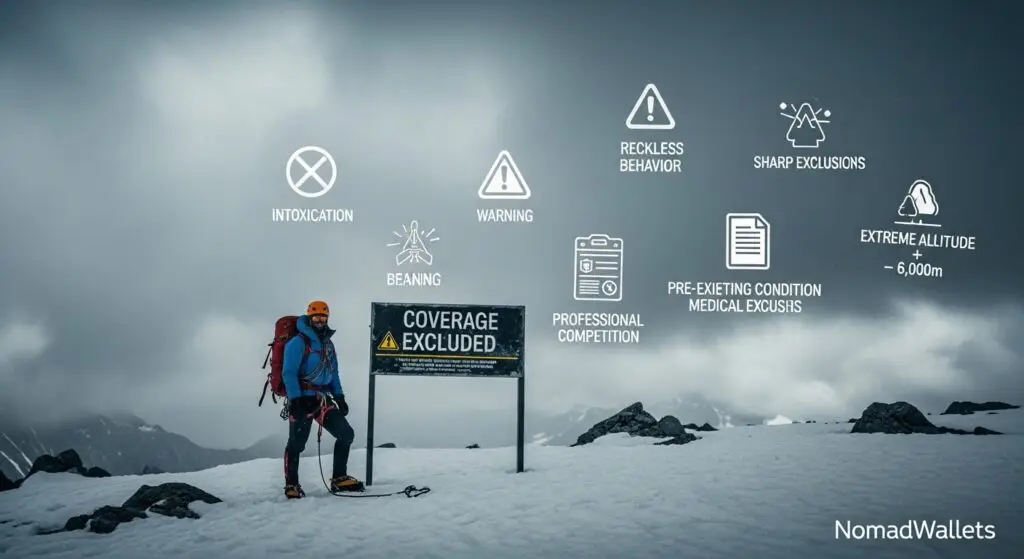
What Is Typically Excluded — Even from Adventure Sports Travel Insurance
Even the most comprehensive adventure sports travel insurance policy has boundaries. Understanding the exclusions is essential to avoiding the shock of a denied claim.
Activities performed while under the influence of alcohol or drugs are universally excluded. This is the most consistently enforced exclusion in the industry, and insurers will use hospital toxicology results to deny claims. Activities undertaken against official warnings — such as entering a closed trail, diving in conditions a professional deemed unsafe, or ignoring a weather advisory — are also excluded.
Professional and competitive sports participation falls outside the scope of standard adventure policies. Pre-existing medical conditions that were not disclosed during the application process can void your entire policy. Activities not explicitly listed in the policy’s covered activity schedule are not covered, regardless of how similar they seem to a listed activity.
Operating motorized vehicles without a valid, locally recognized license is excluded. And most providers will not cover incidents in countries under active government travel warnings or in designated conflict zones.
The lesson from a real traveler makes this concrete. In 2024, a British climber named Tom purchased adventure sports travel insurance for a trip to Kalymnos, Greece, one of the world’s premier rock climbing destinations. He spent two weeks climbing without incident until his final day, when he fell six meters while bouldering alone in an unsupervised area. His policy covered “rock climbing with a certified guide or at a managed climbing facility.” Bouldering alone was neither. His $9,000 medical claim was denied.
Actionable Tip: Before departing, email your insurance provider with the exact name, location, and conditions of every adventure activity you plan to do. Ask for written confirmation of coverage. Screenshot that confirmation and save it in your phone and your email. This single step has saved countless travelers from claim denials.
How to Choose the Best Adventure Sports Travel Insurance in 2026
Selecting the right adventure sports travel insurance policy requires evaluating several critical factors beyond price. Here is what to prioritize.
Activity coverage specificity is the most important criterion. Does the policy explicitly name every activity on your itinerary? Vague language like “adventure sports included” is meaningless without a detailed schedule listing each covered activity along with any relevant conditions, limits, or restrictions.
Medical coverage limits should be a minimum of $100,000 for adventure travel in developed countries and $250,000 to $500,000 or more for remote destinations where evacuation to adequate medical facilities may be necessary. Medical costs escalate quickly abroad, and under-insurance is functionally the same as no insurance when you are facing a six-figure hospital bill.
Emergency evacuation and repatriation benefits must explicitly include helicopter rescue, air ambulance transfer, and medical repatriation to your home country. Look for limits of at least $100,000 for evacuation alone, separate from the medical coverage limit.
Search and rescue coverage is critical for mountaineers, backcountry skiers, ocean sports participants, and anyone venturing into remote terrain. Many countries bill SAR costs directly to the rescued individual, and these costs can be substantial.
24/7 multilingual emergency assistance means you can reach a real person at any hour who can coordinate hospital admission, authorize direct payment, arrange evacuation logistics, and communicate with local authorities on your behalf.
Gear and equipment protection matters if you travel with expensive sports equipment. Confirm whether coverage is at replacement value or depreciated value, and check per-item and total limits.
Provider Evaluation Checklist
| Criteria | Green Flag | Red Flag |
| Activity schedule | Every planned activity named with clear terms | Vague “adventure” language without specifics |
| Medical coverage | $250,000+ | Below $50,000 |
| Evacuation and repatriation | Helicopter + air ambulance, $100K+ limit | Capped at $10,000 or “reasonable expenses” |
| Search and rescue | Dedicated, adequate limit | Not mentioned |
| Gear coverage | Replacement value option | Excluded entirely |
| Emergency helpline | 24/7, multilingual, global | Business hours only |
| Flexibility | Can add activities or extend mid-trip | No modifications permitted |
Top Adventure Sports Travel Insurance Providers for 2026
The following providers are among the most well-regarded in the adventure sports travel insurance market as of early 2026. Always verify current policy details and pricing directly with the provider, as offerings change frequently.

World Nomads Review
World Nomads remains the most recognized name in adventure travel insurance globally. Their Explorer plan covers over 200 activities, policies can be purchased or extended after departure, and their claims process is well established. World Nomads is particularly popular among backpackers, gap year travelers, and multi-activity adventurers. Medical limits vary by plan and nationality but typically reach up to $100,000 on the Explorer tier.
For remote or high-cost destinations such as the United States or alpine Europe, coverage of $250,000–$500,000 is increasingly considered the modern minimum.
IMG Global Review
IMG Global (iTravelInsured) is a strong choice for high-altitude and expedition travelers, with medical limits reaching up to $1,000,000 on select plans and evacuation coverage up to $500,000. IMG’s policies are popular among mountaineers, trekkers planning Himalayan or Andean routes, and travelers heading to medically remote destinations.
Battleface Review
Battleface was designed from the ground up for adventure and extreme travelers. Policies are highly customizable, allowing you to select specific activities and coverage levels. Battleface is one of the few providers that covers travel to conflict-affected and higher-risk regions, making it the go-to choice for travelers with unconventional itineraries.
Heymondo Review
Heymondo has risen rapidly in popularity among European travelers thanks to a seamless app-based experience, competitive pricing, and strong medical and evacuation limits (up to €500,000 on premium plans). Their adventure sports coverage includes a wide range of activities, and their claims process is notably user-friendly.
SafetyWing Review
SafetyWing operates on a subscription model that appeals to digital nomads and long-term travelers. Coverage renews monthly, providing flexibility for open-ended trips. Adventure activity coverage exists but is more limited than dedicated adventure providers, making SafetyWing best suited for travelers who combine moderate adventure activities with extended remote work periods.
Global Rescue Review
Global Rescue is a membership-based evacuation and rescue service rather than a traditional insurer. Members receive access to dedicated field rescue teams capable of extracting them from some of the most remote locations on Earth. Global Rescue pairs exceptionally well with an adventure sports travel insurance policy, adding an extra layer of evacuation security that many serious mountaineers and expedition travelers consider essential.
2026 Provider Comparison Snapshot
| Provider | Best For | Activities Covered | Max Medical Limit | Evacuation Included? | Approx. Cost (2-Week Trip) |
| World Nomads | Backpackers, multi-activity | 200+ | Up to $100,000 | ✅ Yes | $80–$200 |
| IMG Global | Expeditions, high altitude | 100+ | Up to $1,000,000 | ✅ Up to $500K | $100–$250 |
| Battleface | Extreme, remote, conflict zones | Highly customizable | Varies | ✅ Varies | $50–$300 |
| Heymondo | European travelers, app users | 80+ | Up to €500,000 | ✅ Included | €60–€150 |
| SafetyWing | Digital nomads, long-term | Moderate list | Up to $250,000 | ✅ Included | $45–$90/month |
All figures are approximate and subject to change. Verify directly with each provider before purchasing.
What Does Adventure Sports Travel Insurance Actually Cost?
The cost of adventure sports travel insurance is determined by your age, destination, trip duration, selected activities, coverage limits, and deductible. Here are realistic 2026 price ranges based on current market data.
A basic two-week adventure sports travel insurance policy covering moderate-risk activities like hiking, snorkeling, and recreational surfing typically costs between $50 and $200. A comprehensive policy including extreme sports such as skydiving, mountaineering above 5,000 meters, or heli-skiing ranges from $150 to $400 or more for the same duration. Annual multi-trip adventure sports travel insurance policies, ideal for travelers who take two or more adventure trips per year, generally cost between $300 and $800 annually.
Strategies for managing your premium without sacrificing coverage include selecting a higher deductible (which lowers the premium but increases your out-of-pocket cost in a claim), purchasing an annual policy if you travel frequently, comparing quotes from at least three providers, removing activities you will not actually participate in, and buying your policy before your trip begins rather than after departure.
Perspective check: A comprehensive two-week adventure sports travel insurance policy might cost you $200. A single helicopter evacuation in the Himalayas can cost $25,000. That is a 125:1 return on your investment if you ever need it.
How to File a Claim and Get Paid
Filing a successful claim on your adventure sports travel insurance starts the moment an incident occurs, not days or weeks later.
Your first action should be calling your provider’s 24/7 emergency helpline. Many insurers prefer to coordinate and pre-authorize treatment directly with hospitals, which can eliminate the need for you to pay large sums upfront. Early contact also creates an official record of the incident from the beginning, strengthening your claim.
Documentation is everything. Photograph the scene and your injuries. Obtain written medical reports from every treating physician, in English where possible. Keep every receipt — hospital charges, medications, ambulance transport, taxis to the hospital, phone calls, hotel changes, and any other expenses caused by the incident. File a police report if the situation involves theft, a traffic accident, or any third-party interaction.
Submit your claim as soon as practically possible. Most adventure sports travel insurance providers require claims within 30 to 90 days of the incident. Organize your documentation clearly, write a concise chronological narrative of what happened, and include copies of all supporting materials. Keep your own complete file.
Follow up proactively. Claims can take weeks to process, and consistent, polite communication with your claims team keeps your file active and moving toward resolution.
Priya, the 38-year-old hiker from Mumbai whose story appeared in many travel forums in late 2025, is a model of how to do this right. When altitude sickness struck at 4,800 meters on Peru’s Salkantay Trail, she called her adventure sports travel insurance helpline within 90 minutes. She photographed every document, kept every receipt, and filed her claim within a week of arriving home. Her $15,000 evacuation and medical claim was approved in full within 45 days.

Seven Mistakes That Lead to Denied Claims
Based on industry data and traveler testimonials, these are the most frequent and costly errors travelers make with adventure sports travel insurance.
- Assuming standard travel insurance covers adventure activities. It does not. Standard policies exclude hazardous and high-risk sports. Every active traveler needs dedicated adventure sports travel insurance or a verified hazardous activity add-on.
- Skipping the activity schedule and exclusions. The activity schedule is the most important page of your policy. If your specific activity is not listed, it is not covered. Read it completely before you buy.
- Failing to disclose pre-existing medical conditions. Non-disclosure can void your entire adventure sports travel insurance policy, not just claims related to the undisclosed condition. Be thorough and honest.
- Choosing the cheapest policy without examining limits. A $40 policy with $25,000 medical coverage is not insurance — it is an illusion of insurance. Evaluate coverage limits first, price second.
- Not carrying proof of coverage. Many tour operators now require proof of valid adventure sports travel insurance before allowing participation. Save your policy documents on your phone, in your email, and as a printed copy.
- Ignoring altitude, depth, or difficulty limits. Your policy may cover trekking but only to 4,000 meters, or diving but only to 30 meters. Exceeding the stated limit invalidates your coverage for that activity.
- Relying on the tour operator’s insurance. Tour operators carry liability insurance to protect their business. It does not cover your medical bills, your evacuation, or your gear. Your protection is your responsibility.
Who Might Not Need Adventure Sports Travel Insurance?
You may not need specialized coverage if:
- You are only sightseeing in cities
- You are not participating in any altitude, depth, speed, or technical activities
- Your itinerary does not include guided expeditions or adventure excursions
However, even moderate hiking above 3,000–4,000 meters may fall outside standard policy limits.
Frequently Asked Questions
Q1: What is adventure sports travel insurance?
A. Adventure sports travel insurance is a specialized travel insurance product that covers medical expenses, emergency evacuation, trip interruption, and other financial losses arising from participation in high-risk activities such as scuba diving, skydiving, mountaineering, skiing, and rock climbing — activities that standard travel insurance typically excludes.
Q2: Does regular travel insurance cover adventure sports?
A. Almost never. Standard travel insurance policies classify activities like diving, climbing, and skiing as hazardous and exclude them from coverage. You need dedicated adventure sports travel insurance or an explicit hazardous activity rider.
Q3: How much does adventure sports travel insurance cost?
A. A two-week policy for moderate-risk activities costs approximately $50 to $200. Comprehensive extreme sports coverage ranges from $150 to $400+. Annual multi-trip policies cost $300 to $800 per year. Your age, destination, activities, and coverage limits all affect pricing.
Q4: Is adventure sports travel insurance worth the cost?
A. Absolutely. The cost of a policy is a tiny fraction of the potential expenses you face without one. A single helicopter evacuation or emergency surgery abroad can cost $20,000 to $100,000 or more. Adventure sports travel insurance turns a potential financial catastrophe into a manageable, predictable expense.
Q5: Can I buy adventure sports travel insurance after my trip has started?
A. Some providers, including World Nomads, allow post-departure purchase. However, options are more limited, premiums may be higher, and pre-existing incidents are never covered retroactively. Buy before departure whenever possible.
Q6: Does adventure sports travel insurance cover pre-existing conditions?
A. Some providers offer pre-existing condition waivers if you purchase within a specified window (typically 14 to 21 days of your initial trip deposit). Others exclude them entirely. Always disclose fully and confirm in writing.
Q7: Do I need adventure sports travel insurance for hiking?
A. It depends on the type of hiking. Casual day hikes on well-marked, low-altitude trails are often covered by standard insurance. Multi-day treks, high-altitude routes, technical terrain, and wilderness hiking in remote areas require adventure sports travel insurance with appropriate altitude and activity coverage.
Q8: Does adventure sports travel insurance cover my gear?
A. Many providers offer optional gear and equipment coverage for loss, theft, or damage. Check whether it pays replacement value or depreciated value, and note per-item and total coverage limits. High-value items like dive computers or carbon-fiber bikes may need additional coverage.
Q9: Will my adventure sports travel insurance pay the hospital directly?
A. Many providers offer direct payment arrangements with hospitals in their network, particularly when you contact the emergency helpline before treatment. For out-of-network facilities, you may need to pay upfront and submit receipts for reimbursement.
Q10: What happens if my specific activity is not listed in the policy?
A. If an activity is not explicitly named in your policy’s covered activity schedule, it is not covered. Contact your provider before your trip to ask about unlisted activities and get written confirmation of any additions.
Conclusion: The Smartest $200 You Will Ever Spend
Adventure travel is about testing your limits, immersing yourself in wild landscapes, and collecting experiences that no amount of money can buy. But every summit, every dive, every jump, and every rapid carries risk and the financial consequences of that risk, when uninsured, can follow you for years.
Adventure sports travel insurance is not a luxury. It is not an afterthought. It is the single most important non-physical piece of gear you pack. It is the difference between a harrowing story you tell at dinner parties and a financial burden that creates long-term financial strain.
Before your next trip, take three steps. First, list every adventure activity you plan to do, including the specific conditions, altitude, depth, difficulty level, guided or unguided. Second, compare at least three adventure sports travel insurance providers using the criteria in this guide, focusing on activity coverage, medical limits, evacuation benefits, and exclusions. Third, purchase your policy before you depart, read the full policy document, save your emergency helpline number in your phone, and carry proof of coverage with you at all times.
The mountains, the oceans, and the skies are waiting. The right adventure sports travel insurance makes sure you can answer their call without fear.
Get covered. Get out there. Come home with stories, not bills.
If you’re applying for international relocation programs or digital nomad visa requirements, proper insurance is often mandatory — not optional.
Disclaimer: This article is for informational purposes only and does not constitute financial, legal, or insurance advice. Policy terms, coverage limits, pricing, and provider offerings are subject to change. Always read the full policy wording and Product Disclosure Statement before purchasing any adventure sports travel insurance policy. NomadWallets and its publisher are not affiliated with any insurance provider mentioned unless explicitly stated. Verify all details directly with the insurance provider before making a purchase decision. Cost estimates and statistics cited are based on publicly available data from the sources referenced and may not reflect current figures. Last reviewed: 2026.

Hi, I'm Tushar, founder of NomadWallets.com. I created this site after realizing how complicated managing money becomes once you start living and working across multiple countries. Most financial advice online is written for people who never leave their home country, which leaves digital nomads navigating international banking, transfers, taxes, and visas with very little reliable guidance.
NomadWallets exists to provide clear, practical, research-backed financial information for location-independent professionals worldwide. Every article published on this site is researched using official sources, live platform data, and global benchmarks such as World Bank remittance reports. Our research covers international banking, cross-border payments, and financial infrastructure for digital nomads.