
Introduction
If you have just signed a contract in Berlin, accepted a remote role that lets you live in Lisbon-but-actually-Munich, or retired to a flat in Frankfurt, the German tax system will find you. It is thorough, it is federal, and it is surprisingly friendly to anyone willing to file a return. The trouble is that the rules are spread across the Einkommensteuergesetz (EStG), the Abgabenordnung (AO), the Doppelbesteuerungsabkommen with your home country, and a small forest of BMF circulars. This Germany Expat Tax Guide pulls all of it into one place, calibrated for the 2026 tax year and written specifically for foreigners navigating Germany taxes for the first time.
This Germany Expat Tax Guide is written for employed expats, freelancers, business owners, students, retirees, and the growing crowd of digital nomads who have decided to base themselves in Germany for more than a holiday. For broader context on how the German system fits into a global tax-residency strategy, see our Expat Tax Planning Guide. If you are still deciding where to base yourself, our Digital Nomad Finance Guide compares Germany with other popular bases.
If you are paid in euros, paid in dollars, paid in crypto, or paid in stock options, the same question applies: do the Finanzamt and you agree on what counts as taxable German income? Most disputes with the German tax office are not about rates. They are about classification, residency, and timing. The Germany Expat Tax Guide spends most of its pages on those three things, with concrete Germany tax residency rules, German income tax brackets, and the filing steps you will actually use.
By the time you reach the FAQ at the end of this Germany Expat Tax Guide, you should know whether you are a German tax resident, which tax class applies to you, what your marginal and effective Germany tax rates will look like, what social security you are paying into and why, whether your freelance invoices comply with § 14 UStG, and how to file your Germany tax return through ELSTER without paying a German accountant €600 for a return that should take you a weekend.
Where the law is fuzzy (permanent establishment for remote workers, the Aktivrente rule for working retirees, the new Kleinunternehmer threshold), the Germany Expat Tax Guide tells you it is fuzzy and explains what the Finanzamt is likely to do.
Quick Summary
Ten points before the detail. The Germany Expat Tax Guide distils the system into the essentials. If you only read this box, you will still be ahead of most newcomers arriving at the Bürgeramt next week.
✔ Germany taxes residents on worldwide income, not just German-source income.
✔ Non-residents pay tax only on German-source income, typically at the same rates.
✔ Income tax is progressive, from 14% up to 45% (the Reichensteuer) on very high incomes.
✔ Social security is mandatory for most employees; expect roughly 20% of gross to vanish before it hits your account.
✔ Church tax (8% or 9% of income tax) applies only if you have not formally left a recognised church.
✔ Germany has more than 90 double taxation treaties. If you have foreign income, one of them probably covers you.
✔ ELSTER is the official, free filing portal; commercial apps are convenient but cost money.
✔ The 183-day rule is real, but a single Anmeldung at the Bürgeramt can make you resident on day one.
✔ Freelancers and remote workers face permanent-establishment risk for their foreign employer beyond roughly 60 days of presence.
✔ Voluntary filers have four years to claim a refund. Mandatory filers have until 31 July of the following year.
How Germany’s Tax System Works
The Germany Expat Tax Guide starts here, with the architecture. Germany is a federal republic, and its tax system reflects that. The federal government sets the income tax code (the Einkommensteuergesetz (EStG)), but the actual business of collecting taxes in Germany is handled by more than 600 local tax offices, the Finanzämter, each run by one of the 16 Länder.
The Federal Central Tax Office (Bundeszentralamt für Steuern (BZSt)) sits above them, handling international taxation, VAT-IDs, and the central register of tax identification numbers. Customs (Zoll) collects German VAT on imports and excise duties on tobacco, alcohol, and fuel. Tax policy and treaty negotiation sit with the Federal Ministry of Finance (BMF).
The tax year is the calendar year. German payroll tax (Lohnsteuer) is withheld monthly by your employer and forwarded to the Finanzamt through the ELSTER system. Self-employed people pay quarterly prepayments (Vorauszahlungen) based on the most recent assessment, with a true-up after the annual return. Every individual who registers an address in Germany receives an 11-digit Steuer-ID (Tax ID Germany) from the BZSt, which stays with them for life; businesses receive a separate Steuernummer from the local Finanzamt, and an EU-wide USt-IdNr.
(VAT ID) if they trade across borders. The BMF publishes an annual summary of changes (“Das ändert sich 2026”) that consolidates the year’s rate and threshold updates, essential reading for anyone working through a Germany tax calculator.
German Tax Authorities
| Authority | Responsibility |
| Finanzamt (local) | Income tax, trade tax, VAT, payroll tax assessment |
| BZSt (Bundeszentralamt für Steuern) | International taxation, Steuer-ID registry, VAT-ID, withholding tax |
| Zoll (Customs) | Import VAT, excise duties, cross-border goods |
| Bundesministerium der Finanzen (BMF) | Tax policy, official guidance, treaty negotiations |
| Key Takeaway Your point of contact for almost every personal tax question is your local Finanzamt. The BZSt issues your Steuer-ID and handles international matters, but assessments, refunds, and audits come from the local office, and they answer letters in German. |
Tax Residency in Germany
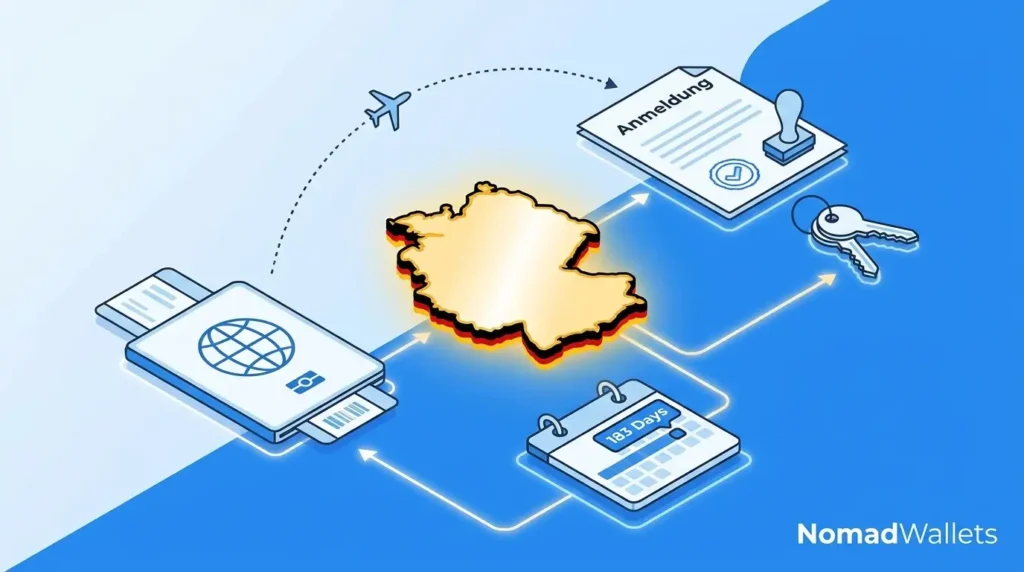
Residency is the single most consequential classification in German tax law, and the Germany Expat Tax Guide treats it accordingly. Understanding Germany tax residency rules matters because resident individuals are taxed on their worldwide income Germany-wide, while non-residents are taxed only on German-source income. Two tests determine German residency for tax purposes, and either one is enough to trigger it.
The first is the Wohnsitz test under § 8 AO (Abgabenordnung): if you occupy a dwelling under circumstances suggesting more than temporary use (a signed lease, a registered address, furniture, family with you), you are resident from the day you move in. The second is the gewöhnlicher Aufenthalt test under § 9 AO: the 183-day rule Germany applies. If you are physically present in Germany for more than 183 days in any twelve-month period, you are resident, regardless of whether you signed a lease.
The 183-day count uses a rolling twelve-month window and short absences do not reset the clock. Weekends, holidays, business trips abroad: they all count as German days if your habitual residence is in Germany. What does break the count is genuinely relocating abroad with a new permanent home and deregistering (Abmeldung) from Germany. Until you deregister, the Finanzamt presumes you are still resident.
The OECD Model Convention Article 4 tie-breaker rules (permanent home, centre of vital interests, habitual abode, nationality) apply when two countries both claim residence, a common situation for anyone living in Germany taxes-wise while holding a foreign employer or foreign assets.
Anmeldung at the Bürgeramt is compulsory within 14 days of moving into a German address (some cities extend this to six weeks, but Berlin and Munich still enforce the 14-day rule and may issue fines). The Anmeldung is what generates your Steuer-ID and is treated by the tax office as evidence of residence. Many expats become German tax residents on day one of their registration, long before the 183-day threshold is reached. For the broader framework on how residency interacts across multiple countries, our Expat Tax Planning guide lays out the OECD tie-breaker tests in detail.
Leaving Germany
When you leave, you deregister at the Bürgeramt and the Finanzamt issues a Bescheinigung für Steuerbescheinigung (or simply notes the move in your file). If you have foreign rental income that becomes taxable in Germany because of the ten-year rule for real estate, or if you held restricted stock that vests after departure, expect the Finanzamt to take an interest. Leaving Germany does not retroactively undo your tax obligations for the months you were present.
Examples
- Example A: Canadian software engineer Signs a 12-month lease in Hamburg, registers, and starts work on 1 March. Tax-resident from 1 March, worldwide income from that date.
- Example B: UK consultant on a project Stays in Berlin short-term lets for 200 days, never registers, returns to London. Under § 9 AO, tax-resident because presence exceeded 183 days in a 12-month period, even without Anmeldung.
- Example C: Swiss-German dual resident Spends 150 days in Munich and 215 days in Zurich over the year. Germany wins under the treaty tie-breaker because the centre of vital interests is Munich (permanent home, family, employer).
| Common Mistake Believing that as long as you spend fewer than 183 days in Germany you cannot be taxed as a resident. The Wohnsitz test can make you resident on day one. If you have a German lease and Anmeldung, you are resident. The day count only matters if you do not have a permanent home. |
Who Pays Tax in Germany
Almost everyone with German-source income pays some tax in Germany. The classification that matters is resident versus non-resident, because it determines whether worldwide income is in scope. Within those two buckets, the Germany Expat Tax Guide covers Germany taxes for foreigners, employees, freelancers, business owners, students, retirees, and the increasingly common category of remote employees of foreign companies, each with slightly different rules.
Employees
Employees have Lohnsteuer withheld by the employer each month, along with the employee share of social security, church tax (if applicable), and the solidarity surcharge (if applicable). The withholding is based on the employee’s tax class (I–VI). At year-end many employees file a voluntary return to claim deductions and recover overpaid tax, the average refund in recent years has been just over €1,000.
Freelancers and the Self-Employed
Freelancers (Freiberufler), doctors, lawyers, artists, journalists, engineers, consultants, are exempt from trade tax. Trades (Gewerbetreibende), virtually any other commercial activity, must register a Gewerbe and pay Gewerbesteuer on profits above the €24,500 allowance. Both groups file quarterly prepayments and an annual Einkommensteuererklärung plus a Umsatzsteuervoranmeldung for VAT if turnover is above the Kleinunternehmer limit.
Business Owners
GmbH and AG profits are subject to corporate income tax (Körperschaftsteuer, 15%) plus the solidarity surcharge (0.825%) plus trade tax, giving an effective combined rate of roughly 30% in most major cities. Distributions to shareholders are then taxed at 25% Abgeltungsteuer plus 5.5% Soli, a classical double taxation that makes holding companies attractive in some structures.
Digital Nomads
If you are working from Germany for a foreign employer and you exceed 183 days, you are German tax-resident. Your foreign salary is taxable in Germany, usually with relief under the applicable DTA. The bigger risk is on the employer side: habitual remote work from Germany can create a permanent establishment for the foreign company, exposing it to German corporate tax and social security registration. We cover this in detail below.
Students and Retirees
Students with a mini-job (up to €538/month in 2026) pay no income tax or social security. Above that, normal rules apply. Retirees drawing a German statutory pension are taxed on the taxable portion, which for new retirees in 2026 is 84% of the pension (rising 1 percentage point per year toward 100% in 2040), as set out by the Deutsche Rentenversicherung pension taxation guide. Foreign pensions are taxable in Germany if the recipient is resident, subject to DTA relief. From 2026, working retirees past the statutory retirement age can earn up to €2,000/month tax-free under the new Aktivrente rule (§ 34a EStG).
Residents vs Non-Residents
| Aspect | Tax Resident | Non-Resident |
| Taxable income scope | Worldwide income | German-source income only |
| Tax rates | Same progressive tariff | Same progressive tariff |
| Filing obligation | Mandatory annual return | Limited obligation; withholding on German income |
| Social security | Mandatory if employed in Germany | Not applicable unless working in Germany |
| Church tax | Applies if church member | Generally not applicable |
| DTA relief | Yes, for foreign-source income | Yes, for German-source income taxed abroad |
German Income Tax Rates (2026)
Germany’s income tax is progressive in the proper sense, the marginal rate rises continuously through two progression zones, not in clean steps. The Germany Expat Tax Guide lays out the 2026 tariff, set out in § 32a EStG, which raises the basic tax-free allowance (Grundfreibetrag) to €12,348 for singles and €24,696 for jointly assessed couples, as confirmed by the BMF 2026 changes summary.
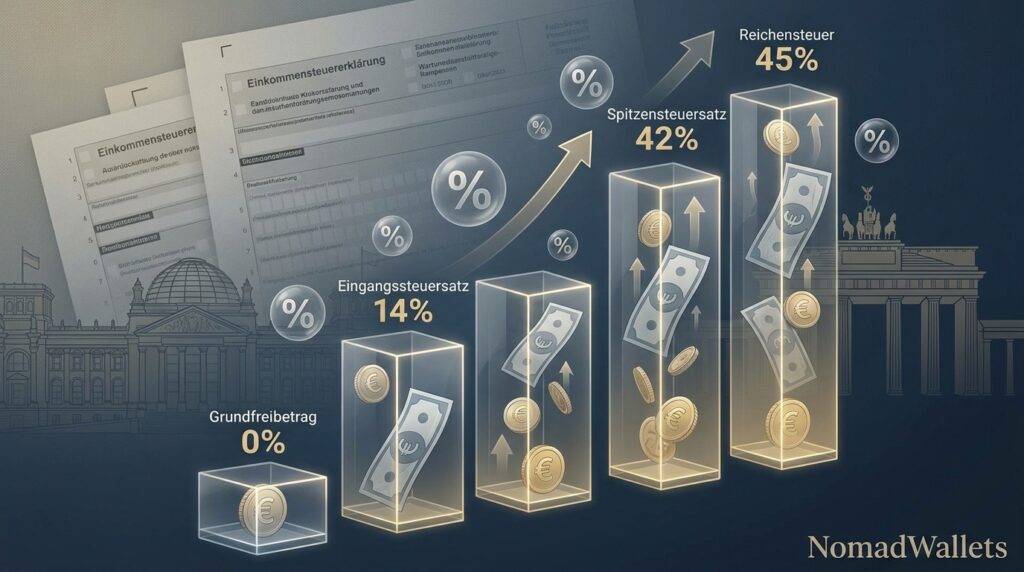
The 42% top rate (Spitzensteuersatz) now kicks in at €69,879 of taxable income for singles, up from €66,760 in 2025. The 45% Reichensteuer remains at €277,826, unchanged from 2025. The official BMF income tax calculator is the Germany tax calculator of record and computes liability for any year from 1958 onward.
Tax Brackets for 2026 (Single Filers)
| Taxable income (€) | Marginal rate |
| 0 – 12,348 | 0% (Grundfreibetrag) |
| 12,349 – 17,799 | 14% rising to ~24% |
| 17,800 – 69,878 | ~24% rising to 42% |
| 69,879 – 277,825 | 42% (Spitzensteuersatz) |
| From 277,826 | 45% (Reichensteuer) |
For jointly assessed married couples, the splittingverfahren effectively doubles the brackets: each spouse is taxed on half of the combined income at the single rates, then the result is doubled. This is generous when one spouse earns much more than the other, and neutral when both earn the same.
| Worked Example, Single Employee in Berlin A single employee earning €70,000 gross in 2026, with standard pension and health insurance deductions, lands at roughly €45,500 of taxable income after Werbungskostenpauschale, social security, and the Grundfreibetrag. Income tax works out to about €10,400, with an effective rate of around 14.9% on gross and a marginal rate of 30%. Net pay after all deductions and church tax (assuming no church membership) is approximately €44,000. |
| Worked Example, Freelancer in Munich A freelancer with €90,000 of profit after expenses falls in the 42% zone. Income tax is approximately €22,800, plus trade tax at the Munich Hebesatz of 490%, an effective rate of around 17.15% on profit above €24,500. Soli applies because income tax exceeds the Freigrenze. Total tax burden before VAT: roughly €29,000. |
The difference between marginal and effective rate is large in Germany because of the broad progression zone and the generous Grundfreibetrag. A €70,000 earner pays a 30% marginal rate but an effective rate below 15%. Many expats are surprised by how much they keep, and equally surprised by how fast the 42% bracket arrives once they pass €70,000.
Social Security
Germany social security is built on five pillars: statutory health insurance (Krankenversicherung), statutory pension (Rentenversicherung, which funds German pension contributions), long-term care (Pflegeversicherung), unemployment (Arbeitslosenversicherung), and accident insurance (Unfallversicherung, paid entirely by the employer). For most employees these are compulsory and split roughly 50/50 between employer and employee.

Total employee-side contributions in 2026 work out to around 20–21% of gross salary, capped at the Beitragsbemessungsgrenze. If you are comparing German public health insurance against international digital-nomad health plans, our Digital Nomad Healthcare Guide weighs the trade-offs. The Germany Expat Tax Guide summarises the 2026 rates and ceilings set out in the Sozialversicherungsrechengrößen-Verordnung 2026 and published by the Deutsche Rentenversicherung.
The headline change for 2026 is in health insurance: the average Zusatzbeitrag rises from 2.5% to 2.9%, taking total average KV contributions to roughly 17.5%, see the Techniker Krankenkasse 2026 overview. Long-term care contributions also rise, to 3.6% for those with children or under 23, and 4.2% for childless individuals aged 23 and above (the 0.6% surcharge is paid entirely by the employee), as documented by the AOK Pflegeversicherung contribution table.
Pension and unemployment rates stay at 18.6% and 2.6% respectively. The contribution ceilings (BBG) are confirmed by the Bundesregierung announcement.
Contribution Ceilings (Beitragsbemessungsgrenze) for 2026
| Branch | Rate 2026 | Employee share | Monthly ceiling |
| Pension (RV) | 18.6% | 9.3% | €8,450 |
| Unemployment (AV) | 2.6% | 1.3% | €8,450 |
| Health (KV) | 14.6% + Zusatzbeitrag (~2.9%) | ~8.75% | €5,812.50 |
| Long-term care (PV) | 3.6% – 4.2% | 1.8% – 2.4% | €5,812.50 |
Employees earning above the ceilings pay no social security on the excess. A senior manager on €15,000 a month, for example, pays pension contributions on only the first €8,450, the rest is social-security-free, though income tax continues to apply at the top rate. The pension ceiling is now uniform across Germany (the historic East/West split ended in 2025).
| Employer Side The employer matches pension, health, long-term care, and unemployment contributions euro-for-euro, and pays 100% of accident insurance. Total employer cost on top of gross salary is roughly 20%, meaning a €60,000 gross salary actually costs the employer around €72,000. This is why German offers are often framed as ‘Bruttolohn’ rather than total compensation. |
Expats seconded to Germany from an EU/EEA country can often keep their home social security for up to 24 months using the A1 form. For non-EU secondees, bilateral social security agreements apply, the US-Germany Totalization Agreement is the most commonly used. Without such an agreement in place, foreign employees become subject to German social security from day one.
Church Tax (Kirchensteuer)
Church tax Germany is levied on members of recognised religious communities, predominantly the Roman Catholic Church, the Protestant Church in Germany (EKD), and Jewish communities. The Germany Expat Tax Guide explains the mechanics: the rate is 8% of income tax in Bavaria and Baden-Württemberg, and 9% in all other states, as set out by the Kirchensteuer-Wirkt portal and confirmed by consumer advice service Finanztip.
It is calculated on the income tax assessment, not on income itself, so a 9% church tax does not mean an extra 9 percentage points on your income.
If you registered a religion on your Anmeldung form, your employer will withhold church tax monthly alongside Lohnsteuer. If you did not register a religion, no church tax is withheld, but if you are a member of a recognised church, you are still legally liable and the Finanzamt will assess it at year-end. Opting out requires a formal church exit (Kirchenaustritt) at the local Standesamt or Bürgeramt; the VLH (Lohnsteuerhilfeverein) guide explains the procedure and the deduction treatment of church tax paid.
| State (Bundesland) | Church tax rate |
| Bavaria (Bayern) | 8% of income tax |
| Baden-Württemberg | 8% of income tax |
| All other states | 9% of income tax |
| Practical Note Many expats who grew up Catholic or Protestant in their home country are surprised to find the German church pursuing them for tax. If you are no longer practising, a Kirchenaustritt is quick (one visit to the Bürgeramt, small fee of €10–30) and stops the liability going forward. It does not backdate. Churches may also refuse sacraments to members who have formally exited, weigh that if it matters to you. |
Freelancer & Self-Employed Taxes

This section of the Germany Expat Tax Guide doubles as a Germany freelancer tax guide. Germany distinguishes between Freiberufler (liberal professionals such as doctors, lawyers, architects, artists, journalists, and consulting engineers, listed in § 18 EStG) and Gewerbetreibende (tradespeople running any other commercial activity). The distinction matters because Freiberufler are exempt from trade tax (Gewerbesteuer) and from registering with the Gewerbeamt.
The Finanzamt decides your classification when you file the Fragebogen zur steuerlichen Erfassung, you do not choose it. German self-employed taxes follow the same progressive income tax tariff as employees, plus trade tax for Gewerbetreibende.
Business Registration
Every new freelancer or self-employed person must file the Fragebogen zur steuerlichen Erfassung electronically via ELSTER before starting work. The Finanzamt then issues a Steuernummer and, on request, a USt-IdNr for cross-border EU trade. Gewerbetreibende must also register with the local Gewerbeamt, a separate, smaller procedure that costs €20–60. The BZSt USt-IdNr. portal processes VAT-ID applications.
VAT (Umsatzsteuer)
Standard rate is 19%, reduced rate 7% applies to food, books, public transport, hotels, and from 1 January 2026, restaurant meals served on-site. Below the Kleinunternehmer threshold, €25,000 of turnover in the previous year and €100,000 in the current year, as raised by the Wachstumschancengesetz, freelancers can opt to charge no VAT and recover no input VAT. The IHK Stuttgart guidance and the IHK Munich 2026 example explain the mechanics and the five-year binding period. Above the threshold, VAT registration is mandatory under § 19 UStG.
Trade Tax (Gewerbesteuer)
Trade tax applies to Gewerbetreibende only, on profit above a €24,500 Freibetrag. The federal Steuermesszahl is 3.5%, multiplied by the local Hebesatz set by each municipality. The DIHK national Hebesatz database publishes the multipliers for every city. Typical 2026 multipliers: Berlin 410%, Hamburg 470%, Frankfurt 460%, Cologne 475%, Munich 490%, yielding effective trade tax rates of roughly 14–17% on profit above the allowance.
Location matters: a freelancer in Berlin pays nearly 3 percentage points less trade tax than the same freelancer in Munich. The legal basis is § 11 GewStG.
Deductible Expenses (Werbungskosten / Betriebsausgaben)
Freelancers deduct business expenses in full: office rent, equipment, software, professional insurance, training, travel to clients, telephone and internet (pro-rated for business use), and a portion of home running costs if a home office is used exclusively for business. The home-office flat-rate deduction was raised in 2023 to €1,260 per year (€210 per day, up to six days a month).
Invoices
Every invoice issued to a German client must comply with § 14 UStG, full name and address of supplier and customer, Steuernummer or USt-IdNr, consecutive invoice number, date, scope of service, net and gross amounts, VAT rate and amount, and issue date. Missing invoice requirements can void the right to deduct input VAT and turn a legitimate business expense into a taxable benefit for the client.
| Freelancer Filing Checklist 1) Fragebogen zur steuerlichen Erfassung filed via ELSTER before first invoice. 2) Steuernummer and USt-IdNr received. 3) Quarterly Umsatzsteuervoranmeldung filed by the 10th of the following month. 4) Quarterly income tax prepayments (Vorauszahlungen) made. 5) Annual Einkommensteuererklärung, Gewerbesteuererklärung (if Gewerbe), and Umsatzsteuerjahreserklärung filed by 31 July of the following year. 6) All invoices retained for ten years. 7) Bank statements and receipts in German or English translation where requested. |
Digital Nomads in Germany
The Germany Expat Tax Guide addresses Germany taxes for digital nomads directly, because this is the category where mistakes are most common and most expensive. Germany does not offer a dedicated digital nomad visa in the way Portugal, Spain, or Estonia do.

The closest equivalents are the freelance residence permit (Aufenthaltserlaubnis nach § 21 AufenthG) for non-EU nationals who can show a viable business plan and German clients, and the Chancenkarte (Opportunity Card, § 20a AufenthG) introduced in 2024: a points-based job-seeker permit that allows up to 20 hours per week of part-time work but is not designed for full-time remote work for a foreign employer.
For a country-by-country comparison of where Germany sits in the global landscape, see our Digital Nomad Visa Guide (2026). If you are weighing whether a tourist visa is enough for short remote stints, our Remote Work Visas vs Tourist Visas comparison is the right starting point. Freelancing in Germany under either route triggers the standard tax residency analysis below.
For EU/EEA citizens, freedom of movement applies, no visa required, just Anmeldung and registration with the tax office. For non-EU citizens already holding a German work permit, remote work for a foreign employer is generally allowed if the permit allows self-employment or if the foreign employer arranges an Employer of Record in Germany.
Tax Risks of Remote Work
Once you exceed 183 days of presence in Germany in any twelve-month period, you become German tax-resident and your worldwide income, including salary paid by a foreign employer, becomes taxable in Germany. Relief may be available under the relevant DTA, but only if the conditions of Article 15 of the OECD Model Tax Convention are met (residence in the other contracting state, presence in Germany ≤ 183 days, paid by a non-German employer, no PE in Germany). Once you cross 183 days, the conditions fail and Germany taxes the salary.
Permanent Establishment Risk for the Employer
The bigger problem is on the employer side. A foreign company with an employee working habitually from Germany may create a Betriebsstätte (permanent establishment), exposing the company to German corporate income tax (15% KSt + 0.825% Soli) plus trade tax (≈15% in most cities), an effective combined rate near 30%. The OECD/BMU PE guidance and the BMF PE circular set out the German position. Risk grows sharply once physical presence exceeds 30–60 days per year, particularly if the employee is signing contracts, managing clients, or carrying inventory.
| Warning Working quietly from a Berlin Airbnb for your US employer for nine months is not a loophole. It is a tax exposure for both you and the employer. The Finanzamt increasingly uses bank data, registration records, and digital footprint evidence to identify undisclosed remote workers. If you intend to stay, formalise your status through an Employer of Record, a German employment contract, or proper self-employment, before the tax office finds you. |
Double Taxation Treaties
Germany has signed more than 90 double taxation agreements, covering virtually every major economy. The full and current list is maintained by the BMF country-specific treaty portal. The treaties follow the OECD Model Convention and typically allocate taxing rights using residence versus source principles: income from employment is taxed where the employee is resident, unless they spend more than 183 days in the other state and meet the conditions of Article 15.
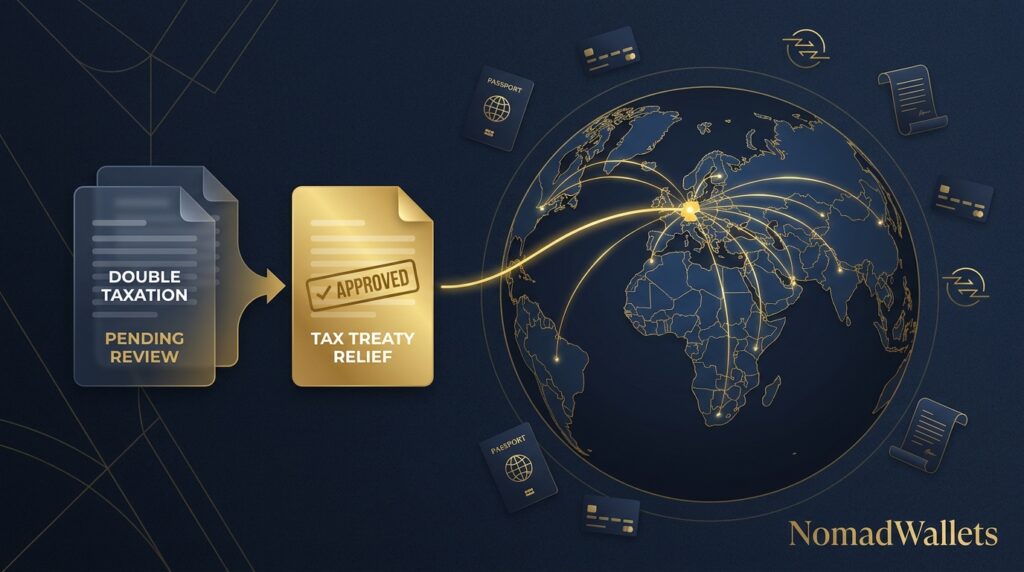
Dividends, interest, and royalties are usually taxed at reduced rates in the source state (often 5–15% for dividends, 0–10% for interest, 0–5% for royalties) with the residence state giving a credit for the withholding tax.
Foreign Tax Credit vs Exemption
Germany uses two methods depending on the treaty. Under the credit method (Anrechnungsmethode), foreign income is included in the German tax base but foreign tax paid is credited against the German tax attributable to that income, capped at the German rate. Under the exemption method (Freistellungsmethode), foreign income is excluded from the German base but still affects the rate on German income through the Progressionsvorbehalt, meaning your worldwide income pushes up the marginal rate applied to your German earnings. Most treaties with EU members and the US use the exemption method for employment income.
Tie-Breaker Rules
When an individual could be resident in two countries, Article 4 of the OECD Model applies a sequence of tie-breakers: permanent home, centre of vital interests, habitual abode, nationality, and finally mutual agreement between the two tax authorities. Most disputes are resolved at the permanent home test.
Selected Treaty Examples
| Partner country | Method for employment income | Dividend WHT (typical) |
| United States | Exemption (with progression) | 15% / 5% qualifying |
| United Kingdom | Exemption (with progression) | 15% / 5% qualifying |
| France | Exemption (with progression) | 15% / 5% qualifying |
| Spain | Exemption (with progression) | 15% / 10% qualifying |
| Netherlands | Exemption (with progression) | 15% / 5% qualifying |
| India | Credit | 10% / 5% qualifying |
| China | Credit | 10% (subject to conditions) |
The full and current list of treaties is maintained by the BMF on its country-specific treaty information pages. Treaties are renegotiated periodically; always check the version currently in force for the year of assessment. The BZSt Reststeuersatzliste sets out the reduced withholding rates for royalties and licence payments under each treaty.
How to File Your German Tax Return

ELSTER (Elektronische Steuererklärung) is the official, free portal run by the Bavarian State Tax Office on behalf of all German tax authorities, accessible at elster.de. Every form (income tax, VAT, trade tax, wage tax) is available in ELSTER, and mandatory filings for businesses must be submitted electronically. The interface is functional rather than friendly; commercial apps like Taxfix, WISO, Steuerbot, and Lohnsteuer-kompakt wrap ELSTER in a more usable UI for a fee of €20–40. For a broader comparison of filing software across multiple jurisdictions, see our Best Digital Nomad Tax Software review. The official Lohnsteueranleitung 2026 explains the wage-tax form line by line.
Who Must File (Pflichtveranlagung)
Self-employed people, freelancers, anyone with income from a second employer or side income above €410, anyone who received severance, and employees with tax class III/V (whose employer-withheld tax does not necessarily match the final liability). The Finanzamt NRW filing obligation guide summarises the full list of mandatory filers. Voluntary filing is open to most other employees, and is almost always worth doing, given the average refund of just over €1,000 reported by the Lohnsteuerhilfeverein.
Deadlines
| Filing scenario | Deadline for tax year 2026 |
| Mandatory filing (Pflichtveranlagung) | 31 July 2027 |
| Filing with a Steuerberater or Lohnsteuerhilfeverein | 1 March 2028 (end of Feb + extension) |
| Voluntary filing (Antragsveranlagung) | Until 31 December 2030 (4-year window) |
Deadlines and the four-year voluntary window are confirmed by consumer service Finanztip and by the Finanzamt NRW.
Documents to Gather
Lohnsteuerbescheinigung (employer-issued wage statement, sent automatically to the Finanzamt by electronic means), receipts for Werbungskosten (commuting, professional training, home office, work equipment), Bescheinigung über Spenden (donation certificates), Kinderbetreuungskosten (childcare), medical expenses above the Zumutbare Belastung threshold, mortgage statements for owner-occupied property, and foreign income statements with proof of foreign tax paid.
Refunds and Penalties
Refunds are typically paid within four to eight weeks of assessment, directly to the bank account listed in ELSTER. Penalties for late mandatory filing start at €25 per month of delay under § 152 AO, but the Finanzamt first issues a Mahnung (reminder) granting a four-week extension; penalties only apply if you ignore the reminder. Interest on late tax payments under § 233a AO is charged at 0.5% per month from the due date.
| Filing Checklist 1) ELSTER account created and activated (allow 1–2 weeks for the activation letter). 2) Lohnsteuerbescheinigung retrieved from employer or Finanzamt online. 3) All Werbungskosten receipts scanned and totalled. 4) Foreign income statements gathered, with proof of foreign tax paid. 5) Krankenversicherungsbeiträge confirmed (sent electronically to Finanzamt). 6) Church tax status confirmed, and Kirchenaustritt filed if desired. 7) Form chosen: Einkommensteuererklärung, Anlage N (employment), Anlage KAP (capital income), Anlage R (pensions), Anlage AUS (foreign income), Anlage Kind (children). 8) Submission via ELSTER, Taxfix, or Steuerberater. 9) Assessment notice (Bescheid) reviewed, appealable within one month. |
Best Banking Options in Germany
Most expats need two accounts: a German current account for rent, salary, and recurring payments, and a multi-currency account for transfers in and out of Germany. German banks are reliable but bureaucratic, opening an account at a branch bank like Commerzbank or Sparkasse can take an appointment and a Schufa check. Mobile-first banks like N26 and DKB are faster but impose daily limits and may reject non-EU passports without a registered address. EMIs like Wise and Revolut are the best option for international transfers and holding multiple currencies, but they cannot replace a full German current account for salary purposes in every case.
For a side-by-side comparison of multi-currency EMIs, see our Best Multi-Currency Accounts for Digital Nomads guide; if you specifically need a German-IBAN current account, our Best Bank Account for Digital Nomads review covers N26, DKB, Commerzbank, and the challengers. For moving larger sums in or out of Germany, the Best Money Transfer Services for Digital Nomads comparison tracks real exchange-rate spreads and fee structures. Independent reviews at All About Berlin and How to Germany cover additional local context.
| Provider | Type | Best for | Expat-friendly notes |
| N26 | German mobile bank | Everyday spending, fast onboarding | English app; can open before Anmeldung in some cases |
| Wise | Multi-currency EMI | International transfers, holding 40+ currencies | Excellent FX rates; works alongside a German account |
| Revolut | Multi-currency EMI | Travel, multi-currency cards, premium tiers | German branch since 2022; supports local IBAN |
| DKB | German direct bank | Free current account if €700+ inbound/month | Requires Anmeldung + Schufa; no English UI |
| Commerzbank | German full-service bank | Branch banking, mortgages, business | English support in major cities; branches widely available |
| Related Reading For a deeper comparison of multi-currency accounts for international transfers, including detailed fee tables and real exchange-rate spreads, see our Best Multi-Currency Accounts guide. Most expats end up with a German current account (N26 or DKB) plus Wise for transfers, and that combination covers 95% of needs. |
Common Tax Mistakes
The same mistakes recur in the inbox of every German tax adviser. Most are avoidable with a checklist and a little timing.

- Assuming the 183-day rule is the only test. The Wohnsitz/Anmeldung test makes you resident on day one.
- Not filing a voluntary return, and leaving €1,000+ of refund on the table every year.
- Forgetting to declare foreign rental income, foreign dividends, or crypto gains. The Finanzamt receives automatic information exchanges under CRS and DAC7.
- Choosing Kleinunternehmer status without understanding the 5-year lock-in.
- Issuing invoices that fail § 14 UStG requirements, which voids input VAT deduction.
- Working remotely for a foreign employer beyond 60 days without considering permanent establishment risk.
- Not applying for DTA relief on foreign income, and paying tax twice.
- Missing the 31 July deadline. The €25/month penalty is small but the interest under § 233a AO compounds.
- Treating the Lohnsteuerbescheinigung as final. It is just the starting point; deductions can materially change the result.
- Not keeping records for ten years, as required by the statutory retention period under § 147 AO.
Warning, Foreign Income Reporting
The single most expensive mistake is failing to report foreign income. Germany participates in the Common Reporting Standard (CRS) and in DAC7 for crypto platforms. The Finanzamt receives information about your foreign accounts and crypto holdings automatically. Undeclared income that emerges later is treated as a serious offence under § 370 AO (tax evasion), with back taxes, interest, and potential surcharges of up to 25% of the evaded tax.
Voluntary disclosure (Selbstanzeige under § 371 AO) can avoid criminal liability if done correctly and before the authorities open an investigation. Retention of records for ten years is mandated by § 147 AO.
Tax Planning Tips
Tax planning in Germany rewards structure and timing more than cleverness. The deductions are well-defined and the thresholds are published; the gains come from documenting expenses properly and acting before deadlines, not after.
- Use deductions deliberately. Track every kilometre driven to your regular workplace. The Pendlerpauschale in 2026 is 38 cents per kilometre from the first kilometre, worth €1,000–2,000 a year for a typical commuter.
- Keep records religiously. Keep digital copies of every business receipt, invoice, and bank statement for ten years (§ 147 AO). A simple folder structure by year and category is sufficient; cloud storage with a German/EU provider avoids data-protection issues.
- Understand residency timing. If you are moving to Germany mid-year, the partial-year rule (time-apportioned allowance) can reduce your effective tax rate. If you are leaving Germany, time the move to control when foreign income becomes taxable.
- Plan before moving. Decide on Kleinunternehmer status, church membership, and tax class before the year starts. Reversing these mid-year is costly or impossible.
A qualified Steuerberater costs €300–1,500 for a typical return and is deductible as a special expense. For complex situations (freelance income, foreign rental, stock options, cross-border moves), the cost is usually repaid several times over in additional refund and avoided mistakes. If you are operating across multiple countries, our Digital Nomad Tax Accountant directory lists advisers who routinely handle German-resident clients with international footprints.
| Strategic Note Germany rewards conservative, well-documented positions and punishes aggressive ones. The Finanzamt is staffed by career civil servants who apply the law consistently, they are not negotiators. A clean return with full disclosure and proper deductions almost always beats a clever return with hidden income or stretched interpretations. |
Frequently Asked Questions
The Germany Expat Tax Guide closes with the 23 questions expats ask most often. These answers are short by design, the body of the guide carries the detail. If your question is not here, the References section links to the official sources that will have the answer.
Q1. How are expats taxed in Germany?
A. Expats are taxed under the same progressive tariff as German citizens. The key question is residency: if you are resident (Wohnsitz or 183 days), Germany taxes your worldwide income; if non-resident, only German-source income. The Germany Expat Tax Guide covers the residency tests in detail above.
Q2. Do expats pay tax in Germany?
A. Yes, anyone resident in Germany pays tax on worldwide income. Non-residents pay tax on German-source income. Employment, freelance profit, rental income, capital gains, pensions, and most benefits in kind are taxable.
Q3. Is there a Germany tax guide for foreigners?
A. This Germany Expat Tax Guide is written specifically for foreigners. It covers residency, income tax brackets, social security, freelancer obligations, digital nomad issues, double taxation treaties, and ELSTER filing, all calibrated for the 2026 tax year.
Q4. What are the Germany tax residency rules?
A. Two tests: the Wohnsitz test under § 8 AO (permanent home + Anmeldung) and the gewöhnlicher Aufenthalt test under § 9 AO (183 days in a 12-month period). Either one makes you a German tax resident, triggering worldwide income taxation.
Q5. How long before I become tax resident in Germany?
A. Either the moment you establish a permanent home (Wohnsitz), typically when you sign a lease and complete Anmeldung, or after 183 days of presence in any twelve-month period. The earlier of the two applies.
Q6. Germany income tax explained, what are the 2026 brackets?
A. The 2026 tariff: 0% up to €12,348, rising from 14% to 42% through two progression zones, 42% from €69,879, and 45% (Reichensteuer) from €277,826. Married couples assessed jointly get double the thresholds through the splittingverfahren.
Q7. Is there a German tax filing guide for 2026?
A. Yes, this Germany Expat Tax Guide includes a full filing section. Mandatory filers must submit by 31 July 2027 for tax year 2026; voluntary filers have until 31 December 2030. ELSTER is the official free portal; commercial apps charge €20–40.
Q8. Do I need to use ELSTER?
A. For mandatory business filings (VAT, trade tax, freelancer income tax), yes, electronic filing is required. For personal income tax, you can use ELSTER directly or one of the commercial apps that submit through ELSTER on your behalf.
Q9. What income is taxable in Germany?
A. For residents: worldwide employment income, freelance and business profit, rental income, capital gains (with the €1,000 saver allowance), pensions, and most benefits in kind. For non-residents: only German-source income.
Q10. Can I avoid double taxation with a Germany double taxation treaty?
A. Germany has more than 90 double taxation treaties. Most use the exemption method for employment income, with the Progressionsvorbehalt pushing up the rate on German earnings. Foreign tax credits apply where the credit method is used. Check the BMF country-specific portal for the treaty in force with your home country.
Q11. How much tax will I pay?
A. It depends on income, marital status, and church membership. A single employee on €50,000 in 2026 has an effective income tax rate near 11% and a marginal rate of 30%; on €100,000 the effective rate rises to around 24% and the marginal rate hits 42%.
Q12. Can digital nomads work from Germany, what are Germany taxes for digital nomads?
A. Yes, but once you exceed 183 days you become tax-resident and your worldwide income, including foreign salary, becomes taxable. Your foreign employer may also face permanent establishment exposure. The Germany Expat Tax Guide covers the PE risk in detail above.
Q13. Is there a Germany freelancer tax guide?
A. This Germany Expat Tax Guide includes a full freelancer section covering Freiberufler vs Gewerbetreibende classification, VAT (Kleinunternehmer threshold €25,000), trade tax (Hebesatz by city), deductible expenses, and § 14 UStG invoice requirements.
Q14. What expenses are deductible for employees?
A. The €1,230 Werbungskostenpauschale covers most employees automatically. Above that: commuting, professional training, work equipment, home office (€1,260 flat rate), relocation costs for a job move, and certain professional insurance premiums. Germany tax deductions are well-defined if you keep receipts.
Q15. Do I have to pay church tax?
A. Only if you are a member of a recognised religious community and have not formally left. The rate is 8% of income tax in Bavaria and Baden-Württemberg, 9% in all other states. A Kirchenaustritt at the Bürgeramt stops withholding.
Q16. How long should I keep tax records?
A. Ten years for businesses and self-employed individuals (§ 147 AO). Six years for purely private income tax records. Digital copies are acceptable if they meet GoBD requirements.
Q17. What is the solidarity surcharge?
A. A 5.5% surcharge on income tax. Since the 2021 reform, around 90% of taxpayers no longer pay it, the 2026 Freigrenze is €20,350 of income tax for singles (€40,700 for couples), with a sliding buffer zone above that.
Q18. Can I file in English?
A. ELSTER is available only in German. Commercial apps offer English interfaces. The Finanzamt corresponds in German; for complex matters, a German accountant or Steuerberater who speaks English is worth the fee.
Q19. What is the difference between Steuer-ID and Steuernummer?
A. The Steuer-ID is an 11-digit personal identifier issued by the BZSt, lifelong, used for employment and personal tax. The Steuernummer is issued by the local Finanzamt for freelancers and businesses, and changes if you move to a different Finanzamt’s district.
Q20. Do I have to pay VAT as a freelancer?
A. Only if your turnover exceeds €25,000 in the previous year or €100,000 in the current year. Below those thresholds you can opt for Kleinunternehmer status, no VAT charged, no input VAT recovered, election binding for five years.
Q21. Are crypto gains taxable in Germany?
A. Private crypto sales are tax-free if held for more than one year. Short-term gains are taxable at the personal income tax rate. Germany participates in DAC7, which requires crypto platforms to report user holdings to the Finanzamt automatically.
Q22. What happens if I file late?
A. The Finanzamt issues a reminder granting four weeks. After that, a Verspätungszuschlag of at least €25 per month applies, plus interest at 0.5% per month under § 233a AO. Voluntary filers face no penalty but lose the refund if they miss the four-year window.
Q23. Do I need a German accountant (Steuerberater)?
A. For a straightforward employee return with standard deductions, no, ELSTER or a €30 app is enough. For freelance income, foreign assets, stock options, or cross-border moves, yes, the savings typically exceed the fee several times over. The Germany Expat Tax Guide recommends engaging one before your first complex filing.
Q24. How does the Aktivrente rule work?
A. From 2026, pensioners past the statutory retirement age who continue working can earn up to €2,000 per month tax-free in addition to their pension. Above €2,000 the normal tax rules apply, with the Progressionsvorbehalt pushing up the rate on the pension.
Q25. What is the Kleinunternehmer threshold for 2026?
A. €25,000 of turnover in the previous calendar year and €100,000 in the current calendar year. Below those limits, freelancers can opt to charge no VAT and recover no input VAT.
Q26. Are foreign pensions taxed in Germany?
A. If you are German tax-resident, yes, subject to DTA relief. Most German treaties allocate pension taxation to the country of residence, but some (notably the US-Germany treaty for certain government pensions) keep taxing rights with the source country.
Q27. What is the Grundfreibetrag for 2026?
A. €12,348 for singles and €24,696 for jointly assessed couples. Income below this amount is tax-free.
Q28. Can I claim commuting costs?
A. Yes, the Pendlerpauschale in 2026 is 38 cents per kilometre from the first kilometre for car or public transport. There is no upper limit, but very long commutes may attract scrutiny.
Q29. What if my employer is not registered in Germany?
A. If you are resident and work in Germany, your salary is taxable in Germany regardless of where the employer is based. The employer should arrange payroll through an Employer of Record, or you should register as self-employed and invoice the foreign entity.
Q30. How do I file a Germany tax return for foreigners?
A. The Germany Expat Tax Guide filing section walks through it: create an ELSTER account, gather your Lohnsteuerbescheinigung and receipts, complete Einkommensteuererklärung plus relevant Anlagen (N, KAP, R, AUS, Kind), and submit by 31 July 2027 for tax year 2026.
Important Limitations and Considerations
A guide this long should also be honest about what it cannot do. Several aspects of the German tax system are contested, fluid, or fact-specific in ways that a published article cannot resolve. The Germany Expat Tax Guide summarises the main limitations below so readers can weigh the advice appropriately and know when to seek professional input. None of these caveats invalidate the broader picture, but each one marks a boundary beyond which bespoke advice is required.
1. The 183-day rule is less mechanical than it sounds
Treaty articles and the Abgabenordnung describe the 183-day test as if it were a simple day count. In practice, the OECD commentary, German tax court rulings, and individual Finanzamt interpretations disagree on what counts as a day, how to handle arrival and departure days, whether short absences reset the clock, and how to aggregate presence across calendar years.
A worker who spends 180 days in Germany and 200 days abroad may still be resident if their centre of vital interests is German. Conversely, a worker who exceeds 183 days may still be non-resident under a tie-breaker if their permanent home is abroad. Treat the 183-day figure as a rule of thumb, not a cliff edge.
2. Permanent establishment risk is genuinely unsettled
The BMF circulars on home-office permanent establishment (most recently updated in 2023) and the OECD’s 2022 PE guidance do not give bright-line thresholds. The 30-to-60-day window cited in this guide reflects practitioner consensus, not statutory law. A foreign employer with a single German-based developer may or may not create a PE depending on whether the developer signs contracts, manages other staff, or carries inventory.
Each case turns on its specific facts and on the willingness of the local Finanzamt to assert the position. Employer-of-Record arrangements mitigate but do not eliminate the risk.
3. Tax treaties are renegotiated and interpreted differently
Germany’s 90+ double taxation agreements are not identical. Some predate the OECD Model’s current text and contain country-specific carve-outs. The US-Germany treaty, for example, treats government pensions differently from private pensions; the India-Germany treaty uses the credit method rather than the exemption method for some income types. Treaties are also renegotiated periodically, sometimes with retroactive effect.
Always verify the version in force for the assessment year and check the BMF’s country-specific information pages for the latest protocol updates.
4. Social security contribution rates change annually
The Zusatzbeitrag for health insurance is set each autumn by the BMG based on the previous year’s claims experience. The 2.9% average quoted for 2026 is the federal average, individual Krankenkassen set their own Zusatzbeitrag within a band, and many charge more. Pflegeversicherung rates depend on family status and number of children, and the Beitragsbemessungsgrenze rises most years.
The figures in this guide are accurate as of July 2026 but should be re-verified at the start of each calendar year against the Sozialversicherungsrechengrößen-Verordnung.
5. This guide is not a substitute for a Steuerberater
Several readers will face situations this guide cannot cover: stock options with cross-border vesting, real estate held through foreign structures, crypto staking rewards, trust income, US citizens subject to FATCA, and complex succession scenarios. These situations require bespoke analysis by a qualified German Steuerberater or tax-focused lawyer. A guide can frame the questions; only an adviser can answer them for your specific facts.
6. Regional variation is significant
Trade tax Hebesätze, church tax rates, and the rigour with which local Finanzämter apply certain rules (home-office deductions, commuting allowances, freelancer classification) all vary by city and by individual tax inspector. Munich and Berlin enforce the 14-day Anmeldung rule strictly; smaller towns may be more relaxed. A practice accepted in Frankfurt may be challenged in Hamburg. Treat any generalisation in this guide as a starting point, not a guarantee.
Final Thoughts
Germany’s tax system is dense but predictable. The rates are published, the deductions are listed, the deadlines are fixed, and the Finanzamt applies the rules consistently. The Germany Expat Tax Guide has walked through every layer of that system, residency, income tax brackets, social security, church tax, freelancer obligations, digital nomad risks, double taxation treaties, and ELSTER filing.

The expats who run into trouble are usually the ones who assumed the rules did not apply to them, the remote worker who never registered, the freelancer who treated VAT as optional, the high earner who forgot about CRS reporting on a foreign account. Almost every problem in this guide is preventable with registration, disclosure, and a modest amount of paperwork.
For broader concepts, how to think about tax residency across multiple countries, how to structure a long-term nomad portfolio, how to choose between credit and exemption methods, see our Expat Tax Planning Guide. For day-to-day movement of money across borders, our Best Multi-Currency Accounts for Digital Nomads guide compares Wise, Revolut, N26, DKB and the smaller challengers in detail.
Together with this Germany Expat Tax Guide, those two pieces cover most of what a working expat in Germany needs.
The 2026 changes are modest but worth knowing: a higher Grundfreibetrag, a higher Spitzensteuersatz threshold, a new Aktivrente rule for working retirees, a cut in VAT on restaurant food, and an increase in health and long-term care contributions. None of them rewrite the system; all of them affect paycheques and refund expectations. If you are new to Germany, file your first return carefully, the patterns set in year one tend to repeat for years afterwards.
The Germany Expat Tax Guide will be updated annually as new BMF circulars and treaty protocols come into force.
Disclaimer
This Germany Expat Tax Guide is for educational purposes only and reflects German tax law as understood in July 2026. It is not financial, legal, or tax advice, and no reader should act on its contents without independent verification. Tax rules change, sometimes with retroactive effect, and individual circumstances vary, particularly for cross-border situations involving foreign income, freelance work, holding companies, trusts, or non-EU citizenship.
Before acting on anything in this Germany Expat Tax Guide, consult a qualified German tax adviser (Steuerberater) registered with the Steuerberaterkammer, a Lohnsteuerhilfeverein for employee-only matters (DLSL/VLH directory), or a tax-focused lawyer admitted in Germany. The BMF publishes official guidance at bundesfinanzministerium.de and the BZSt at bzst.de; both should be consulted for the current official position. NomadWallets disclaims any liability for losses arising from reliance on this Germany Expat Tax Guide.

Tushar Sharma is the founder and editor of NomadWallets, where he writes about international banking, travel cards, cross-border payments, taxes, and financial tools for digital nomads and globally mobile professionals. He created NomadWallets to make global money decisions simpler through practical, research-backed guides built from official sources and real-world financial data.