

Quick Overview
Before diving into the details, here is a snapshot of everything this guide covers. Whether you are a seasoned digital nomad or just starting your location-independent journey, this quick reference table will help you navigate to the sections most relevant to your needs. The best multi currency accounts for digital nomads can save you thousands in hidden fees each year, and choosing the right one starts with understanding what matters most for your lifestyle.
| Topic | Best Multi Currency Accounts for Digital Nomads |
| Focus Keyword | Best Multi Currency Accounts for Digital Nomads |
| Target Audience | Digital nomads, remote workers, freelancers, expats |
| Key Providers | Wise, Revolut, Payoneer, N26, Airwallex, Bunq, Charles Schwab |
| Top Pick | Wise (overall best); Revolut (best for travelers) |
| Estimated Savings | Up to 3–5% per international transaction compared with many traditional banks |
| Last Updated | July 2026 |
| Key Takeaway: Traditional banks often charge 2–3% or more through hidden exchange rate markups and conversion fees. For a digital nomad earning $50,000 per year and converting currencies monthly, that can translate to $1,000–$2,500 in unnecessary costs annually. A good multi-currency account can reduce these costs to under 0.5% per conversion. |
At a Glance: Which Account Is Right for You?
Not sure where to start? This simple summary highlights the top pick for each common need among digital nomads. Think of it as your cheat sheet before we dive into the detailed reviews. Whether you are looking for the best overall option, a daily spending companion, or a freelancer-friendly payment solution, the table below points you in the right direction at a glance.
| Need | Best Choice |
| Overall | Wise |
| Daily spending | Revolut |
| Freelancers | Payoneer |
| EU residents | N26 |
| Businesses | Airwallex |
| Automation | Bunq |
| US travelers | Charles Schwab |
| Quick Tip Many digital nomads combine two or three of these accounts for maximum flexibility. For example, Wise for international transfers, Revolut for daily spending, and Payoneer for receiving freelance payments. The right combination depends on your income sources and travel patterns. |

The Invisible Tax on Your Nomadic Life
Picture this: you are sipping coconut water on a Balinese beach, your laptop perched on a bamboo table, and a client payment just landed in your account. But by the time that money travels from your client’s bank in London to your account in Bali, it has quietly shed 3 to 5 percent of its value through hidden exchange rate markups, intermediary bank fees, and receiving charges you never agreed to. That is the invisible tax on every digital nomad’s life, and most people do not even know they are paying it.
The reality is that conventional banking was never built for people who live across borders. Traditional banks were primarily designed for domestic banking, so international transactions often involve exchange rate markups, foreign transaction fees, and currency conversion costs. As explained in Wise’s official guide to the mid-market exchange rate, some providers apply their own exchange rate instead of the real market rate, effectively increasing the total cost of a transaction.
Wise also explains on its official pricing page that it uses the mid-market exchange rate and displays its fees separately rather than embedding hidden costs in the exchange rate. For digital nomads who convert currencies regularly, these additional costs can accumulate into hundreds or even thousands of dollars over time.
This is precisely why the best multi currency accounts for digital nomads have become not just convenient but essential. These accounts let you hold, convert, and spend money in multiple currencies without the predatory markups that traditional banks impose. For a deeper understanding of how to manage your finances as a location-independent worker, check out our comprehensive Digital Nomad Finance Guide, which covers everything from tax optimization to insurance for remote workers.
The digital nomad community has grown rapidly in recent years, driven by the rise of remote work, improved digital infrastructure, and more countries introducing digital nomad visas. As more professionals choose location-independent careers, managing money efficiently across borders has become one of their biggest financial challenges. This guide explains how to choose the best multi-currency account to reduce fees, simplify international payments, and manage finances while living and working abroad.
Why Multi-Currency Accounts Matter for Digital Nomads
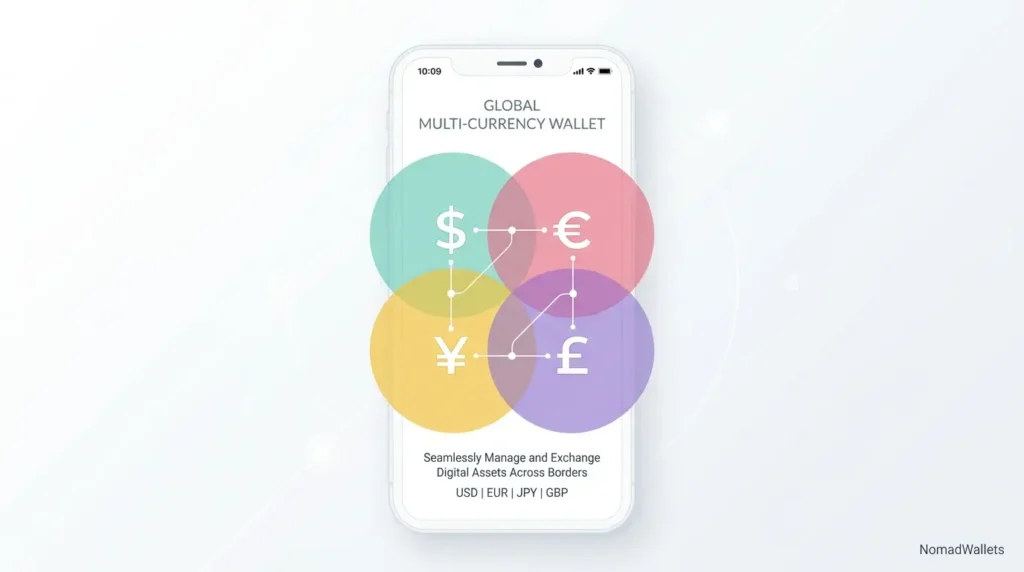
A multi-currency account is a financial product that allows you to hold, receive, and send money in multiple currencies from a single account. Unlike many traditional bank accounts, which may automatically convert foreign currency transactions and apply exchange rate markups or conversion fees, multi-currency accounts let you keep balances in different currencies and convert funds when it best suits your needs. As explained in Wise’s official guide to the Wise Account, users can hold and manage multiple currencies from a single account while receiving local account details where available.
Wise also explains on its official pricing page that it uses the mid-market exchange rate and displays conversion fees transparently rather than hiding costs within the exchange rate. This gives digital nomads, freelancers, and international travelers greater control over exchange costs and cross-border payments.
The importance of multi-currency accounts becomes clear when you examine the fee structures of traditional banks. Chase Bank’s guide for digital nomads acknowledges that international transactions through conventional banks routinely incur fees of 2 to 5 percent, including exchange rate markups, wire transfer charges, and intermediary bank deductions. For someone earning $50,000 a year and converting currencies monthly, that can mean losing $1,000 to $2,500 annually to fees alone.
Multi-currency accounts solve this problem by offering transparent, low-cost currency conversion, local account details in multiple countries, and debit cards that work globally without foreign transaction fees. They are designed from the ground up for the borderless lifestyle that digital nomads lead. For more on choosing the right banking partner, see our guide to the Best Bank Account for Digital Nomads.
Wise: The Gold Standard for Borderless Banking
Wise, formerly known as TransferWise, has established itself as the most trusted multi-currency account for digital nomads worldwide. Founded in 2011 by Taavet Hinrikus and Kristo Kaarmann, two Estonians frustrated by the cost of transferring money between countries, Wise has grown to serve over 16 million customers globally. According to Wise’s official account page, the platform supports over 50 currencies and provides local account details in 9 currencies, making it possible to receive payments like a local in the US, UK, EU, Australia, and several other regions.
What sets Wise apart is its commitment to the mid-market exchange rate. When you convert currencies on Wise, you pay a small, transparent fee, typically between 0.33 percent and 1.5 percent depending on the currency pair, and you get the same rate you see on Google or Reuters. There is no hidden markup. As Forbes’ review of multi-currency accounts notes, Wise consistently ranks as the most transparent option for international money transfers, making it the top overall pick in our comparison of the best multi currency accounts for digital nomads.
For digital nomads who need to send money internationally, Wise pairs perfectly with our guide to the Best Money Transfer Service for Digital Nomads, where Wise features prominently as the top recommendation for affordable, transparent transfers.
The Wise debit card is equally impressive. It automatically converts currencies using the mid-market exchange rate, with a transparent conversion fee where applicable, making it a popular choice for international spending. As explained on Wise’s official debit card page and in its pricing guide, there are no monthly account fees or minimum balance requirements, and users can spend in multiple currencies while avoiding many of the hidden exchange rate markups charged by traditional banks.
For business users, the Wise Business account adds features such as batch payments, invoice management, multi-user access, and international payment capabilities. These features are detailed on Wise Business’s official page and in the Wise Business Help Centre.
| Pros | Cons |
| Mid-market exchange rate with no hidden markups | Limited free ATM withdrawals ($100/month) |
| Over 50 currencies supported with local account details in 9 | No interest on held balances |
| Transparent fee structure (0.33% – 1.5% per conversion) | No investment or crypto features |
| Free to open and maintain with no monthly fees | Card delivery can take 2-3 weeks in some countries |
| Debit card works in 170+ countries worldwide | No credit or overdraft facilities |
| Business account with batch payments and invoicing | Customer support can be slow during peak periods |
Revolut: The All-in-One Financial Super-App
Revolut has redefined what a banking app can be for digital nomads. Launched in 2015, this UK-based fintech has grown into a financial super-app with over 35 million personal customers worldwide. As Revolut’s official Features page highlights, Revolut offers currency exchange, stock trading, crypto investment, insurance, and budgeting tools all within a single app, making it the most feature-rich option for nomads who want everything in one place.

The standout feature for digital nomads is Revolut’s approach to currency exchange. On weekdays, you can exchange currencies at the interbank rate with no markup, which is the same rate that banks use when trading with each other. On weekends, a 0.5 percent to 1 percent markup applies. As explained in Revolut’s official pricing and exchange rates documentation and Fees & Pricing page, this makes Revolut the best choice for frequent travelers who need to spend in different currencies regularly, provided they plan their exchanges for weekdays.
Revolut offers tiered plans from Free to Ultra (€13.99/month for the Ultra plan). Higher tiers come with increased exchange and ATM limits, travel insurance, airport lounge access, and priority customer support. For spending abroad with credit cards, our guide to the Best Credit Cards for Digital Nomads complements Revolut’s debit offering with rewards and additional protections that debit cards cannot match.
Community feedback is particularly telling. A popular Reddit r/digitalnomad discussion comparing Revolut and Wise reveals that many nomads use both: Wise for large international transfers and Revolut for daily spending. This combination leverages the strengths of each platform while minimizing their respective weaknesses.
| Pros | Cons |
| Interbank exchange rate on weekdays (no markup) | Weekend exchange markup of 0.5% – 1% |
| Comprehensive app with budgeting, investing, and insurance | Fair usage limits on free plan (currency exchange capped) |
| Free plan available with useful features | Not a full bank in all jurisdictions |
| Instant virtual cards for secure online spending | Account freezes reported without clear explanation |
| Real-time spending notifications and analytics | Premium features require monthly subscription |
| Travel insurance included in paid plans | Customer support quality varies significantly |
Payoneer: The Freelancer’s Payment Gateway
Payoneer occupies a unique position in the multi-currency account landscape. While Wise and Revolut focus on individual consumers, Payoneer has built its reputation as the go-to payment solution for freelancers and online businesses. According to Payoneer’s official multi-currency page, the platform supports sending and spending in over 150 currencies, while offering dedicated receiving accounts in USD, EUR, GBP, JPY, CAD, AUD, and more, making it the widest-reaching option for receiving international client payments.

The killer feature for freelancers is Payoneer’s deep integration with major freelance marketplaces. If you earn through Upwork, Fiverr, Freelancer.com, or dozens of other platforms, Payoneer can receive your earnings directly, often with preferred withdrawal fees. As Payoneer’s pricing page outlines, receiving payments from other Payoneer customers is free, while receiving via the Global Payment Service (bank transfer to your Payoneer account) typically incurs a 0 to 1 percent fee depending on the currency and country.
For freelancers specifically focused on receiving international client payments, our detailed guide on International Client Payment Processing provides step-by-step strategies for setting up payment flows that minimize fees and maximize convenience, with Payoneer as a core component of the recommended setup.
However, Payoneer’s conversion fees can be steep. When you withdraw funds to a local bank account in a different currency, you face a conversion fee of up to 2 percent, which is significantly higher than Wise’s rates. The annual card fee of $29.95 also adds to the cost. Based on Payoneer’s official pricing and available account features, Payoneer is best used as a receiving tool rather than a primary spending account.
| Pros | Cons |
| Integration with 200+ freelance marketplaces and platforms | Conversion fees up to 2% (higher than Wise/Revolut) |
| Receiving accounts in 9+ major currencies | $29.95 annual card fee |
| Support for 150+ currencies overall | Receiving bank transfers can incur 0-1% fee |
| Free transfers between Payoneer customers | Limited daily spending functionality |
| Withdrawal to local bank accounts worldwide | Account verification can be slow and bureaucratic |
| Dedicated business tools and working capital options | Not ideal as a primary spending account |
N26: Europe’s Digital Banking Champion
N26 holds the distinction of being a fully licensed German bank, which means your deposits are protected under the EU’s Deposit Guarantee Scheme up to €100,000. According to N26’s official site, the bank serves over 8 million customers across 25 EU markets and offers a sleek, app-first banking experience that appeals strongly to European digital nomads. The Standard account is free and includes a German IBAN, a Mastercard, and Spaces sub-accounts for budgeting.
For EU-based nomads, N26’s biggest advantage is the complete absence of fees for Euro transactions. Whether you are paying for a coffee in Berlin or booking a train ticket online, there are no foreign transaction fees within the Eurozone. Outside the Eurozone, N26 charges a 1.7 percent foreign currency fee on ATM withdrawals. According to N26’s official pricing and card documentation and N26 Support, this makes N26 the most cost-effective option for nomads who primarily operate within the EU but occasionally travel beyond it.
N26 offers four plans: Standard (free), Smart (€4.90/month), You (€9.90/month), and Metal (€16.90/month). Higher tiers include features like Spaces sub-accounts, insurance packages, and partner offers. However, as Global Health Insurance’s banking review points out, N26’s multi-currency capabilities are limited compared to Wise or Revolut, with no ability to hold non-EUR balances directly. For that reason, many EU-based nomads pair N26 with Wise for their international transfer needs.
| Pros | Cons |
| Fully licensed EU bank with €100,000 deposit protection | Limited multi-currency support (no non-EUR balances) |
| No fees for Euro transactions | 1.7% fee for non-EUR ATM withdrawals |
| Free Standard account with German IBAN and Mastercard | Not available outside the EU/EEA |
| Instant push notifications and spending categorization | Fewer currency exchange features than Wise/Revolut |
| Spaces feature for budgeting and savings goals | Premium plans needed for insurance and partner offers |
| Available in 25 EU markets | No check deposit or overdraft on free plan |
Airwallex: The Business-Focused Powerhouse
Airwallex has positioned itself as the premier multi-currency solution for businesses and ambitious freelancers who need enterprise-grade financial infrastructure. According to Airwallex’s official blog on multi-currency accounts, the platform supports over 60 currencies and offers local collection accounts in 11 countries, enabling businesses to receive payments from global customers without the friction and cost of traditional cross-border banking.

What truly distinguishes Airwallex is its suite of business tools. Beyond simple currency conversion, Airwallex offers multi-currency invoicing, expense management with corporate cards, batch payments to suppliers and contractors worldwide, and API integration for businesses that need to embed financial workflows into their own platforms. Conversion fees are competitive with mid-market rates, and there are no hidden markups.
For digital nomad entrepreneurs running agencies, SaaS products, or e-commerce businesses, Airwallex provides the financial backbone that scales with growth.
Airwallex offers both free and custom-priced plans depending on your transaction volume and feature requirements. The free tier includes business accounts with multi-currency support and basic payment capabilities, while custom plans unlock advanced features like foreign exchange risk management, priority support, and dedicated account management.
As the platform continues to expand its geographic coverage, it is becoming an increasingly viable alternative to traditional business banking for location-independent companies.
| Pros | Cons |
| Enterprise-grade multi-currency infrastructure | Primarily designed for businesses (less consumer-friendly) |
| Local collection accounts in 11 countries | Limited consumer debit card features compared to Wise/Revolut |
| Business tools: invoicing, expense management, batch payments | Custom pricing can be opaque for small businesses |
| Competitive mid-market conversion rates | Not available in all countries |
| API integration for custom financial workflows | Account approval process can be thorough and slow |
| Scales from freelancers to large businesses | No personal investing or insurance features |
Bunq: The Automation-Friendly European Option
Bunq is a Dutch fintech that has carved out a niche among digital nomads who value automation and multi-IBAN functionality. According to Bunq’s official business features page, the platform offers up to 25 local IBANs across different Eurozone countries, which is a game-changer for nomads who need to appear as local account holders in multiple EU markets simultaneously.
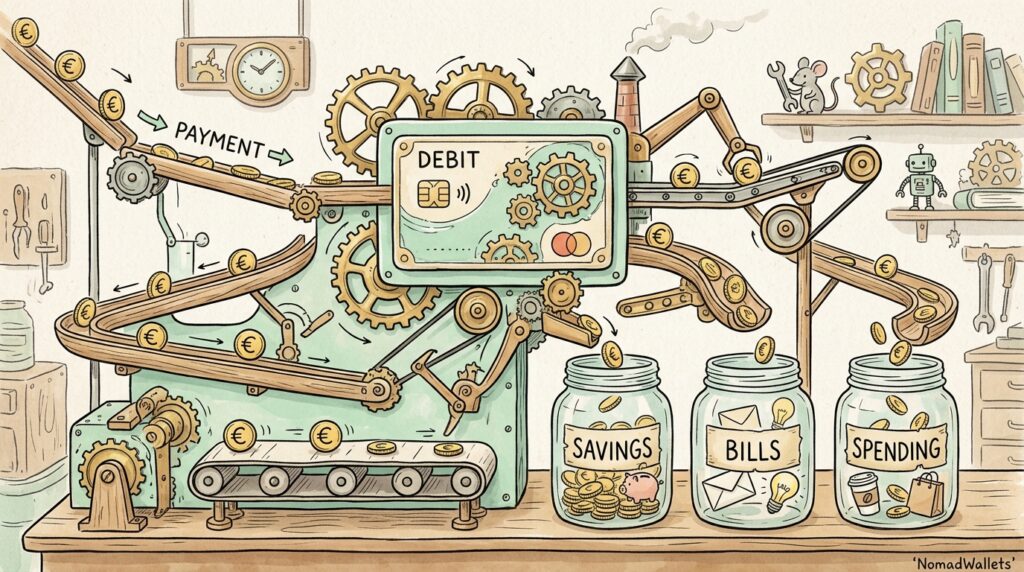
Bunq supports over 20 currencies and provides a debit card with no foreign transaction fees on its paid plans. The real differentiator, however, is the automation capability. Bunq allows users to set up automatic rules for categorizing transactions, splitting bills, setting aside savings, and even making recurring payments. Based on Bunq’s official Features page and Bunq Together Support, these automation features make Bunq particularly appealing to nomads who want their banking to run on autopilot while they focus on their work and travels.
Bunq offers three tiers: Easy Savings (free, savings account only), Easy Green (€7.99/month), and Easy Money (€13.99/month). The paid plans include the full current account with debit card, multi-IBAN support, and automation features. Bunq also plants trees for every €100 spent with its card, appealing to environmentally conscious digital nomads. The main limitation is geographic availability, as Bunq primarily serves EU residents, though it has been expanding its reach.
| Pros | Cons |
| Up to 25 local IBANs across Eurozone countries | Limited currency support (20+ vs. Wise’s 50+) |
| Powerful automation rules for transaction management | Paid plans needed for full current account features |
| No foreign transaction fees on paid plans | Primarily available to EU residents |
| Tree planting with every €100 spent (eco-friendly) | Conversion fees of 0.5% – 1.5% on some currency exchanges |
| Free savings account tier available | Less global reach than Wise or Revolut |
| Strong privacy and data protection (Dutch regulation) | No investment or insurance features |
Charles Schwab: The US Citizen’s Best Friend Abroad
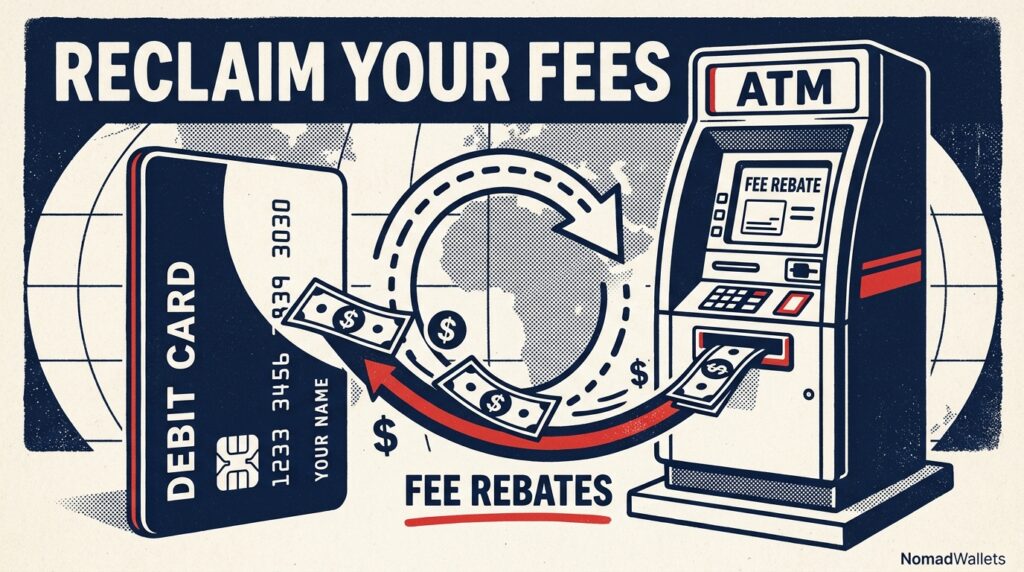
For US citizens living abroad, Charles Schwab’s Investor Checking account offers something no other multi-currency account can match: unlimited ATM fee rebates worldwide. Every time you withdraw cash from any ATM anywhere in the world, Charles Schwab refunds the ATM surcharge at the end of the month.According to Charles Schwab’s official Investor Checking Account page and its Debit Card FAQs, this makes Charles Schwab the undisputed champion for US nomads who need regular cash access in countries where card acceptance is limited.
The account has no monthly fees, no minimum balance requirements, and no foreign transaction fees on debit card purchases. The Visa debit card is accepted virtually everywhere globally. According to Charles Schwab’s official Investor Checking Account page and its Debit Card FAQs, the combination of no account fees and unlimited ATM fee rebates can save frequent international travelers significant money compared to many traditional debit cards.
The catch is that you must be a US resident to open the account, though once opened, you can use it indefinitely while living abroad.
Charles Schwab does have limitations. It only supports USD, meaning there is no multi-currency holding capability. Every foreign transaction is converted at Visa’s exchange rate plus a small fee built into the rate, which is competitive but not as transparent as Wise’s mid-market rate. The account also requires a linked Schwab brokerage account, though there is no obligation to use it for investing.
For US nomads who want the best of both worlds, combining Charles Schwab for cash withdrawals with Wise for multi-currency management and transfers is a popular strategy.
| Pros | Cons |
| Unlimited ATM fee rebates worldwide | Only supports USD (no multi-currency holding) |
| No monthly fees or minimum balance | Must be a US resident to open the account |
| No foreign transaction fees on debit purchases | Exchange rate includes a small markup (Visa rate) |
| Visa debit card accepted globally | Requires linked brokerage account to open |
| FDIC insured up to $250,000 | No instant transfers or app-based currency exchange |
| Linked brokerage account for investing | Not designed for receiving international payments |
Head-to-Head Comparison
The following table provides a side-by-side comparison of all seven providers across the metrics that matter most to digital nomads. Use this as your reference point when deciding which account or combination of accounts best fits your specific needs.
| Provider | Currencies | Conversion Fees | Monthly Fee | ATM Withdrawal | Best For |
| Wise | 50+ | 0.33% – 1.5% | Free | $1.50 + 1.75% (above limit) | Overall best for nomads |
| Revolut | 30+ | Weekday: interbank; Weekend: 0.5% – 1% | Free – €13.99/mo | Free up to plan limit | Frequent travelers & spenders |
| Payoneer | 150+ | 0.5% – 2% | Free (annual $29.95 card fee) | $1.50 per withdrawal | Freelancers receiving global payments |
| N26 | EUR base + 30 | 0% EUR; 1.7% non-EUR ATM | Free – €16.90/mo | Free in Eurozone | Europe-based digital nomads |
| Airwallex | 60+ | Competitive mid-market | Free – Custom | Varies by plan | Business & freelancer payments |
| Bunq | 20+ | 0.5% – 1.5% | Free – €13.99/mo | Free (plan-based) | Multi-IBAN & automation |
| Charles Schwab | USD base | No foreign transaction fee | No monthly fee | Unlimited ATM rebates | US citizens traveling worldwide |
Who Should Choose What?
Choosing the right multi-currency account is not a one-size-fits-all decision. Your ideal setup depends on your citizenship, income sources, travel patterns, and financial priorities. Below are targeted recommendations for the most common digital nomad profiles to help you make the right choice quickly and confidently.
Best for Beginners: Wise
If you are new to the digital nomad lifestyle and feeling overwhelmed by the banking options, start with Wise. It is the simplest, most transparent, and most widely recommended multi-currency account for good reason. You get the mid-market exchange rate on every conversion, there are no monthly fees, and the app is intuitive enough that you can set it up in under ten minutes.
According to Wise’s official pricing, the average fee for a USD to EUR transfer is just 0.33 percent, which is roughly one-tenth of what a traditional bank would charge. Wise is your safe, reliable starting point.
Best for Frequent Travelers: Revolut
If you are constantly hopping between countries and need a card that works seamlessly everywhere, Revolut is your best bet. The weekday interbank exchange rate means you can spend in any of 30+ currencies without paying a markup, and the real-time notifications help you track spending across different countries and currencies. Based on Revolut’s official pricing plans and features, the free plan is sufficient for many travelers, while the Premium plan adds travel insurance and higher exchange limits for those who need more.
Best for Freelancers: Payoneer
If your income comes primarily from freelance marketplaces like Upwork, Fiverr, or Freelancer.com, Payoneer is the obvious choice. Its direct integration with these platforms means you can receive earnings without the delays and fees of traditional bank transfers. As Payoneer’s official documentation confirms, the platform supports receiving accounts in over 9 major currencies, and transfers between Payoneer users are completely free. Pair it with Wise for better conversion rates when you need to switch currencies.
Best for EU Residents: N26
If you are based in Europe, N26 gives you the rare combination of a fully licensed bank with no Euro transaction fees and German deposit protection. The free Standard account includes a German IBAN and Mastercard, making it ideal as your primary EU banking hub. As N26’s official site highlights, the app provides instant spending categorization and Spaces for budgeting. Supplement N26 with Wise for your international transfer needs, since N26 does not support holding non-EUR balances.
Best for Businesses: Airwallex
If you are running a business with international clients, contractors, or suppliers, Airwallex provides the enterprise-grade infrastructure you need. With local collection accounts in 11 countries, multi-currency invoicing, and batch payment capabilities, it handles the complexity of global business finance that other platforms were not designed for. According to Airwallex’s blog, the platform processes billions in cross-border transactions annually for businesses of all sizes.
Best for Automation: Bunq
If you want your banking to run on autopilot, Bunq’s automation rules are unmatched. Set up automatic transaction categorization, bill splitting, recurring payments, and savings rules, and let the app handle the routine while you focus on your work and adventures. As Bunq’s official features page details, the multi-IBAN functionality also means you can appear as a local account holder in multiple EU countries, which is invaluable for receiving local payments without cross-border fees.
Best for US ATM Withdrawals: Charles Schwab
If you are a US citizen who frequently needs cash in countries where card acceptance is limited, nothing beats Charles Schwab’s unlimited ATM fee rebates. Every surcharge from every ATM worldwide is refunded at the end of each month. According to Charles Schwab’s official Investor Checking Account page and Debit Card FAQs, the account reimburses unlimited ATM fees worldwide and charges no foreign transaction fees on debit card purchases. For US nomads who regularly withdraw cash abroad, these benefits can significantly reduce everyday banking costs. Combine it with Wise for multi-currency management and you have the perfect US nomad banking stack.
Real-World Scenarios: How Digital Nomads Actually Use These Accounts
Understanding features and fees in isolation is one thing, but seeing how these accounts work in real nomadic situations brings the value to life. Below are three detailed scenarios that illustrate how different digital nomads combine multi-currency accounts to match their specific circumstances.

Scenario 1: Indian Freelancer Working for US Clients While Living in Thailand
Priya is a software developer from Bangalore who earns $4,500 per month from US-based clients on Upwork while living in Chiang Mai, Thailand. Her primary challenge is receiving USD payments efficiently and converting them to Thai Baht for daily expenses while also maintaining some savings in USD and INR for trips back to India. Here is how she sets up her financial stack:
Priya uses Payoneer as her primary receiving account because it integrates directly with Upwork and charges zero fees for marketplace withdrawals to her Payoneer balance. She then transfers funds from Payoneer to Wise, where she holds a USD balance and converts to THB at the mid-market rate when she needs cash. The conversion fee on Wise is approximately 0.7 percent for USD to THB, compared to the 2 percent she would pay on Payoneer.
For daily spending in Thailand, she uses her Revolut card at local restaurants and shops, taking advantage of the weekday interbank rate for THB spending. She keeps her Wise INR balance for occasional transfers back to her Indian bank account for family expenses. This three-account strategy saves Priya approximately $150 per month compared to using a single traditional bank account.
Scenario 2: US Citizen Living in Portugal on a D7 Visa
Marcus is a retired US software engineer who moved to Lisbon on Portugal’s D7 visa. He receives Social Security payments and investment income in USD but needs to pay rent, utilities, and daily expenses in EUR. His financial setup is designed to minimize conversion costs while ensuring reliable access to cash:
Marcus maintains a Charles Schwab Investor Checking account for cash withdrawals. In Portugal, many smaller restaurants and shops are cash-only, so having unlimited ATM fee rebates at any Portuguese ATM is invaluable. He uses his Wise account for larger USD-to-EUR conversions, moving money in batches when the exchange rate is favorable. Wise provides him with a European IBAN, which he uses for direct debits like rent and utilities.
He also keeps a Revolut card as a backup spending card with its weekday interbank rate for EUR transactions. Marcus converts about $3,500 per month from USD to EUR, and by using Wise instead of his traditional US bank, he saves approximately $70 to $105 per month in exchange rate markups alone.
Scenario 3: UK Freelancer Traveling Across Southeast Asia
Emma is a freelance graphic designer from London who spends three to four months in each Southeast Asian country, rotating between Thailand, Vietnam, Indonesia, and the Philippines. She earns GBP from UK clients and USD from international clients, but needs to spend in local currencies like THB, VND, IDR, and PHP. Her multi-currency setup reflects the complexity of her situation:
Emma uses Wise as her central hub, holding balances in both GBP and USD. She has local account details for GBP and EUR, making it easy for her UK clients to pay her via domestic bank transfer. When she arrives in a new country, she converts the appropriate amount to the local currency on Wise at the mid-market rate and uses the Wise debit card for spending. For countries where Wise does not support the local currency well, she uses Revolut for weekday exchanges at the interbank rate.
She also maintains a Payoneer account for receiving payments from US-based agency clients who prefer the ACH transfer option. By avoiding traditional bank conversions entirely, Emma estimates she saves over £1,200 per year compared to her previous setup with a UK high street bank.
How to Choose the Right Multi-Currency Account
Selecting the right multi-currency account requires honest assessment of your specific needs. Start by asking yourself these five questions: Where do your clients pay you from? Where do you spend most of your time? What currencies do you need to hold? How often do you need cash? And what is your monthly transaction volume? The answers will guide you toward the right combination of accounts. For a broader perspective on choosing the right banking partner, our guide to the Best Bank Account for Digital Nomads provides additional criteria and considerations.
- Prioritize by your biggest cost center. If you lose the most money to conversion fees, choose Wise. If ATM fees are your biggest pain point, choose Charles Schwab (for US citizens). If marketplace withdrawal fees eat into your earnings, choose Payoneer.
- Do not try to find one account that does everything. No single multi-currency account excels at every function. The most effective strategy is to combine two or three providers, each handling what it does best.
- Consider your tax residency. Some accounts are only available to residents of certain countries. Ensure your chosen providers support your country of tax residence before building your financial stack around them.
- Test with a small transfer first. Before committing large sums, send a test transfer through each provider to verify that the process works smoothly and the fees are as advertised. This prevents unpleasant surprises with your main income.
- Check availability in your current location. Provider availability varies by country, and some features may be restricted depending on where you are physically located when you sign up. Always verify before you travel.
The Other Side: Limitations and Risks
No financial product is perfect, and the best multi currency accounts for digital nomads come with genuine limitations that deserve honest discussion. The most significant risk is regulatory vulnerability. Fintech companies like Wise, Revolut, and Payoneer operate under various national licenses but are not full banks in every jurisdiction where they operate.
Wise and Revolut safeguard customer funds in accordance with applicable financial regulations, but the level of protection depends on the product, provider, and jurisdiction. As explained in Wise’s official guide to keeping money safe and Revolut’s official safeguarding and security documentation, customer funds may not always be covered by government-backed deposit insurance in every jurisdiction. For this reason, many financial experts recommend keeping day-to-day spending money in fintech accounts while maintaining larger long-term savings in fully protected bank accounts where applicable.
Account restrictions are another consideration when choosing a primary banking solution. Like other regulated financial institutions, Revolut may temporarily restrict accounts during identity verification, fraud prevention, Anti-Money Laundering (AML), or Know Your Customer (KYC) reviews, as explained in Revolut’s official article “Why does Revolut restrict accounts?“ and its Help Center guidance on restricted accounts.
While these checks are intended to protect customers and comply with financial regulations, temporary restrictions can be stressful for travelers who rely on a single account. Community discussions, including this Reddit thread, highlight that while most users never experience this issue, those who do often find it disruptive when they need immediate access to funds.
The solution is simple but important: never keep all your money in a single account.
Exchange rate volatility is an often-overlooked risk when holding multiple currencies. While the ability to hold balances in different currencies is a feature, it also exposes you to currency risk. If you hold a significant balance in a currency that depreciates, you lose value. This is not a reason to avoid multi-currency accounts, but it is a reason to convert strategically rather than holding large balances in volatile currencies.
Finally, there is the compliance burden. Digital nomads who maintain accounts across multiple jurisdictions must navigate increasingly strict Know Your Customer (KYC) and Anti-Money Laundering (AML) regulations. Providers are required to verify your identity, proof of address, and source of funds, and these requirements can become more onerous over time as regulations tighten. Be prepared for periodic requests to update your documentation, and always respond promptly to avoid account restrictions.
Suggestions for Getting the Most from Your Multi-Currency Account
Beyond choosing the right account, there are several strategies that can help you squeeze maximum value from your multi-currency setup. These practical suggestions come from experienced digital nomads who have refined their financial stacks over years of borderless living.
- Start with Wise as your foundation. Even if you eventually add other accounts, Wise should be your first choice. Its combination of transparency, low fees, and broad currency support makes it the most versatile base for any nomad financial stack. You can always add specialized accounts on top of it.
- Add Revolut as your daily spending card. The real-time notifications, budgeting tools, and fee-free weekday exchanges make Revolut ideal for day-to-day transactions. Even the free plan offers enough functionality for many nomads.
- If you are a US citizen, open a Charles Schwab account. The unlimited ATM fee rebates worldwide are unmatched by any other provider. Use it exclusively for cash withdrawals while relying on Wise and Revolut for electronic payments and currency management.
- If you are a freelancer on marketplaces, add Payoneer. Its integrations with Upwork, Fiverr, and other platforms make it the easiest way to receive freelance income. Transfer funds from Payoneer to Wise for better conversion rates when you need to switch currencies.
- Always maintain a backup account with a different provider. Never rely on a single platform for all your financial needs. A frozen account or technical outage in a foreign country can be devastating without a fallback option.
- Keep some physical cash as an emergency reserve. Technology fails, cards get blocked, and ATMs run out of money. Having a few hundred dollars in USD or EUR as physical cash can be a lifesaver in unexpected situations.
- Convert currencies strategically but do not try to time the market. Use the ability to hold multiple currencies to convert when rates are favorable, but avoid speculative holding. Convert what you need when you need it, and use limit orders if your provider offers them.
Frequently Asked Questions
These are the most common questions digital nomads ask about multi-currency accounts. Each answer is designed to be clear, concise, and optimized for AI retrieval, so you can quickly find the information you need.
Q1. What is a multi-currency account?
A. A multi-currency account is a financial account that allows you to hold, send, and receive money in multiple currencies from a single platform. Unlike traditional bank accounts that convert everything to your home currency at unfavorable rates, multi-currency accounts let you maintain separate balances in different currencies and convert between them at competitive exchange rates. According to Wise’s official guide to the Wise Account, multi-currency accounts can provide local account details in supported countries, enabling users to receive payments as if they had a local bank account in those regions. The best multi currency accounts for digital nomads provide debit cards for global spending, mobile apps for managing currencies on the go, and transparent fee structures that make international money management affordable.
Q2. Is Wise better than Revolut?
A. It depends on your primary use case. Wise is better for international money transfers and holding multiple currencies at the mid-market exchange rate with transparent fees, typically 0.33 to 1.5 percent per conversion. Revolut is better for daily spending abroad, offering the interbank rate on weekdays with no markup and a rich app experience with budgeting, investing, and insurance features. As a Reddit r/digitalnomad discussion confirms, many nomads use both: Wise for large transfers and Revolut for daily card spending. If you must choose only one, Wise is the safer all-around choice for its transparency and reliability, while Revolut excels as a spending companion for frequent travelers.
Q3. Can digital nomads have multiple bank accounts?
A. Yes, and most experienced digital nomads actively recommend it. Having accounts with two or three different providers ensures you always have access to your money even if one platform experiences outages or freezes your account for verification. A common setup is Wise for international transfers, Revolut for daily spending, and Payoneer for freelance marketplace income. You can also maintain a traditional bank account in your home country for tax purposes and as an additional safety net. Just be sure to understand the reporting requirements for foreign accounts in your country of tax residence, such as the FBAR requirement for US citizens.
Q4. Which multi-currency account has the lowest fees?
A. Wise generally has the lowest overall fees for most users. Its currency conversion fees range from 0.33 percent to 1.5 percent, and there are no monthly account fees or hidden markups. According to Wise’s official pricing, the average fee for popular currency routes like USD to EUR is just 0.33 percent. Revolut’s free plan offers zero-fee exchanges on weekdays up to a monthly limit, which can be even cheaper for small, frequent exchanges. Charles Schwab offers the lowest fees for US citizens who need cash, with unlimited ATM rebates and no foreign transaction fees. The key is to match the lowest-fee provider to your specific transaction pattern.
Q5. Are multi-currency accounts safe?
A. Multi-currency accounts from established providers are generally safe, but the level of protection varies by provider and jurisdiction. N26 is a fully licensed German bank with €100,000 deposit protection under the German Deposit Guarantee Scheme, and Charles Schwab brokerage cash is protected under applicable FDIC insurance where eligible. Wise and Revolut safeguard customer funds in accordance with applicable regulations, although the level of deposit protection may vary depending on the product and jurisdiction. For added financial security, many experienced travelers choose to keep only their day-to-day spending money in fintech accounts while maintaining larger emergency savings in a traditional bank account that offers applicable deposit protection.
Q6. Can freelancers receive client payments through multi-currency accounts?
A. Yes, and this is one of the primary reasons freelancers choose multi-currency accounts. Payoneer is specifically designed for this purpose, offering direct integration with platforms like Upwork and Fiverr. Wise provides local account details in 9 currencies, so clients can pay you via domestic bank transfer in their own country, which is often free or very low cost for them. Airwallex offers local collection accounts in 11 countries for business users. For a comprehensive strategy on receiving international payments, see our guide on International Client Payment Processing.
Q7. Which multi-currency account is best for US citizens?
A. For US citizens, Charles Schwab’s Investor Checking account is the best option for cash access abroad due to its unlimited ATM fee rebates. For multi-currency management and international transfers, Wise is the top choice because it supports USD natively and offers transparent conversion rates. Revolut is also available to US residents in all 50 states and provides the interbank rate on weekday exchanges. A combination of Charles Schwab for cash withdrawals and Wise for electronic payments and currency conversion gives US nomads the best of both worlds.
Q8. Which multi-currency account is best for EU residents?
A. N26 is the best primary account for EU residents because it is a fully licensed German bank with no Euro transaction fees and deposit protection up to €100,000. However, N26’s multi-currency capabilities are limited, so most EU nomads pair it with Wise for international transfers and currency conversion. According to N26’s official site, the Standard account is free and includes a German IBAN and Mastercard. Bunq is another strong option for EU residents who need multiple local IBANs and automation features, available at competitive monthly rates.
Q9. Do I need a business account as a digital nomad?
A. It depends on your income sources and whether you operate as a sole proprietor or a registered business. If you receive payments through freelance marketplaces, a personal Payoneer or Wise account is usually sufficient. If you invoice clients directly, have contractors, or run a registered business, a business account like Wise Business or Airwallex offers advantages like multi-user access, batch payments, invoicing tools, and corporate cards. Payoneer’s business account also provides working capital options. As a general rule, if your annual revenue exceeds $50,000 or you have regular contractor payments, a business account is worth the additional features.
Q10. Can I hold money in different currencies without converting it?
A. Yes, this is one of the key features of multi-currency accounts. Wise lets you hold balances in over 50 currencies, Revolut supports 30+, and Airwallex covers 60+. You can keep money in USD, EUR, GBP, and other currencies simultaneously and convert only when you choose to, rather than being forced into automatic conversions at unfavorable rates. This is particularly useful when you want to wait for a better exchange rate before converting, or when you need to maintain balances in currencies you use regularly. As explained in Wise’s official guide to the Wise Account and Airwallex’s official Global Accounts page, multi-currency accounts are designed to let users hold balances in multiple currencies and convert funds only when needed, giving them greater control over international payments and exchange costs.

Conclusion: Your Money, Without Borders
The best multi currency accounts for digital nomads represent more than just financial tools; they are enablers of a lifestyle that would have been impractical just a decade ago. When you can hold 50 currencies in your pocket, receive payments like a local in a dozen countries, and convert between currencies at rates that are a fraction of what traditional banks charge, the friction that once made borderless living expensive and cumbersome has been dramatically reduced.
Wise remains the top overall recommendation for its unmatched combination of transparent fees, broad currency coverage, and global accessibility. Revolut is the best choice for nomads who value an all-in-one financial super-app with excellent spending tools. Payoneer serves freelancers who earn through international marketplaces. N26 provides European nomads with a regulated banking home base. Airwallex and Bunq offer specialized features for business and automation. And Charles Schwab gives US citizens the ultimate ATM freedom worldwide.
The future of borderless banking is moving toward even greater integration and accessibility. As remote work, cross-border freelancing, and location-independent lifestyles continue to expand, competition among financial providers is expected to intensify, driving innovation, lowering fees, and expanding available features. New entrants are already exploring decentralized finance (DeFi) integration, AI-powered financial management, and multi-jurisdictional tax compliance tools that could make the current generation of multi-currency accounts look primitive by comparison.
For now, the most important step you can take is to start. If you are still using a traditional bank account with 3 to 5 percent exchange rate markups, switching to even a single multi-currency account will likely save you hundreds of dollars in your first year. Combine two or three providers as recommended in this guide, and the savings compound even further. For more financial strategies tailored to the nomadic lifestyle, explore our Digital Nomad Finance Guide and our comparisons of the Best Credit Cards for Digital Nomads and Best Money Transfer Service for Digital Nomads. Your money deserves to travel as freely as you do, and with the accounts reviewed here, it finally can.
Disclaimer
This article is provided for informational and educational purposes only and does not constitute financial, investment, legal, tax, or accounting advice, nor should it be considered a recommendation or endorsement of any specific financial institution, product, or service. The fees, features, and terms described in this article are based on publicly available information available at the time of publication and are subject to change without notice. Always verify the latest information directly on each provider’s official website before making any financial decisions.
Foreign exchange rates fluctuate continuously, and the actual fees, exchange rates, and services you receive may vary depending on your country of residence, transaction type, currency pair, account tier, and applicable regulations. The author and publisher make reasonable efforts to keep this information accurate but cannot guarantee that all information will remain current or error-free. The author and publisher shall not be liable for any financial loss, indirect damages, or other consequences resulting from the use of the information or financial products discussed in this article.
Always consult a qualified financial advisor, tax professional, or legal advisor before making significant financial decisions, particularly those involving international banking, cross-border payments, tax residency, regulatory compliance, or multi-jurisdictional financial matters. Digital nomads, freelancers, remote workers, and expatriates should ensure they understand and comply with the banking, tax, and reporting requirements of all relevant jurisdictions.

Tushar Sharma is the founder and editor of NomadWallets, where he writes about international banking, travel cards, cross-border payments, taxes, and financial tools for digital nomads and globally mobile professionals. He created NomadWallets to make global money decisions simpler through practical, research-backed guides built from official sources and real-world financial data.