Why this matters: banking fees, ATM allowances, and account eligibility change often, sometimes by country and by plan. We’ve linked directly to each provider’s own current pricing and help-center pages throughout this guide, and we’d rather send you to verify a number than risk quoting one that’s already out of date.
If you’ve ever tried to explain to a traditional bank that you don’t really live anywhere, that you got paid in euros last month, spent most of it in Thai baht, and you’re now sitting in a co-working space in Lisbon wondering why your card just got declined, you already know why we wrote this guide to the best banking apps for EU digital nomads in 2026.
This guide is for EU citizens and EU-based remote workers who need a practical setup for travel, international money transfer, and everyday spending across multiple countries. If that’s you, the rest of this article is built around your actual problem, not a generic list of “top apps in Europe.”
EU citizens who work remotely and move around don’t have a normal banking problem. You need an account that can receive a salary or freelance invoice in euros, hold a few other currencies without punishing you for it, survive an ATM in a country you’ve never been to, and not freeze itself the moment your login location changes three times in a month. Most high-street banks were never built for that. Most travel debit card apps weren’t either, not fully.
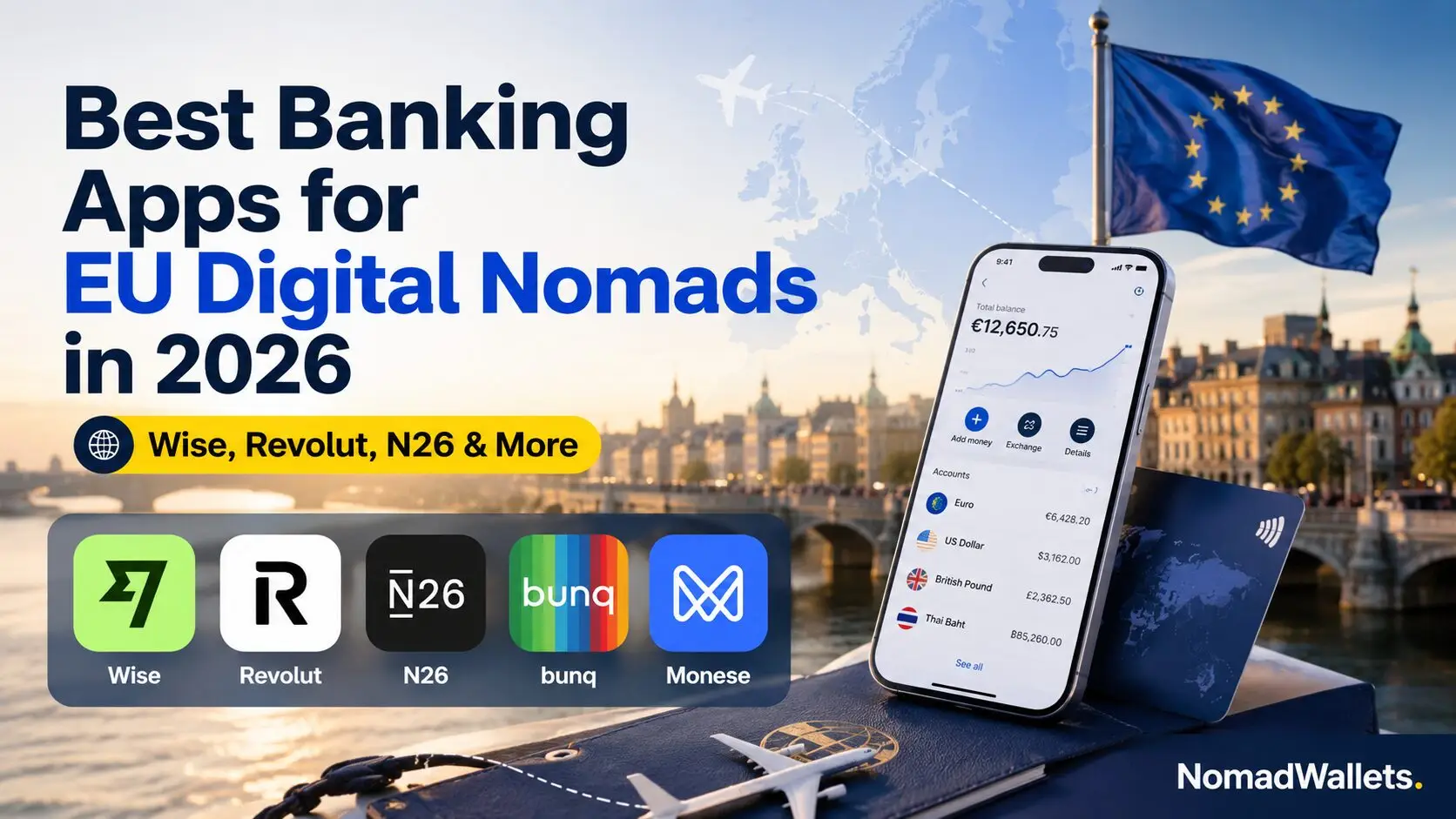
This guide compares the apps that actually get used by EU-based nomads: Wise, Revolut, N26, bunq, and Monese, on fee structure, ATM behavior, multi-currency support, and how each one holds up once you’re outside the eurozone for a while.
One honest note before we start: this isn’t financial advice, and nobody paid to be on this list. We’re not going to pretend one app is a “clear #1” for every reader. The right answer depends on whether you want a primary bank, a travel companion, or both, and on where you’re actually based.
Quick answer
If you only read one paragraph: among the best banking apps for EU digital nomads, Wise is the strongest pick for getting paid internationally and converting currency cheaply, thanks to its use of the mid-market exchange rate. Revolut is the most rounded everyday travel app if you’re comfortable keeping an eye on plan tiers and usage limits. N26 is the simplest full EU bank account if your spending stays mostly in euros. Most full-time nomads end up carrying two of these, not one.
Best banking apps for EU digital nomads at a glance
| App | Best for | Monthly fee (entry tier) | Full bank or e-money? |
| Wise | Getting paid internationally, cheap conversion | Free (pay-per-transfer) | E-money institution |
| Revolut | All-round travel spending and budgeting | Free (Standard) | Bank in the EEA (Revolut Bank UAB) |
| N26 | Simple EU mobile bank account | Free (Standard) | Full bank (German BaFin licence) |
| bunq | Multiple sub-accounts and budgeting automation | Paid entry tier | Full bank (Dutch licence) |
| Monese | Fast onboarding, secondary travel account | Free (entry tier) | E-money institution |
Exact monthly fees, ATM allowances, and FX terms shift by country and by plan generation, so treat this table as a starting point and confirm current numbers on each provider’s own page before you decide.
How NomadWallets evaluated the best banking apps for EU digital nomads
We reviewed each provider against the features that matter most to remote workers who travel: account fees, exchange-rate markups, ATM withdrawal policies, multi-currency support, SEPA and IBAN usability, app-based card controls, international payment features, and how practical the account actually is for long-term travel outside the eurozone.
We also checked whether each provider operates as a licensed bank or an e-money institution, since that affects how customer funds are protected. Because pricing and limits can change by country and by plan, we’re deliberately light on exact figures in places. You should always verify current details directly with the provider before opening an account, and we link to the right page each time.
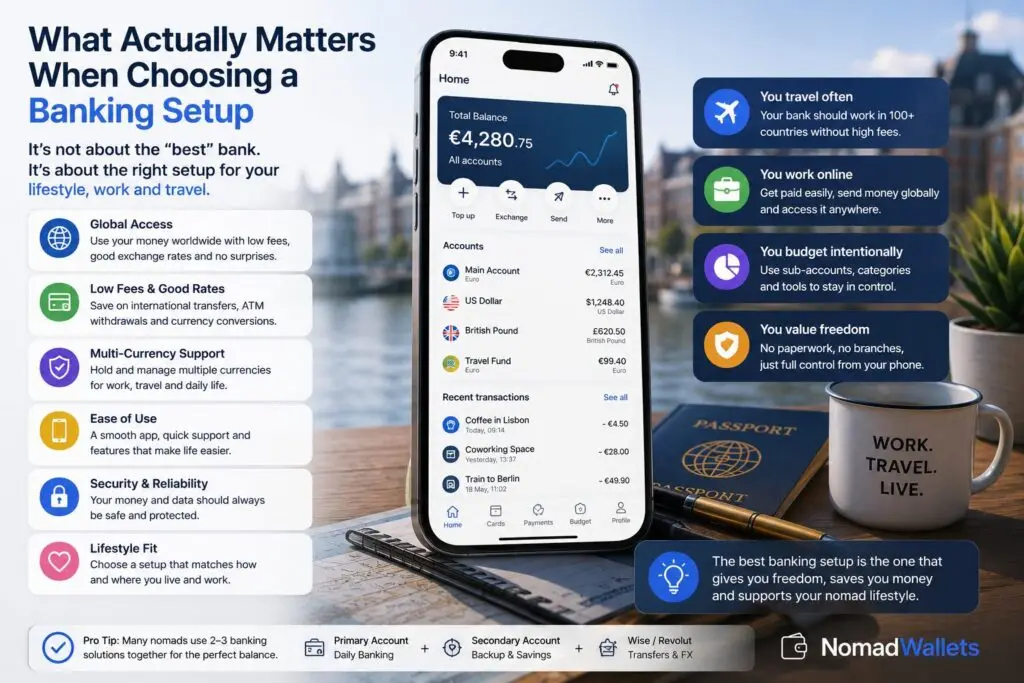
What actually matters when choosing a banking setup
These are the factors that actually separate the best banking apps for EU digital nomads from ones that simply happen to work while you’re passing through Europe.
The exchange rate markup matters more than the sticker price. A “free” account that quietly marks up every conversion by 2-3% will often cost you more over a year than a paid account using the real mid-market rate. Always check whether a provider converts at the interbank rate or adds a spread on top.
ATM withdrawal fees are where most nomads get caught out, and the rules keep changing. Every provider on this list caps how much you can withdraw for free each month, and more than one has adjusted those caps in the past year. Wise, for example, restructured its ATM fee schedule from 1 May 2026. Rather than repeat exact allowances here that may already be stale by the time you read this, we’ll point you to the provider’s own current page in each section below. These charges are sometimes labeled foreign transaction fees on your statement, so it’s worth knowing what to look for.
Multi-currency balances save you from double conversion. If you’re regularly paid in USD or GBP and spend in EUR, holding those currencies natively, rather than converting on arrival and again on spend, is one of the biggest fee-savers available to a nomad, and a big part of what makes a multi-currency wallet useful for remote worker banking in the first place.
SEPA and a real IBAN still matter, even if you’re barely in Europe. Rent payments, EU tax authorities, and most freelance clients expect a SEPA-compatible IBAN. An app that can’t do this cleanly isn’t a viable primary account for an EU-based nomad, whatever else it offers.
App controls and backup access matter as much as fees. Instant card freezing, disposable virtual cards, and two-factor authentication are standard on every app in this guide, but it’s still worth confirming you can freeze a card and order a replacement from abroad before you actually need to. Worth pairing with a secure connection, too, especially on public Wi-Fi: see our guide to secure online banking for digital nomads if you haven’t locked that down yet.
Not every app works identically everywhere. Availability, verification requirements, and fee schedules can differ depending on which country your account is registered in, sometimes called your account’s “T&C country.” N26’s ATM allowance is one example of this: it depends partly on where your account’s terms and conditions sit, not just which plan you’re on.
Verification checks happen, and they happen more to nomads. Moving between countries frequently, logging in from new locations, and receiving payments in multiple currencies are all things that can trigger a compliance review. That’s not a reason to avoid these apps. It’s an argument for never relying on just one, and for keeping your tax residency and proof-of-address paperwork in order before you need it.
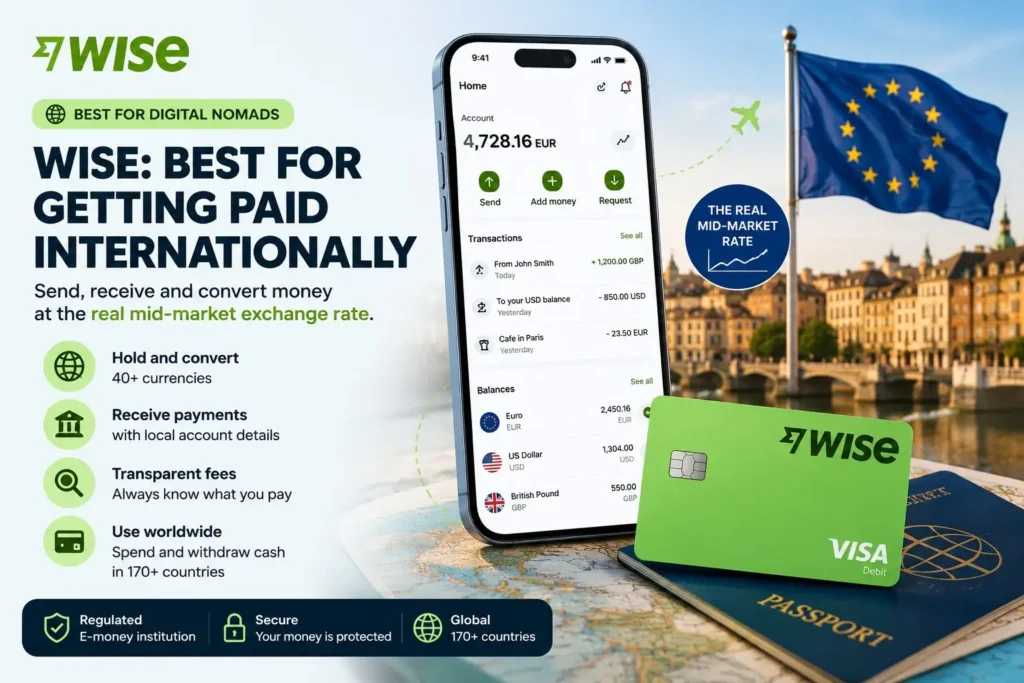
Wise: best for getting paid internationally and converting money cheaply
Wise (formerly TransferWise) isn’t structured like a typical bank account with monthly tiers. There’s no subscription fee: you pay per transfer or per card use, and the appeal is that conversions run on the real mid-market exchange rate rather than a marked-up one.
For a freelancer invoicing in USD or GBP and living on euros, that difference alone can be the single biggest fee-saver among the best banking apps for EU digital nomads, and one reason it’s often cited as a strong pick for freelancers with EU citizenship who bill clients abroad. If Wise’s transfer-first model appeals to you but you want to see how it stacks up against dedicated transfer services, our best money transfer service for digital nomads guide covers that comparison in more depth.
Where it’s strong: holding and converting between dozens of currencies, receiving payments via local account details in several countries, and transparent, itemized fees on every transfer.
Where to be careful: Wise changed its card ATM withdrawal terms in May 2026, adjusting both the free monthly allowance and the fee charged once you exceed it. The exact figures depend on which country your card is registered in, so check Wise’s own ATM fee page in-app rather than relying on a number quoted elsewhere, including this article.
Not ideal if: you withdraw cash frequently in small amounts, you want a traditional full-service bank relationship with a physical branch option, or you want a single app that also handles budgeting and everyday spending perks.
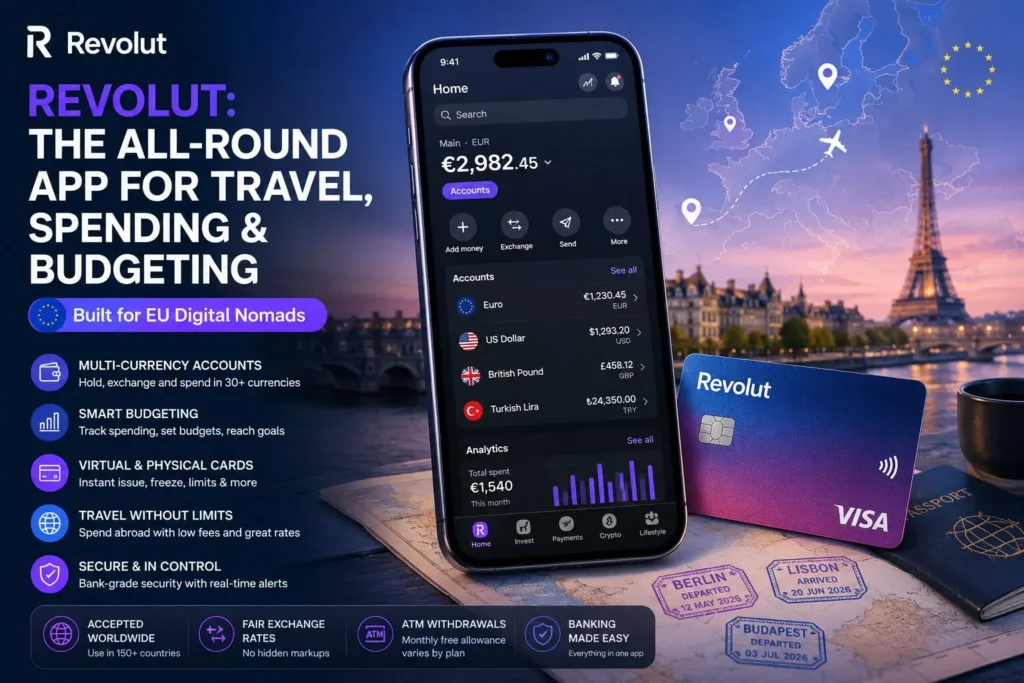
Revolut: best all-round app for travel, spending, and budgeting
Revolut is the closest thing to a true do-everything app on this list: budgeting tools, multi-currency wallets, virtual cards, and a strong travel spending experience. It’s one of the most frequently recommended of the best banking apps for EU digital nomads for exactly this reason. It currently offers several personal tiers, from Standard up through premium plans, and which one makes sense depends on how much you travel and convert currency.
If budgeting is the main draw for you, it’s worth comparing Revolut’s built-in tools against dedicated options in our best budgeting apps for digital nomads guide.
Where it’s strong: an app experience most people find easier to use day-to-day than a traditional bank, solid multi-currency spending, and higher tiers that relax or remove the usage limits that apply on the free plan.
Where to be careful: Standard-plan users have a monthly currency-exchange allowance before a fair-usage fee applies, plus a separate fee for exchanges made outside standard market hours (broadly, weekends) unless you’re on a higher tier. ATM withdrawals follow a similar structure: the free monthly allowance depends on your plan, and fees apply once you go over it.
These figures are denominated differently by country and revised periodically, so check Revolut’s own plan comparison page for your country rather than a number you’ve seen quoted for a different market.
Not ideal if: you stay on the free Standard plan but convert or withdraw large amounts monthly, since the fair-usage limits will start costing you, or if you want the simplicity of a single flat fee rather than a tiered plan structure.
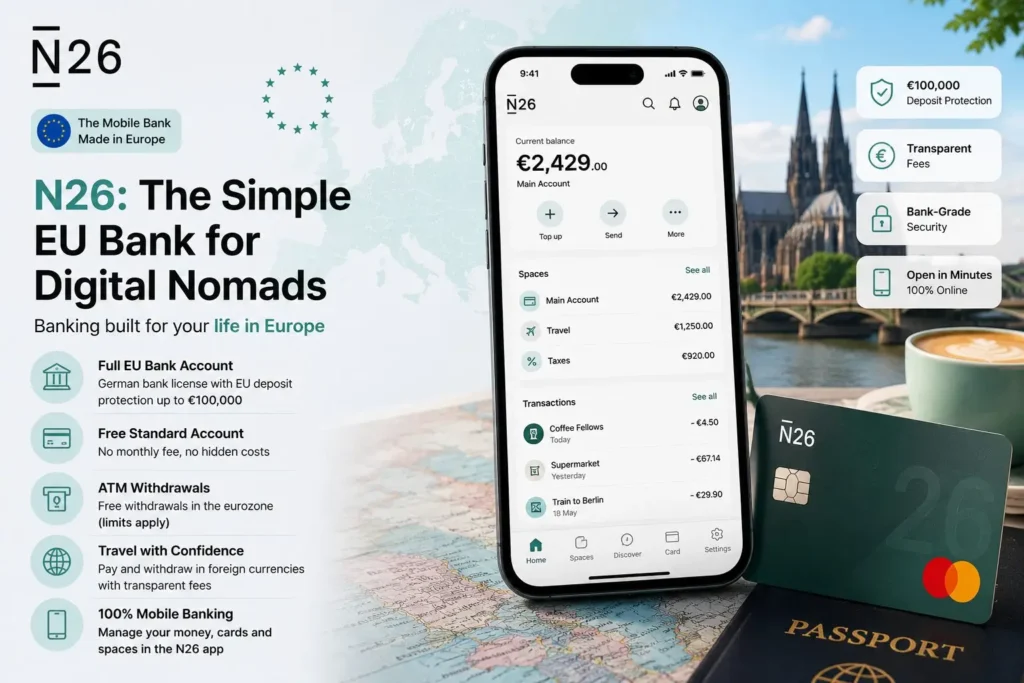
N26: best for a simple, no-frills EU mobile bank
N26 is a fully licensed German bank, which puts it in a different regulatory category from Wise and Monese: deposits are covered by Germany’s statutory deposit guarantee scheme up to €100,000, the standard EU-wide threshold. The free Standard plan is genuinely simple: no monthly fee and a clean euro account, which is a big part of why it keeps showing up in searches for the best online bank for EU citizens abroad.
Where it’s strong: a proper EU bank account with a real IBAN, straightforward pricing, and a more traditional current-account experience than many travel-focused fintech apps.
Where to be careful: the free Standard plan includes a limited number of free ATM withdrawals per month in the eurozone, with a flat fee applying beyond that, and the exact allowance depends partly on your account’s T&C country. Withdrawing in a non-euro currency also carries a conversion fee on the lower tiers, which the top tiers waive along with the ATM allowance limit. Check N26’s own pages for the numbers that apply to your account before assuming a figure you’ve read elsewhere still holds.
Not ideal if: most of your travel spending happens outside the eurozone and you’re on a lower-tier plan, or you specifically need a dedicated international-payments tool rather than a standard current account.
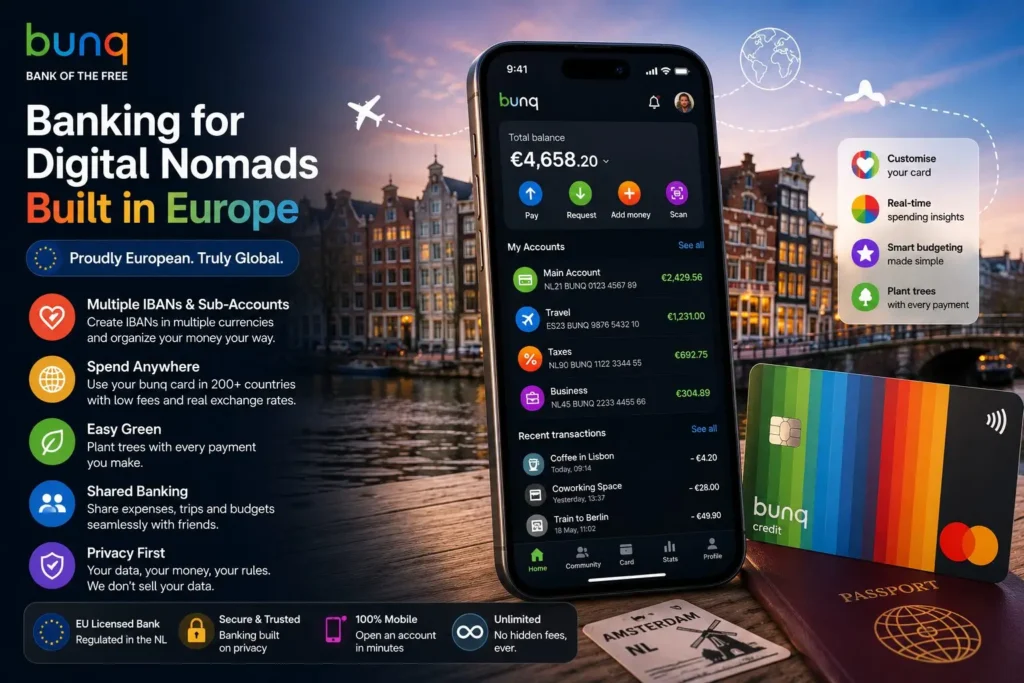
bunq: best for people who want multiple sub-accounts and automation
bunq leans hard into the “bank as an app” idea: its plans support several sub-accounts, each with its own IBAN, automatic budgeting rules, and a roundup-savings feature. It’s a Dutch-licensed bank, so deposits carry standard EU deposit protection.
Where it’s strong: splitting money across purposes, such as rent, tax savings, and travel spending, without opening separate bank accounts, plus a fee-free foreign-currency spending feature on its higher tiers.
Where to be careful: bunq’s entry tier is closer to a savings account than a full spending account, so you’ll likely want a paid tier for a physical card and everyday use. ATM allowances and foreign-spending benefits vary by plan and have changed more than once recently, so it’s worth checking bunq’s current pricing page before signing up rather than trusting a specific number from a review.
Not ideal if: you want the cheapest possible free account, or you’d rather have one simple card than manage several sub-accounts and plan tiers.
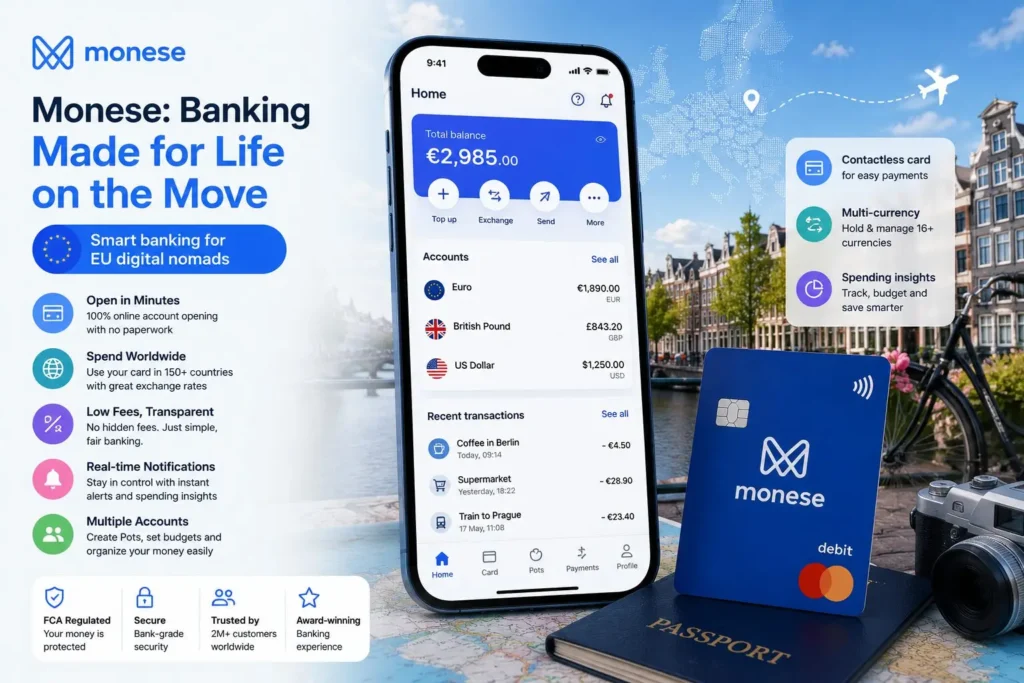
Monese: best as a secondary or travel account, with caveats
Monese markets itself around fast onboarding: you can genuinely open an account without a fixed address or long credit history, which is useful the week you land somewhere new. It operates under an e-money licence, not a full banking one, which is one reason it often makes more sense as a secondary travel account than as your only primary bank.
Where it’s strong: quick account opening, decent app usability, and increasingly generous spending and ATM allowances on its paid tiers.
Where to be careful: the free entry plan has a comparatively low free ATM allowance before a percentage fee applies, and Monese doesn’t carry the same deposit protection as a licensed bank. Its plan structure has been reworked more than once in recent years, so check the current fees and limits page for your country rather than an older review, including ours if enough time has passed.
Not ideal if: you want your primary account to carry deposit-guarantee-scheme protection, or you’re looking for the strongest multi-currency conversion rates rather than fast onboarding.
Deeper comparison: the best banking apps for EU digital nomads side by side
| App | Best for | Fee model | Multi-currency support | ATM policy | FX approach | SEPA / IBAN | Bank or e-money | Best as primary? | Best as backup? |
| Wise | International payments and conversion | Pay-per-use | Strong, dozens of currencies | Free allowance, then a fee; check current terms | Mid-market rate, transparent fee | Yes, with local account details in selected currencies | E-money | Alongside a spending card | Not typically |
| Revolut | Everyday travel spending | Free to paid tiers | Strong, tiered limits | Monthly free allowance varies by plan and country | Fair-usage limit, then a fee (waived on top tiers) | Yes | Bank (EEA) | Yes, especially higher tiers | Yes |
| N26 | Simple EU banking | Free to paid tiers | Basic on lower tiers | Limited free allowance on Standard | Conversion fee on lower tiers, waived on top tiers | Yes | Bank (Germany) | Yes | Not typically |
| bunq | Sub-account budgeting | Paid tiers | Good on higher tiers | Tiered allowance | Travel FX benefits improve on higher tiers; check current plan terms | Yes | Bank (Netherlands) | Yes | Possible |
| Monese | Fast onboarding, backup | Free to paid tiers | Moderate | Lower allowance on free tier | Percentage fee, improves with plan | Yes | E-money | Not recommended alone | Yes |
Wise vs Revolut vs N26 for digital nomads: the most-asked comparison
Choose Wise if your priority is getting paid in multiple currencies and converting money as cheaply as possible. Choose Revolut if you want one app that handles budgeting, travel spending, and multi-currency balances together. Choose N26 if you want the simplest possible full EU bank account and mostly spend in euros.
Best banking apps for EU digital nomads by use case
- Best overall for EU digital nomads: Revolut, for the breadth of what one app covers.
- Best for getting paid internationally: Wise.
- Best as a simple EU primary bank: N26.
- Best for budgeting with multiple sub-accounts: bunq.
- Best backup or transitional account: Monese.
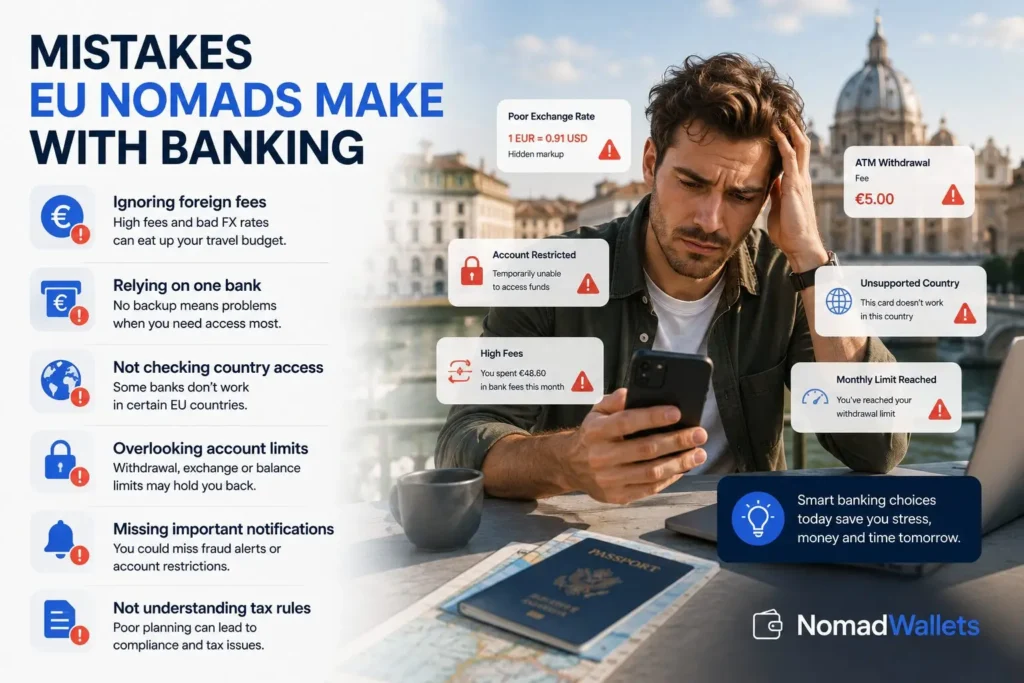
Mistakes we see EU nomads make with banking
Even with the best banking apps for EU digital nomads sitting right there on your phone, these are the mistakes that cost people the most.
Relying on one account for everything. Card freezes, compliance checks, and lost cards all happen, usually at the worst possible moment, several time zones from home. A second account with a different provider is cheap insurance.
Ignoring after-hours FX rules. Several apps, including Revolut’s lower tiers, apply a different exchange rate outside standard market hours. If you’re converting a large amount, timing it for a weekday can genuinely save money.
Assuming your plan works identically in every country. Fee schedules, free ATM allowances, and even account availability can shift depending on which country your account is registered in.
Treating proof-of-address and tax residency as a formality. If you move often, have a plan for how you’ll satisfy address verification, whether that’s a family member’s address, a long-term rental contract, or whatever your provider accepts, well before you need it urgently.
Recommended banking setup for EU digital nomads
If you’re a freelancer paid internationally: use Wise for invoices and currency conversion, keep N26 or bunq as your main EU account for SEPA and admin, and carry Revolut as a travel-spending backup. If you’re also dealing with the client-side logistics of getting paid (invoicing platforms, contracts, payment processors), our guide to processing international client payments covers that side of the equation.
If you’re mostly traveling but still based in the eurozone: N26 as your primary account, Revolut for travel spending, and Wise only if you regularly receive foreign currency.
If you spend most of the year outside Europe: a Wise-plus-Revolut combination for payments and spending, while still keeping a proper EU bank account for SEPA, taxes, and admin, and always carrying a backup card from a different provider than your main one.
None of these combinations are the only right answer. The point is redundancy and specialization, not loyalty to any single app.
A simple 2-card setup most EU nomads can start with
If juggling three accounts feels like overkill to start, a practical entry point is one primary EU bank account for salary, rent, SEPA transfers, and admin, plus one travel-focused card for foreign spending, ATM withdrawals, and backup access abroad. For many people comparing the best banking apps for EU digital nomads, that means something like N26 paired with Wise, or N26 paired with Revolut, depending on whether international transfers or day-to-day travel spending matters more to you. You can always add a third account later once you know which gaps you actually run into.
Are fintech banking apps safe for EU digital nomads?
This isn’t really a question of one type being “safer” than another. It’s a question of legal structure. Licensed banks like N26 and bunq protect customer deposits through their home country’s statutory deposit guarantee scheme, typically up to €100,000. E-money institutions like Wise and Monese protect customer funds through safeguarding rules instead, which work differently but aren’t inherently less secure.
What matters is understanding which structure applies to the account you’re using, and, as a simple precaution, not keeping your entire emergency fund in a single account of either type.
FAQ: best banking apps for EU digital nomads
Q1. What is the best banking app for EU digital nomads?
A. There isn’t one universal answer. Wise leads for international payments and conversion, Revolut for all-round travel spending, N26 for simplicity as a primary account.
Q2. Is Wise or Revolut better for digital nomads in Europe?
A. Wise is generally the cheaper option for converting and receiving money in different currencies; Revolut is the stronger everyday spending and budgeting app. Many nomads use both.
Q3. Can EU citizens open a bank account while living abroad?
A. Yes, though eligibility, required documents, and verification steps vary by provider and by which country you register the account in.
Q4. Which banking app has the lowest foreign exchange fees?
A. Wise’s use of the mid-market rate generally makes it the cheapest for currency conversion, though exact costs depend on the currency pair and amount, so check each provider’s live rate before a large transfer.
Q5. What is the best bank for freelancers with EU citizenship?
A. Wise tends to top this search specifically because of how it handles receiving and converting international freelance income, though N26 or bunq are worth pairing with it for SEPA-based invoicing and admin.
Q6. Is N26 good for digital nomads outside Europe?
A. It can work well as a primary euro account, but its lower tiers apply a conversion fee on non-euro ATM withdrawals, so heavy travelers outside the eurozone should check the current terms for their plan.
Q7. Do digital nomads need more than one bank account?
A. Most experienced nomads use at least two, a primary account plus a backup card, to guard against freezes, fraud checks, or a lost card.
Q8. Are fintech banking apps safe for long-term travel?
A. Yes, but the protection mechanism differs between licensed banks (deposit guarantee scheme) and e-money institutions (safeguarding). Both can be safe; it’s worth knowing which one applies to your account.
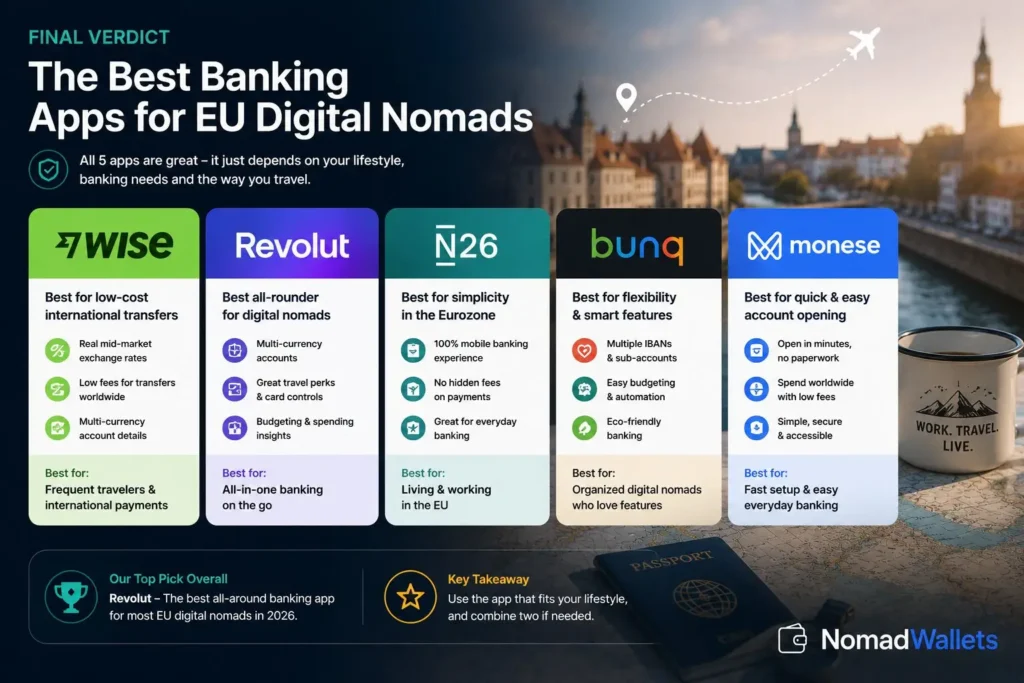
Final verdict
If you’re comparing the best banking apps for EU digital nomads, the honest answer is that no single app wins every category. Choose Wise if getting paid internationally and converting currency cheaply is your main problem. Choose Revolut if you want the most complete single app for travel spending and budgeting. Choose N26 if you want the simplest full EU bank account and spend mostly in euros. Choose bunq if you like managing money across several sub-accounts. Consider Monese only as a secondary or transitional account.
Whatever you land on, pricing, fee structures, and eligibility rules for all five providers have changed at least once in the past year, so before you open anything, check the official pricing page linked above for your own country, not just this article.
Disclosure: this article is for informational purposes only and does not constitute financial advice. Always confirm current pricing, availability, and account protections directly with the provider before opening an account.

Tushar Sharma is the founder and editor of NomadWallets, where he writes about international banking, travel cards, cross-border payments, taxes, and financial tools for digital nomads and globally mobile professionals. He created NomadWallets to make global money decisions simpler through practical, research-backed guides built from official sources and real-world financial data.