Editorial note: This guide is written for digital nomads, freelancers, and remote workers managing money across borders. It draws on NomadWallets’ research into international banking, money transfers, tax systems, travel cards, and financial tools used by location-independent professionals. It is designed as an educational guide, not personal tax, legal, or investment advice.
Disclaimer: This article is for educational purposes only and does not constitute tax, legal, accounting, or investment advice. Rules around tax residency, banking access, and reporting obligations vary by country and personal circumstances. If you’re unsure, speak with a qualified tax advisor or financial professional.
This digital nomad finance guide isn’t just about finding a credit card with no foreign transaction fees.
When you live and work in a different country every few months, your money has to move with you. It needs to cross borders, switch currencies, handle client payments, and stay on the right side of tax authorities, and do all of this without losing a chunk of your income to hidden fees or compliance mistakes.
The real challenge of managing money as a digital nomad is building a financial system that works across currencies, countries, tax rules, and payment methods. A reliable digital nomad financial setup usually has to handle:
- Receiving income from international clients or employers
- Spending in multiple currencies
- Moving money across borders cheaply
- Keeping business and personal finances organized
- Staying compliant with tax and residency rules
Random tips won’t fix a broken system. In this digital nomad finance guide, we’ll break things down into the six core systems you actually need: banking, getting paid, cards and spending, budgeting, taxes, and financial protection.
Who this guide is for: This guide is written for digital nomads, freelancers, founders, and remote employees who earn, spend, or save across borders. It’s especially useful if you’re juggling foreign-currency spending, international client payments, travel cards, tax questions, or multiple country moves in the same year.
What is digital nomad finance?
Digital nomad finance is the practice of managing your income, spending, savings, and tax obligations while living and working location-independently across multiple countries.
It is fundamentally different from regular personal finance. If you live in one country, you usually have one bank account, one currency, and one tax authority to worry about. Finance for digital nomads changes the equation completely. Instead of one bank, one currency, and one tax system, you may be dealing with several at once.
Why money becomes more complicated when you live across countries
When you start digital nomad financial planning, you quickly run into friction points that regular banking isn’t built to handle:
- Multiple currencies: Your income might be in USD, your rent in EUR, and your groceries in Thai Baht.
- Inconsistent banking access: Some traditional banks will freeze your account if they see too many foreign logins or transactions.
- Tax residency confusion: Spending time in different countries can trigger unexpected tax liabilities.
- Payment friction: Getting paid by clients or employers across borders often involves slow wire transfers and terrible exchange rates.
The 6 pillars of a strong digital nomad financial system
To keep your money from turning into a part-time job, this digital nomad finance guide breaks the process down into six distinct layers:
- Banking setup
- Getting paid
- Cards and spending
- Budgeting and cash flow
- Taxes and tax residency
- Risk management and backup planning
Let’s break down exactly how to set up each layer.
Start with your banking setup, not your travel card
Most people start their digital nomad money management journey by looking for a good travel card. That’s putting the cart before the horse. Your digital nomad banking setup needs to be built in layers, starting with where your money actually lives.
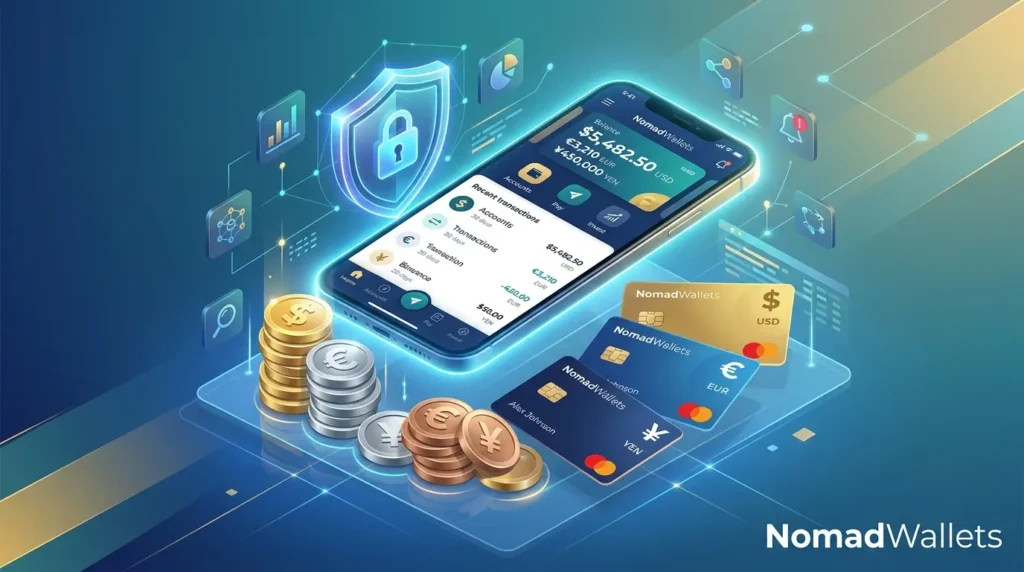
The 4 accounts many digital nomads actually need
If you want to avoid banking chaos, don’t rely on a single account. A strong digital nomad financial system usually includes:
- Primary day-to-day account: For spending, ATM withdrawals, subscriptions, and card payments. This is the account connected to your main debit card.
- Multi-currency / transfer account: An account specifically designed for receiving, holding, and converting money at the mid-market rate. Services like Wise or Revolut fit here.
- Business account (if self-employed): Keeping your freelance or contractor income separate from your personal cash is non-negotiable for tax time.
- Backup bank account: A completely separate account from a different provider. If your primary card gets frozen, stolen, or blocked, this is what keeps you fed and housed while you sort it out.
For example, a freelance designer paid in USD but living between Portugal, Thailand, and Spain might use a multi-currency account to receive USD from clients, convert only what’s needed into EUR or local currency, keep a separate backup card for cash access, and use a dedicated business account to avoid mixing invoices with personal spending.
What to look for in a digital nomad bank account
Not all accounts are created equal when you leave your home country. When reviewing options for digital nomad international banking, look for:
- Low or no foreign transaction fees: You shouldn’t pay 3% every time you buy a coffee.
- Fair ATM fee policies: Some banks refund a certain number of ATM fees per month; others charge you plus the local ATM fee.
- App quality and support: If your card is stolen in a different time zone, you need an app that lets you freeze it instantly and a support team that actually replies.
- Card replacement abroad: Can they mail a replacement card to your current country?
- Security controls: The ability to freeze/unfreeze your card, set spending limits, and use biometric logins.
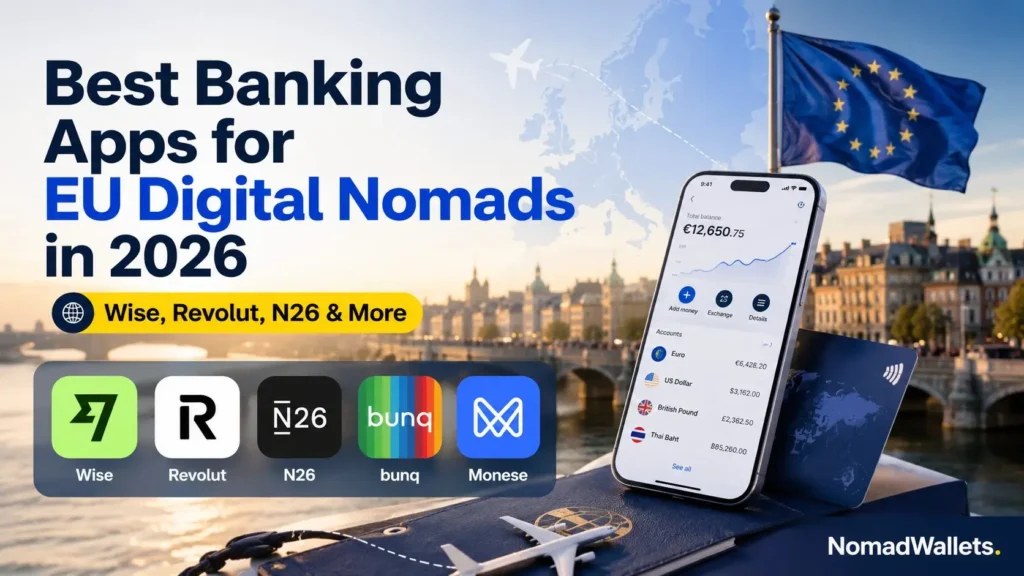
If you’re comparing account options in more detail, our guides to the best bank accounts for digital nomads, best banking apps for EU digital nomads, and best mobile banks for travelers go deeper on fees, usability, and country fit.
Why relying on one bank account is risky
If all your money is tied up in a single traditional bank from your home country, you are taking a massive risk.
Banks have automated fraud detection systems. If you suddenly log in from Vietnam, buy a coworking pass in Chiang Mai, and then try to pull out cash in Bali, your bank might flag it as suspicious and freeze everything. If you don’t have a backup bank account, you could be stuck without access to your money for days while you try to prove your identity over a bad internet connection.
KYC (Know Your Customer) rules also mean banks can suddenly close accounts if they feel they can’t verify your current residency. Having multiple accounts reduces the risk that one fraud flag, KYC review, or card issue leaves you without access to money while abroad.
How digital nomads get paid internationally
Getting paid is usually the first major hurdle in digital nomad money management. If you are a remote worker, freelancer, or online business owner, you need a reliable way to pull money from clients or employers into your accounts.
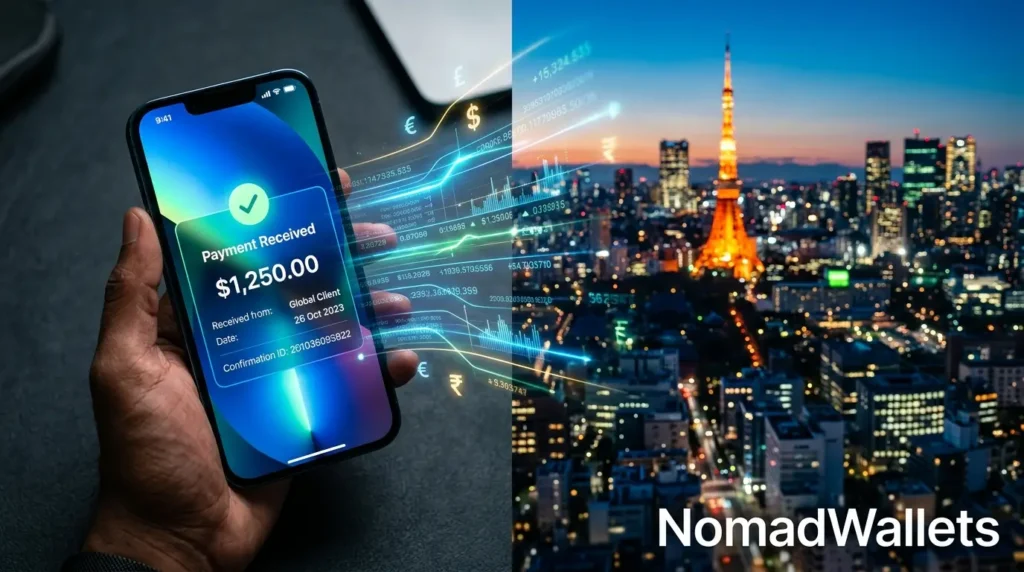
The most common ways digital nomads receive money
- Direct bank transfer (SWIFT): The traditional way. It works, but it’s often slow and both the sender and receiver usually get hit with fees.
- Multi-currency platforms: Using your own borderless account details (like those provided by Wise or Payoneer) to receive money locally in USD, EUR, GBP, etc., without routing it through the expensive SWIFT network.
- Payment processors: Services like Stripe or PayPal. These are easy for clients to use, but the foreign transaction and conversion fees can eat into your income if you aren’t careful.
- Freelance platforms: Upwork, Fiverr, or Toptal handle the payment processing for you, but they hold your funds in escrow and take a percentage of your earnings.
How to choose the right payment setup for your work
The right setup depends heavily on how you earn. A salaried remote employee paid in one currency may only need a reliable receiving account and a strong spending card. A freelancer with clients in the US, UK, and EU will usually care more about local receiving details, conversion fees, invoicing, and having a second payout route if one platform gets locked for review.
Payment problems that cost nomads money
The biggest mistake people make with finance for digital nomads is letting clients choose the payment method. If a client insists on paying via a traditional international wire transfer, and your bank charges a $15 incoming fee plus a 2% exchange rate markup, that’s money out of your pocket.
Where possible, negotiate how you get paid rather than defaulting to the client’s most expensive option. Ask clients to use platforms like Wise or Payoneer to send money, or build transfer fees into your freelance rates.
For a deeper breakdown of fees, payout methods, and which platforms work best for freelancers versus business owners, see our guides to the best money transfer services for digital nomads and international client payment processing.
Cards, currencies, and everyday spending abroad
Once your money is in your account, you need to spend it. The way you use cards abroad can either save you hundreds of dollars a year or quietly drain your bank account.
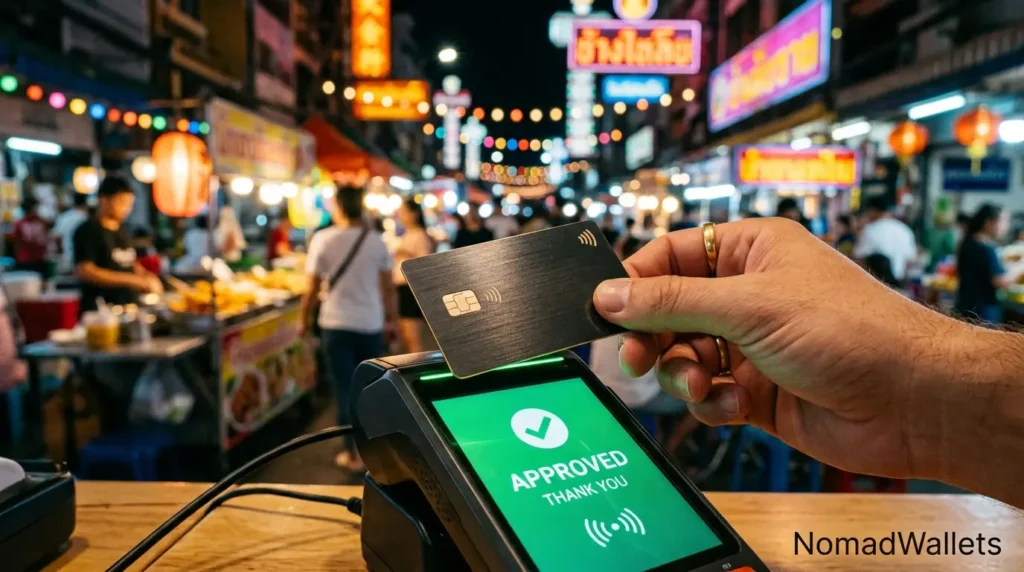
What matters more than “travel card hype”
Influencers love to push specific “travel hack” credit cards, but when it comes to digital nomad financial planning, you should ignore the hype and look at the raw numbers:
- FX Markup: The actual fee the card charges to convert your money into the local currency. You want 0%.
- ATM Limits & Fees: How much can you pull out at once, and what does the card provider charge?
- Acceptance: Visa and Mastercard are accepted almost everywhere globally. Amex is not.
- App Controls: Can you instantly lock the card if you leave it at a bar?
How to manage spending across multiple currencies
If you are moving from Mexico to Japan to Spain, your spending baseline is constantly shifting. The easiest way to handle this is to keep your primary budget numbers in your home currency, but do your actual spending in the local currency.
Never choose to be billed in your home currency at an ATM or point-of-sale terminal. This is called Dynamic Currency Conversion (DCC). The local merchant’s bank will offer to convert the bill to USD for you, but they use a terrible exchange rate with a massive markup. Always choose to pay in the local currency and let your bank do the conversion at the real mid-market rate.
A simple card setup for digital nomads
Don’t carry a wallet full of plastic. A practical setup looks like this:
- 1 primary debit card: For daily spending, Apple/Google Pay, and ATMs.
- 1 backup debit card: Kept in a separate bag or safe in case your primary card is lost or stolen.
- 1 credit card: Used for large purchases (like flights or laptops) for chargeback protection, and for hotel deposits so your actual cash isn’t tied up.
If you’re building out the card side of your setup, our guide to the best credit cards for digital nomads compares broader options, while best travel cards for Indians is useful if you want an India-specific backup card strategy.
Budgeting as a digital nomad is different from normal budgeting
Digital nomad budgeting breaks traditional budgeting apps. Most apps assume you have fixed rent, a single currency, and predictable utility bills. As a nomad, your cost of living changes every time you cross a border.
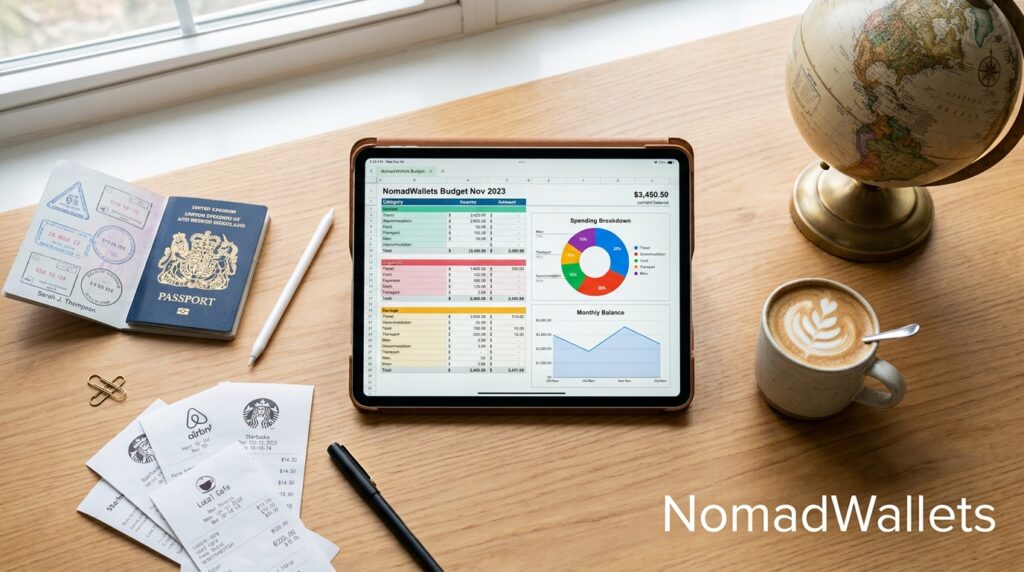
The expense categories digital nomads often underestimate
When building a digital nomad financial setup, people often forget to budget for:
- Visa runs and immigration costs: Tourist visas, visa extensions, and exit stamps cost money.
- Local transport variability: A $2 Grab ride in Bangkok vs. a $40 taxi in Zurich.
- Coworking spaces: If you can’t work from your hostel or Airbnb.
- Replacement electronics: Adapters break, laptops get spilled on, and phones get dropped.
- Tax set-asides: If you aren’t an employee, no one is withholding taxes for you.
How to build a nomad budget that still works when you move countries
Instead of tracking every single coffee, this digital nomad finance guide recommends organizing your money into four buckets:
- Fixed Global Expenses: Things that cost the same no matter where you are (software subscriptions, phone plan, insurance, debt payments).
- Location-Specific Expenses: Rent, groceries, and local transport. This is the bucket that fluctuates.
- Business Expenses: If you are a freelancer, keep a strict separate budget for tools, hosting, or hiring contractors.
- Savings / Tax Buckets: Money moved immediately out of your spending account so you aren’t tempted to touch it.
For instance, a nomad spending three months in Lisbon may be able to treat rent and coworking as semi-fixed costs, while someone moving every two weeks across Southeast Asia will need a looser budget that can absorb flights, SIM cards, transport swings, and short-notice accommodation changes.
Budgeting tools that actually help when you live across currencies
Look for tools that allow you to set budgets in multiple currencies or manually adjust your monthly limits based on your current location. Many nomads end up using a simple spreadsheet because traditional apps can’t handle a base currency that constantly shifts against local spending.
If you want help turning this into a working monthly system, start with our guides to best budgeting apps for digital nomads and digital nomad budget tracking, then use healthcare costs by country for digital nomads to stress-test your insurance and medical budget.
Taxes: The biggest challenge in this digital nomad finance guide
This is the section where digital nomad money management gets serious. Messing up your banking just costs you fees. Messing up your taxes can cost you tens of thousands of dollars in penalties.
Why “no fixed home” does not automatically mean “no tax”
There is a persistent myth that if you travel constantly, you don’t owe taxes anywhere. This is completely false and highly dangerous.
Tax authorities don’t care that you “feel” like a citizen of the world. They look at facts: How many days did you spend in our country? Where is your permanent home? Where is your economic center? If you move frequently without understanding tax residency rules, you can accidentally create filing obligations or tax exposure in a country you didn’t expect. For many digital nomads, the real risk is not “paying tax everywhere.” Instead, it’s failing to understand where they are resident, what income is taxable, and what reporting still follows them from home.
The three tax questions digital nomads need to answer
If you are doing your own digital nomad financial planning, you need clear answers to these three questions:
- Where are you a tax resident? Many countries use a day-count test such as 183 days as one residency trigger, but that is not the only rule that matters. Some also look at where you maintain a home, where your family or economic ties are located, and whether you have formally broken residency elsewhere.
- Where is your income sourced? Some countries tax all income you earn anywhere in the world if you are a resident. Others only tax income generated inside their borders.
- What reporting obligations follow you? Even if you aren’t legally required to pay tax in your home country (like US expats using the Foreign Earned Income Exclusion), you almost always still have to file paperwork. The penalties for failing to report foreign bank accounts (like FBAR or FATCA for US citizens) are severe.
When to get help from a tax professional
If your situation involves US citizenship, self-employment across borders, foreign business income, or a move into a country-specific regime such as Portugal’s current tax framework or a UAE residency structure, it’s usually worth getting advice from a cross-border tax professional rather than trying to piece everything together yourself.
If tax is the part of your setup that still feels fuzzy, start with our guides to digital nomad tax accountants, best digital nomad tax software, and US digital nomad taxes. We also cover specific deadlines in 2026 US tax deadlines for expats and Portugal-specific tax questions in our Portugal NHR / IFICI guide.
Build a financial safety net before you need one
Digital nomad financial planning isn’t just about optimizing your daily spending. It’s about making sure a single bad day doesn’t send you home broke.
Your emergency fund should be built for travel disruption, not just job loss
A traditional emergency fund covers 3-6 months of rent if you lose your job. A nomad emergency fund needs to cover that, plus travel-specific disasters:
- A last-minute, same-day flight home for a family emergency.
- An unexpected medical bill in a country with no public healthcare for foreigners.
- Replacing a stolen laptop and camera gear so you can actually keep working.
- Paying for an extended hotel stay if your Airbnb gets canceled at the last minute.
The backup systems smart nomads set up early
Don’t wait until your card is declined to figure out a backup plan. Set this up in week one:
- A funded backup bank account: It doesn’t need thousands of dollars, but it needs enough to cover a week of food and a hostel.
- A backup way to receive money: If your primary Wise account gets locked for a security review, do you have a PayPal or Payoneer account a client can use?
- Secure document storage: Keep encrypted digital copies of your passport, driver’s license, bank statements, tax returns, and birth certificate in a secure cloud storage drive.
- Cash reserves: Always keep $100-$200 in crisp, undamaged USD bills hidden in your bag. It is the ultimate universal fallback in places where cards fail.
Insurance is part of digital nomad finance too
Travel insurance and health insurance are not just budget items. They are a core part of your financial risk management system. Without them, a simple scooter accident or a sudden illness can wipe out your savings.
Understand the difference between travel insurance (covers trips, cancellations, lost luggage, short-term medical) and global health insurance (covers long-term medical care, often with higher limits).
Check out our comprehensive guides: Digital Nomad Healthcare Guide, the Complete Guide to Travel Insurance for Digital Nomads, specialized coverage like Adventure Sports Travel Insurance, and answers to edge-case questions like Does Travel Insurance Cover War?.
A simple digital nomad finance setup for beginners
Theory is great, but let’s make this concrete. Here is what a functional, anti-fragile digital nomad financial system actually looks like on day one.
| Need | Simple beginner setup |
| Main spending account | One primary debit/mobile bank account for daily spending and ATM use |
| International transfers | One multi-currency account for receiving, holding, and converting money |
| Backup access | One separate backup debit account with emergency funds |
| Business income | A separate business/payment account if you freelance or run a business |
| Cards | One main debit card + one backup debit card + one no-foreign-fee credit card |
| Taxes | A dedicated tax savings bucket and a system for storing receipts/invoices |
| Budgeting | A simple spreadsheet or budgeting app with a base-currency view |
| Safety net | Emergency fund + insurance + backup way to receive money |
A sample finance stack for a freelance digital nomad
- Receiving Money: Wise Business account. You give clients your Wise USD/EUR/GBP account details to avoid wire fees.
- Primary Spending: Wise debit card (connected to the above account) or a Revolut account.
- Backup Account: A Chime, Monzo, or N26 account kept separate with a few hundred dollars.
- Credit Card: A no-foreign-transaction-fee card from your home country, kept in your bag for large purchases and hotels.
- Budgeting: A Google Sheet tracking your fixed global costs and a fluctuating “current location” cost.
- Taxes: 25% of every freelance payment automatically swept into a high-yield savings account (or a separate Wise bucket) the day it hits your account.
A sample finance stack for a remote employee paid by one company
- Receiving Money: Direct deposit into your primary traditional bank account or a remote-friendly bank like Mercury.
- Primary Spending: A debit card from a digital bank like Revolut or Wise.
- Backup Account: Your traditional home-country bank account.
- Credit Card: Your primary travel credit card.
- Taxes: If your employer withholds taxes in your home country, your main job is still to keep clean records of where you worked, how long you stayed in each country, and whether any local tax or reporting obligations could apply. Employer withholding does not automatically solve cross-border tax issues.
A sample finance stack for a slow traveler vs fast-moving nomad
- Slow traveler (staying 1-6 months per country): You can lean more heavily on local bank accounts if you qualify, set up local utility accounts, and use a traditional budgeting app since your costs are stable for months at a time.
- Fast-moving nomad (new country every few weeks): You need heavy reliance on multi-currency accounts, zero local ties, and a spreadsheet budget. You cannot afford to open local bank accounts, and your daily spending variance is high.
Common digital nomad finance mistakes to avoid
To wrap up the core systems, this digital nomad finance guide highlights the most expensive mistakes to avoid:
- Relying on one bank account: The single fastest way to end up stranded with no money.
- Ignoring tax residency: Assuming travel equals tax-free living. It doesn’t.
- Not separating business and personal money: You will hate your life when tax season arrives.
- Choosing cards based only on influencer hype: Points and miles are useless if the card charges a 3% foreign transaction fee that wipes out the value.
- Not setting aside money for taxes: If you’re a freelancer or self-employed, failing to set aside money for taxes can create a painful cash-flow problem when filings and payments come due.
- Paying terrible FX rates: Using your home bank’s default exchange rate instead of a service like Wise.
- Having no backup card or cash access: Cards get skimmed, snapped in ATMs, and stolen. Always have a Plan B.
- Not reviewing recurring subscriptions: That $15 VPN, $10 Spotify, and $20 software subscription adds up. Cancel things you aren’t using.
- Assuming “travel insurance covers everything”: Read the fine print. Most standard travel insurance does not cover high-risk activities or pre-existing conditions.
Quick-Start Digital Nomad Finance Checklist
Use this as a setup checklist when you are building your system for the first time, or as a review tool before your next big move.
Banking Setup
- Open a primary digital or mobile bank account with low or no foreign transaction fees.
- Open a multi-currency account for receiving, holding, and converting foreign currency.
- Open a backup bank account with a completely different provider.
- Fund the backup account with enough cash to cover 1–2 weeks of basic expenses.
Getting Paid
- Set up your invoicing system or confirm your employer’s payroll routing.
- Provide clients or employers with the most cost-effective receiving details available to you, such as local account details from a multi-currency provider where supported.
- Test a small payment from a client or secondary account before relying on the setup for your main income.
Cards and Spending
- Activate a primary debit card linked to your everyday spending account.
- Activate a backup debit card and store it separately from your main wallet.
- Use a no-foreign-transaction-fee credit card for larger purchases, hotel deposits, and chargeback protection where possible.
- When paying or withdrawing cash abroad, choose to be billed in the local currency rather than your home currency to avoid Dynamic Currency Conversion (DCC) markups.
Budgeting and Cash Flow
- Calculate your fixed global monthly expenses, such as subscriptions, insurance, software, and debt payments.
- Create a flexible budget bucket for location-specific expenses such as rent, groceries, and local transport.
- Set up an automatic sweep to move a percentage of your income into a tax savings bucket if taxes are not withheld for you.
- Audit and cancel unused subscriptions before or during long trips.
Taxes and Compliance
- Determine your current tax residency status and where you may have filing or payment obligations.
- Research tax residency rules, day-count thresholds, and reporting triggers for the next country you plan to stay in.
- Create a secure digital folder for invoices, receipts, contracts, and tax documents.
- Consider speaking with a cross-border tax professional if your setup involves US citizenship, self-employment across borders, foreign business income, or a move to a country-specific tax regime such as Portugal or the UAE.
Risk Management and Safety Net
- Build a travel-specific emergency fund that covers 3–6 months of essential expenses plus the cost of a last-minute flight home.
- Arrange travel insurance and/or global health insurance before departure where appropriate for your situation.
- Store secure digital copies of your passport, ID, bank statements, and key financial documents in encrypted cloud storage.
- Keep a small emergency cash reserve in a widely accepted currency relevant to your travel plans, stored separately from your main wallet in case cards fail or you temporarily lose account access.
FAQ : Digital nomad finance guide
Q1. How do digital nomads manage money across countries?
A. A common setup is building a centralized financial system. Many nomads use a primary multi-currency account for spending and transferring, a backup account for emergencies, and a business account to keep freelance income separate. They avoid carrying multiple traditional bank accounts from different countries and rely on digital-first banking.
Q2. What bank account is best for digital nomads?
A. There is no single “best” account, as it depends on your home country, residency status, and where you’re eligible to open accounts. Digital banks like Wise and Revolut are popular globally because they often offer low foreign transaction fees, multi-currency features, and strong mobile apps, but availability, receiving account details, and business features vary by region.
Q3. Do digital nomads need a multi-currency account?
A. In many cases, yes. If you earn or spend in multiple currencies, a multi-currency account can reduce conversion costs and make transfers easier. But the right setup still depends on your citizenship, bank access, and where your income is paid from.
Q4. How do digital nomads pay taxes if they move around a lot?
A. Digital nomads do not get a free pass on taxes just because they travel. The answer depends on several moving parts: your citizenship, where you are tax resident, how long you stay in each country, where your income is sourced, and whether your home country still requires tax filings or foreign account reporting.
Some nomads intentionally build long-term residency plans around countries with more favorable tax rules, but that only works when the legal details line up including residency tests, treaty rules, home-country exit rules, and the way their income is earned. If your setup involves self-employment, multiple countries, or US tax obligations, it’s worth getting professional advice rather than guessing.
Q5. Should digital nomads use debit cards or credit cards abroad?
A. Use both, but for different things. Debit cards are better for daily spending and ATM withdrawals. Credit cards are better for large purchases, hotel deposits, and emergencies because they offer fraud protection and chargeback abilities that debit cards do not. Just make sure both have $0 foreign transaction fees.
Q6. How much emergency savings should a digital nomad have?
A. At a minimum, you should have enough to buy a last-minute flight home and cover 3 to 6 months of basic living expenses. Because nomads face unique risks (stolen gear, medical evacuations, sudden visa changes), a robust emergency fund is arguably more important for you than for someone living in one place.
Q7. Can digital nomads use one bank account for everything?
A. It is highly discouraged. Mixing business income, personal spending, and tax savings in one account creates an accounting nightmare. Furthermore, if that single account gets frozen due to a fraud alert while you are abroad, you will have zero access to your money.
Final thoughts: digital nomad finance is really about building a system
As this digital nomad finance guide has covered, managing your money isn’t about finding one “perfect” travel card. It is about building a reliable, repeatable system that keeps your money safe, accessible, and compliant no matter where you wake up.
If you try to manage your money randomly, you will lose money to bad exchange rates, get stressed when a bank freezes your card, and potentially face massive headaches with tax authorities. But if you take the time to layer your banking, optimize how you get paid, budget for the realities of travel, and sort out your tax residency, managing money as a digital nomad becomes completely automatic.
Start simple. Get one good multi-currency account, separate your business and personal funds, and build from there.
NomadWallets publishes educational content for digital nomads and international freelancers. We are not a tax law firm, accounting firm, or regulated financial advisor. Always verify country-specific rules, bank eligibility, tax residency obligations, and reporting requirements before making financial decisions abroad.

Tushar Sharma is the founder and editor of NomadWallets, where he writes about international banking, travel cards, cross-border payments, taxes, and financial tools for digital nomads and globally mobile professionals. He created NomadWallets to make global money decisions simpler through practical, research-backed guides built from official sources and real-world financial data.